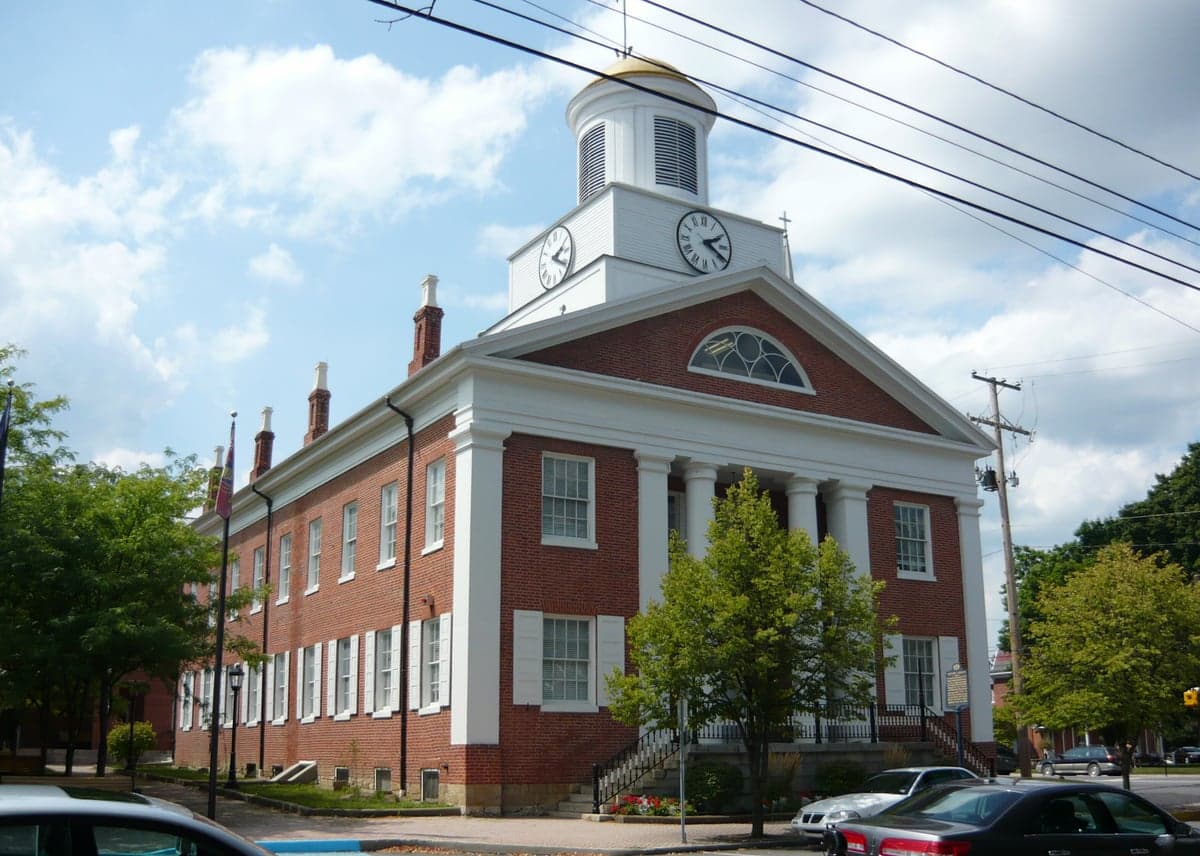
Photo: Wikipedia
Political ClimatePolitical Climate in Bedford County
Showing county-level results — no local-only data available.
Lean and PVI are calculated from this county’s 2020 and 2024 presidential results, Cook-style.
Political rankings in Pennsylvania
- Most Conservative Cities in Pennsylvania
- Most Liberal Cities in Pennsylvania
- Best Conservative-Leaning Towns in the Northeast
- Best Conservative-Leaning Towns in the Mid-Atlantic
- Most Affordable Liberal-Leaning Small Towns in the U.S.
- Safest Liberal-Leaning Cities in the U.S.
- Most Conservative Counties in Pennsylvania
- Most Liberal Counties in Pennsylvania
Local Political AnalysisPolitical Analysis of Bedford County
Bedford County is one of the most reliably Republican areas in all of Pennsylvania, with a Cook Partisan Voting Index (PVI) of R+35. That means the county votes about 35 points more Republican than the nation as a whole, a stark contrast to the state of Pennsylvania, which sits at EVEN on the PVI. This isn't a recent shift; the county has been a GOP stronghold for decades, and the trend has only deepened in recent cycles. In 2024, Donald Trump carried the county by a margin of roughly 75% to 23%, a spread that dwarfs his statewide performance. The political trajectory here is one of consolidation: the rural, conservative base has become more unified, while the small pockets of Democratic voters have shrunk and become more geographically concentrated.
How it compares
The difference between Bedford County and Pennsylvania as a whole is night and day. The state's EVEN PVI reflects a perfect battleground, where Philadelphia and its suburbs pull left and the central and northern rural regions pull right. Bedford County is the engine of that rightward pull. Within the county, the political geography is not entirely uniform. The borough of Bedford, the county seat, is the most moderate area, with a slightly higher share of Democratic voters, particularly in the precincts around the historic downtown and the hospital. You'll see a few Harris/Walz yard signs there, which are almost nonexistent in the outlying townships. In contrast, towns like Everett and Saxton are deeply red, with Trump flags flying year-round. The swing precincts, if you can call them that, are in the more populated townships like Bedford Township and Colerain Township, where a mix of commuters and retirees can produce a slightly less lopsided result, but still overwhelmingly Republican. The unincorporated village of Breezewood, a major travel stop, tends to mirror the county's overall lean, driven by transient traffic and local service workers.
What this means for residents
For conservative residents, the political climate is comfortable and affirming. Local government, from the county commissioners to the school board, is reliably Republican. Policy debates tend to focus on tax rates, gun rights, and opposition to state-level mandates from Harrisburg. There is little pressure to moderate views, and conservative candidates rarely face serious primary challenges from the left. For liberal residents, the reality is different. They are a clear minority, and their political influence is limited to local races in Bedford borough or perhaps a school board seat. Socially, it can feel isolating, but the county's small size means most people know each other personally, and political disagreements rarely escalate into open conflict. The biggest practical impact is on state-level representation: Bedford County's state representative and senator are among the most conservative in the Pennsylvania General Assembly, and they reliably vote against any legislation supported by the Philadelphia delegation.
Culturally, the county's politics are deeply intertwined with its rural identity, gun culture, and strong religious conservatism. There is a palpable distrust of state government, especially around environmental regulations affecting farming and natural gas development. The county is also a stronghold for the "Second Amendment sanctuary" movement, with local officials publicly vowing not to enforce any future state-level gun restrictions. This creates a distinct policy environment: for example, Bedford County has some of the lowest property tax rates in the state, but also some of the lowest levels of public funding for social services. The political reality here is stable and predictable, with little chance of a major shift in the near future. The county's population is aging and slowly declining, which only reinforces the existing political alignment. For anyone moving here, understanding that this is a place where the local culture and politics are one and the same is essential.

State Political ClimatePolitical Climate in Pennsylvania
State Political AnalysisPolitical Environment in the State
Pennsylvania is the ultimate swing state, with a Cook PVI of EVEN that perfectly captures its razor-thin margins in every major election over the past two decades. The state has flipped from blue to red and back again in presidential races, with Democrats winning in 2008 and 2020 by less than 1% each time, while Trump carried it in 2016 by just 0.7%. Over the longer 10-20 year arc, the dominant trend is a slow but steady rightward shift in the rural and exurban areas, offset by Democrats consolidating power in the two major metros—Philadelphia and Pittsburgh—and their close-in suburbs. This has created a state that is perpetually up for grabs, with neither party able to build a durable coalition.
Urban vs. rural divide
The political map of Pennsylvania is a textbook study in the urban-rural chasm. Philadelphia and its collar counties—Montgomery, Delaware, Chester, and Bucks—are the engine of the Democratic vote, delivering margins of 80-85% in the city itself and 55-65% in the inner suburbs. Pittsburgh and Allegheny County are similarly blue, though less overwhelmingly so, with the city proper voting about 70% Democratic while the surrounding county is closer to 60%. The rest of the state is a sea of red. The vast rural expanse from the northern tier down through the center and into the southwest—places like Williamsport, Lock Haven, and Johnstown—routinely vote 65-75% Republican. The critical battlegrounds are the exurban and suburban counties that have been trending blue: Erie County in the northwest, which flipped from Obama to Trump to Biden, and Northampton and Lehigh Counties in the Lehigh Valley, which have become reliably Democratic after being swing areas. Meanwhile, Lancaster County remains a Republican stronghold, but its growing Hispanic population is slowly shifting it toward purple. The Scranton/Wilkes-Barre area (Lackawanna and Luzerne Counties) is the classic bellwether—heavily union, Catholic, and working-class, it went for Obama twice, then Trump twice, then narrowly for Biden in 2020.
Policy environment
Pennsylvania's policy environment reflects its divided government. The state has a flat income tax rate of 3.07%, one of the lowest in the nation, and a sales tax of 6% (8% in Philadelphia and Allegheny County). Property taxes are high, averaging about 1.5% of home value, which is a major pain point for homeowners. The regulatory posture is moderate—not as business-friendly as Texas or Florida, but far less burdensome than New York or California. Education policy is a flashpoint: the state funds schools primarily through local property taxes, creating massive disparities between wealthy suburbs and poor rural districts. A 2023 court ruling declared the funding system unconstitutional, but the legislature has yet to act. Healthcare is dominated by large systems like UPMC in the west and Jefferson Health in the east, with high costs but broad access. Election laws are relatively straightforward: no-excuse mail-in voting was enacted in 2019, but it remains controversial, with Republicans regularly calling for its repeal. Voter ID is required for first-time voters but not for established ones, a middle-ground position that frustrates both sides.
Recent policy direction
The last few years have seen Pennsylvania lurch in contradictory directions. On gun rights, the state is a preemption state—localities cannot pass their own gun laws—which has blocked Philadelphia's attempts to enact stricter ordinances. However, in 2023, the Democratic-controlled House passed a bill requiring universal background checks, though it died in the Republican Senate. On education and parental rights, Governor Josh Shapiro has vetoed bills that would have created a school voucher program and restricted transgender athletes' participation, while the legislature has passed and he has signed bills expanding school safety funding. On abortion, the state remains a relative haven in the region: abortion is legal up to 24 weeks, and Shapiro has pledged to veto any restrictions. On election integrity, the 2020 election saw massive controversy, with Trump's legal team challenging the results in multiple counties. The state has since tightened ballot security measures, including requiring pre-canvassing of mail-in ballots to begin earlier, but no major voter ID law has passed. On property rights, the state has a strong eminent domain framework, but fracking has created tensions between landowners and drillers in the Marcellus Shale region. On taxation, the flat income tax has remained stable, but there is growing pressure to raise the corporate net income tax, which is currently 8.99% and scheduled to drop to 4.99% by 2031.
Civil unrest & political movements
Pennsylvania has seen its share of political flashpoints. The 2020 election aftermath was intense, with Trump supporters rallying at the state capitol in Harrisburg and filing dozens of lawsuits. The January 6th investigation led to the indictment of several Pennsylvania activists. On the left, the Black Lives Matter protests in Philadelphia in 2020 were large and occasionally violent, leading to property damage and a lasting debate over policing. Immigration politics are less heated than in border states, but Philadelphia is a sanctuary city, and the state has seen a influx of migrants from New York City bused in by Mayor Eric Adams, creating friction. The Lancaster County area has seen a growing anti-government movement, with some residents involved in the "constitutional sheriff" movement. The fracking debate is a persistent source of tension, with environmental activists blocking pipelines in the Pittsburgh area and rural landowners fighting for drilling rights. Overall, the state is not a hotbed of civil unrest, but the partisan divide is deep and visible in the competing rallies that occur regularly in Harrisburg.
Projection
Over the next 5-10 years, Pennsylvania is likely to remain a swing state, but the demographic trends favor Democrats. The Philadelphia suburbs are becoming more diverse and educated, and the Lehigh Valley is growing rapidly with commuters from New Jersey and New York. The rural areas are aging and losing population, which will slowly erode the Republican base. However, the working-class white voters in the northeast and southwest who flipped to Trump are not returning to the Democratic fold, and the GOP is making inroads with Hispanic voters in Reading and Allentown. The wild card is the Pittsburgh region: as the tech and healthcare sectors grow, the city is becoming more liberal, but the surrounding counties are becoming more conservative. Expect the state to remain a toss-up in presidential elections, with the winner likely determined by turnout in the Philadelphia suburbs and the ability of each party to hold its base. A new resident moving in now should expect to live in a state where their vote truly matters, but where the political climate is perpetually tense and divided.
For a new resident, the bottom line is that Pennsylvania offers a balanced political environment where your vote carries real weight. If you lean conservative, you'll find strong representation in the legislature and a governor who, while Democratic, is moderate enough to veto only the most extreme bills. If you lean liberal, you'll find a solid base in the cities and suburbs, with a governor who protects abortion rights and vetoes school vouchers. The practical takeaway is that Pennsylvania is not a place where one party dominates—you will encounter both sides regularly, and the political conversation will be a constant part of life. The state's low flat income tax and moderate regulations make it a decent place for business, but the high property taxes and school funding disparities are real concerns. If you want a state where your political views are the norm, look elsewhere. If you want a state where you can make a difference, Pennsylvania is the place.
* Values derived from national, state, county, city and local statistics and may differ in a specific area. Last updated: 2026-11-22T00:02:26.000Z
Narrative content on this page is AI-generated and may contain mistakes. Verify any details that matter before acting on them.
ReloMaps may earn a commission from affiliate links at no extra cost to you.

