
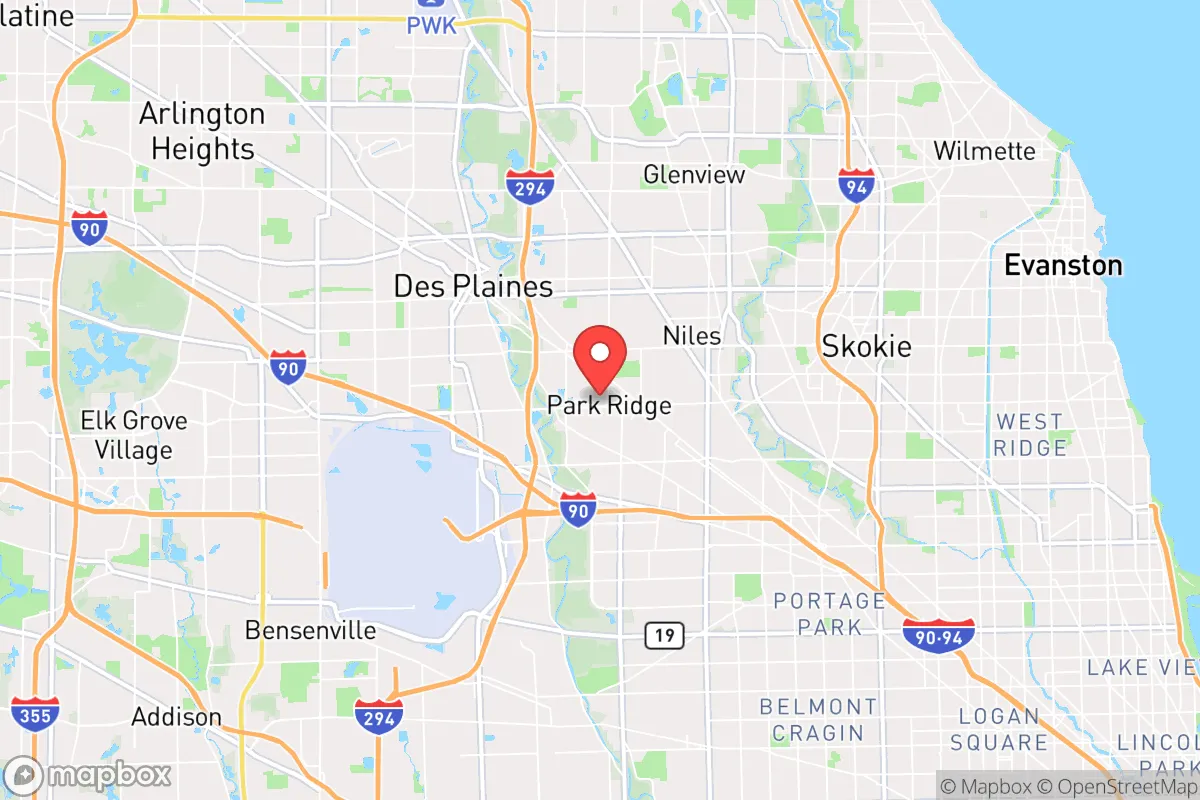
Photo: Wikipedia
Personal Sovereignty in Park Ridge, IL
Viable for self-reliance. Generally workable, though some barriers may limit total independence.
What does Personal Sovereignty tell us?
Personal Sovereignty measures your capacity for self-reliance and independence with minimal government friction. Higher scores mean fewer barriers between you and the way you want to live... but it assumes you have the space you need and good neighbors.
What does this tell us?
Personal Sovereignty measures your capacity for self-reliance and independence with minimal government friction. Higher scores mean fewer barriers between you and the way you want to live... but it assumes you have the space you need and good neighbors.
State Policy
Energy independence: Importer (63% of energy produced in-state)
Personal Liberty
Homesteading

Personal Liberty Analysis
Park Ridge, Illinois, offers a constrained personal sovereignty environment typical of Cook County's inner-ring suburbs, where local and state regulations significantly limit individual autonomy in taxation, self-defense, and property use. While the city provides high-quality public services and a strong sense of community, residents face a heavy tax burden, restrictive gun laws, and zoning codes that discourage self-reliance practices like homesteading. For a conservative-leaning individual or family prioritizing personal freedom, Park Ridge requires careful trade-offs: you gain safety and amenities but lose the latitude to make independent choices on finances, defense, and lifestyle.
Tax burden and regulatory posture: how heavy is the hand of government?
Park Ridge's tax and regulatory environment is among the most burdensome in the nation, driven by Illinois's high state income tax (a flat 4.95% as of 2025) and Cook County's property tax system. The city's effective property tax rate hovers around 2.1% of assessed value, among the highest in the Chicago metro area, with a median annual bill exceeding $10,000 for a typical single-family home. This is compounded by a state sales tax of 6.25% plus Cook County's 1.75% surcharge, bringing the total to 8.0% in most of Park Ridge. The regulatory posture is similarly heavy: the city enforces strict zoning codes, building permits, and historic preservation overlays in some neighborhoods, requiring approvals for even minor exterior modifications. Business licensing is thorough, with annual fees for home-based enterprises and commercial operations alike. For a reader accustomed to lower-tax states like Texas or Florida, Park Ridge represents a significant fiscal commitment, though the trade-off includes well-funded schools, police, and infrastructure that many residents find worthwhile.
Self-defense and gun law specifics: what are your rights to protect yourself?
Illinois imposes some of the most restrictive firearm regulations in the United States, and Park Ridge residents must comply fully. The state requires a Firearm Owner's Identification (FOID) card for possession, a process that includes a background check and can take up to 30 days. Concealed carry is legal only with a state-issued license, which requires 16 hours of training and a separate application; as of 2025, Illinois does not recognize out-of-state permits. Park Ridge itself has no additional local gun ordinances beyond state law, but Cook County's assault weapons ban—enacted in 2023—prohibits many semi-automatic rifles and high-capacity magazines. Open carry is illegal statewide, and carrying in public places like parks, schools, and government buildings is restricted. For self-defense at home, handguns and shotguns are permitted with a FOID, but magazine capacity is capped at 10 rounds for long guns and 15 for handguns under state law. The practical effect: a law-abiding resident can defend their home, but carrying outside requires significant bureaucratic hurdles and is effectively banned in many public spaces. This is a stark contrast to states with constitutional carry or shall-issue regimes.
Self-reliance and homesteading viability: can you live off your own land?
Park Ridge's zoning and lot sizes make traditional homesteading or off-grid living largely impractical. The city's residential lots average 0.15 to 0.25 acres, typical for a dense suburb, with most homes built on 50-foot-wide lots. Zoning codes prohibit livestock—chickens are allowed only with a permit and strict coop requirements, while goats, pigs, or larger animals are banned. Vegetable gardens are permitted, but front-yard gardens are restricted in many subdivisions, and homeowners' associations in some neighborhoods impose additional rules. Off-grid systems like solar panels are legal but require building permits and must connect to the grid; battery storage is allowed but subject to fire code inspections. Rainwater harvesting is limited to 55-gallon barrels per state law, and composting is permitted only in enclosed bins. No property in Park Ridge is zoned for agricultural use, and the city's water and sewer infrastructure is mandatory—wells and septic systems are not allowed. For a reader seeking self-reliance through food production, energy independence, or reduced utility dependence, Park Ridge offers minimal viability. The suburb is designed for convenience, not autonomy.
Personal liberties: parental rights, medical autonomy, speech, and property
Personal liberties in Park Ridge are shaped by Illinois's progressive state laws and Cook County's enforcement culture. Parental rights are moderately protected: Illinois requires parental consent for minors' medical procedures, including abortion (with a judicial bypass option), and parents can opt children out of sex education. However, the state mandates comprehensive sex ed in public schools, and parents cannot exempt children from LGBTQ-inclusive curriculum under the 2020 Inclusive Curriculum Law. Medical autonomy for adults is broad—Illinois allows medical marijuana (with a state card) and has no vaccine mandates for adults, though COVID-19-era restrictions have largely expired. Speech is protected under the First Amendment, but Park Ridge enforces noise ordinances and sign regulations that limit political signage on private property to 30 days before and after an election. Property rights are constrained by Cook County's property tax system, which reassesses every three years, and by zoning that restricts home-based businesses and short-term rentals (Airbnb is effectively banned in residential zones). For a conservative reader, the most notable liberty is the ability to homeschool without state registration or testing requirements—Illinois is one of the least restrictive states for homeschooling. Overall, personal liberties are moderate but tilted toward state-level mandates, particularly in education and healthcare.
Compared to other Chicago suburbs, Park Ridge offers a middle ground on personal sovereignty: more restrictive than exurban McHenry or Kane counties, where lower taxes and looser zoning allow greater self-reliance, but less restrictive than downtown Chicago or Evanston, where rent control and stricter gun laws apply. For a relocation reader prioritizing autonomy, Park Ridge demands a clear-eyed assessment: you gain excellent schools, low crime, and a walkable downtown, but you accept high taxes, limited self-defense options, and a regulatory framework that discourages independence. The suburb is best suited for those who value community stability over individual latitude, and who are willing to trade personal sovereignty for institutional reliability.

* Values derived from national, state, county, city and local statistics and may differ in a specific area. Last updated: 2026-11-26T16:52:43.000Z
Narrative content on this page is AI-generated and may contain mistakes. Verify any details that matter before acting on them.
ReloMaps may earn a commission from affiliate links at no extra cost to you.

