Photo: Wikipedia
Political ClimatePolitical Climate in Paola, KS
District shown is the primary district for this city’s centroid. Cities may span multiple districts.
Local Political AnalysisPolitical Analysis of Paola, KS
Paola, Kansas, sits in a bit of a political bubble compared to the rest of the state. While the surrounding area of Kansas, KS, carries a Cook PVI of R+9, Paola itself is rated D+2, making it one of the few reliably Democratic-leaning towns in an otherwise deeply red region. This isn't a new development—Paola has been a quiet blue dot for decades, anchored by a mix of long-time working-class families and a small but steady influx of commuters who work in the Kansas City metro but prefer the slower pace of Miami County. The trajectory here is subtle: the town's Democratic lean has held steady, but the surrounding county has been trending redder as exurban development pushes south from Overland Park and Olathe, bringing more conservative-leaning residents into the broader area.
How it compares
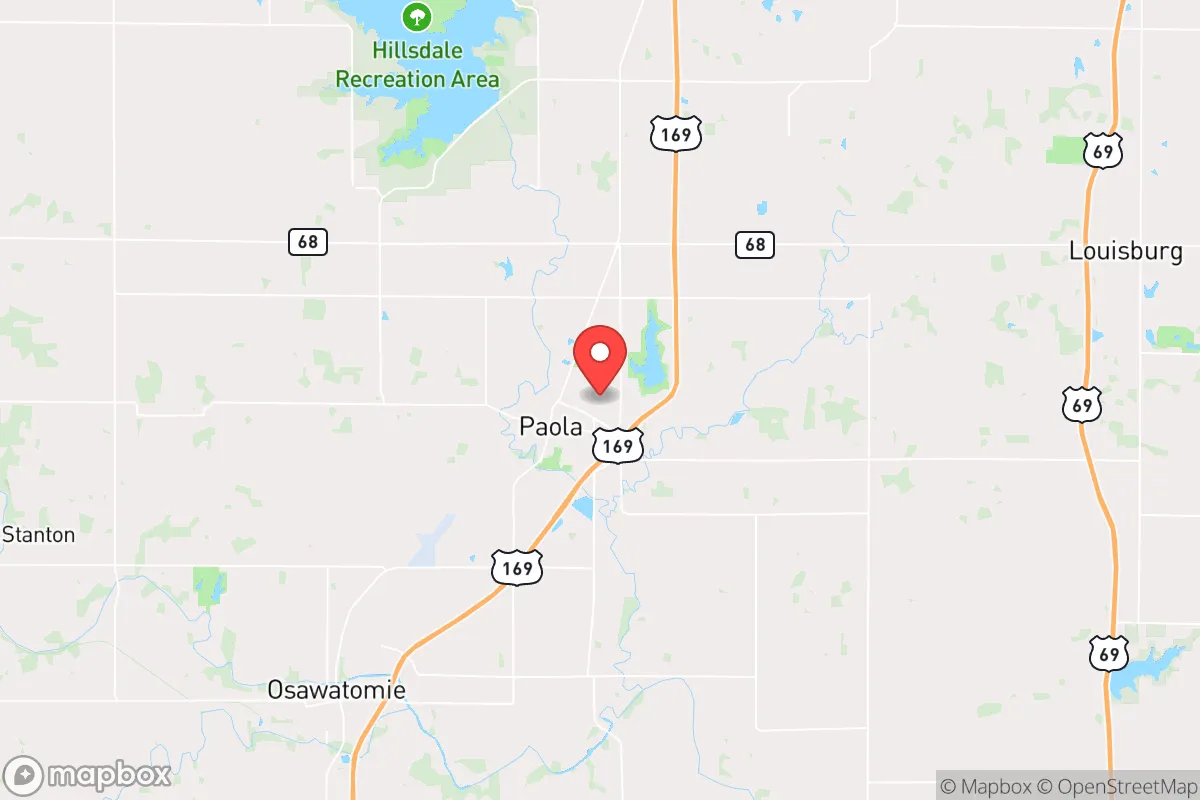
Drive 15 minutes north to Louisburg or 20 minutes east to Spring Hill, and you'll feel the political shift immediately. Those towns lean heavily Republican, mirroring the R+9 of Kansas as a whole. Paola's D+2 rating puts it in stark contrast—it's more aligned politically with Lawrence or Wyandotte County than with its own neighbors. The difference is visible in local elections: Paola's city council and school board races often feature candidates who are more moderate or openly Democratic, while county-level positions in Miami County are almost uniformly held by Republicans. Statewide, Paola's voters consistently break for Democratic candidates in close races, but those votes are easily swamped by the surrounding rural and suburban precincts. For example, in the 2022 governor's race, Paola precincts went for Laura Kelly, while the county as a whole went for Derek Schmidt.
What this means for residents
For conservative residents, living in Paola means being in the minority locally but part of the overwhelming majority countywide and statewide. You'll find plenty of like-minded neighbors in the surrounding towns, and your vote carries more weight in county and state elections. For liberal residents, Paola offers a rare pocket where your local vote actually matters—you can elect a city council member or school board trustee who shares your views. But you'll also feel the isolation: state-level policies on abortion, gun rights, and education funding are set by a legislature that doesn't reflect Paola's preferences. The practical reality is that both sides coexist without much friction day-to-day. People here are neighborly, and political signs tend to be more subdued than in the suburbs to the north. The biggest flashpoints are usually over development and school funding, not culture war issues.
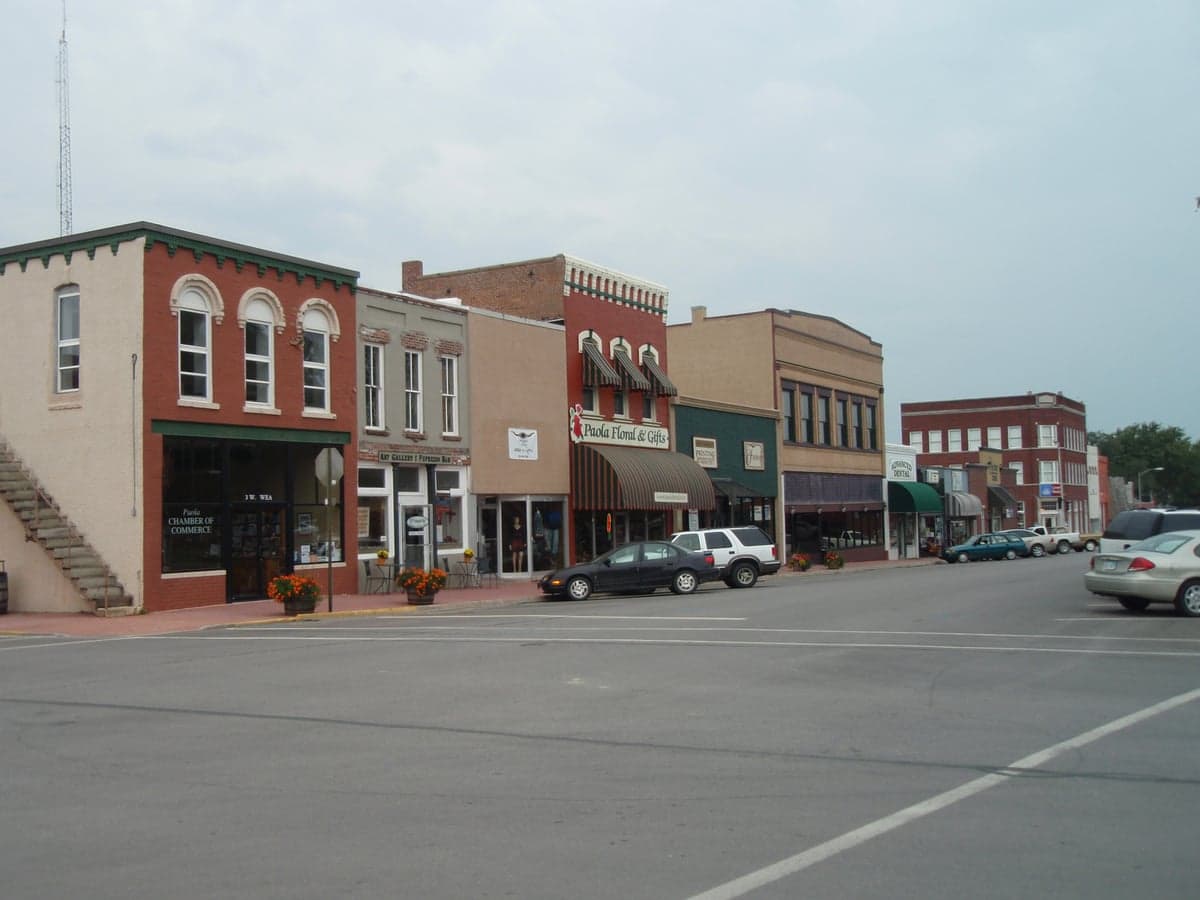
Culturally, Paola retains a distinct identity that sets it apart from the surrounding area. The town's historic square, the annual Paola Farmers Market, and the strong presence of the local Catholic community (including the Paola High School Saints) give it a more traditional, community-focused feel that doesn't map neatly onto partisan lines. You won't find the same evangelical megachurch culture that dominates in places like Gardner or Edgerton. Instead, the social fabric is woven from civic clubs, the local library, and the Paola Community Center. Policy-wise, the town has been more willing to support public infrastructure projects and maintain a higher local sales tax for services, reflecting a pragmatic, less ideologically rigid approach. If you're moving here, expect the local politics to be more about potholes and parks than about national talking points—at least for now.

State Political ClimatePolitical Climate in Kansas
State Political AnalysisPolitical Environment in the State
Kansas is a solidly Republican state with a Cook PVI of R+9, meaning it typically votes about nine points more Republican than the national average. Over the past 10-20 years, the state has shifted rightward in statewide races, driven by rural consolidation and suburban drift, though it has not become a deep-red monolith — Democratic governors Laura Kelly (elected 2018, re-elected 2022) have won by threading the needle in the suburbs. The dominant coalition is a mix of rural conservatives, small-city moderates, and a growing exurban population around Kansas City, but the state’s political trajectory has been defined by internal GOP fights between pragmatists and hardliners, not by a rising Democratic challenge.
Urban vs. rural divide
The political map of Kansas is a classic urban-rural split, but with a twist. The Democratic vote is concentrated in two metros: Kansas City (Wyandotte and Johnson counties) and Lawrence (Douglas County). Johnson County, the state’s wealthiest and most populous, has been trending blue — it voted for Joe Biden in 2020 and for Laura Kelly in 2022, driven by college-educated suburbanites in places like Overland Park and Shawnee. Meanwhile, Wichita (Sedgwick County) remains a swing area; it leans Republican but can go blue in a good year for Democrats, as it did for Kelly. The rest of the state is deeply red. Rural counties in western Kansas — like Garden City (Finney County) and Dodge City (Ford County) — vote Republican by 40-50 points, even though their populations are heavily Latino and immigrant. The divide isn’t just about geography; it’s about culture. In Manhattan (Riley County), home to Kansas State University, the vote is more moderate, while Topeka (Shawnee County) is a purple battleground that often decides close races. The net effect is a state that looks red on a map but has real blue pockets that matter in statewide contests.
Policy environment
Kansas’s policy environment is a study in contrasts. The state has no income tax on Social Security benefits and a flat state income tax rate of 5.7% (down from a progressive structure after the 2012 “Brownback tax cuts,” which were partially reversed in 2017). Property taxes are moderate but vary widely by county. The regulatory posture is business-friendly, with a right-to-work law and limited zoning in most rural areas. On education, Kansas has a mixed record: school funding has been a perennial legal battleground, with the Kansas Supreme Court repeatedly ordering the legislature to increase aid to poor districts. The state has school choice, including charter schools and a tax-credit scholarship program, but no universal voucher system. Healthcare policy is defined by the state’s refusal to expand Medicaid under the Affordable Care Act, leaving about 150,000 low-income adults in a coverage gap. Election laws are moderately restrictive: voters must show a photo ID at the polls, and the state has a 20-day advance voting period. There is no automatic voter registration, but same-day registration is not allowed. The state also has a “constitutional carry” law (permitless carry of handguns) since 2015, and it is a “shall issue” state for concealed carry permits.
Recent policy direction
Recent legislation in Kansas shows a state pulling in multiple directions. On gun rights, the 2023 law allowing permitless carry of firearms (HB 2058) was a major win for conservatives, and the state also passed a “Second Amendment Preservation Act” in 2021 that purports to nullify federal gun laws — though it’s largely symbolic. On parental rights and education, the 2023 “Parents’ Bill of Rights” (SB 83) requires schools to notify parents about curriculum changes and allows them to opt their children out of certain materials. The state has also banned transgender girls from participating in girls’ sports (SB 55, 2023) and restricted gender-affirming care for minors (SB 180, 2023). On abortion, Kansas is a notable outlier: in August 2022, voters overwhelmingly rejected a constitutional amendment that would have allowed the legislature to ban abortion, preserving the right under the state constitution. This has made Kansas a regional haven for abortion access, with clinics in Overland Park and Wichita seeing patients from Texas, Oklahoma, and Missouri. On voting, the 2021 election integrity law (HB 2332) tightened signature verification for mail ballots and banned ballot harvesting, but it did not restrict early voting hours. On taxes, the 2024 flat tax reduction (from 5.7% to 5.5% by 2025) continues the state’s long-term trend toward lower rates, though property tax relief remains a hot-button issue. On privacy and surveillance, Kansas has no statewide ban on facial recognition by law enforcement, but local police departments in Kansas City and Wichita have adopted it voluntarily. The overall direction is a state that is culturally conservative on social issues (guns, transgender rights, parental rights) but has a libertarian streak on taxes and a surprising moderation on abortion.
Civil unrest & political movements
Kansas has not seen the level of civil unrest seen in coastal states, but there have been flashpoints. The 2020 George Floyd protests in Kansas City and Wichita were largely peaceful, though there were isolated incidents of property damage. The state has a small but active militia movement, particularly in rural areas, tied to anti-government sentiment. Immigration politics are a live wire in western Kansas, where meatpacking plants in Garden City and Dodge City rely heavily on immigrant labor. The state has no sanctuary city policies, and the 2021 “Kansas Immigration Enforcement Act” (SB 160) requires local law enforcement to cooperate with federal immigration authorities. There have been periodic protests over this law, but they have not disrupted daily life. Election integrity controversies flared after 2020, with some rural counties pushing for hand-count audits, but the state’s Republican Secretary of State, Scott Schwab, has generally defended the security of Kansas elections. The most visible political movement in recent years has been the anti-abortion-rights campaign, which suffered a major defeat in the 2022 vote but remains active in pushing for restrictions. A new resident would notice that political signs and bumper stickers are common, but the tone is more “Midwestern polite” than confrontational — people disagree without it becoming personal in most settings.
Projection
Over the next 5-10 years, Kansas is likely to remain a solidly Republican state in presidential elections, but the margin could narrow. The key demographic shift is the continued growth of Johnson County, which is becoming more diverse and more educated — it’s the only county in the state that is growing faster than the national average. This will pull the state slightly toward the center on cultural issues, but it won’t flip the state blue because the rural vote is so lopsided. The in-migration pattern is modest: Kansas gains people from other states, but not at the rate of Texas or Florida. Most newcomers are from the Midwest and Plains, and they tend to be moderate conservatives or apolitical. The big question is whether the GOP can hold its coalition together. The party is split between the “Main Street” wing (business-friendly, moderate on social issues) and the “Freedom Caucus” wing (hardline on guns, abortion, and immigration). If the hardliners gain control, they could push policies that alienate suburban voters, as happened in 2022 when the abortion amendment failed. A new resident moving in now should expect a state that is reliably red but not deeply red — a place where a conservative can feel at home politically, and a liberal can find community in the cities, but where the overall direction is toward a more moderate, suburban-influenced conservatism rather than a hard-right turn.
For a new resident, the bottom line is that Kansas offers a stable, low-drama political environment compared to many states. The tax burden is moderate and trending downward, the schools are decent but underfunded in rural areas, and the culture is broadly conservative but not oppressive. If you’re a conservative, you’ll find your values reflected in state law on guns, parental rights, and taxes. If you’re a liberal, you’ll have a harder time on social issues but will find a strong community in the Kansas City metro and Lawrence, and you’ll appreciate the state’s protection of abortion rights. The practical takeaway is that Kansas is a place where politics doesn’t dominate daily life — people are more concerned with the weather, the Chiefs, and the price of wheat than with the latest culture war. That’s the real draw for many relocators.
* Values derived from national, state, county, city and local statistics and may differ in a specific area. Last updated: 2026-10-03T18:49:00.000Z
Narrative content on this page is AI-generated and may contain mistakes. Verify any details that matter before acting on them.
ReloMaps may earn a commission from affiliate links at no extra cost to you.

