Photo: Wikipedia
Demographics of Paola, KS
Affluence Level in Paola, KS
A middle-class area roughly in line with national averages across income, home values, education, and employment.
People of Paola, KS
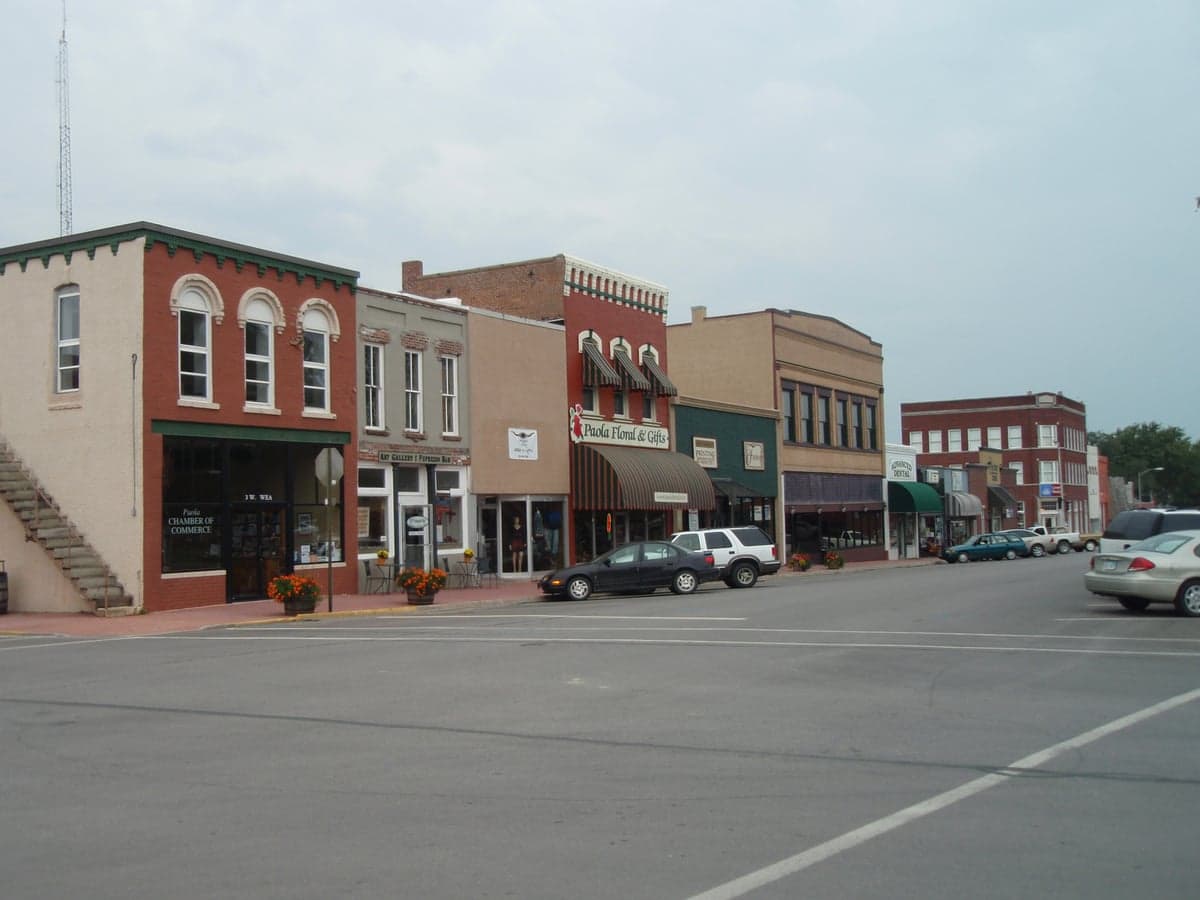
The people of Paola, Kansas, today form a predominantly white, family-oriented community of 5,757 residents, characterized by a strong sense of local heritage and a slower pace of life. With a 93% white population and a foreign-born rate of 0.0%, the city is notably less diverse than the national average, reflecting its deep roots in European settlement and limited recent immigration. The population is slightly older than the state median, with a college attainment rate of 28.7%, and the community’s identity is closely tied to its historic downtown, agricultural surroundings, and a conservative-leaning civic culture. For those moving in now, Paola offers a stable, tight-knit environment where generational ties run deep and newcomers are often drawn by affordable housing and a quiet, safe atmosphere.
How the city was settled and grew
Paola’s human history begins with the Osage and Kansa tribes, who used the area along the Marais des Cygnes River as hunting grounds before European-American settlement. The city was formally founded in 1855 by a group of pro-slavery settlers from Missouri, who named it after Paola, a Native American woman of the Osage tribe. The original town site was platted near the river, and the first wave of permanent residents were largely farmers and merchants from the Upper South and Midwest, drawn by the fertile bottomlands and the promise of land under the 1854 Kansas-Nebraska Act. The Old Town district, centered around Silver and Peoria streets, became the commercial and social hub for these early settlers, with many families building homes on large lots that still define the neighborhood’s character today. By the 1870s, the arrival of the Missouri-Kansas-Texas Railroad (the Katy) spurred a second wave of growth, attracting German and Irish immigrants who worked as railroad laborers and later as craftsmen and shopkeepers. These groups settled primarily in Railroad Addition, a neighborhood south of the tracks where modest frame houses and a Catholic church (Holy Trinity, established 1871) anchored the community. The city’s economy diversified with a flour mill, a foundry, and a limestone quarry, but agriculture remained the backbone, and the population grew slowly to about 2,500 by 1900. The early 20th century saw little new immigration; the city’s character was set by the descendants of these original settlers, with North Park and South Park neighborhoods developing as middle-class residential areas for local business owners and professionals.
Modern era (post-1965)
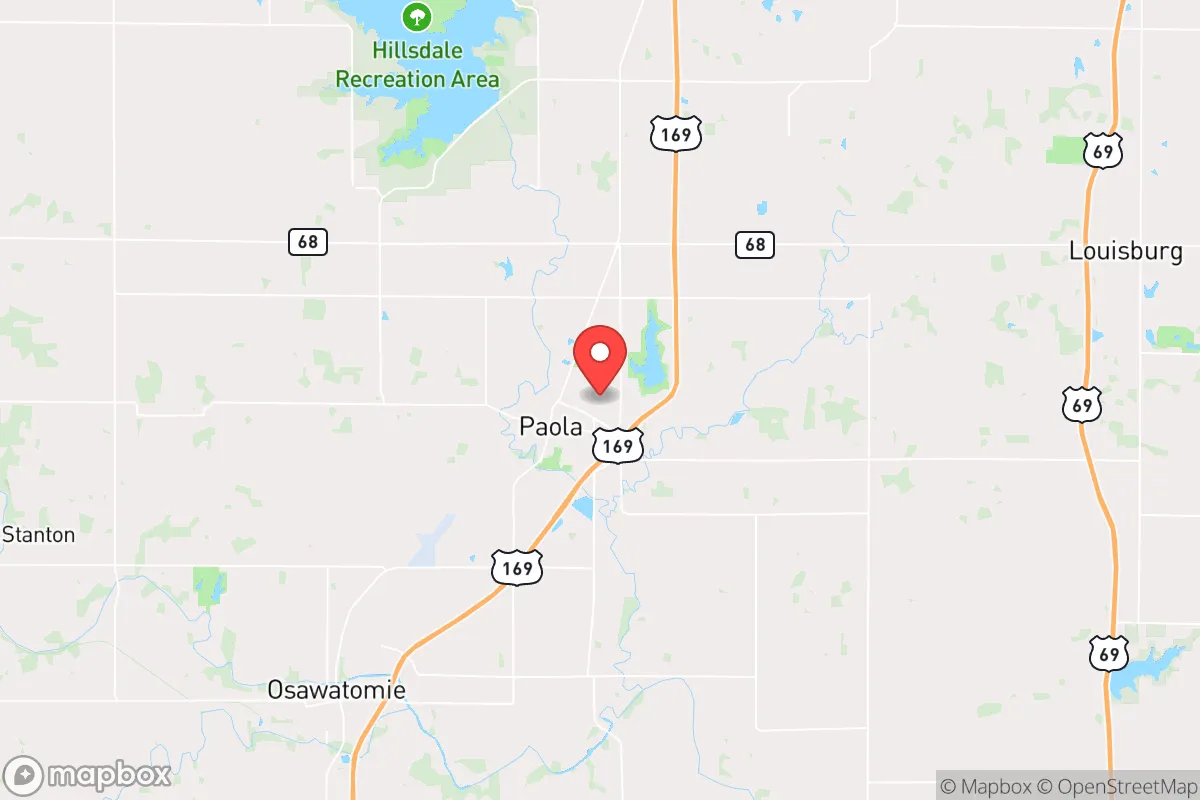
After the 1965 Immigration and Nationality Act, Paola experienced virtually no influx of foreign-born residents—the foreign-born share remains 0.0% today. Instead, the city’s post-1965 demographic story is one of domestic in-migration from the Kansas City metro area, about 40 miles north. As suburban sprawl pushed south along U.S. Highway 169, Paola attracted white families seeking larger lots, lower taxes, and a rural lifestyle within commuting distance of Overland Park and Olathe. This wave settled predominantly in newer subdivisions on the city’s north and west edges, such as Prairie View Estates and Deerfield, where custom-built homes on half-acre lots became the norm. The Hispanic population grew modestly from near zero to 2.3%, with families concentrated in the East Side neighborhood near the Miami County Fairgrounds, often working in construction, landscaping, or at the local poultry processing plant. The Black population (1.8%) and East/Southeast Asian population (0.6%) remain very small, with no distinct ethnic enclaves; these residents are dispersed across the city, often in the older West Side neighborhood near the hospital. The Indian-subcontinent population is 0.0%. The city’s racial homogeneity has been reinforced by the lack of major employers attracting diverse workforces—the largest employers are the Paola school district, Miami County government, and a few light manufacturing firms. The college-educated share (28.7%) is below the Kansas average, reflecting a workforce tilted toward trades, retail, and local services.
The future
Paola’s population is projected to remain stable or grow slowly, with the 2020 census showing a 1.2% increase from 2010. The city is unlikely to become significantly more diverse in the next 10–20 years. The foreign-born rate will likely stay near zero, as there are no refugee resettlement programs, no large employers recruiting international workers, and no ethnic community organizations to anchor new arrivals. The Hispanic share may inch upward as families follow agricultural and construction jobs, but growth will be gradual and concentrated in the East Side and older rental stock near downtown. The white population will continue to dominate, with an aging cohort of long-term residents and younger families moving in from Johnson County for affordable housing. New development is pushing into Hillsdale Estates, a master-planned subdivision on the city’s southern edge, which is attracting mostly white, middle-class families. The city’s cultural identity will remain rooted in its historic downtown, annual festivals like the Paola Roots Festival, and a conservative, self-reliant ethos. For a newcomer, this means moving into a community where social networks are strong but can feel insular, and where diversity is minimal.
Paola is becoming a quiet, stable bedroom community for the Kansas City metro—whiter, older, and less diverse than the region as a whole. For someone moving in now, the city offers a safe, affordable, and family-friendly environment with a strong sense of local history, but little demographic change on the horizon. New residents will find a place where fitting in often means embracing the existing culture rather than reshaping it.

* Values derived from national, state, county, city and local statistics and may differ in a specific area. Last updated: 2026-10-03T18:49:00.000Z
Narrative content on this page is AI-generated and may contain mistakes. Verify any details that matter before acting on them.
ReloMaps may earn a commission from affiliate links at no extra cost to you.

