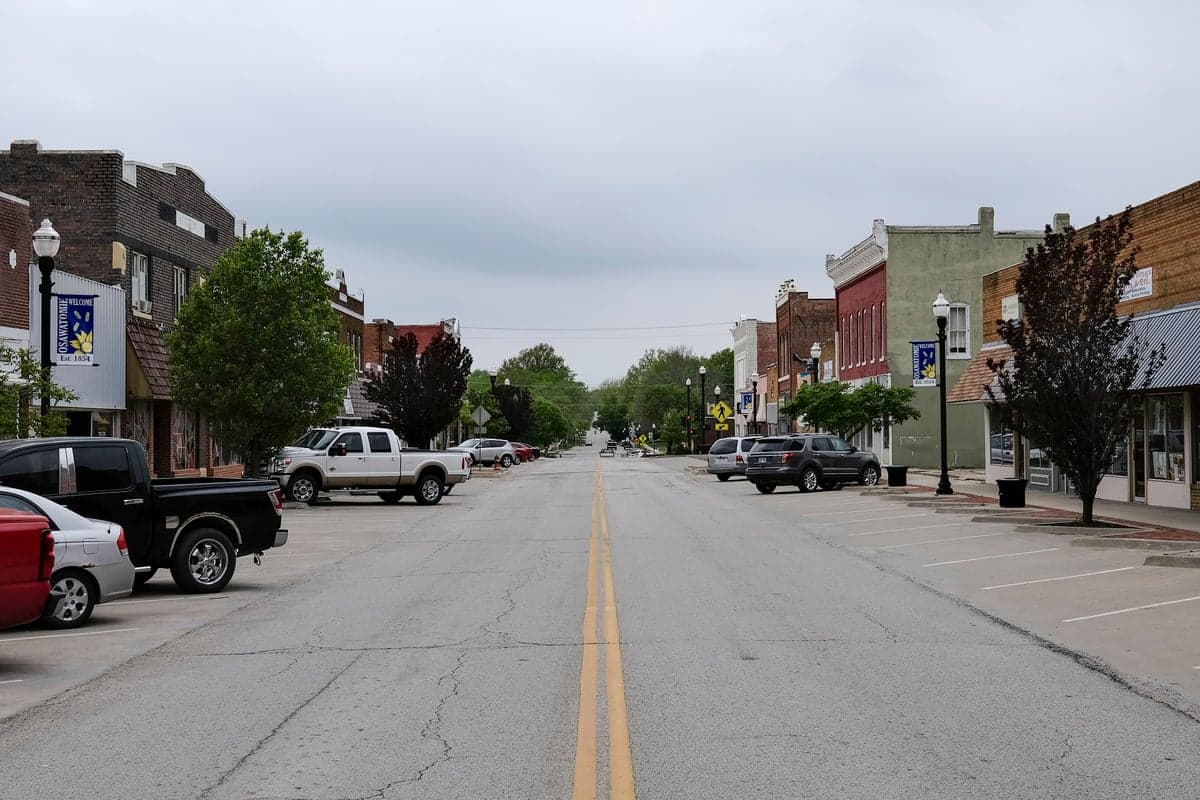
Photo: Wikipedia
Political ClimatePolitical Climate in Osawatomie, KS
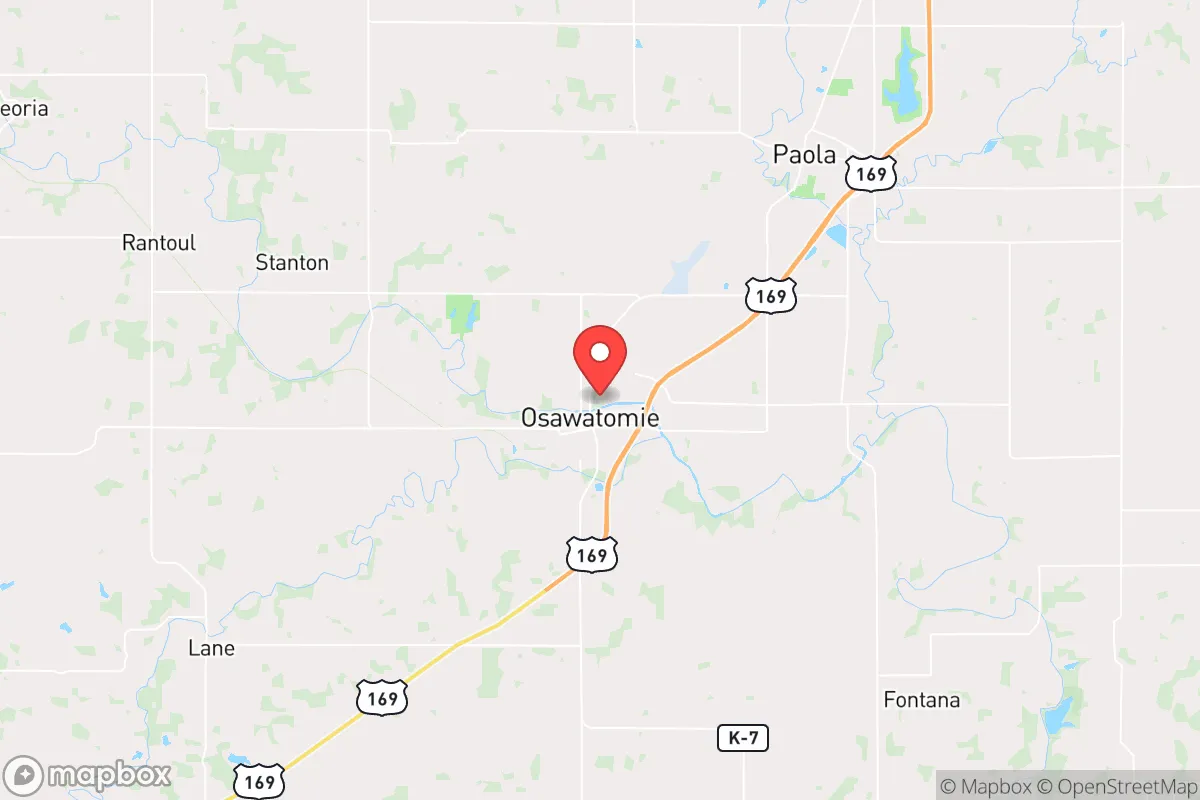
District shown is the primary district for this city’s centroid. Cities may span multiple districts.
Local Political AnalysisPolitical Analysis of Osawatomie, KS
Osawatomie, Kansas, has a political identity that sets it apart from much of the rest of the state. With a Cook Partisan Voting Index (PVI) of D+2, it leans slightly Democratic, a stark contrast to the statewide Kansas PVI of R+9. This means Osawatomie is about 11 points more Democratic than Kansas as a whole, a gap that has widened in recent years as the surrounding rural areas have shifted rightward. The town’s political trajectory has been relatively stable—it’s not flipping red anytime soon—but the local dynamics are more nuanced than a simple blue dot on a red map.
How it compares
To understand Osawatomie’s political climate, you have to look at its neighbors. Drive 15 miles north to Paola, and you’re in a reliably Republican area that mirrors the state’s R+9 lean. Head 20 miles west to Garnett, and the politics get even more conservative, with many precincts voting 70% or more Republican in recent elections. Osawatomie, by contrast, has a history of labor union influence and a working-class base that keeps it competitive for Democrats. The town’s D+2 PVI means it’s a place where local races—like county commission or school board seats—can genuinely swing either way, unlike in much of rural Kansas where Republican primaries are the only real contest. The contrast is sharpest in presidential elections: while Kansas went for Trump by 15 points in 2020, Osawatomie’s precincts were within a few points of a tie, with some even breaking for Biden.
What this means for residents
For conservative residents, living in a D+2 town means you’re in the minority locally but part of the overwhelming majority statewide. You’ll find plenty of like-minded neighbors in the surrounding countryside, and state-level policies—like the flat income tax passed in 2024 or the abortion restrictions enacted after the 2022 vote—still apply to you. The local political culture is more moderate than the state’s, so you might see more compromise on issues like public school funding or infrastructure than you would in a deep-red county. For liberal residents, Osawatomie offers a rare pocket where your vote actually matters in local elections. You can realistically elect a Democrat to the city council or even the county commission, which is nearly impossible in most of Kansas outside of Lawrence or Wyandotte County. That said, you’ll still feel the weight of state-level conservative policies, from gun laws to tax structures, and the social atmosphere can be isolating if you’re used to a more progressive environment.
One cultural distinction worth noting is how Osawatomie’s political lean interacts with its identity as a small town. The local paper, the Osawatomie Graphic, tends to avoid overt partisanship, focusing on community events and high school sports rather than national politics. The town’s annual Osawatomie Celebration Day is a non-political affair that draws everyone together, regardless of party. In practice, this means the political divide is less personal than in bigger cities—you can disagree with a neighbor over a county commissioner candidate and still share a beer at the VFW. The long-term trajectory likely stays the same: Osawatomie will remain a D+2 outlier in a R+9 state, buffered by its history and demographics, while the surrounding areas grow even more conservative. For anyone moving here, the key takeaway is that you’ll get a mix of local blue and state red, and the real action is in the local races, not the national ones.

State Political ClimatePolitical Climate in Kansas
State Political AnalysisPolitical Environment in the State
Kansas is a solidly Republican state with a Cook PVI of R+9, meaning it typically votes about nine points more Republican than the nation as a whole. The dominant coalition is a mix of rural conservatives, suburban moderates, and a growing libertarian-leaning wing, but the state has shifted rightward over the past 10-20 years, particularly after the 2010 Tea Party wave and the 2018 election of hardline conservative Governor Sam Brownback. While Democrats hold a stronghold in the Kansas City metro (Johnson and Wyandotte counties) and can compete in Lawrence and parts of Topeka, the rest of the state has become increasingly red, with many rural counties voting 70-80% Republican in recent cycles.
Urban vs. rural divide
The political map of Kansas is a classic urban-rural split, but with a few key wrinkles. The Kansas City suburbs—especially Overland Park, Leawood, and Olathe in Johnson County—are the state’s most politically competitive area. Johnson County has trended Democratic in recent years, flipping from a 12-point Republican margin in 2012 to a narrow Democratic lean in 2020 and 2024, driven by college-educated professionals and a growing diverse population. Lawrence, home to the University of Kansas, is the state’s most reliably Democratic city, often voting 70%+ for Democrats. Topeka and Wichita are more mixed: Wichita’s Sedgwick County leans Republican but by narrower margins than the rest of the state, while Topeka’s Shawnee County is a swing area that has trended slightly redder. Meanwhile, the vast rural expanse—places like Garden City, Dodge City, and Hays—are deeply Republican, often voting 75-80% for GOP candidates. The divide is stark: Johnson County alone produces about 20% of the state’s votes, and its shift leftward has made statewide races closer than they were a decade ago, but the rural vote still overwhelms it.
Policy environment
Kansas has a low-tax, low-regulation policy environment that appeals to conservatives. The state income tax has a flat rate of 5.7% (down from a progressive top rate of 6.45% before the Brownback tax cuts), and the sales tax is 6.5% statewide, with local add-ons. Property taxes are moderate but vary widely by county. The state has a right-to-work law, meaning no one can be required to join a union as a condition of employment. Education policy is a perennial battleground: the state has a school choice program (tax-credit scholarships for private school) and a charter school law, but funding has been a source of repeated lawsuits, with the Kansas Supreme Court ordering the legislature to increase funding for poor districts. Healthcare policy is conservative: Kansas did not expand Medicaid under the Affordable Care Act, leaving about 150,000 low-income adults in a coverage gap. Election laws are moderately restrictive: voters must show photo ID at the polls, and the state has a 20-day advance voting period but no same-day registration. Abortion is heavily restricted: after the 2022 Dobbs decision, a state constitutional amendment to protect abortion rights was rejected by voters, but the legislature has since passed a near-total ban (with exceptions for rape, incest, and life of the mother) that is currently blocked by the courts.
Recent policy direction
Kansas has moved decisively rightward on most fronts in the last five years. On gun rights, the state enacted constitutional carry in 2021, allowing permitless concealed carry for adults 21 and older. On parental rights and education, the legislature passed a Parents’ Bill of Rights in 2022, requiring schools to notify parents about curriculum changes and allowing them to opt their children out of certain materials. On speech and privacy, the state passed a law in 2023 banning TikTok on government devices and restricting certain data collection by tech companies. On medical and bodily autonomy, the abortion ban is the biggest flashpoint, but the state also passed a law in 2024 banning gender-affirming care for minors (now also blocked by courts). On property rights, Kansas has strong eminent domain protections and a low property tax cap for seniors. On taxation, the legislature passed a major income tax cut in 2024, reducing the flat rate from 5.7% to 5.5% and accelerating the elimination of the state’s estate tax. On voting and ballot access, the state tightened voter ID requirements in 2021 and banned ballot drop boxes except at county election offices. The overall direction is toward smaller government, fewer regulations, and more cultural conservatism, but the courts have been a check on some of the most aggressive moves.
Civil unrest & political movements
Kansas has seen relatively little large-scale civil unrest compared to coastal states, but there have been notable flashpoints. The 2020 Black Lives Matter protests in Wichita and Kansas City were sizable but mostly peaceful, with some property damage in downtown Wichita. The state has a small but active anti-government movement, particularly in rural areas like Sedgwick County and the Flint Hills, where “constitutional sheriff” rhetoric is common. Immigration politics are less heated than in border states, but Garden City and Dodge City have large immigrant populations (mostly from Central America and Southeast Asia) that have sparked occasional local tensions over housing and schools. There are no sanctuary cities in Kansas; in fact, the state passed a law in 2024 requiring local law enforcement to cooperate with federal immigration authorities. Election integrity controversies flared after 2020, with a handful of county-level audits and a failed attempt to create a state-level election police force. The most visible political movement in recent years has been the anti-abortion side, which has held large annual rallies at the Statehouse in Topeka, and the pro-choice side, which organized a successful 2022 ballot measure campaign to reject the constitutional amendment. A new resident would notice the strong presence of church-affiliated political groups, especially in the rural areas, and a general sense that politics is less polarized in daily life than in many other states.
Projection
Over the next 5-10 years, Kansas is likely to remain solidly Republican but with a slowly narrowing margin. The key demographic shift is the continued growth of Johnson County, which is becoming more diverse and more Democratic-leaning as it fills up with professionals from the Kansas City metro. If Johnson County continues its leftward trend, it could eventually make statewide races competitive for Democrats, but the rural vote is so lopsided that it would take a major realignment to flip the state. In-migration patterns are mixed: the state is gaining some remote workers from the coasts (especially in the Kansas City suburbs and Lawrence) who tend to be more moderate, but it’s also losing young people to other states. The policy direction will likely continue rightward on cultural issues (abortion, transgender rights, education) but may moderate on taxes and spending as the state faces budget pressures from the 2024 tax cuts. A new resident moving in now should expect a state that is reliably conservative but with a growing urban-suburban counterweight, and a political culture that is more about quiet pragmatism than loud confrontation.
For a new resident, the bottom line is that Kansas offers a low-tax, low-regulation environment with a strong conservative tilt, but the political reality is more nuanced than the R+9 label suggests. If you’re conservative, you’ll find a state that generally aligns with your values on guns, taxes, and education, with a legislature that is actively pushing those priorities. If you’re liberal, you’ll find a few blue islands (Lawrence, parts of Johnson County) where you can feel at home, but you’ll be in the minority in most of the state, and you’ll need to accept that state policy will often go against your preferences. The practical takeaway: Kansas is a good fit for someone who wants a stable, affordable, and politically predictable place to live, but it’s not a place where you’ll see dramatic political change anytime soon.
* Values derived from national, state, county, city and local statistics and may differ in a specific area. Last updated: 2026-10-06T17:45:54.000Z
Narrative content on this page is AI-generated and may contain mistakes. Verify any details that matter before acting on them.
ReloMaps may earn a commission from affiliate links at no extra cost to you.

