Photo: Wikipedia
Demographics of Osawatomie, KS
Affluence Level in Osawatomie, KS
A below-average socioeconomic profile. Incomes, home values, and educational attainment trail the U.S., with higher poverty and unemployment.
People of Osawatomie, KS
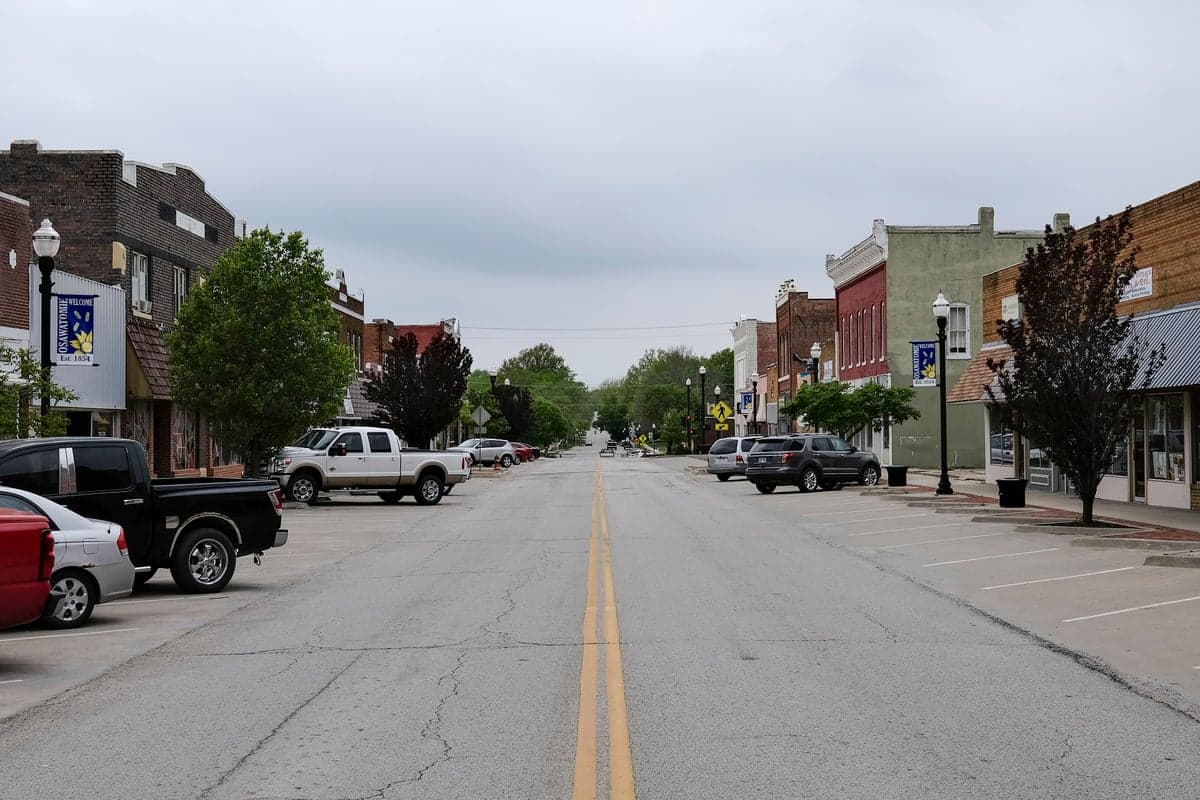
The people of Osawatomie, Kansas, today number 4,244, forming a predominantly white (81.6%) community with a small but established Black population (5.3%) and a growing Hispanic presence (4.4%). The city is notably less diverse than the national average, with a foreign-born population of just 0.1% and a college-educated rate of 13.0%, reflecting its roots as a working-class, rural industrial town. Residents identify strongly with the city’s abolitionist and Civil War history, and the population is concentrated in older, single-family home neighborhoods like Downtown Osawatomie and South Osawatomie, with newer development pushing toward the U.S. 169 corridor.
How the city was settled and grew
Osawatomie was founded in 1854 by pro-slavery and anti-slavery settlers during the Bleeding Kansas conflict, with the name combining "Osage" and "Pottawatomie" from local Native American tribes. The town’s first major population wave came from New England abolitionists, including the famous John Brown, who established a free-state stronghold in what is now John Brown Memorial Park and the surrounding Old Town district. After the Civil War, the city grew as a railroad and milling center, drawing German and Irish immigrants who settled in the North Osawatomie area near the Marais des Cygnes River. By the early 1900s, the establishment of the Osawatomie State Hospital (a psychiatric facility) brought a steady influx of medical and support staff, many of whom built homes in the Hospital Hill neighborhood. The city’s population peaked at around 4,800 in the 1960s, driven by manufacturing jobs at companies like Kaw Valley Products and the hospital’s expansion.
Modern era (post-1965)
After the 1965 Hart-Cellar Act, Osawatomie saw minimal immigration, with the foreign-born share remaining near zero. The city’s modest Black population (5.3%) is largely descended from families who moved during the Great Migration to work in the railroad and hospital industries, and they remain concentrated in the South Osawatomie and Downtown areas. The Hispanic population (4.4%) began growing in the 1990s, primarily through domestic migration from Texas and the Southwest, settling in rental housing along the U.S. 169 corridor and in the West Osawatomie neighborhood. East/Southeast Asian residents (0.1%) and Indian subcontinent residents (0.0%) are virtually absent, reflecting the city’s limited economic draw for immigrant communities. Suburbanization has been modest, with most new single-family construction occurring in the Prairie View Estates subdivision on the city’s eastern edge, attracting families from the Kansas City metro seeking lower housing costs.
The future
Osawatomie’s population is projected to remain stable or decline slightly, as the city lacks the job growth to attract significant in-migration. The Hispanic share is expected to continue rising slowly, driven by natural increase and continued domestic migration, but the city will likely remain overwhelmingly white (80%+) for the foreseeable future. The Black population is aging and may decline without new arrivals, while East/Southeast Asian and Indian populations are unlikely to grow without a major employer shift. New development is concentrating in the U.S. 169 corridor and Prairie View Estates, but the city’s cultural identity remains rooted in its abolitionist heritage and small-town, working-class character. The lack of college-educated residents (13.0%) and limited economic diversification suggest the city will continue to be a bedroom community for the Kansas City metro rather than a destination for young professionals or immigrants.
For someone moving in now, Osawatomie offers a quiet, affordable, and historically rich environment, but with limited demographic diversity and economic opportunity. The city is becoming slightly more Hispanic and slightly less white, but the pace of change is slow, and the community’s identity as a conservative-leaning, family-oriented small town is likely to persist through the next decade.

* Values derived from national, state, county, city and local statistics and may differ in a specific area. Last updated: 2026-10-06T17:45:54.000Z
Narrative content on this page is AI-generated and may contain mistakes. Verify any details that matter before acting on them.
ReloMaps may earn a commission from affiliate links at no extra cost to you.

