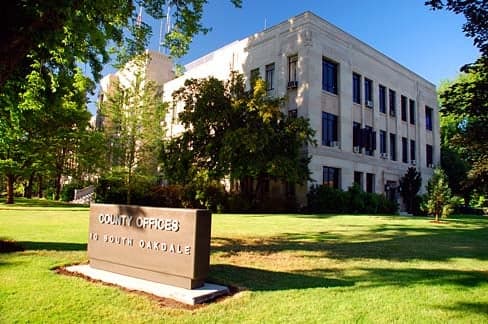
Photo: Wikipedia
Political ClimatePolitical Climate in Jackson County
Showing district-level results — no local-only data available.
Local Political AnalysisPolitical Analysis of Jackson County
Jackson County, Oregon, is a solidly conservative stronghold in an otherwise deeply blue state, carrying a Cook Partisan Voting Index of R+14 compared to Oregon’s overall D+8. That 22-point gap is one of the widest urban-rural political divides in the country, and it’s been widening for a decade. The county hasn’t voted for a Democratic presidential candidate since 1964, and in 2024, Donald Trump carried it by roughly 15 points, mirroring the PVI. But the real story is the internal variation: the county is a patchwork of deep-red rural precincts, purple suburban swing areas, and a small but vocal blue island in Ashland.
How it compares
Statewide, Oregon’s D+8 lean is driven almost entirely by the Portland metro area and the Willamette Valley. Jackson County, sitting 300 miles south near the California border, is culturally and politically closer to northern California’s rural interior than to Portland. The contrast is stark: while Oregon’s legislature has passed some of the nation’s most progressive housing and drug policy reforms, Jackson County voters consistently reject similar measures. In 2020, the county voted 57% against Measure 110 (drug decriminalization), which passed statewide. The county’s largest city, Medford, is a reliable Republican stronghold, but its neighbor to the south, Ashland, is the exception — home to Southern Oregon University and a liberal arts scene, Ashland precincts routinely vote 70-80% Democratic. The swing precincts cluster in the suburban corridor between Medford and Ashland, particularly around Talent and Phoenix, where housing affordability pressures are creating a younger, more transient electorate that leans slightly left of the county average.
What this means for residents
For conservative residents, Jackson County offers a rare experience in Oregon: local government that aligns with their values. The county commission is entirely Republican, and the sheriff’s office has publicly stated it will not enforce certain state gun laws. Property taxes are relatively low — the median effective rate is about 0.85% — and there’s no county-level income tax. For liberal residents, life is more of a balancing act. Ashland provides a progressive bubble with its own city council, farmers’ markets, and a thriving arts scene, but drive 15 minutes north to Medford and the political tone shifts dramatically. The practical reality is that progressive policies on housing, land use, and environmental regulation often stall at the county level, even when they pass statewide. One concrete example: Jackson County was one of the last in Oregon to adopt a countywide urban growth boundary update, delaying new housing construction for years.
Looking ahead, the trajectory is toward further polarization. The county’s population is growing slowly — about 0.5% annually — but the growth is concentrated in the Medford-Ashland corridor, where new arrivals are a mix of California transplants (often more moderate) and remote workers (often more progressive). Meanwhile, the rural eastern half of the county, including towns like Butte Falls and Eagle Point, is aging and shrinking. The net effect is that the county’s R+14 lean is likely to hold steady for the next decade, but the internal cultural friction between Ashland and the rest of the county will intensify. If you’re moving here, the key takeaway is simple: your daily political experience depends almost entirely on which of the county’s distinct communities you choose to live in.

State Political ClimatePolitical Climate in Oregon
State Political AnalysisPolitical Environment in the State
Oregon is a reliably Democratic state with a Cook PVI of D+8, but that single number hides a deeply fractured political landscape. The state has shifted leftward over the past 20 years, driven by explosive growth in the Portland metro and the Willamette Valley, while rural and eastern counties have hardened into some of the most conservative territory in the Pacific Northwest. For a conservative-leaning relocator, Oregon offers a mixed bag: a state government that consistently passes progressive legislation, but also vast stretches where local culture, gun rights, and property freedoms are fiercely defended.
Urban vs. rural divide
The political map of Oregon is essentially two countries. The Portland metro area—Multnomah, Washington, and Clackamas counties—accounts for roughly half the state’s population and delivers the Democratic margins that decide statewide elections. Multnomah County alone gave Joe Biden a 40-point margin in 2020. Meanwhile, the rest of the state is a sea of red. Eastern Oregon counties like Malheur, Harney, and Lake routinely vote 70-80% Republican. The I-5 corridor south of Portland, including Eugene and Salem, leans blue but with notable exceptions: Linn County (Albany, Lebanon) voted for Trump in 2020, and Douglas County (Roseburg) is a conservative stronghold. The coastal counties are split—Tillamook and Lincoln lean left, while Curry and Coos tilt right. The real flashpoint is the suburban ring: Clackamas County, once a swing county, has moved steadily blue, while Washington County (Beaverton, Hillsboro) is now solidly Democratic. The only reliably red metro area is Medford in Jackson County, which voted for Trump by 8 points in 2020.
Policy environment
Oregon’s state-level policies reflect its urban majority. There is no state sales tax, but property taxes are moderate and income taxes are high—the top marginal rate is 9.9%, one of the highest in the nation. The regulatory environment is business-friendly in some sectors (no sales tax, no inventory tax) but heavily restrictive in others: land use laws under the 1973 Senate Bill 100 tightly control development, and the state has some of the strictest environmental regulations on the West Coast. Education policy is progressive: Oregon has a $10.2 billion K-12 budget (2023-25), but test scores lag behind national averages. Healthcare is dominated by the Oregon Health Plan, the state’s Medicaid expansion, which covers about one in four residents. Election laws are among the most accessible in the country: Oregon was the first state to vote entirely by mail (1998), and automatic voter registration at the DMV has boosted turnout. There is no voter ID law, which conservatives often cite as a vulnerability.
Recent policy direction
Over the past five years, Oregon’s legislature has moved aggressively on several fronts. On gun policy, the 2023 Measure 114 (passed by voters) requires a permit to purchase a firearm, bans magazines over ten rounds, and mandates a completed background check before transfer—currently tied up in court challenges. On self-defense, Oregon has no “stand your ground” law; the duty to retreat applies outside the home. On parental rights, the 2023 HB 2002 expanded access to abortion and gender-affirming care for minors without parental consent, sparking intense backlash. On education, the 2019 Student Success Act poured $2 billion into K-12, but also mandated ethnic studies and LGBTQ-inclusive curricula. On property rights, the 2021 HB 2001 effectively ended single-family zoning in cities over 10,000, allowing duplexes and triplexes in most residential areas. On taxes, the 2020 Measure 110 decriminalized possession of small amounts of all drugs and redirected tax revenue from cannabis to addiction services—a policy that has been widely criticized for exacerbating public drug use and homelessness. On voting, Oregon has no restrictions on ballot harvesting, and same-day voter registration is allowed. For a conservative relocator, the key takeaway is that state law preempts local control on many issues, meaning even in a red county, you’re subject to Portland’s policy preferences on guns, land use, and education.
Civil unrest & political movements
Oregon has a long history of political activism, from the 1934 West Coast Longshoremen’s Strike to the 2020 Portland protests. The 2020 George Floyd protests in Portland were among the most sustained and violent in the nation, with 110 consecutive nights of demonstrations, federal intervention, and property damage estimated at $2.3 million. The left is organized through groups like the Pacific Northwest Youth Liberation Front and the Portland Democratic Socialists of America. On the right, the Oregon Republican Party has become more militant, with several county GOP chapters passing resolutions supporting secession or “nullification” of state laws. The People’s Rights network, founded by Ammon Bundy, has a presence in eastern Oregon. Immigration politics are a flashpoint: Portland is a sanctuary city, and the 1987 state law (ORS 181A.820) prohibits state and local law enforcement from using resources to enforce federal immigration law. Election integrity remains a live issue: in 2020, the Oregon GOP sued to restrict ballot drop boxes, and in 2022, a ballot box fire in Portland destroyed hundreds of ballots. For a new resident, the most visible flashpoint is homelessness: Portland’s tent encampments and the state’s permissive camping laws (HB 3115, 2021) have become a daily reality in every major city.
Projection
Over the next 5-10 years, Oregon’s political trajectory is likely to continue leftward at the state level, but with increasing friction. Demographic trends favor Democrats: in-migration from California and other blue states has been steady, and the Portland metro continues to grow. However, there are countercurrents. The 2022 gubernatorial race was the closest in decades, with Democrat Tina Kotek winning by just 3.5 points over Republican Christine Drazan, while unaffiliated candidate Betsy Johnson (a former Democrat) pulled 8.6%. This suggests a ceiling on Democratic dominance. The rural-urban divide is likely to widen, with more counties considering “Greater Idaho” secession movements—11 eastern Oregon counties have voted to explore joining Idaho. The housing crisis and homelessness may shift some suburban voters toward centrist or conservative candidates. For a conservative moving in now, expect state government to remain progressive on gun control, education, and drug policy, but also expect that local communities in red areas will continue to resist. The practical reality is that Oregon is not a place where conservatives can easily change state policy, but it is a place where they can find like-minded communities in places like Roseburg, Grants Pass, or Baker City.
For a new resident, the bottom line is this: Oregon offers stunning natural beauty and a relatively high quality of life, but the political climate is sharply divided. If you’re conservative, you’ll find your values reflected in local culture and county government in much of the state, but you’ll be living under state laws that often contradict those values. The trade-off is worth it for many—low crime in rural areas, strong property rights at the local level, and no sales tax—but it requires a tolerance for political dissonance. If you’re liberal, you’ll find a welcoming environment in the cities and suburbs, but you’ll also encounter a deeply entrenched rural opposition that makes statewide governance a constant negotiation. Either way, Oregon is a state where your vote matters more at the local level than the state level, and where the political landscape is unlikely to shift dramatically in the next decade.
* Values derived from national, state, county, city and local statistics and may differ in a specific area. Last updated: 2026-06-16T23:52:10.000Z
Narrative content on this page is AI-generated and may contain mistakes. Verify any details that matter before acting on them.
ReloMaps may earn a commission from affiliate links at no extra cost to you.

