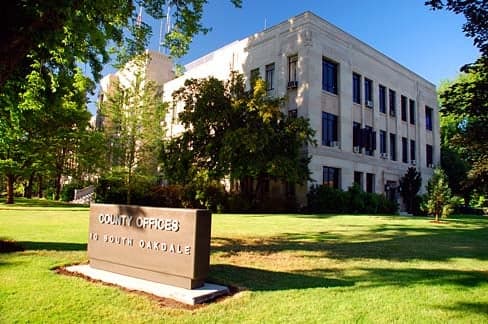
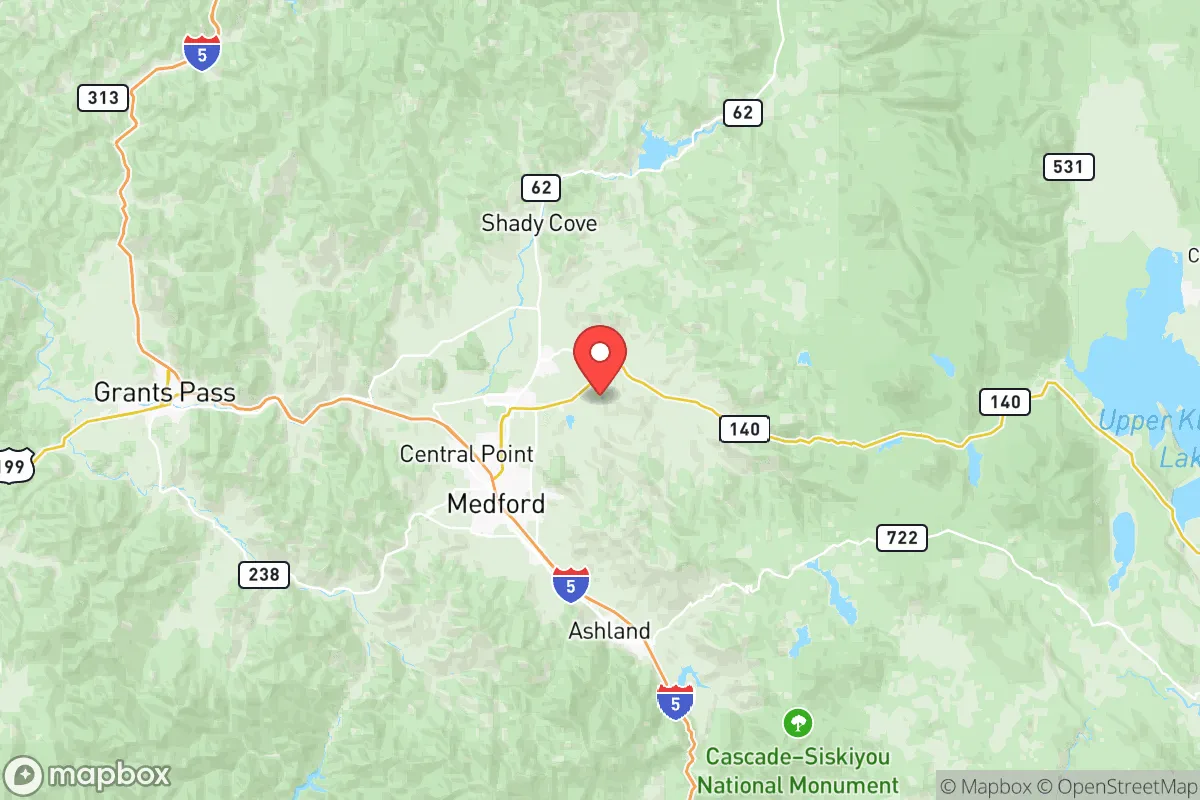
Photo: Wikipedia
Demographics of Jackson County
Affluence Level in Jackson County
A middle-class area roughly in line with national averages across income, home values, education, and employment.
People of Jackson County
The people of Jackson County, Oregon, today number 222,563, forming a predominantly white (77.5%) and notably less diverse population than the national average, with a foreign-born share of just 2.8%. The county’s identity is shaped by a blend of historic agricultural roots, a growing retirement and outdoor-recreation draw, and a political culture that leans conservative relative to Oregon’s Willamette Valley, though the city of Ashland provides a liberal counterweight. Distinctive markers include a strong sense of local independence, a population concentrated in the Rogue Valley cities of Medford and Ashland, and a demographic profile that is slowly diversifying, primarily through Hispanic growth (14.2%) and modest East/Southeast Asian and Indian subcontinent communities.
Settlement & growth (pre-1960)
Before American settlement, the region was home to the Takelma and Shasta peoples, who lived along the Rogue River for thousands of years. The Rogue River Wars of the 1850s, a series of conflicts between white settlers and Native tribes, ended with the forced removal of most Indigenous people to the Siletz and Grand Ronde reservations on the Oregon Coast. The first permanent American settlers arrived in the 1850s, drawn by the Donation Land Claim Act of 1850, which offered 320 acres to married couples. These early pioneers were primarily of English, Scots-Irish, and German stock, moving west from the Midwest and Upper South. They established the towns of Jacksonville (1851), which became a booming gold rush hub, and Ashland (1852), which grew as an agricultural and milling center.
The completion of the Oregon and California Railroad through the Rogue Valley in the 1880s transformed the region. Medford, founded in 1883 as a railroad town, quickly eclipsed Jacksonville as the commercial and population center. The railroad brought a wave of new settlers, including more Midwestern farmers and a smaller number of Italian and Portuguese immigrants who worked in the orchards and vineyards. By the early 1900s, Jackson County’s economy centered on fruit growing—pears, apples, and peaches—and timber. The Great Depression and Dust Bowl of the 1930s pushed a significant number of “Okies” and “Arkies” from Oklahoma, Texas, and Arkansas into the Rogue Valley, seeking work in agriculture and logging. These migrants, largely of Scots-Irish and English descent, settled in rural areas around Central Point, Eagle Point, and White City, reinforcing the county’s conservative, independent character. World War II brought a small but lasting Japanese American population: the Tule Lake War Relocation Center in nearby California held many internees, and some resettled in Jackson County after the war. By 1960, the county’s population was roughly 73,000, overwhelmingly white, with a small Hispanic community of farm laborers and a tiny Black population.
Modern era (post-1965)
The 1965 Hart-Cellar Act had a muted effect on Jackson County compared to urban Oregon. Immigration remained low, and the foreign-born share today (2.8%) is far below the national average of 13.7%. The most significant demographic shift since 1965 has been the growth of the Hispanic population, which rose from under 5% in 1990 to 14.2% in the latest data. This growth came primarily from Mexican immigrants and their U.S.-born children, drawn by agricultural work in the pear and wine grape orchards, as well as construction and service jobs in Medford and Ashland. Hispanic residents are concentrated in Medford’s south and east sides, in Phoenix, and in Talent, where a growing Latino community has established small businesses and churches. The East/Southeast Asian population (1.0%) includes a small but established Japanese American community, along with more recent Vietnamese and Filipino residents, many working in healthcare and hospitality in Medford and Ashland. The Indian subcontinent population (0.1%) is tiny, primarily professionals in tech and medicine in Medford. The Black population (0.6%) remains very small, with no historic enclave; most Black residents are recent arrivals in Medford and Ashland, often in professional roles.
Domestic migration has reshaped the county more than immigration. Since the 1990s, Jackson County has attracted retirees and remote workers from California, particularly from the Bay Area and Los Angeles, seeking lower housing costs and a more rural lifestyle. This “California exodus” has concentrated in Ashland, known for its liberal arts college and Oregon Shakespeare Festival, and in the newer subdivisions around Medford and Central Point. These newcomers have increased the share of college-educated residents to 30.6%, up from 18% in 2000, and have pushed housing prices higher, creating tension with longer-term residents. Suburbanization has spread outward from Medford, with bedroom communities like Eagle Point and Gold Hill growing as families seek larger lots and lower taxes.
The future
Jackson County is becoming slightly more diverse, but the pace is slow. The Hispanic share is projected to reach 18-20% by 2040, driven by natural increase and continued agricultural labor demand. The East/Southeast Asian and Indian subcontinent populations will likely grow modestly as healthcare and tech sectors expand in Medford, but they will remain small. The white population, while still the overwhelming majority, is aging: the median age in the county is 43, above the national average, and many younger white residents leave for college and jobs in Portland or Bend. The most dynamic demographic force is continued domestic in-migration from California and other high-cost states, which will keep the county’s population growing at about 1% annually. These newcomers tend to be more educated and politically moderate, gradually softening the county’s conservative edge, especially in Ashland and Medford’s newer subdivisions. The cultural identity is evolving from a purely agricultural and timber-based society to a more mixed economy of healthcare, tourism, and remote work, with a growing emphasis on outdoor recreation and wine tourism.
For someone moving in now, Jackson County offers a predominantly white, politically moderate-to-conservative community with a strong sense of local identity, affordable housing relative to California, and a growing Hispanic cultural presence in Medford and Talent. The county is not becoming a diverse melting pot, but it is slowly opening to new influences, particularly from California transplants and a rising Latino population. The bottom line: this is a place where traditional Oregonian independence meets a gentle, ongoing demographic shift, making it a stable but gradually changing choice for families and individuals seeking a slower-paced, nature-oriented life.

* Values derived from national, state, county, city and local statistics and may differ in a specific area. Last updated: 2026-06-16T23:52:10.000Z
Narrative content on this page is AI-generated and may contain mistakes. Verify any details that matter before acting on them.
ReloMaps may earn a commission from affiliate links at no extra cost to you.

