

Photo: Wikipedia
Political ClimatePolitical Climate in Olive Branch, MS
District shown is the primary district for this city’s centroid. Cities may span multiple districts.
Local Political AnalysisPolitical Analysis of Olive Branch, MS
Olive Branch, Mississippi, has long been a solidly conservative stronghold, and that hasn't changed much despite the rapid growth. The Cook PVI rating of R+18 tells you everything you need to know about the baseline—this area leans heavily Republican, and that's been the case for as long as I can remember. But here's the thing: as more folks move in from Memphis and other parts of the country, you're starting to see a subtle shift. It's not a blue wave by any stretch, but there's a creeping influence of progressive ideas that a lot of us locals keep a close eye on. The trajectory is still conservative, but it's a more suburban, "country club" conservatism than the old-school, rock-ribbed kind we grew up with.
How it compares
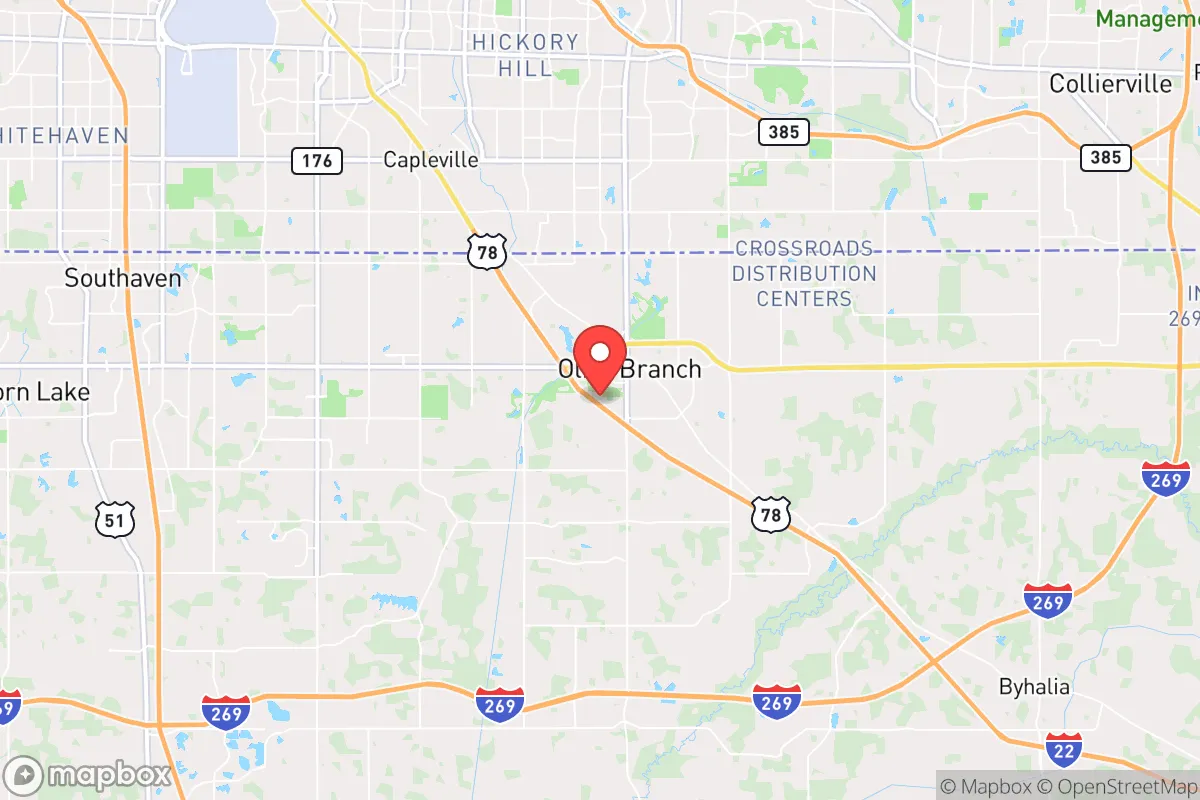
If you want to see the contrast, just look north across the state line into Memphis, Tennessee. Shelby County is a deep blue stronghold, and you can feel the difference in policy and culture the moment you cross into Tennessee. Olive Branch, by contrast, is a world apart. We're in DeSoto County, which is one of the most reliably Republican counties in the state. Nearby Southaven and Hernando lean the same way, but Olive Branch has a slightly more moderate feel—probably because of all the new subdivisions and transplants. Still, compared to Oxford or Jackson, Mississippi, we're firmly on the conservative side. The local school board, city council, and county supervisors are all Republican-dominated, and that's unlikely to change anytime soon. But I've noticed a few more "Blue Lives Matter" signs being replaced by generic "Neighbor" signs, which tells me some folks are trying to avoid the culture war stuff. That's fine, but it also means we have to stay vigilant about not letting those progressive Memphis values bleed south.
What this means for residents
For the average family here, the political climate means lower taxes, less red tape, and a general hands-off approach from local government. You can build a fence without a dozen permits, and the sheriff's department isn't going to come knocking about a backyard barbecue. That's the kind of freedom that keeps people here. But there's a growing concern about government overreach, especially when it comes to school policies and property rights. Some folks are worried that as the city grows, we'll see more zoning restrictions and HOA-style rules imposed from above. The good news is that the local leadership still respects the Second Amendment and parental rights in education. The bad news is that national trends—like DEI initiatives and climate mandates—are starting to trickle down through school curriculum and county planning. If you're the kind of person who values personal liberty and wants to be left alone, Olive Branch is still a great place. But you have to stay engaged, because the fight over those freedoms is real, even here.
One thing that sets Olive Branch apart culturally is its strong sense of community and a "live and let live" attitude that's rare in bigger cities. You won't find a lot of political lawn signs or heated arguments at the grocery store. Most folks just want to raise their kids, go to church, and enjoy their weekends without the government sticking its nose in. That said, there's a quiet but growing tension between the old guard—who remember when this was all farmland—and the newcomers who want more bike lanes and "sustainable" development. The long-term outlook is still conservative, but it's a conservatism that's being tested by growth. If you're moving here, just know that the political culture is friendly and respectful, but it's also protective of its values. Keep an eye on local elections, because that's where the real battles over your rights will be fought.

State Political ClimatePolitical Climate in Mississippi
State Political AnalysisPolitical Environment in the State
Mississippi is one of the most reliably conservative states in the country, with a deep-rooted Republican lean that has only solidified over the past two decades. The state hasn’t voted for a Democratic presidential candidate since 1976, and in 2024, Donald Trump carried it by over 16 points. The dominant coalition is a mix of rural white evangelicals, suburban families, and a growing number of conservative-leaning retirees and remote workers moving in from higher-tax states. Over the last 10-20 years, the shift has been unmistakable: as the old “Blue Dog” Democratic tradition faded in the Delta and along the Gulf Coast, Republicans now control every statewide office, both chambers of the legislature, and three of four U.S. House seats. This isn’t a purple state in disguise—it’s a place where conservative values are baked into the culture and the law.
Urban vs. rural divide
The political map of Mississippi is a textbook case of urban-rural polarization, but with a twist: even the state’s largest cities aren’t reliably blue. Jackson, the capital and only major city with a population over 150,000, is a Democratic stronghold—heavily African American and consistently voting 80%+ for Democrats. But that’s an island in a sea of red. Gulfport and Biloxi along the coast lean Republican, though they’re more moderate than the interior, with some precincts still competitive. Hattiesburg, home to the University of Southern Mississippi, has a slight Democratic tilt in the city core but is surrounded by deep-red Forrest County. The real engine of the GOP majority is the sprawling rural and exurban landscape: counties like DeSoto (just south of Memphis), Rankin (east of Jackson), and Madison (north of Jackson) are among the fastest-growing and most conservative in the state. DeSoto County alone delivered over 70% of its vote to Trump in 2024, and it’s where many Memphis-area conservatives have fled for lower taxes and better schools. The Delta region—places like Greenville and Clarksdale—remains Democratic due to high poverty and a majority-black population, but those areas are losing population fast, further diluting their political influence.
Policy environment
Mississippi’s policy environment is aggressively pro-business, low-tax, and culturally conservative. There is no state income tax on the first $5,000 of income, and the top marginal rate is just 4.7%—with a phased-in plan to eliminate the income tax entirely by 2026. Property taxes are among the lowest in the nation, averaging about 0.6% of home value. The state is a right-to-work state with no state-level minimum wage above the federal $7.25. On education, Mississippi has embraced school choice: the state’s Education Scholarship Account (ESA) program, expanded in 2024, allows parents to use public funds for private school tuition, homeschooling, or tutoring. The legislature also passed a parental rights bill in 2023 that requires schools to notify parents of any changes to a student’s health or well-being. Healthcare policy is limited—Mississippi did not expand Medicaid under the ACA, and the state has some of the strictest abortion laws in the country, with a near-total ban in effect since the Dobbs decision. Election laws are straightforward: voter ID is required, early voting is limited (no-excuse absentee voting was only introduced in 2024), and the state has no automatic voter registration. For a conservative family or individual, the policy environment is about as friendly as it gets in the U.S.
Trajectory & freedom
Mississippi is moving in a direction of expanded personal liberty, particularly on gun rights, parental rights, and economic freedom. In 2024, the legislature passed a constitutional carry law—no permit needed to carry a concealed firearm—making Mississippi the 28th state to do so. The same session saw the passage of the “Mississippi Parental Bill of Rights,” which codifies a parent’s right to direct their child’s education, medical care, and religious upbringing. On medical autonomy, the state has resisted federal vaccine mandates and passed a law in 2023 prohibiting employers from requiring COVID-19 vaccinations as a condition of employment. Property rights are strong: Mississippi has no statewide zoning mandates, and the “Castle Doctrine” law allows homeowners to use deadly force against intruders without a duty to retreat. The only area where freedom is arguably contracting is in the realm of speech and public expression: the state has a “critical race theory” ban in K-12 schools (HB 1025, 2022) and a law prohibiting transgender girls from participating in female sports (HB 1125, 2023). For conservatives, these are protections of traditional values; for progressives, they’re restrictions. On balance, the trajectory is toward more individual liberty in the traditional sense—less government in your wallet, your home, and your family life.
Civil unrest & political movements
Mississippi has a relatively low level of visible civil unrest compared to larger states, but there are flashpoints. The most notable in recent years was the 2020 protests in Jackson following the George Floyd killing, which included some property damage and a heavy police presence, but nothing on the scale of Portland or Seattle. The state’s political movements are dominated by grassroots conservative activism: the Mississippi Republican Party is heavily influenced by the Mississippi Tea Party, which has pushed for school choice, gun rights, and anti-tax measures. On the left, the Mississippi Poor People’s Campaign and local NAACP chapters organize around voting rights and economic justice, but they have limited electoral impact. Immigration politics are relatively quiet—Mississippi has a small foreign-born population (about 2.5%), and there are no sanctuary cities. The state did pass a law in 2024 requiring local law enforcement to cooperate with ICE detainers. Election integrity has been a hot topic: after the 2020 election, the legislature passed a law banning ballot harvesting and requiring signature verification for absentee ballots. There’s no serious secessionist movement, but there is a strong strain of “state sovereignty” rhetoric, particularly around federal overreach on environmental regulations and education mandates. A new resident would notice that political conversations are more likely to happen at church or at the local diner than in street protests—it’s a quieter, more community-based form of politics.
Projection
Over the next 5-10 years, Mississippi is likely to become even more conservative, driven by two demographic trends: the continued exodus of Democratic-leaning populations from the Delta and the influx of conservative migrants from higher-tax states like California, Illinois, and New York. The Gulf Coast and the DeSoto County area are seeing the most growth, and these new residents are overwhelmingly Republican. The state’s population is projected to remain flat or grow slightly, but the political composition is shifting rightward. The income tax elimination, if fully implemented by 2026, will make Mississippi even more attractive to remote workers and retirees. The only wild card is the potential for a moderate Democratic resurgence in the suburbs if national Democrats moderate their brand, but that seems unlikely given current trends. Expect the legislature to continue passing culturally conservative bills—further restrictions on abortion, expanded school choice, and possibly a ban on gender-affirming care for minors. A new resident moving in now should expect to find a state that is stable, predictable, and increasingly aligned with traditional conservative values, with little chance of a political shift in the next decade.
Bottom line for a new resident: If you’re a conservative looking for low taxes, strong gun rights, parental control over education, and a community that shares your values, Mississippi is a safe bet. The politics are stable, the government is small, and the culture is welcoming to those who want to be left alone to live their lives. Just know that the state’s infrastructure and public services are limited—you’re trading some convenience for freedom. But for families and individuals who prioritize liberty over government handouts, it’s hard to beat.
* Values derived from national, state, county, city and local statistics and may differ in a specific area. Last updated: 2026-04-29T22:11:55.000Z
Narrative content on this page is AI-generated and may contain mistakes. Verify any details that matter before acting on them.
ReloMaps may earn a commission from affiliate links at no extra cost to you.

