
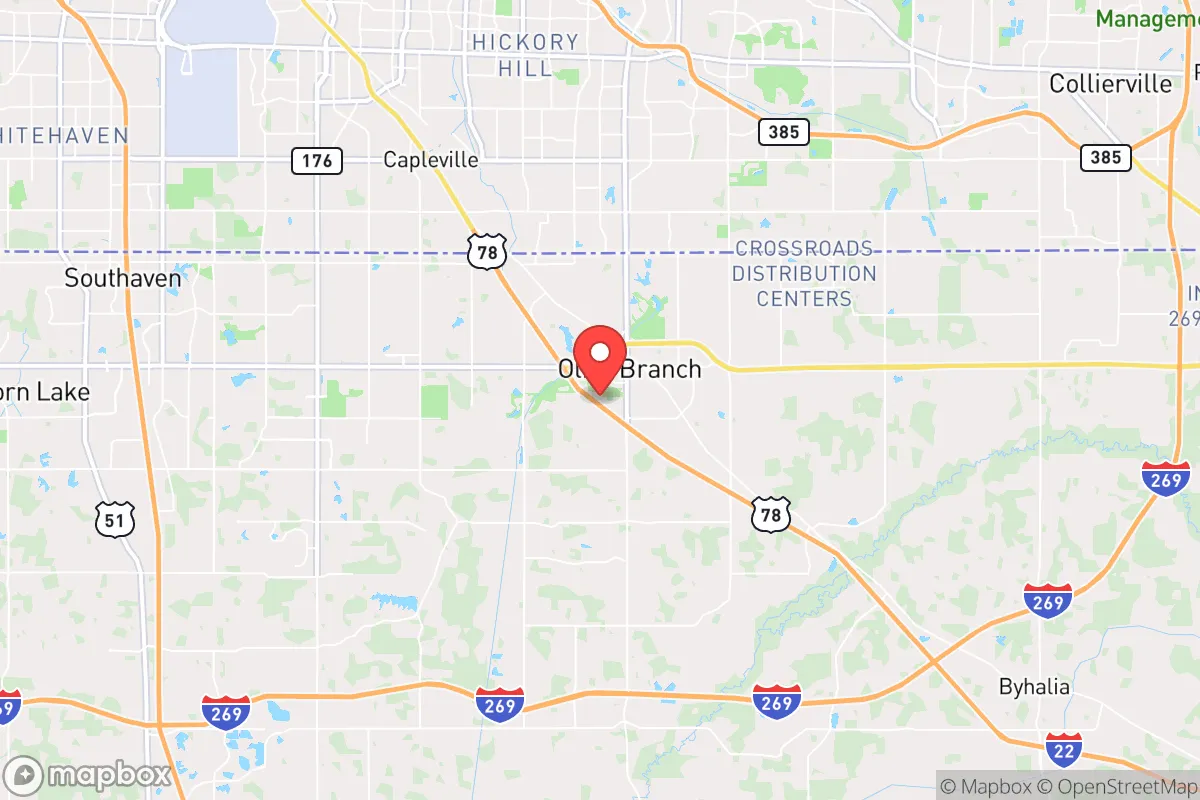
Photo: Wikipedia
Personal Sovereignty in Olive Branch, MS
Viable for self-reliance. Generally workable, though some barriers may limit total independence.
What does Personal Sovereignty tell us?
Personal Sovereignty measures your capacity for self-reliance and independence with minimal government friction. Higher scores mean fewer barriers between you and the way you want to live... but it assumes you have the space you need and good neighbors.
What does this tell us?
Personal Sovereignty measures your capacity for self-reliance and independence with minimal government friction. Higher scores mean fewer barriers between you and the way you want to live... but it assumes you have the space you need and good neighbors.
State Policy
Energy independence: Importer (50% of energy produced in-state)
Personal Liberty
Homesteading

Personal Liberty Analysis
Olive Branch, Mississippi, offers a notably high degree of personal sovereignty compared to many suburban enclaves, largely because it sits within a state that has consistently pushed back against federal overreach and maintains a light regulatory touch. For the individualist or prepper-minded relocator, the environment here is one where the default assumption is that you are free to act unless a specific law says otherwise, rather than the reverse. This isn't a libertarian utopia—there are still zoning codes and building permits—but the cultural and legal DNA of the area leans heavily toward self-reliance and minimal government intrusion into daily life. The key question is whether this autonomy holds up under the pressures of suburban growth and proximity to Memphis, and the answer is a cautious yes, with specific caveats around land use and taxation.
Tax burden and regulatory posture: How Mississippi's low-tax framework protects your earnings
Mississippi's tax structure is a major pillar of personal sovereignty here, as it directly limits the state's ability to extract wealth from your labor. There is no state income tax on wages—a flat 4% rate on certain business income exists, but for most individuals, the state leaves your paycheck alone. Property taxes in DeSoto County are among the lowest in the nation, with an effective rate typically around 0.6% to 0.8% of assessed value. For a $300,000 home, that means roughly $1,800 to $2,400 annually, compared to $6,000+ in nearby Shelby County, Tennessee. Sales tax is 7% (state plus county), which is moderate, but the absence of an income tax means you keep more of what you earn to invest in your own preparedness, land, or supplies. Regulatory posture is similarly restrained: there are no state-level gun registration schemes, no mandatory vehicle emissions testing, and business licensing requirements are minimal for most trades. The state government's philosophy is essentially "don't get in the way," which translates to fewer permits, fewer fees, and less bureaucratic friction when you want to build a shed, start a side business, or modify your property. For someone concerned about government overreach, this low-tax, low-regulation baseline is a significant advantage over states like California, New York, or even Illinois.
Self-defense and gun law specifics: Stand your ground, permitless carry, and castle doctrine
Mississippi is a powerhouse for Second Amendment advocates, and Olive Branch residents enjoy the full suite of self-defense rights without local dilution. The state has permitless (constitutional) carry for anyone 21 or older who can legally possess a firearm—no license, no training requirement, no waiting period. This applies to both open and concealed carry. The Stand Your Ground statute (Miss. Code Ann. § 97-3-15) removes any duty to retreat before using deadly force if you are lawfully present and reasonably believe force is necessary to prevent death, great bodily harm, or a forcible felony. The Castle Doctrine is equally strong: your home, vehicle, and place of business are considered extensions of your person, and there is a legal presumption that anyone unlawfully entering these spaces intends to cause harm. There are no "may issue" hurdles, no magazine capacity restrictions, and no state-level registry of firearms or owners. The only notable restriction is that carrying a firearm into a posted "gun-free zone" (like a school or courthouse) can still get you charged, but the list of prohibited places is short and reasonable. For the survivalist, this means your defensive capabilities are limited only by your own training and resources, not by local politicians. The legal climate strongly favors the defender, which is a critical factor when considering personal sovereignty in an uncertain world.
Self-reliance and homesteading viability: Lot sizes, zoning, and off-grid feasibility in a growing suburb
This is where Olive Branch shows its suburban tension. The city itself is growing rapidly, and newer subdivisions often have HOAs with restrictive covenants that ban chickens, limit outbuildings, and require manicured lawns. However, the unincorporated areas of DeSoto County—just a few miles outside Olive Branch city limits—offer a different story. Lot sizes in the county can range from 1 to 20+ acres, and zoning is far more permissive. You can keep livestock (chickens, goats, even a cow on larger parcels), build a detached workshop or barn without endless red tape, and install rainwater collection systems for irrigation. Off-grid feasibility is mixed: Mississippi has no state law prohibiting solar panels, and net metering is available, but the local utility (Entergy or DeSoto County Electric) will require an interconnection agreement. Completely disconnecting from the grid is technically legal if you meet basic safety codes, but the county may require a septic system permit and well water testing. There are no state-level bans on composting toilets or greywater systems, but local health department rules apply. The real constraint is HOA covenants in newer developments—if you buy in a subdivision with an active HOA, your homesteading dreams will be limited. The strategic move for a prepper is to buy land in the county, not inside city limits, where you can build a self-sufficient property with minimal interference. Water access is good (the Memphis Sand aquifer provides abundant, clean groundwater), and the growing season is long enough for serious food production.
Personal liberties: Parental rights, medical autonomy, speech, and property protections
Mississippi has some of the strongest parental rights laws in the country, which is a major draw for those concerned about government overreach in education and family matters. The state has a Parental Bill of Rights (Miss. Code Ann. § 37-13-173) that explicitly affirms parents' authority to direct their children's upbringing, education, and healthcare. This means no mandatory "critical race theory" or gender ideology curricula without parental opt-out, and schools are required to notify parents of any medical or mental health services offered to minors. Medical autonomy is more complex: Mississippi has strict laws against vaccine mandates (no state-level COVID-19 or childhood vaccine mandates for adults), but employers can still require them in some cases. The state does not have a "right to try" law for experimental treatments, but it does allow for alternative medical practitioners (naturopaths, etc.) under limited scope. Free speech protections are robust—there is no state-level hate speech law that criminalizes political or religious expression, and the state has a strong record of defending First Amendment rights in court. Property rights are protected by a strict eminent domain standard (post-Kelo, Mississippi law limits takings to public use, not private economic development). For the individualist, this means your land is unlikely to be seized for a shopping mall. The overall legal environment is one where the state government generally stays out of your personal decisions, from how you raise your kids to what you say in public.
Compared to the rest of the country, Olive Branch and DeSoto County offer a sovereignty profile that is well above average for a suburban area. You won't find the extreme libertarian autonomy of rural Alaska or New Hampshire's "Live Free or Die" ethos, but you also won't find the bureaucratic chokehold of the Northeast or West Coast. The trade-off is proximity to Memphis's crime and urban decay—which actually reinforces the need for self-reliance—while enjoying Mississippi's legal framework that respects your right to prepare, defend, and live as you see fit. For the strategic relocator who values personal sovereignty above all else, this is a solid, defensible choice in a region that still remembers what freedom looks like.

* Values derived from national, state, county, city and local statistics and may differ in a specific area. Last updated: 2026-04-29T22:11:55.000Z
Narrative content on this page is AI-generated and may contain mistakes. Verify any details that matter before acting on them.
ReloMaps may earn a commission from affiliate links at no extra cost to you.

