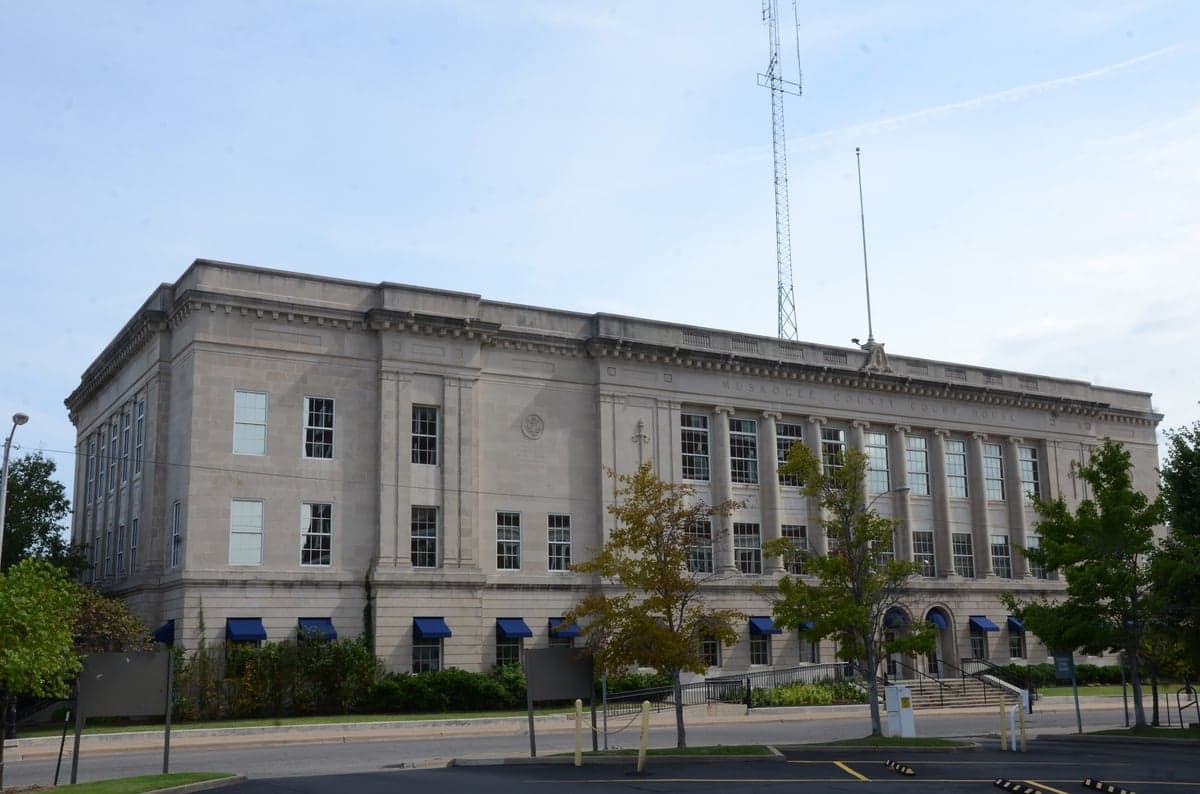
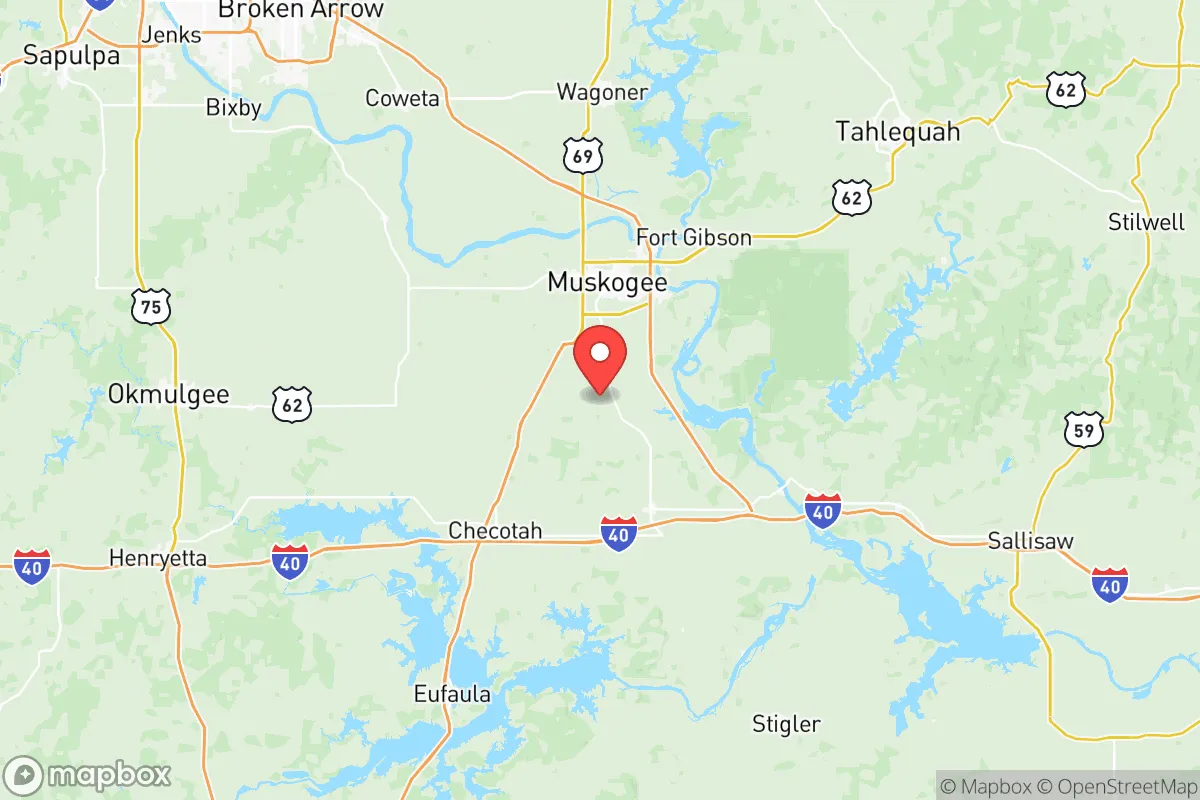
Photo: Wikipedia
Political ClimatePolitical Climate in Muskogee County
Showing district-level results — no local-only data available.
Local Political AnalysisPolitical Analysis of Muskogee County
Muskogee County is one of the most reliably Republican counties in eastern Oklahoma, with a Cook Partisan Voting Index of R+28 — a full ten points more conservative than the state of Oklahoma as a whole, which sits at R+18. That gap has widened in recent cycles, driven largely by the rural precincts outside the city of Muskogee turning out at higher rates for GOP candidates while the county seat itself has become a rare blue-leaning island in a deep red sea. If you’re looking at the raw numbers, the county hasn’t voted for a Democratic presidential candidate since 1996, and even then it was a squeaker. The real story, though, is the internal split between the urban core and the surrounding small towns.
How it compares
Oklahoma’s R+18 PVI already marks it as one of the most conservative states in the nation, but Muskogee County’s R+28 puts it in a league with places like Texas’s Panhandle or rural Kansas. The difference is stark when you drive from the city of Muskogee — where precincts around the downtown area and near Bacone College have occasionally gone Democratic in local races — to towns like Warner or Fort Gibson, where Republican candidates routinely pull 75-80% of the vote. In the 2024 presidential election, for example, the precinct covering the southwest corner of Muskogee city limits (around the old Whitten Park neighborhood) went for the Democratic candidate by a narrow margin, while the precinct covering the rural area around Braggs voted over 85% Republican. The swing precincts — the ones that decide county commission races — are generally the suburban fringe around Haskell and the newer developments near the Muskogee Turnpike, where voters tend to be fiscally conservative but socially moderate. Compared to the state average, Muskogee County is less influenced by the oil-and-gas libertarian streak that dominates western Oklahoma; here, the politics are more rooted in evangelical Christianity and a strong sense of local tradition.
What this means for residents
For conservative residents, the R+28 lean means their values are the default in nearly every local election, from county commissioner to school board. The Republican primary in June is effectively the general election for most county offices, and candidates who win it tend to govern with a focus on low taxes, Second Amendment rights, and limited regulation. For liberal residents, the political reality is more isolating. While the city of Muskogee itself has a small but active Democratic party organization — and the precincts around the Manual Training High School area and the York Street corridor reliably vote blue — they have little influence on county-level policy. That said, the county’s deep conservatism hasn’t translated into the kind of culture-war battles seen in some other Oklahoma counties; the local government tends to focus on practical issues like road maintenance, economic development, and the opioid crisis, which affects both red and blue precincts equally. The biggest practical impact for everyone is that property taxes remain among the lowest in the state, and there’s little appetite for new county-level taxes or bond issues.
Culturally, Muskogee County’s politics are shaped by its unique history as a former Confederate stronghold and a major center of the Five Tribes. The county has a higher Native American population than most of Oklahoma — around 20% — and tribal politics often crosscut partisan lines. The Cherokee Nation and Muscogee (Creek) Nation both have significant influence here, and their support for issues like tribal sovereignty and gaming can create strange-bedfellow alliances with conservative county officials who oppose federal overreach. The annual Azalea Festival and the Oklahoma Music Hall of Fame are points of civic pride that transcend partisan divides, but the county’s politics remain firmly anchored in the rural, evangelical conservatism that defines most of eastern Oklahoma. If you’re moving here, expect a place where the political conversation is polite but deeply entrenched, and where the biggest local debates are less about national culture wars and more about how to keep the hospital open and the roads paved.

State Political ClimatePolitical Climate in Oklahoma
State Political AnalysisPolitical Environment in the State
Oklahoma is one of the most reliably Republican states in the country, with a Cook Partisan Voting Index of R+18, meaning it votes about 18 points more Republican than the national average. Over the last 20 years, the state has shifted sharply rightward — in 2004, George W. Bush won it by 31 points; by 2024, Donald Trump carried it by 34 points. The dominant coalition is a mix of rural conservatives, evangelical Christians, and oil-and-gas interests, with Democrats largely confined to a few urban and tribal areas. For a relocator, this means you’re moving into a state where conservative values shape nearly every level of government, but the intensity of that conservatism varies a lot depending on where you land.
Urban vs. rural divide
The political map of Oklahoma is a textbook study in the urban-rural split. Oklahoma City and its suburbs — places like Edmond, Yukon, and Moore — lean Republican but are more moderate than the rest of the state. Oklahoma County itself has trended purple in recent cycles; in 2020, Biden lost it by just 3 points, a sign of growing Democratic strength in the metro core. Tulsa is similar: the city proper is competitive (Biden lost Tulsa County by 9 points in 2020), while the surrounding suburbs like Broken Arrow and Jenks are deeply red. The real Republican strongholds are the rural plains and small towns — Woodward, Guymon, McAlester — where GOP margins routinely exceed 70-80%. The only reliably blue areas are the state’s two urban cores and parts of tribal nations like the Cherokee Nation and Choctaw Nation, where Democratic registration remains strong. If you’re a conservative, you’ll feel at home almost anywhere outside downtown OKC or Tulsa; if you’re a liberal, you’ll want to stick to the Plaza District in OKC or Cherry Street in Tulsa to find like-minded neighbors.
Policy environment
Oklahoma’s policy environment is aggressively conservative. The state has a flat income tax of 4.75% (down from 5% in 2022), with a goal of reaching 3.99% by 2027. There’s no estate tax, and property taxes are among the lowest in the nation — about 0.9% of assessed value on average. The regulatory posture is business-friendly, especially for energy and agriculture; the state is a national leader in oil and gas production, and permitting for drilling is streamlined. On education, Oklahoma has one of the most expansive school choice programs in the country: the Oklahoma Parental Choice Tax Credit (2023) provides up to $7,500 per child for private school tuition, and charter schools are widespread. Healthcare is a mixed bag: the state did expand Medicaid under the 2020 ballot measure State Question 802, but it has one of the highest uninsured rates in the nation (about 13%). Election laws are restrictive: voter ID is required, early voting is limited to three days, and absentee ballots require a notary or copy of ID. For a conservative relocator, the low taxes and school choice are major draws; for a liberal, the limited healthcare access and voting restrictions are real downsides.
Recent policy direction
The last five years have seen Oklahoma push hard on cultural and liberty issues. On guns, the state enacted permitless carry in 2019 (HB 2597), allowing any adult 21 or older to carry a firearm without a license. On education and parental rights, the Save Women’s Sports Act (2022) bans transgender athletes from female sports, and the Parental Bill of Rights (2022) requires schools to notify parents about curriculum changes. Speech and privacy: the state passed a law in 2023 requiring age verification for adult websites and banning “obscene” content in school libraries. Medical and bodily autonomy: Oklahoma has one of the strictest abortion bans in the nation — SB 612 (2022) bans abortion from fertilization, with no exceptions for rape or incest, only to save the mother’s life. Property rights: the Oklahoma Landowner Protection Act (2023) limits eminent domain for carbon capture pipelines, a nod to rural concerns about private property. On voting, the state passed SB 440 (2021) which tightened absentee ballot rules and banned private funding of election administration. For a relocator, the direction is clear: Oklahoma is doubling down on individual liberty in the traditional sense — gun rights, school choice, property rights — while restricting it on reproductive and LGBTQ issues. If you align with that trade-off, you’ll feel freer here; if not, you’ll find the environment increasingly restrictive.
Civil unrest & political movements
Oklahoma has seen its share of political flashpoints, but they tend to be localized rather than statewide. The most visible recent movement was the 2022 teacher walkout — a nine-day strike that shut down schools across the state, including in Norman and Stillwater, demanding higher pay and more education funding. It was one of the largest labor actions in the state’s history, and it succeeded in securing a $6,000 raise for teachers. On the right, the Oklahoma Second Amendment Association is active, organizing rallies at the state capitol and pushing for permitless carry. Immigration politics are less heated than in border states, but Guymon in the Panhandle has seen tensions over its growing Hispanic population, which now makes up over 60% of the town. There’s no sanctuary city policy anywhere in the state; in fact, SB 1001 (2023) requires local law enforcement to cooperate with federal immigration authorities. Election integrity controversies flared after 2020, with the state GOP launching a “forensic audit” of Tulsa County’s results — it found no evidence of fraud, but the effort fueled ongoing distrust among some conservatives. For a new resident, you won’t see daily protests, but you’ll hear the political divide in conversations at coffee shops in Edmond versus Norman.
Projection
Over the next 5-10 years, Oklahoma is likely to stay deeply red, but the margins may narrow slightly as Oklahoma City and Tulsa continue to grow and diversify. In-migration is modest — the state gained about 50,000 people between 2020 and 2024 — and it’s mostly from other red states like Texas and Kansas, so the political balance isn’t shifting dramatically. The biggest wildcard is the Cherokee Nation and other tribal governments, which are asserting more sovereignty and could become a counterweight to state policy, especially on issues like gaming and healthcare. The state’s tax-cutting trajectory will likely continue, with the flat income tax dropping toward 3.99% by 2027. On social issues, expect more legislation on school choice expansion, further restrictions on abortion access, and continued battles over library content and transgender rights. For a relocator, the Oklahoma of 2035 will look much like today — conservative, low-tax, and culturally traditional — but with a slightly more urbanized, slightly more diverse population in the two big metros.
Bottom line for a new resident: If you’re a conservative family looking for low taxes, school choice, and a culture that aligns with traditional values, Oklahoma is a strong bet. If you’re a liberal, you can find a comfortable niche in Norman or Midtown Tulsa, but you’ll be swimming against the current at the state level. The practical takeaway: your daily life will be shaped more by your specific city than by the state’s overall lean — Edmond feels very different from Lawton — so choose your neighborhood carefully.
* Values derived from national, state, county, city and local statistics and may differ in a specific area. Last updated: 2026-08-04T04:41:29.000Z
Narrative content on this page is AI-generated and may contain mistakes. Verify any details that matter before acting on them.
ReloMaps may earn a commission from affiliate links at no extra cost to you.

