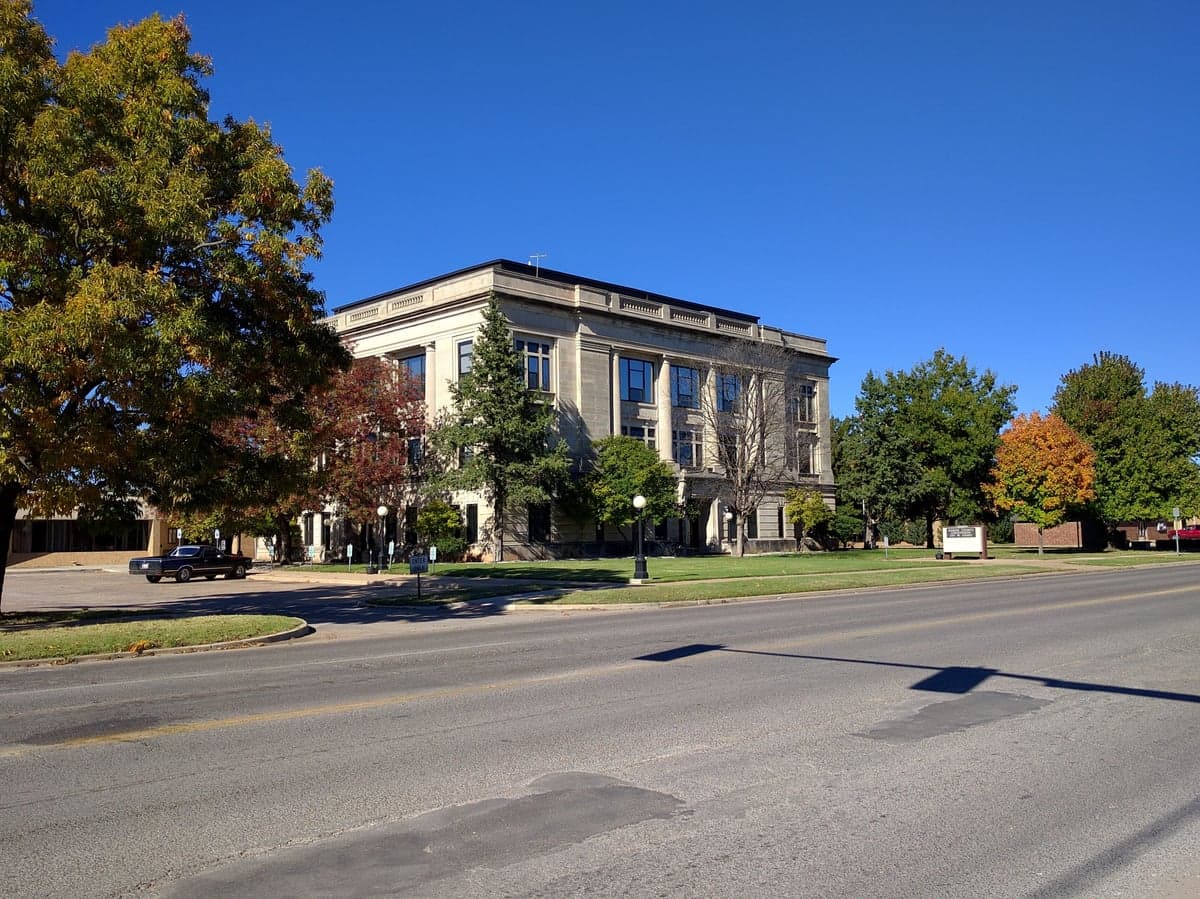
Photo: Wikipedia
Political ClimatePolitical Climate in Garvin County
Showing district-level results — no local-only data available.
Local Political AnalysisPolitical Analysis of Garvin County
Garvin County is about as red as they come, with a Cook PVI of R+17, and it’s been drifting further right for the better part of two decades. That puts it just a hair behind the state of Oklahoma’s overall R+18, but the real story is in the margins — the county has been moving toward the GOP at a faster clip than the state average since 2016, especially in the rural precincts outside the county seat. If you’re looking at a map of south-central Oklahoma, this is a solid block of Republican territory, but it’s not a monolith, and the local voting patterns tell a more nuanced story than the PVI number suggests.
How it compares
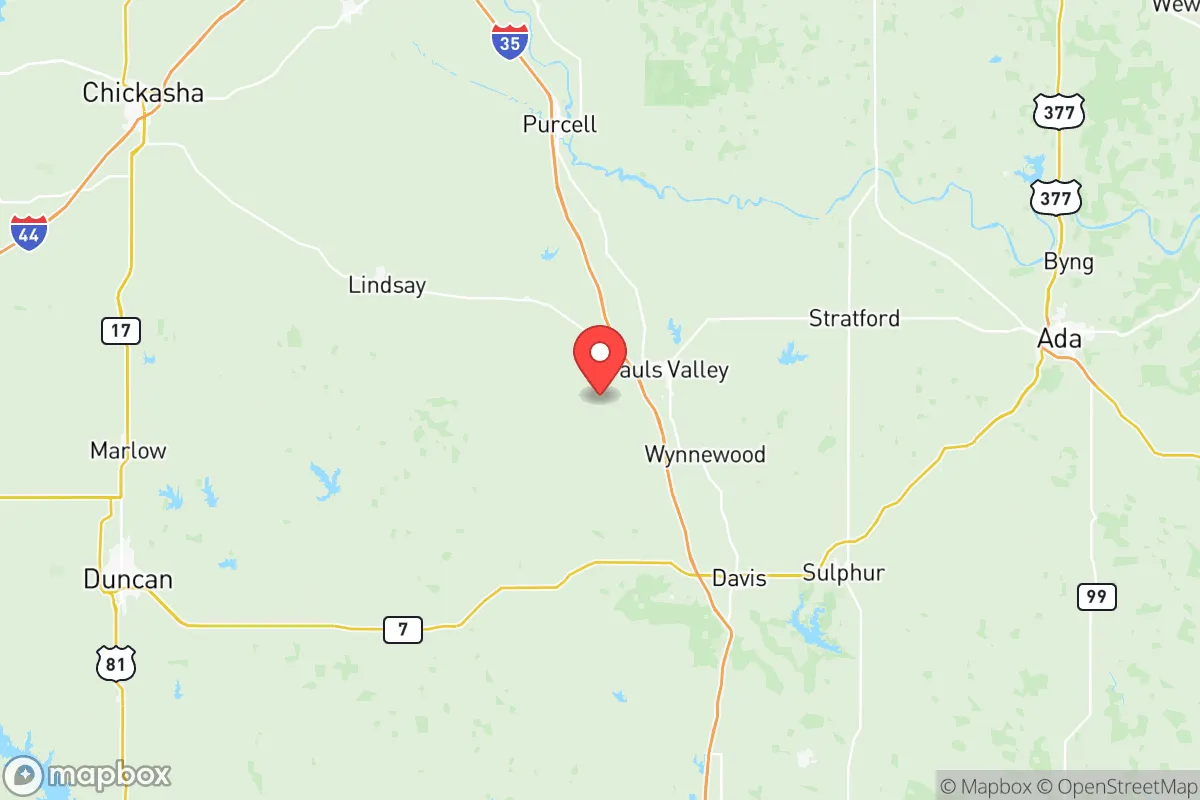
On paper, Garvin County (R+17) and Oklahoma as a whole (R+18) are nearly identical, but the internal dynamics differ. The state’s R+18 is buoyed by massive margins in the Oklahoma City and Tulsa suburbs, while Garvin County’s lean is driven by rural, agricultural communities like Pauls Valley, Lindsay, and Wynnewood. The county’s biggest town, Pauls Valley, is actually the swing precinct — it voted for Trump by a 12-point margin in 2020, down from a 20-point Trump win in 2016, and it’s the only place in the county where a Democrat can realistically crack 40% of the vote. The smaller towns are far more conservative: Lindsay and Maysville routinely deliver 75-80% Republican margins, and the unincorporated areas around Elmore City and Katie are the deepest red, often hitting 85% or higher. The county’s trajectory mirrors the state’s — both have shifted roughly 8 points to the right since 2008 — but Garvin County’s shift has been steadier, without the suburban volatility you see around OKC.
What this means for residents
For conservative residents, the R+17 lean means their values are the default in local government — county commissioners, the sheriff’s office, and the school boards in Pauls Valley and Lindsay are all reliably Republican, and there’s little pressure to moderate on issues like gun rights, oil and gas development, or school choice. The county’s three state House districts and one Senate seat have been held by Republicans since 2010, and no Democrat has filed to run in most local races in recent cycles. For liberal residents, the reality is that they’re a distinct minority — a blue voter in Garvin County is likely to be the only one in their precinct, and they’ll find little in the way of organized progressive infrastructure outside of the occasional county Democratic Party meeting in Pauls Valley. That said, the county isn’t hostile to moderates in practice: the local economy depends on agriculture and the Chickasaw Nation’s presence, which keeps the political conversation focused on practical issues like water rights and road funding rather than culture-war flashpoints.
What this means for residents
The cultural and policy distinctions in Garvin County are rooted in its rural identity and its relationship with the Chickasaw Nation, which operates the large medical center in Pauls Valley and is one of the county’s largest employers. That gives the area a pragmatic streak — tribal sovereignty and healthcare access are bipartisan concerns here, even as national politics grow more polarized. The county also has a strong oil and gas presence, particularly around Elmore City, which keeps energy policy front-and-center. Looking ahead, the trajectory is clear: Garvin County will stay R+17 or move slightly redder, driven by out-migration of younger voters to OKC and the continued consolidation of rural conservative voting. But the swing precincts in Pauls Valley mean the county isn’t a lost cause for Democrats — a well-funded moderate candidate could realistically keep a local race competitive, even if the county’s presidential vote remains deeply Republican.

State Political ClimatePolitical Climate in Oklahoma
State Political AnalysisPolitical Environment in the State
Oklahoma is one of the most reliably Republican states in the country, holding a Cook PVI of R+18, meaning it votes about 18 points more Republican than the nation as a whole. The state hasn't voted for a Democratic presidential candidate since Lyndon Johnson in 1964, and the GOP now holds every statewide office, a supermajority in both legislative chambers, and all five congressional seats. Over the last 20 years, the shift has been less about Democrats becoming Republicans and more about rural voters consolidating behind the GOP while the state's few urban centers have become increasingly isolated Democratic islands.
Urban vs. rural divide
The political map of Oklahoma is a stark study in geographic polarization. The two major population centers — Oklahoma City and Tulsa — are the only places where Democrats remain competitive, and even there, the margins are tightening. Oklahoma City's core, particularly around the Paseo and Plaza districts, votes solidly blue, but the sprawling suburbs like Edmond, Moore, and Yukon are deeply red. Tulsa tells a similar story: the city's midtown and downtown precincts lean Democratic, but the surrounding suburbs of Broken Arrow, Jenks, and Bixby are among the most conservative communities in the state.
Outside the two metros, the political landscape is overwhelmingly Republican. The old Democratic strongholds in eastern Oklahoma — places like McAlester, Muskogee, and the coal country around Poteau — have flipped hard to the GOP over the past two decades, driven by cultural conservatism and a feeling of abandonment by the national Democratic Party. The Panhandle towns of Guymon and Boise City are as red as anywhere in America, while Norman, home to the University of Oklahoma, is the state's most reliably liberal city, consistently electing Democrats to the state legislature and providing the only real blue pocket in the central part of the state.
Policy environment
Oklahoma's policy environment is shaped by a deep commitment to low taxation and limited government. The state has a flat income tax rate of 4.75%, which lawmakers have been steadily cutting for years, and there is a serious push to eliminate the income tax entirely. The sales tax is comparatively high — the state rate is 4.5%, but local municipalities often push the combined rate above 9% — which makes the tax structure regressive but popular with the state's conservative base. Property taxes are among the lowest in the nation, a major draw for families looking to buy homes.
The regulatory posture is decidedly business-friendly, with Oklahoma ranking consistently in the top 10 of the ALEC-Laffer State Economic Competitiveness Index. There is no state-level occupational licensing for many trades, and the "right to work" law, passed in 2001, has kept unionization rates among the lowest in the country. Education policy has become a flashpoint: the state has embraced school choice aggressively, with the 2023 Oklahoma Parental Choice Tax Credit Act providing up to $7,500 per student for private school tuition, one of the most generous programs in the nation. Healthcare is a mixed bag — the state did expand Medicaid under the 2020 State Question 802, but it has some of the most restrictive abortion laws in the country, banning the procedure at fertilization with no exceptions for rape or incest.
Recent policy direction
The last several legislative sessions have pushed Oklahoma firmly into the national vanguard of conservative policymaking. On gun rights, the state adopted constitutional carry in 2019, allowing any adult who can legally possess a firearm to carry it openly or concealed without a permit. The Second Amendment Sanctuary Act, passed in 2021, prohibits state agencies from enforcing any future federal firearms restrictions that the legislature deems unconstitutional. On education, beyond the school choice tax credit, the state has passed the "Save Women's Sports Act" and the "Students' Right to Know Act," which requires schools to inform parents about curriculum materials and library books.
On social issues, Oklahoma has been a leader in the movement to restrict gender-affirming care for minors, passing a 2023 law that bans such procedures entirely. The state has also enacted a near-total abortion ban, with no exceptions for rape or incest, making it one of the most restrictive in the nation. On election integrity, Oklahoma has some of the most secure voting systems in the country — it uses paper ballots exclusively — and has passed voter ID laws and restrictions on mail-in voting. The state has also moved to protect property rights, passing a 2022 law that requires local governments to compensate landowners for any loss in value caused by zoning changes.
Civil unrest & political movements
Oklahoma has not seen the kind of large-scale civil unrest that has marked other states, but there have been notable flashpoints. The 2020 George Floyd protests in Oklahoma City and Tulsa were relatively small and peaceful compared to other cities, but they did spark a renewed focus on the 1921 Tulsa Race Massacre, which has become a major cultural and political touchpoint. The state has seen a growing movement around the "Ten Commandments" controversy — the state supreme court ordered the removal of a monument from the capitol grounds in 2015, but lawmakers have repeatedly tried to bring it back.
Immigration politics are a live issue, particularly in the Panhandle and southwestern Oklahoma, where meatpacking plants in Guymon and Altus employ large numbers of immigrant workers. The state has passed laws requiring local law enforcement to cooperate with federal immigration authorities, and there is ongoing litigation over a 2024 law that would create a state-level crime for being in the country illegally. The "Oklahoma Standard" of neighborliness still holds in most communities, but the political rhetoric around immigration has sharpened considerably in recent years.
Projection
Over the next 5-10 years, Oklahoma's political trajectory points further right, but with some interesting wrinkles. The state is experiencing modest in-migration, particularly to the Oklahoma City metro, which is drawing people from Texas and California for the low cost of living and business climate. These newcomers tend to be conservative-leaning, reinforcing the existing political structure. The Democratic Party's base is shrinking to a handful of urban precincts in Oklahoma City, Tulsa, and Norman, and there is no realistic path to statewide competitiveness in the near term.
However, the state's demographics are slowly shifting — the Hispanic population is growing, particularly in the Panhandle and southwest, and younger voters in the metros are more moderate than their rural counterparts. The school choice movement is likely to continue expanding, and the income tax elimination push will probably succeed within the decade. The most significant wildcard is the ongoing federal-state conflict over abortion and immigration, which could force Oklahoma to spend significant resources defending its laws in court.
For a new resident, the bottom line is straightforward: Oklahoma is a state where conservative values are not just the majority but the default assumption of public life. If you lean right, you will find a welcoming environment with low taxes, strong gun rights, and a government that shares your priorities. If you lean left, you will be in a distinct minority, but you will find like-minded communities in the urban cores of Oklahoma City, Tulsa, and Norman, and the state's low cost of living and friendly people make it a comfortable place to live even if you lose every election. The political climate is stable, predictable, and unlikely to change dramatically in the coming decade — for better or worse, Oklahoma knows what it is.
* Values derived from national, state, county, city and local statistics and may differ in a specific area. Last updated: 2026-10-31T04:35:22.000Z
Narrative content on this page is AI-generated and may contain mistakes. Verify any details that matter before acting on them.
ReloMaps may earn a commission from affiliate links at no extra cost to you.

