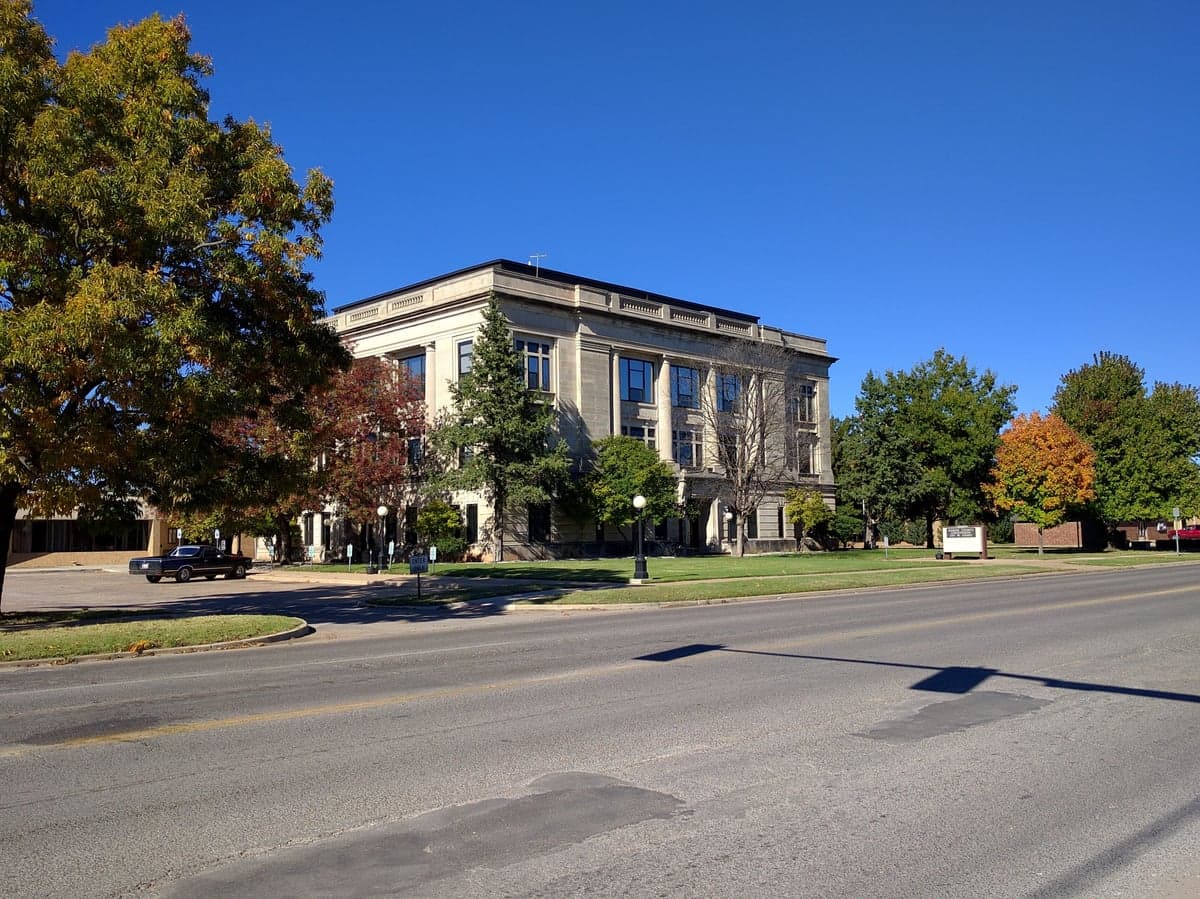
Photo: Wikipedia
Demographics of Garvin County
Affluence Level in Garvin County
A middle-class area roughly in line with national averages across income, home values, education, and employment.
People of Garvin County
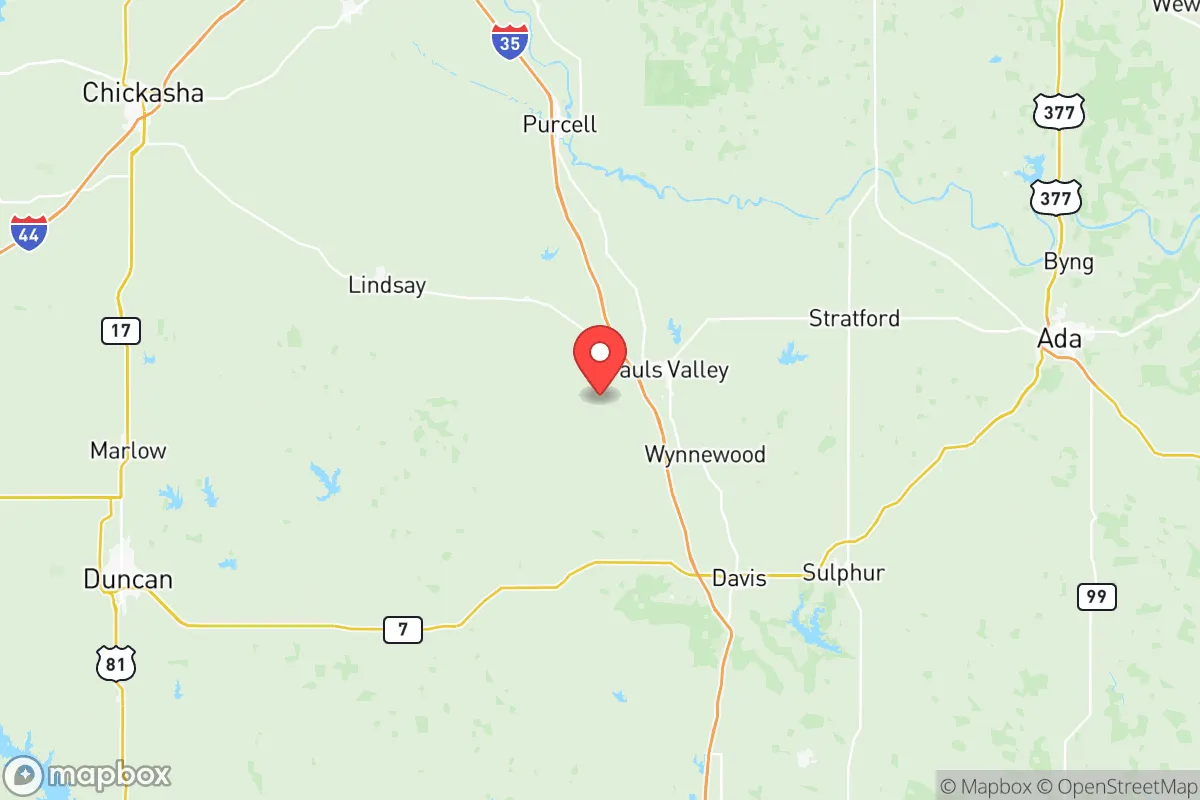
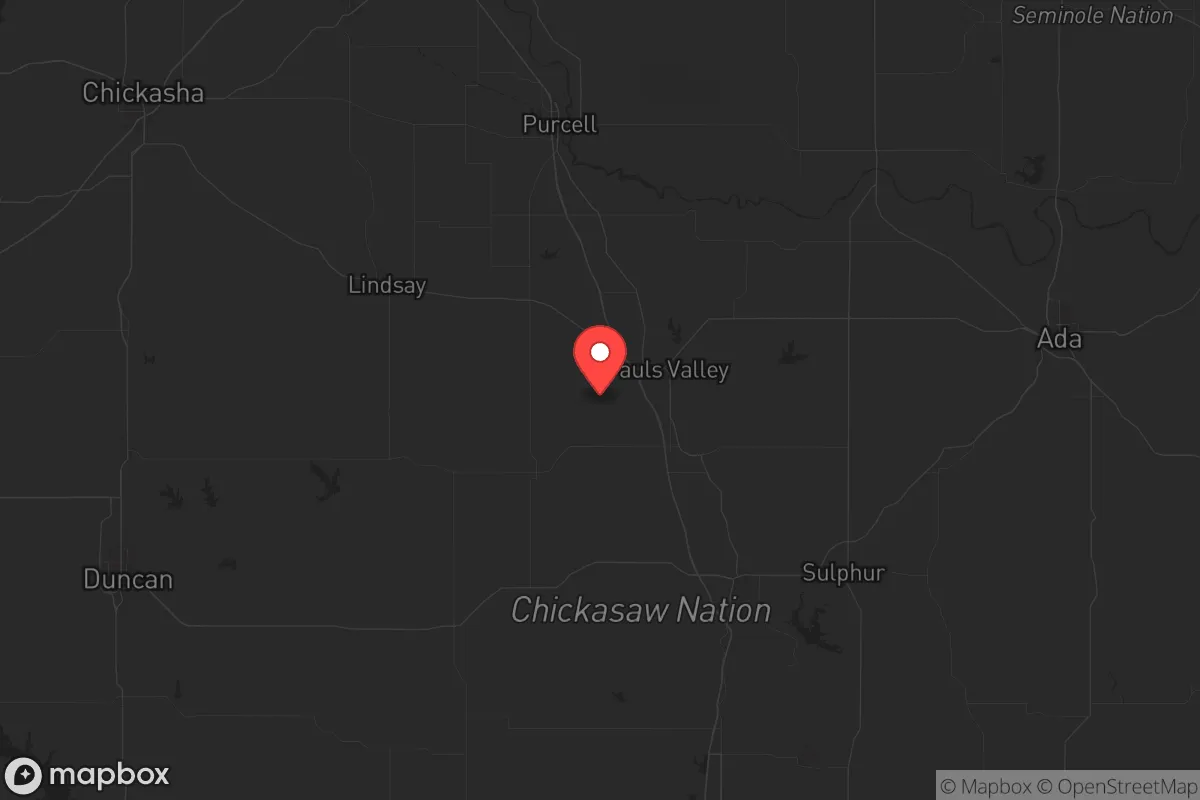
The people of Garvin County, Oklahoma today are a predominantly white, native-born population of roughly 25,779, anchored by the county seat of Pauls Valley and the twin towns of Lindsay and Wynnewood. With a foreign-born share of just 2.5% and a Hispanic population of 10.0%, the county retains a distinctly rural, small-town Oklahoma character that is more ethnically homogeneous than the state average. The county's identity is rooted in its Chickasaw heritage, its early 20th-century oil boom, and a present-day economy built on agriculture, healthcare, and light manufacturing.
Settlement & growth (pre-1960)
Long before Oklahoma was a state, the land that is now Garvin County was the domain of the Plains and Woodland Native nations, including the Wichita and Caddo. In the 1830s, under the federal Indian Removal policy, the Chickasaw Nation was forcibly relocated to this region from their homelands in Mississippi and Alabama. The Chickasaw established their own government and towns, and their presence remains a defining feature of the county's identity; the Chickasaw Nation is still a major landowner and employer in the area today, with tribal headquarters in nearby Ada.
The first significant wave of white settlement came in the 1850s and 1860s, when the Chickasaw Nation, seeking to develop its agricultural economy, signed permits allowing white farmers and ranchers—many of them of Scots-Irish and English descent—to lease land. These early settlers established communities along the Washita River, including the settlement that would become Pauls Valley, named after Smith Paul, a Chickasaw citizen of mixed heritage who operated a trading post there. The arrival of the Atchison, Topeka and Santa Fe Railway in 1887 transformed Pauls Valley from a trading post into a regional shipping hub, drawing merchants, blacksmiths, and laborers.
The county's defining demographic event came in the early 20th century with the oil boom. The discovery of the Pauls Valley oil field in the 1910s and the broader Garvin County oil play brought a wave of domestic migrants—roughnecks, drillers, and speculators—from Texas, Kansas, and other parts of Oklahoma. Towns like Lindsay, Wynnewood, and Stratford boomed almost overnight, with populations swelling as workers arrived to man the derricks. This oil-driven influx was overwhelmingly white and native-born, and it cemented the county's demographic character for the next century. By the 1930s, the boom had subsided, but the oil industry remained a steady employer, and the county's population plateaued at roughly 30,000, a level it would hold for decades.
Following the oil bust, the county's economy diversified modestly. The construction of the Pauls Valley State School (now the Pauls Valley State School for the intellectually disabled) in the 1930s and the establishment of a Veterans Administration hospital in the 1940s brought a small but steady influx of healthcare workers and state employees. The post-World War II era saw a modest suburbanization around Pauls Valley and Lindsay, but the county remained overwhelmingly rural and agricultural, with cotton, wheat, and cattle as the economic mainstays.
Modern era (post-1965)
The 1965 Hart-Cellar Act, which abolished national-origin quotas, had a minimal direct impact on Garvin County. Unlike coastal cities or even larger Oklahoma metros like Oklahoma City and Tulsa, the county did not attract significant new immigrant communities. The foreign-born population today stands at just 2.5%, a figure that has remained essentially flat for decades. The most notable demographic shift since 1965 has been the steady growth of the Hispanic population, which now constitutes 10.0% of the county's residents. This growth is not a product of the Hart-Cellar Act but rather of domestic migration and, to a lesser extent, immigration from Mexico and Central America, drawn by work in the poultry processing plants and agricultural operations in and around Lindsay and Pauls Valley.
The Black population, at 1.6%, is a small but long-established community, with roots tracing back to the post-Civil War era when freedmen and their descendants settled in the region as farmers and laborers. The East/Southeast Asian population (0.4%) and the Indian-subcontinent population (0.1%) are tiny, concentrated almost entirely in professional roles such as physicians at the county's hospitals and engineers at the few manufacturing plants. The county has not experienced the large-scale suburbanization seen in the Sun Belt; instead, its population has slowly dispersed from the historic town centers into unincorporated rural areas, a trend driven by the availability of inexpensive land and the desire for larger lots.
Domestically, the county has seen a modest but steady outflow of young adults, who leave for college or jobs in Oklahoma City, Norman, or Dallas, and a corresponding inflow of retirees and remote workers seeking a lower cost of living. The county's college-educated share of 17.7% is well below the national average, reflecting the blue-collar and agricultural nature of the local economy. The closure of several oilfield service companies in the 2010s and the consolidation of the poultry industry have led to a slight population decline from the county's peak, but the presence of the Chickasaw Nation, which operates a health clinic and several businesses in the area, has provided a stabilizing economic anchor.
The future
Garvin County is likely to remain a predominantly white, native-born community for the foreseeable future. The Hispanic population is projected to continue its slow, steady growth, potentially reaching 12-14% of the county's total by 2040, driven by natural increase and continued employment in agriculture and food processing. This growth will be dispersed across the county rather than concentrated in a single enclave, though Lindsay and the southern parts of Pauls Valley are likely to see the highest concentrations. The East/Southeast Asian and Indian-subcontinent populations are expected to remain negligible, as the county lacks the professional job base or university presence to attract significant numbers of skilled immigrants.
The broader trend is one of slow, gentle decline in total population, with the county projected to lose perhaps 5-8% of its residents over the next two decades as the aging native-born population passes away and out-migration of young adults continues. The county's cultural identity is likely to remain rooted in its Chickasaw heritage, its oil and agricultural history, and its small-town, evangelical Christian character. The most significant demographic wildcard is the potential for remote work to attract new residents from higher-cost coastal areas, but the county's lack of high-speed internet infrastructure in rural areas and its distance from major airports make this an unlikely large-scale phenomenon.
For those moving to Garvin County now, the picture is clear: this is a stable, slow-growing, and culturally conservative community where the population is aging and the economy is modest. New residents will find a place where the cost of living is low, the pace of life is unhurried, and the community is welcoming to those who share its values of self-reliance and neighborliness. The county is not becoming more diverse in any dramatic way, but it is becoming more connected—to the Chickasaw Nation's growing economic footprint, to the regional healthcare network centered on Pauls Valley, and to the broader Oklahoma City metro, which lies just an hour to the north. The future of Garvin County is not one of transformation, but of quiet persistence.

* Values derived from national, state, county, city and local statistics and may differ in a specific area. Last updated: 2026-10-31T04:35:22.000Z
Narrative content on this page is AI-generated and may contain mistakes. Verify any details that matter before acting on them.
ReloMaps may earn a commission from affiliate links at no extra cost to you.

