
Photo: Wikipedia
Demographics of Garfield County
Affluence Level in Garfield County
A middle-class area roughly in line with national averages across income, home values, education, and employment.
People of Garfield County
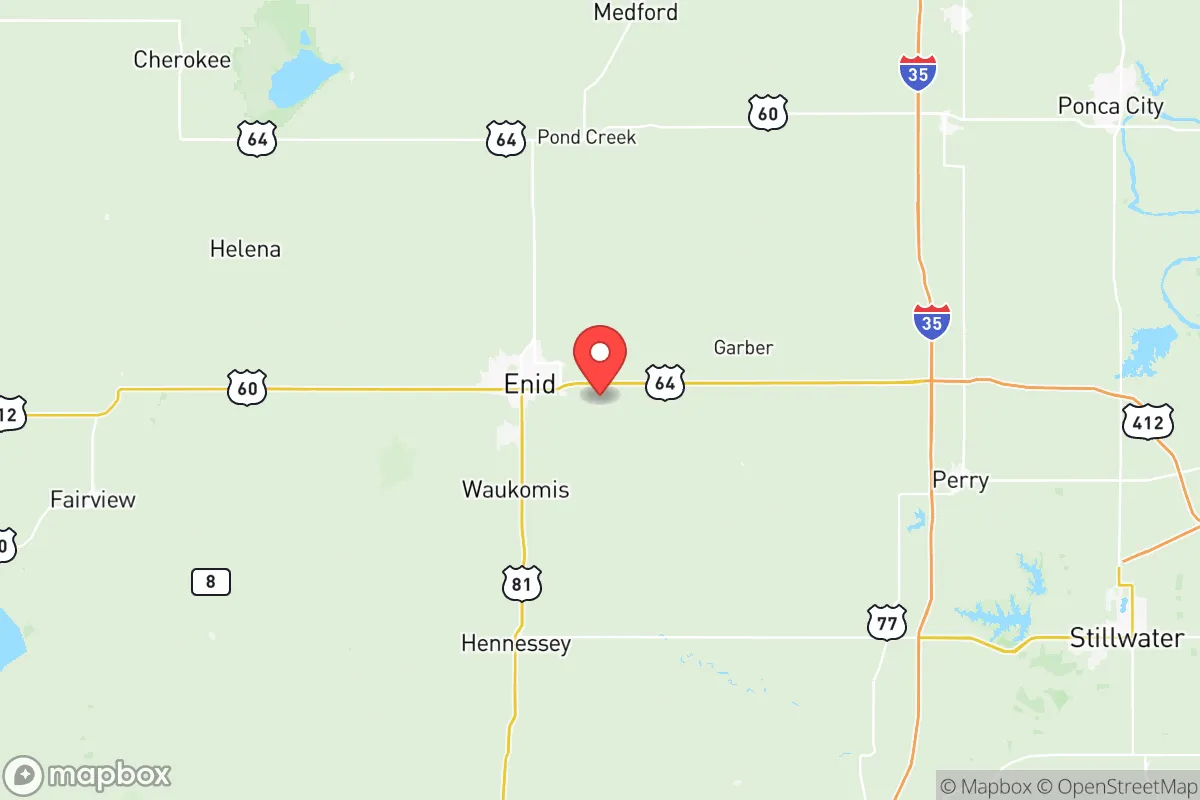
The people of Garfield County, Oklahoma today number 62,322, a population that is 70.8% white, 14.8% Hispanic, and 1.9% Black, with a foreign-born share of just 4.3%. The county’s identity is rooted in its agricultural heritage and small-town character, anchored by the county seat of Enid, which holds roughly 80% of the population. It is a region where a conservative, family-oriented culture predominates, shaped by waves of homesteaders, railroad workers, and oil-field laborers, and where the population has remained relatively stable over the past two decades.
Settlement & growth (pre-1960)
Before American settlement, the area that is now Garfield County was part of the traditional hunting grounds of the Plains Apache, Comanche, and Kiowa nations. The land was not permanently occupied by European-Americans until after the 1866 treaties and the subsequent opening of the Cherokee Outlet in 1893. The Cherokee Outlet, a strip of land leased by the Cherokee Nation to the U.S. government, was opened to non-Native settlers via the famous Land Run of September 16, 1893. This event drew tens of thousands of homesteaders, many of them from Kansas, Nebraska, and the Midwest, who staked claims on 160-acre parcels. The town of Enid was founded that same day as a railroad stop on the Rock Island line, quickly becoming the region’s commercial and administrative hub.
The early settlers were overwhelmingly white, native-born Americans of Northern European descent—primarily English, German, and Scots-Irish stock. They were drawn by the promise of free land and the opportunity to farm wheat and corn. The railroad’s arrival in the 1890s cemented Enid’s role as a grain-shipping center, and by 1900 the county’s population had reached 22,000. Smaller communities like Waukomis, Drummond, and Carrier sprang up along the rail lines, serving as grain elevators and supply points for surrounding farms. The discovery of oil in the nearby Garber and Covington fields in the 1910s and 1920s brought a new wave of workers—roughnecks, drillers, and roustabouts—many of whom settled in Garber and Covington, though the oil boom was modest compared to the giant fields in Tulsa and Oklahoma City.
African American settlement in Garfield County was minimal during this period. A small Black community existed in Enid, centered around the east side, but the county’s Black population never exceeded 2% before 1960. The Dust Bowl of the 1930s hit the county hard, causing a net out-migration of farm families, but the population rebounded after World War II as agricultural mechanization reduced the need for farm labor and the county’s economy diversified into manufacturing and services. By 1960, the population stood at 52,000, with Enid dominating as the retail and medical center for the surrounding rural area.
Modern era (post-1965)
The post-1965 period in Garfield County has been characterized by stability rather than dramatic demographic transformation. The 1965 Hart-Cellar Act, which reshaped immigration nationwide, had a muted effect here. The foreign-born population remains low at 4.3%, and the county has not seen the large-scale immigration from Asia or Latin America that has reshaped many urban and suburban areas. The Hispanic population, however, has grown steadily from a negligible base in 1970 to 14.8% today. This growth is driven primarily by domestic migration from Texas and the southwestern U.S., as well as some direct immigration from Mexico and Central America. Hispanic residents are concentrated in Enid, particularly in the city’s north and west sides, where they work in agriculture, meatpacking (at the nearby Tyson Foods plant in Hennessey, just south of the county line), and construction. The town of Lahoma has also seen a small but noticeable Hispanic presence, tied to farm labor.
The East/Southeast Asian population, at 1.2%, is small and largely concentrated in Enid, where a handful of families operate restaurants and small businesses. The Indian-subcontinent population is negligible at 0.1%. The Black population has remained flat at 1.9%, with most Black residents living in Enid’s older neighborhoods near the downtown core. The white population, while still the majority at 70.8%, has declined slightly in share as the Hispanic population has grown. Domestic migration patterns have been mixed: the county has lost some young adults to larger cities like Oklahoma City and Tulsa, but has attracted retirees and families seeking lower housing costs and a slower pace of life. Suburbanization has been limited; Enid’s newer subdivisions on the south and east sides have drawn some residents from the rural towns, but the county’s overall density remains low.
The future
Garfield County’s population is projected to remain relatively stable over the next 10-20 years, with modest growth driven by natural increase and continued Hispanic in-migration. The county’s college-educated share, at 22.3%, is below the national average, and the economy’s reliance on agriculture and energy means that population growth will likely track commodity prices. The Hispanic population is expected to continue rising, potentially reaching 20-25% by 2040, as younger Hispanic families have higher birth rates and as the county’s agricultural sector continues to attract labor. This will make the county more diverse, but the change will be gradual and concentrated in Enid, while the smaller towns like Bison, Fairmont, and Kremlin are likely to remain overwhelmingly white and aging. The cultural identity of the county is evolving, with Enid’s annual Hispanic Heritage Festival and the growing number of bilingual services reflecting the shift, but the overall character—conservative, churchgoing, and family-focused—is unlikely to change fundamentally.
For someone moving in now, Garfield County offers a stable, affordable, and safe environment with a strong sense of community, but with limited diversity and economic opportunity compared to larger metropolitan areas. The population is becoming slightly more Hispanic and slightly less white, but the change is slow and the county remains one of Oklahoma’s most homogenous rural areas. New residents will find a place where the Land Run legacy of self-reliance and neighborliness still holds, and where the future looks much like the present—steady, quiet, and rooted in the land.

* Values derived from national, state, county, city and local statistics and may differ in a specific area. Last updated: 2026-07-15T04:45:26.000Z
Narrative content on this page is AI-generated and may contain mistakes. Verify any details that matter before acting on them.
ReloMaps may earn a commission from affiliate links at no extra cost to you.

