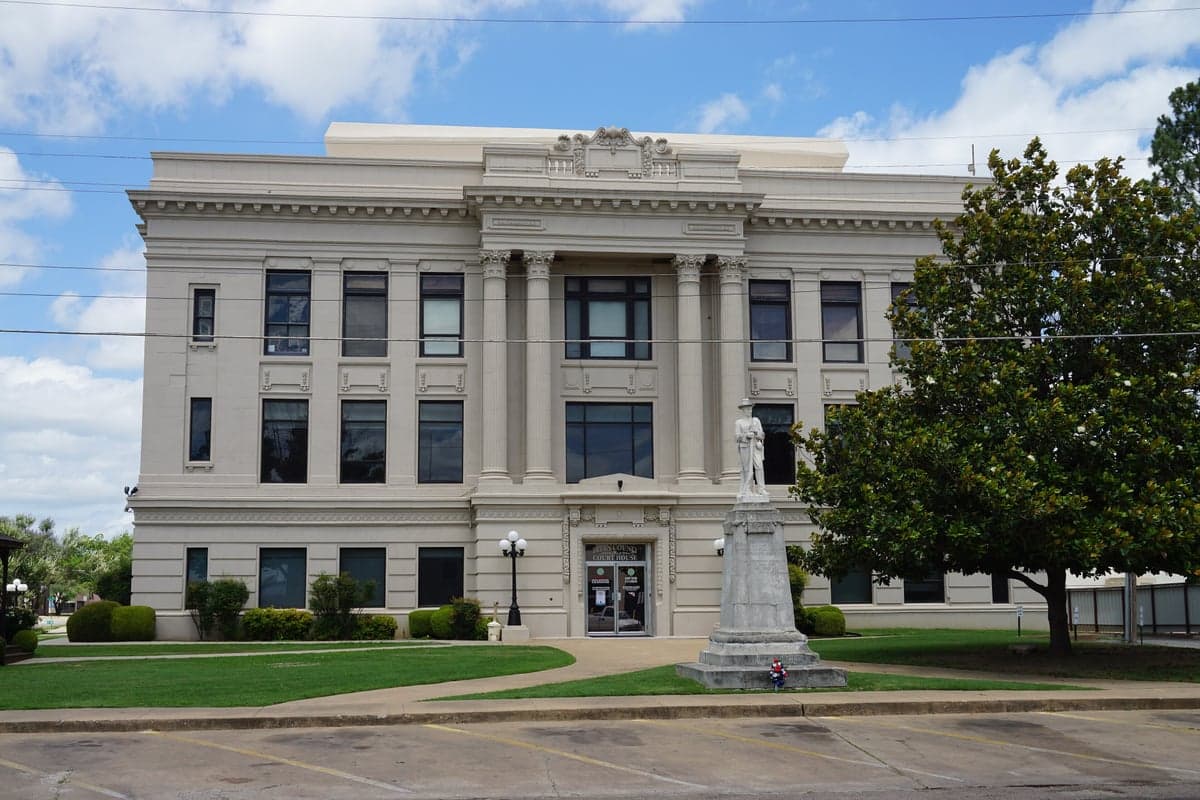
Photo: Wikipedia
Political ClimatePolitical Climate in Bryan County
Showing district-level results — no local-only data available.
Local Political AnalysisPolitical Analysis of Bryan County
Bryan County, Oklahoma, is a reliably Republican stronghold with a Cook Partisan Voting Index (PVI) of R+28, making it significantly more conservative than the state of Oklahoma as a whole, which sits at R+18. This isn't a recent shift; the county has been deeply red for decades, but the margin has actually widened in the last two presidential cycles as rural, culturally conservative areas have pulled further from the national Democratic Party. The county's politics are largely driven by its small-town, agricultural, and energy-sector roots, though there are subtle variations between communities that a close observer would notice.
How it compares
The R+28 PVI means Bryan County votes about 10 points more Republican than the state average. In practical terms, that translates to a county where Democratic candidates rarely break 30% of the vote in presidential races. For context, Oklahoma's R+18 already makes it one of the most Republican states in the country; Bryan County is in the top tier of Oklahoma's most conservative counties. The biggest difference between the county and the state is the absence of any major urban or suburban liberal enclaves. While Oklahoma City and Tulsa have pockets of blue voters, Bryan County's largest towns — Durant (the county seat), Calera, and Colbert — all vote heavily Republican. The only precincts that occasionally trend closer to the county average or show a slight Democratic lean are in parts of Durant near the university (Southeastern Oklahoma State University) and some lower-income neighborhoods, but even those are still solidly red by national standards. The rural precincts around Mead, Bennington, and Bokchito are among the most conservative in the county, often pushing 80%+ Republican.
What this means for residents
For conservative residents, Bryan County offers a deeply affirming political environment. Local elected offices — from county commissioners to school boards — are almost universally held by Republicans, and conservative policy priorities on taxes, gun rights, and social issues are the baseline. There is little political friction in daily life; conservative viewpoints are the default in most social and business settings. For liberal residents, the reality is different. They are a distinct minority, and while there is no active hostility in most public spaces, they often find themselves politically isolated. The university in Durant provides a small, more diverse bubble, but even there, the student body leans right. Political discussions in casual settings — at a diner in Calera or a feed store in Caddo — are unlikely to encounter progressive viewpoints. That said, the county is not politically monolithic in a way that creates personal conflict; most people are neighborly regardless of party, and the area's small-town culture prioritizes personal relationships over political disagreements.
Culturally and policy-wise, Bryan County is distinct from the state's urban centers in a few ways. The county is part of the Texoma region, with a strong economic and social connection to the Dallas-Fort Worth metroplex just an hour south. This influences local politics: there is a pragmatic, business-friendly conservatism that sometimes diverges from the more ideological strain found in rural western Oklahoma. Local government tends to focus on economic development, infrastructure, and keeping taxes low, rather than cultural wedge issues. The county's proximity to Texas also means that regional issues like water rights from Lake Texoma and cross-border commerce often dominate local political discourse more than national culture war topics. For anyone moving here, the political climate is straightforward: it's a deeply conservative area where the Republican primary is the real election, but daily life is defined more by community ties and practical concerns than by partisan division.

State Political ClimatePolitical Climate in Oklahoma
State Political AnalysisPolitical Environment in the State
Oklahoma is one of the most reliably Republican states in the country, with a Cook Partisan Voting Index of R+18, meaning it votes about 18 points more Republican than the national average. The state hasn't voted for a Democratic presidential candidate since 1964, and over the last 20 years, the GOP has tightened its grip from a competitive two-party state in the 1990s to a deep-red stronghold where Democrats hold no statewide elected offices. The shift accelerated after 2008, driven by rural realignment and the collapse of the old "Blue Dog" Democratic tradition in places like southeastern Oklahoma.
Urban vs. rural divide
The political map breaks down along a classic urban-rural axis, but with a twist. Oklahoma City and its suburbs, particularly Edmond and Yukon, are solidly Republican, though the core of OKC proper has trended bluer in recent cycles, with precincts around the Plaza District and Midtown voting Democratic. Tulsa is more evenly split — its downtown and midtown neighborhoods lean left, while the southern suburbs like Broken Arrow and Jenks are deeply conservative. The real GOP firepower comes from the vast rural expanse: the Panhandle, the southwest around Lawton and Altus, and the northeast ranching counties all deliver 75-85% Republican margins. The one notable Democratic holdout is Norman, home to the University of Oklahoma, which consistently votes blue in statewide races and has become a liberal island in a red sea. Stillwater, despite hosting Oklahoma State, leans more conservative than Norman, reflecting the university's different culture. The southeastern corner of the state, around McAlester and Hugo, was historically Democratic but has flipped hard red over the past two decades as cultural issues replaced economic populism as the main voting driver.
Policy environment
Oklahoma's policy environment is aggressively conservative. The state has a flat income tax of 4.75%, with ongoing legislative efforts to phase it out entirely. Sales taxes are high — the state rate is 4.5%, but local add-ons push combined rates above 10% in some cities like Tulsa and Oklahoma City. Property taxes are among the lowest in the nation, capped by a constitutional amendment. The state is a right-to-work state and has some of the weakest labor protections in the country. Education policy has been a flashpoint: Oklahoma has a robust school choice program, including tax credits for private school tuition and a thriving charter school sector, but teacher pay remains below the regional average despite a major walkout in 2018 that forced a raise. Healthcare is a mixed bag — the state rejected Medicaid expansion until 2020, when voters passed it via ballot initiative, but the legislature has since added work requirements and other restrictions. Election laws have tightened: voter ID is required, absentee ballot drop boxes are banned, and the state has purged inactive voters aggressively.
Recent policy direction
The last five years have seen Oklahoma move sharply right on nearly every front. In 2022, the legislature passed a near-total abortion ban with no exceptions for rape or incest, triggering immediately after the Dobbs decision. Gun laws are among the most permissive in the country: permitless carry was enacted in 2019, and the state has a "stand your ground" law and preemption statutes that block local gun ordinances. On education and parental rights, Oklahoma was an early adopter of the "Parents' Bill of Rights" and in 2023 mandated that schools provide parents with access to all instructional materials. The state also passed a law requiring public schools to display the Ten Commandments, though it's been tied up in court. On speech and privacy, the legislature has targeted social media platforms with laws requiring age verification and parental consent for minors, and has banned TikTok on state devices. Medical and bodily autonomy is sharply restricted: gender-affirming care for minors is banned, and the abortion ban has no health exceptions. Property rights are strong — the state has a "right to farm" constitutional amendment protecting agricultural operations from nuisance lawsuits. Voting and ballot access has been restricted: same-day registration is not allowed, early voting is limited to a few days, and the state has closed its primary elections to registered party members only.
Civil unrest & political movements
Oklahoma has a history of dramatic political flashpoints. The 2018 teacher walkout was one of the largest in the nation, shutting down schools for two weeks and forcing a teacher pay raise, though it didn't fundamentally shift the state's political balance. More recently, the Walters administration — State Superintendent Ryan Walters, a firebrand conservative — has sparked constant controversy over his push to inject Christian nationalism into public schools, including calls for Bible-based curriculum and investigations into "critical race theory." Immigration politics are heated but largely symbolic: the state passed a law in 2024 making illegal immigration a state crime, modeled on Texas's SB 4, though enforcement is limited. There's been no serious secession or nullification movement, but the state has repeatedly sued the federal government over environmental regulations and vaccine mandates. Election integrity remains a live issue: the 2020 and 2022 cycles saw Republican calls for audits and hand-counts, and the state has since banned private funding of election administration. A new resident would notice the heavy presence of political signage along rural highways, the ubiquity of conservative talk radio, and the near-total absence of visible progressive organizing outside of Norman and pockets of Tulsa.
Projection
Over the next 5-10 years, Oklahoma is likely to stay deep red, but the nature of that conservatism is shifting. The in-migration from California and Texas — driven by lower housing costs and remote work — is bringing more moderate Republicans and some independents to the Oklahoma City and Tulsa suburbs, which could soften the edges of the state's politics. The rural population is aging and shrinking, which will slowly reduce the GOP's raw margins even if the party's share of the vote stays high. The Democratic Party is essentially a non-factor statewide, but could become competitive in a few state legislative districts around Norman and midtown Tulsa if national trends shift. The biggest wildcard is education: if the school choice expansion leads to a hollowing out of rural public schools, it could create a backlash that realigns some voters. The push to eliminate the income tax entirely will continue, which would make the state even more reliant on sales and oil and gas revenue, increasing volatility. A new resident moving in now should expect a state that remains culturally and politically conservative, but with growing internal tensions between the libertarian-leaning business wing and the social conservative activist wing that currently dominates the legislature.
For someone relocating to Oklahoma, the bottom line is straightforward: if you align with conservative cultural values and want low taxes, weak regulation, and strong gun rights, you'll find a state that's actively moving in your direction. If you're liberal, you'll find a state where your vote has little impact on statewide outcomes, but where you can find like-minded communities in Norman, midtown Tulsa, and parts of Oklahoma City. The practical reality is that the state's politics are stable and predictable — no one is expecting a flip or a dramatic shift. The key is to understand that Oklahoma's conservatism is not just electoral but deeply embedded in the policy environment, and that's unlikely to change in the next decade.
* Values derived from national, state, county, city and local statistics and may differ in a specific area. Last updated: 2026-07-04T02:11:26.000Z
Narrative content on this page is AI-generated and may contain mistakes. Verify any details that matter before acting on them.
ReloMaps may earn a commission from affiliate links at no extra cost to you.

