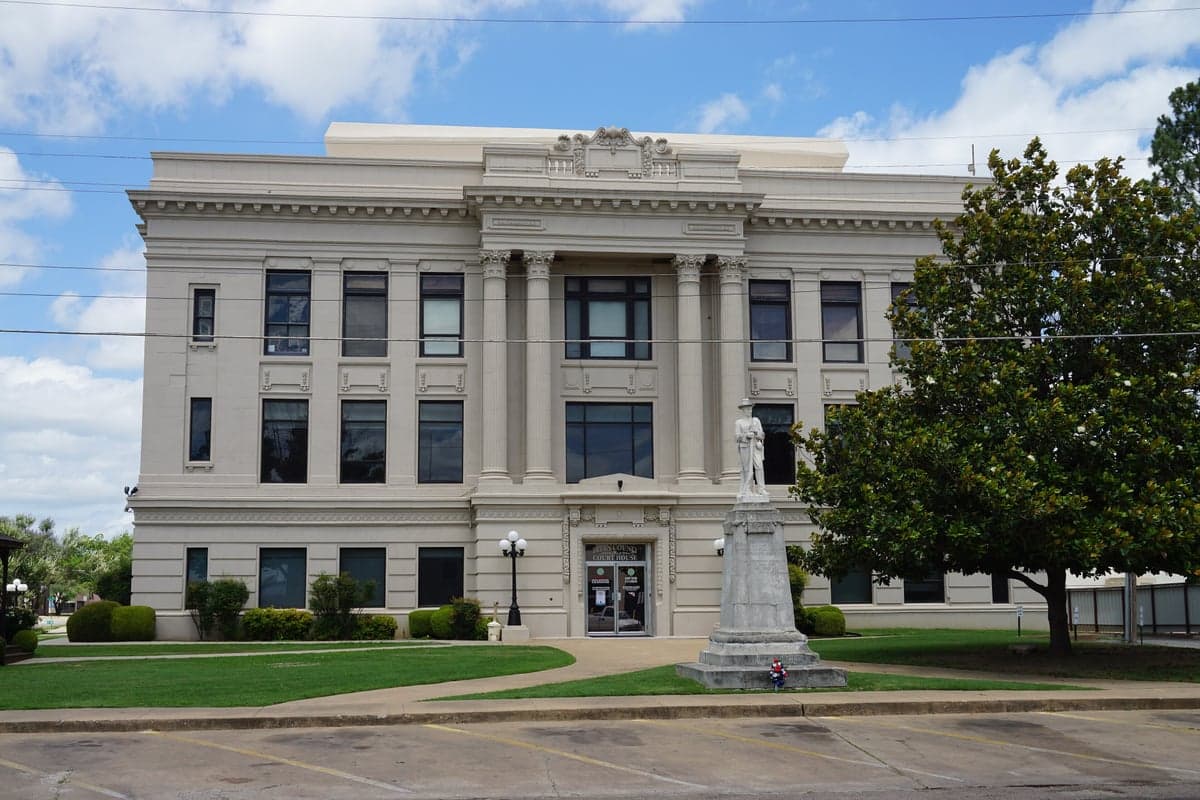
Photo: Wikipedia
Demographics of Bryan County
Affluence Level in Bryan County
A below-average socioeconomic profile. Incomes, home values, and educational attainment trail the U.S., with higher poverty and unemployment.
People of Bryan County
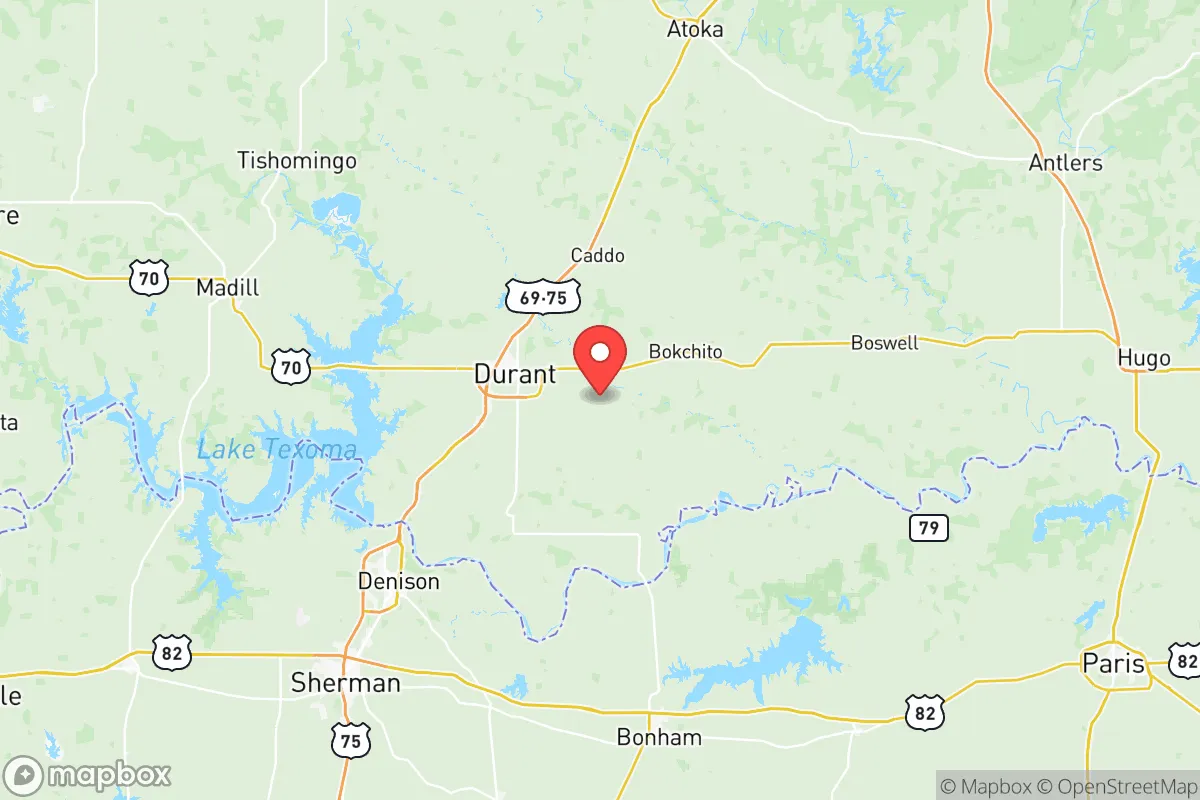
The people of Bryan County, Oklahoma today are a predominantly white, native-born population of roughly 47,000, concentrated in the county seat of Durant and the smaller towns of Calera, Colbert, and Caddo. With a foreign-born share of just 1.8% and a Hispanic population of 7.6%, the county remains far less ethnically diverse than the national average, and its character is shaped by deep-rooted Native American heritage—particularly the Choctaw Nation, which maintains its headquarters in Durant—and a steady, slow-growth economy anchored by agriculture, manufacturing, and the Chickasaw Nation’s gaming and hospitality sector. The population is notably less college-educated than the state average (24.4% vs. 26.5%), and the county’s identity is distinctly rural and conservative, with a strong sense of local tradition and community self-reliance.
Settlement & growth (pre-1960)
Before American settlement, the land that is now Bryan County was part of the vast territory controlled by the Choctaw Nation, one of the Five Civilized Tribes forcibly relocated from the Southeast along the Trail of Tears in the 1830s. The Choctaws established a functioning government, schools, and farms in the region, and their presence remains the single most defining cultural and political force in the county today. The area was sparsely populated by non-Native settlers until after the Civil War, when the Choctaw government began leasing land to white ranchers and farmers, a practice that accelerated after the Dawes Act of 1887 broke up tribal landholdings into individual allotments.
The first major wave of non-Native settlement came in the 1870s and 1880s, when Anglo-American farmers from Texas, Arkansas, and the Deep South moved into the Red River valley, drawn by cheap land and the cotton boom. These settlers were overwhelmingly of Scots-Irish and English stock, and they established small farming communities like Caddo (founded 1872), Colbert (named for a Choctaw family), and Bennington. Cotton was king, and the region’s economy revolved around plantation-style agriculture worked by a mix of white tenant farmers and a small number of Black sharecroppers—the county’s Black population, now just 2.1%, was historically larger but never exceeded 10% even at its peak.
The arrival of the Missouri-Kansas-Texas Railroad (the Katy) in the 1870s transformed the county. The railroad bypassed the older river towns and created new hubs, most notably Durant, founded in 1872 and named for a Choctaw chief. Durant quickly became the commercial and political center of the county, attracting merchants, lawyers, and bankers. A second wave of settlers—German and Czech farmers—arrived in the 1890s and early 1900s, settling around Bokchito and Mead, where they introduced diversified crop farming and dairying. These groups remained culturally distinct for a generation but largely assimilated into the Anglo majority by mid-century.
The oil boom of the 1910s and 1920s brought a brief, chaotic influx of roughnecks and speculators to the county, particularly around the Albany and Brown fields near Durant. The boom was modest compared to the giant strikes in Tulsa and Oklahoma City, but it injected cash into the local economy and spurred a population spike that peaked around 1930. The Great Depression and the Dust Bowl hit Bryan County hard; cotton prices collapsed, and many farmers abandoned the land for California or Texas. The county’s population actually declined between 1930 and 1960, as mechanization reduced the need for farm labor and young people left for urban jobs.
World War II brought a modest recovery, as the Naval Ammunition Depot at McAlester and other defense plants drew workers from the region, but Bryan County remained a quiet, rural backwater through the 1950s. The Choctaw Nation, meanwhile, had been systematically dispossessed by federal policy; by 1960, most Choctaw families lived in poverty in rural enclaves like Armstrong and Kemp, and the county’s Native American population—though culturally significant—was a small minority.
Modern era (post-1965)
The 1965 Hart-Cellar Act had almost no direct effect on Bryan County. Unlike the booming metropolitan areas of Texas or California, the county attracted virtually no new immigration from Asia, Africa, or Latin America during the post-1965 wave. The foreign-born population today is a mere 1.8%, and the county’s small Hispanic population (7.6%) is largely composed of Mexican-American families who have been in the region for generations, not recent arrivals. The county’s East/Southeast Asian population (0.3%) and Indian-subcontinent population (0.3%) are negligible, consisting mostly of a handful of professionals working at the Choctaw Nation’s headquarters or at Southeastern Oklahoma State University in Durant.
The most significant demographic shift since 1965 has been the resurgence of the Choctaw Nation. The Indian Self-Determination Act of 1975 and the subsequent growth of tribal gaming (the Choctaw Casino Resort in Durant opened in 1987 and has since expanded into one of the largest casino complexes in Oklahoma) transformed the tribe from a marginalized population into the county’s largest employer and most powerful political force. The Choctaw Nation now provides health care, education, and housing to its members, and its headquarters in Durant has drawn Native Americans from across the region to the county. The tribal population is not fully captured in census data (many Choctaw identify as white or multiracial), but the cultural and economic footprint is enormous.
Domestic migration since 1965 has been modest but notable. Retirees and second-home buyers from Texas—particularly from the Dallas-Fort Worth metroplex, about 90 miles south—have moved into lakefront properties on Lake Texoma, which forms the county’s southern border. Towns like Cartwright and Willow Springs have seen an influx of relatively affluent, older Texans, many of whom maintain ties to the Dallas area. This migration has brought a slightly more politically diverse and wealthier element to the county, but it has not fundamentally altered the rural, conservative character of the population.
Suburbanization has been limited. Durant has grown from a town of about 12,000 in 1980 to roughly 19,000 today, but it remains a small, low-density city with no major suburbs. The county’s population density is just 44 people per square mile, and the vast majority of the land is still used for agriculture, ranching, and timber.
The future
Bryan County’s population is projected to grow slowly but steadily over the next 10-20 years, driven primarily by continued expansion of the Choctaw Nation’s enterprises and retiree migration from Texas. The county is unlikely to become significantly more diverse: the Hispanic share may rise modestly (perhaps to 10-12% by 2040) as younger families move in for service-sector jobs, but the foreign-born population will remain well below 5%. The Black and Asian shares are expected to stay flat or decline slightly, as younger, college-educated residents continue to leave for larger cities.
The most significant cultural shift will be the growing influence of the Choctaw Nation. As the tribe expands its health care, education, and housing programs, and as more Choctaw citizens return to the county for employment and community, the Native American share of the population—both officially and culturally—will increase. This is already visible in Durant, where Choctaw language classes, cultural centers, and tribal government buildings are prominent features of the town. The county’s identity, once defined by white cotton farmers and ranchers, is becoming increasingly bicultural: Anglo and Choctaw, with the tribal government acting as a parallel power structure to the county commission.
Climate change and water availability may also shape the future. Lake Texoma is a critical water source for both Oklahoma and Texas, and prolonged drought could limit lakefront development and agricultural productivity. Conversely, the county’s relatively low cost of living and mild winters may attract more climate migrants from the Southwest and Gulf Coast in the coming decades.
Bryan County is becoming a place where Native American sovereignty and rural Anglo tradition coexist, sometimes uneasily but increasingly pragmatically. For someone moving in now, the county offers a low-cost, low-crime, family-oriented lifestyle with strong community ties and a growing tribal economy—but little ethnic diversity, limited urban amenities, and a political culture that remains deeply conservative. It is not a place of rapid change or demographic transformation, but of slow, steady evolution shaped by the enduring presence of the Choctaw Nation and the gravitational pull of nearby Texas.

* Values derived from national, state, county, city and local statistics and may differ in a specific area. Last updated: 2026-07-04T02:11:26.000Z
Narrative content on this page is AI-generated and may contain mistakes. Verify any details that matter before acting on them.
ReloMaps may earn a commission from affiliate links at no extra cost to you.

