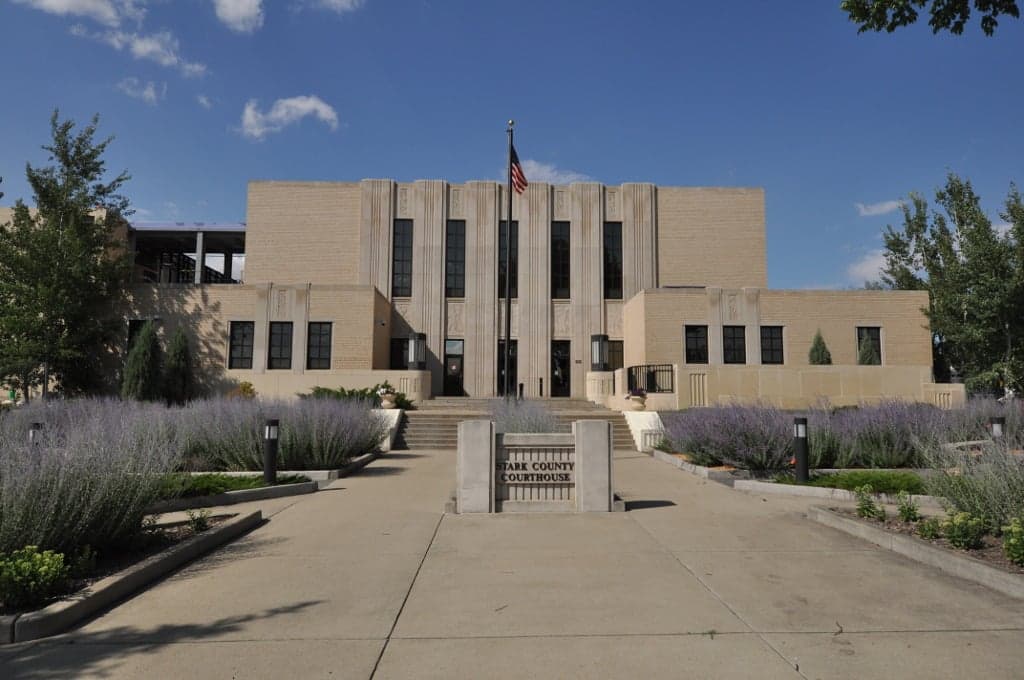
Photo: Wikipedia
Demographics of Stark County
Affluence Level in Stark County
A middle-class area roughly in line with national averages across income, home values, education, and employment.
People of Stark County
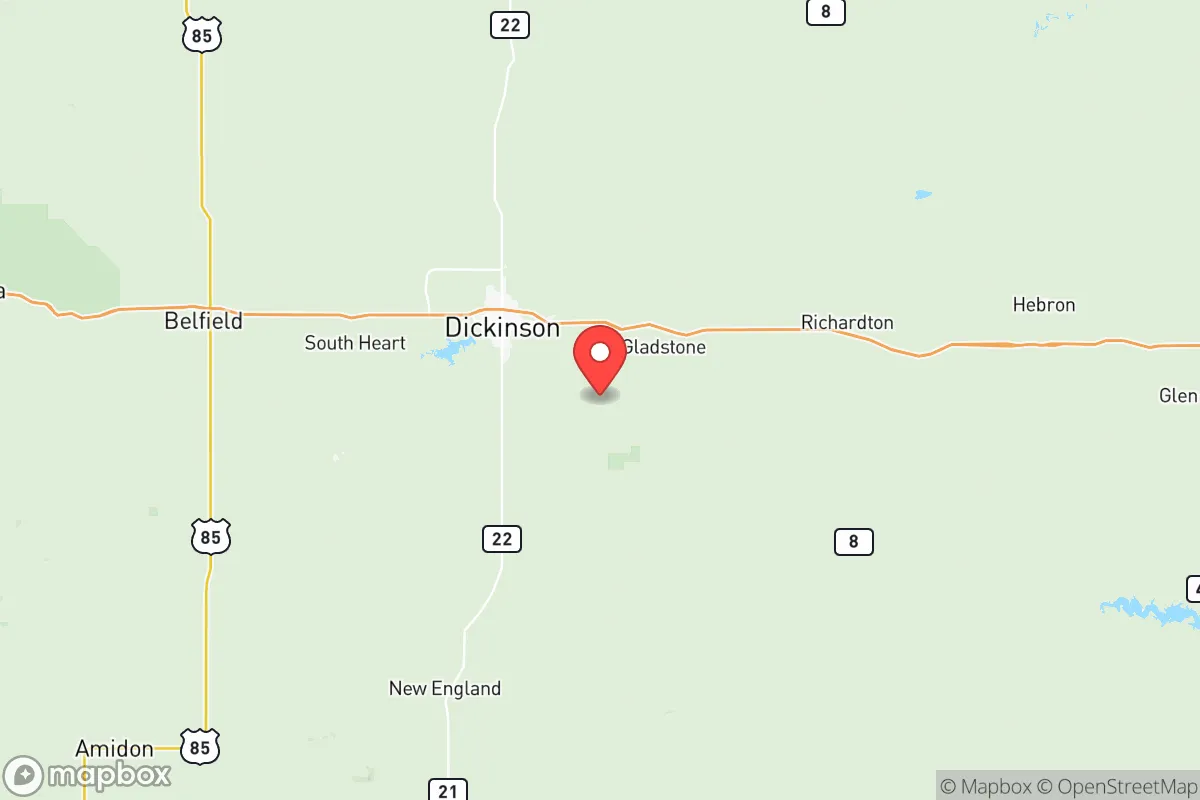
The people of Stark County, North Dakota today are a predominantly white, native-born population of roughly 33,000, shaped by a century of energy booms, agricultural settlement, and a recent influx of workers tied to the Bakken oil fields. The county's identity is rooted in its German-Russian and Scandinavian heritage, with a distinctly conservative, family-oriented character centered on the county seat of Dickinson and smaller communities like Belfield, South Heart, and Gladstone. With a foreign-born population of just 1.7% and a Hispanic share of 7.0%, the county remains far less diverse than the national average, though the oil-driven economy has introduced modest new demographic layers since 2010.
Settlement & growth (pre-1960)
Before European settlement, the area that is now Stark County was part of the traditional territory of the Mandan, Hidatsa, and Arikara (Three Affiliated Tribes), who lived in semi-permanent earth-lodge villages along the Missouri River to the east. The nomadic Lakota Sioux also hunted bison across the open prairies of what would become the county. The first non-Native presence came with the U.S. Army's Fort Dilts (1864) and later Fort Lincoln, but permanent settlement did not begin until the Northern Pacific Railway pushed through the region in the early 1880s.
The railroad's arrival in 1881 triggered the county's founding and its first major population wave. The city of Dickinson was platted in 1881 as a railroad division point and quickly became the commercial hub. The Homestead Act of 1862 drew waves of immigrants from Northern and Central Europe, particularly German-Russians (ethnic Germans who had lived in the Volga River region of Russia) and Norwegians. These groups arrived in large numbers between 1885 and 1910, drawn by cheap land and the promise of wheat farming. The German-Russians, known for their strong family structures and conservative Lutheran faith, concentrated in Dickinson and the surrounding farmsteads, while Norwegian settlers clustered in the northern part of the county around Taylor and Regent (the latter now in Hettinger County but historically tied to the same wave).
A secondary wave of Czech and Polish immigrants arrived in the 1890s-1910s, settling in smaller hamlets like Belfield and South Heart. These groups worked as farmers, railroad laborers, and coal miners—lignite coal deposits were discovered early and became a minor industry. The county's population peaked at roughly 19,000 by 1930, then declined during the Dust Bowl and Great Depression as drought and mechanization pushed families off marginal farms. The post-World War II period saw a slow recovery, with Dickinson growing as a regional trade center for agriculture and the emerging oil industry, but the county's population remained below 20,000 through the 1960s.
Modern era (post-1965)
The 1965 Hart-Cellar Act had minimal direct impact on Stark County, as the region attracted almost no international immigration during the late 20th century. Instead, the county's modern demographic story is one of domestic migration tied to energy cycles. The first major oil boom began in the 1980s following the discovery of the Williston Basin's deeper reserves, drawing workers from Texas, Oklahoma, and other oil-producing states. This wave was short-lived, collapsing with oil prices in 1986, but it established a pattern of cyclical, male-dominated migration that would repeat.
The true transformation came with the Bakken oil boom after 2008. Horizontal drilling and hydraulic fracturing unlocked vast oil reserves, and Stark County's population surged from roughly 22,000 in 2000 to over 33,000 by 2020. This boom brought a new demographic mix: Hispanic workers (primarily of Mexican and Central American origin) arrived to work in oilfield support, construction, and service industries, raising the Hispanic share from under 2% in 2000 to 7.0% today. These workers concentrated in Dickinson's lower-cost housing and in man camps on the outskirts, with a smaller presence in Belfield and Gladstone. The Black population, now at 2.3%, also grew during this period, largely from domestic migration of African American workers from the Gulf Coast and Midwest seeking oilfield jobs. East/Southeast Asian communities (1.0%) and Indian-subcontinent residents (0.2%) remain tiny, mostly professionals in healthcare and education in Dickinson.
Suburbanization has been limited by the county's rural character, but Dickinson has expanded outward with new subdivisions like Prairie Hills and West River, attracting families seeking newer housing and better schools. The county's college-educated share (27.2%) lags the national average, reflecting the blue-collar nature of the oil economy, though Dickinson State University provides a modest anchor for professional-class residents.
The future
Stark County's population trajectory is almost entirely dependent on oil prices. If the Bakken remains viable through 2035-2040, the county will likely see continued modest growth, with the Hispanic share rising toward 10-12% as families settle permanently and second-generation children enter the school system. The Black and Asian shares may grow slowly but will likely remain below 5% each. If oil prices decline or renewable energy displaces demand, the county could see a population contraction similar to the 1980s bust, with younger workers leaving and the demographic profile aging.
Culturally, the county is becoming slightly more diverse but remains overwhelmingly white and conservative. The German-Russian and Scandinavian heritage is still dominant in community festivals, church life, and family structures, particularly in smaller towns like South Heart and Taylor. The Hispanic community is slowly integrating, with bilingual programs appearing in Dickinson Public Schools and Spanish-language services expanding. However, the county's low foreign-born share and high native-born white majority mean that Stark County will likely remain one of the least diverse counties in the Upper Midwest for the foreseeable future.
For someone moving in now, Stark County offers a stable, family-oriented community with strong schools in Dickinson, low crime rates, and a robust economy tied to energy and agriculture. The trade-off is limited cultural diversity, a harsh winter climate, and economic vulnerability to oil price swings. The county is becoming slightly more varied in its population, but its core identity as a German-Russian and Scandinavian prairie community remains intact.

* Values derived from national, state, county, city and local statistics and may differ in a specific area. Last updated: 2026-08-04T11:12:31.000Z
Narrative content on this page is AI-generated and may contain mistakes. Verify any details that matter before acting on them.
ReloMaps may earn a commission from affiliate links at no extra cost to you.

