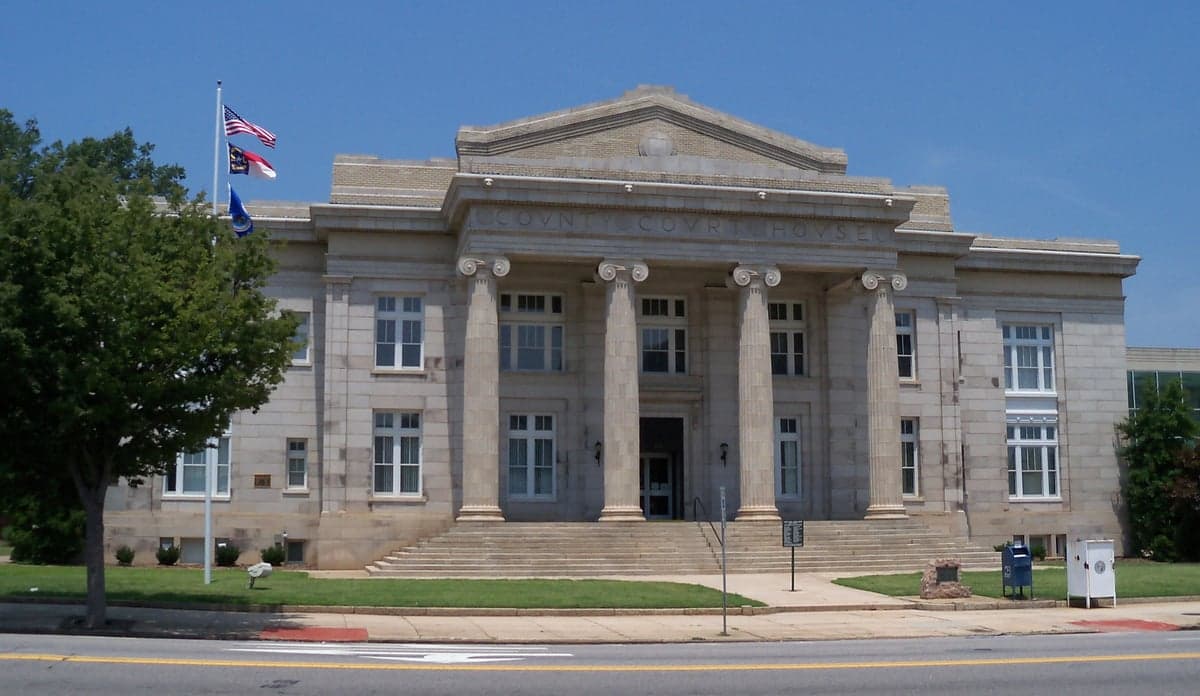
Photo: Wikipedia
Demographics of Rowan County
Affluence Level in Rowan County
A middle-class area roughly in line with national averages across income, home values, education, and employment.
People of Rowan County
Rowan County, North Carolina, is a community of 148,487 residents shaped by a deep Scots-Irish and German Protestant heritage, with a growing Hispanic population and a stable Black minority that together create a culturally traditional, family-oriented county. The population remains predominantly white (68.5%) and native-born (only 4.2% foreign-born), giving the county a slower pace of demographic change than nearby Mecklenburg or Wake counties. Residents identify strongly with small-town values, church life, and manufacturing and logistics employment, with a distinctive identity rooted in the region's Piedmont textile and furniture history. Salisbury is the county seat and cultural anchor, while the towns of China Grove, Landis, Spencer, and Rockwell each retain distinct settlement-era character.
Settlement & growth (pre-1960)
Before European settlement, the area now known as Rowan County was home to the Catawba and Cherokee nations, who used the Yadkin River valley for hunting and seasonal camps. The Catawba maintained a presence along the river's western banks, while the Cherokee claimed the more mountainous western reaches of what was then a vast frontier. Neither group established permanent large villages within present-day Rowan County, but their trails and trading paths—including the Great Wagon Road—became the routes that later brought European settlers.
The first major wave of European settlement began in the 1740s and 1750s, when Scots-Irish Presbyterians and German Lutherans and Reformed migrants traveled the Great Wagon Road from Pennsylvania down the Shenandoah Valley. These groups were drawn by the promise of cheap, fertile land in the North Carolina Piedmont, offered through the Granville District land grants. The Scots-Irish concentrated in the northern and western parts of the county, founding the communities of Mount Ulla and Barber, while German settlers clustered around Organ Church and St. John's Lutheran Church in what is now eastern Rowan County. Salisbury, established in 1753 as the county seat, quickly became a regional trading and judicial center, attracting English merchants and lawyers who formed a small professional class.
During the Revolutionary War and early republic period, Rowan County's population remained overwhelmingly of British and German stock, with a small number of enslaved Africans brought primarily by English planters who established farms along the Yadkin River and its tributaries. By 1790, enslaved people made up roughly 15% of the county's population, a share that grew to about 30% by 1860 as cotton cultivation expanded in the southern part of the county around Gold Hill and Franklin. The Gold Hill area experienced a brief mining boom in the 1820s-1840s, attracting a small influx of Cornish miners and other skilled laborers, though most left after the California Gold Rush of 1849.
After the Civil War and Reconstruction, Rowan County's economy shifted from agriculture to textile manufacturing, a transition that defined the county's population for the next century. The 1880s and 1890s saw the construction of cotton mills in Salisbury, Spencer, and China Grove, drawing rural white families off farms and into mill villages. The Southern Railway established its major repair facility in Spencer in 1896, creating a working-class community of railroad mechanics and their families that remained predominantly white and native-born. The town of Landis grew around a furniture factory and cotton mill, attracting additional white migrants from the surrounding countryside. African Americans, who had worked as sharecroppers and tenant farmers after emancipation, began moving into Salisbury's west side and into the mill villages of East Spencer, where they found employment in the rail yards and as domestic workers.
The early 20th century brought no major new immigrant waves to Rowan County. Unlike Northern industrial cities that received Southern and Eastern European immigrants, Rowan's mills and railroads were staffed almost entirely by native-born white and Black workers from the surrounding region. The county's foreign-born population peaked at just 1.2% in 1910, consisting mostly of a small number of German and Irish immigrants who worked as merchants or skilled tradesmen in Salisbury. The Great Migration of African Americans out of the rural South actually reduced Rowan County's Black population share from 30% in 1900 to 22% by 1950, as many left for industrial jobs in Northern cities.
Modern era (post-1965)
The 1965 Hart-Cellar Act had a minimal direct impact on Rowan County, as the county never developed the kind of ethnic enclaves or chain migration patterns that transformed Charlotte or Greensboro. The foreign-born population remains low at 4.2%, and the county's demographic shifts since 1965 have been driven primarily by domestic migration and natural increase rather than international immigration. The most significant change has been the growth of the Hispanic population, which now stands at 11.3%, up from less than 2% in 1990. This growth came primarily through Mexican and Central American migrants who arrived in the 1990s and 2000s to work in poultry processing plants, construction, and agriculture. The Hispanic community is concentrated in Salisbury's south side and in the rural areas around Cleveland and Rockwell, where they work in the region's remaining poultry and hog operations.
The Asian population remains very small at 0.8% East/Southeast Asian and 0.2% Indian subcontinent, reflecting the county's lack of high-skilled tech or academic employment that draws Asian professionals to the Research Triangle or Charlotte. The small Asian community that exists is primarily Vietnamese and Filipino, concentrated in Salisbury and employed in healthcare and manufacturing. The Indian subcontinent population is negligible, consisting of a handful of medical professionals at Salisbury's Novant Health hospital and a few small business owners.
The Black population has remained stable at 15.4%, a figure that reflects both natural increase and some return migration of African Americans from Northern cities to the South. The Black community remains concentrated in East Spencer and Salisbury's west side, with smaller populations in China Grove and Landis. The county's white population has declined slightly in percentage terms as the Hispanic share has grown, but the absolute number of white residents has remained steady, as Rowan County has attracted some domestic migrants from the Rust Belt and from more expensive parts of North Carolina seeking lower housing costs and a slower pace of life.
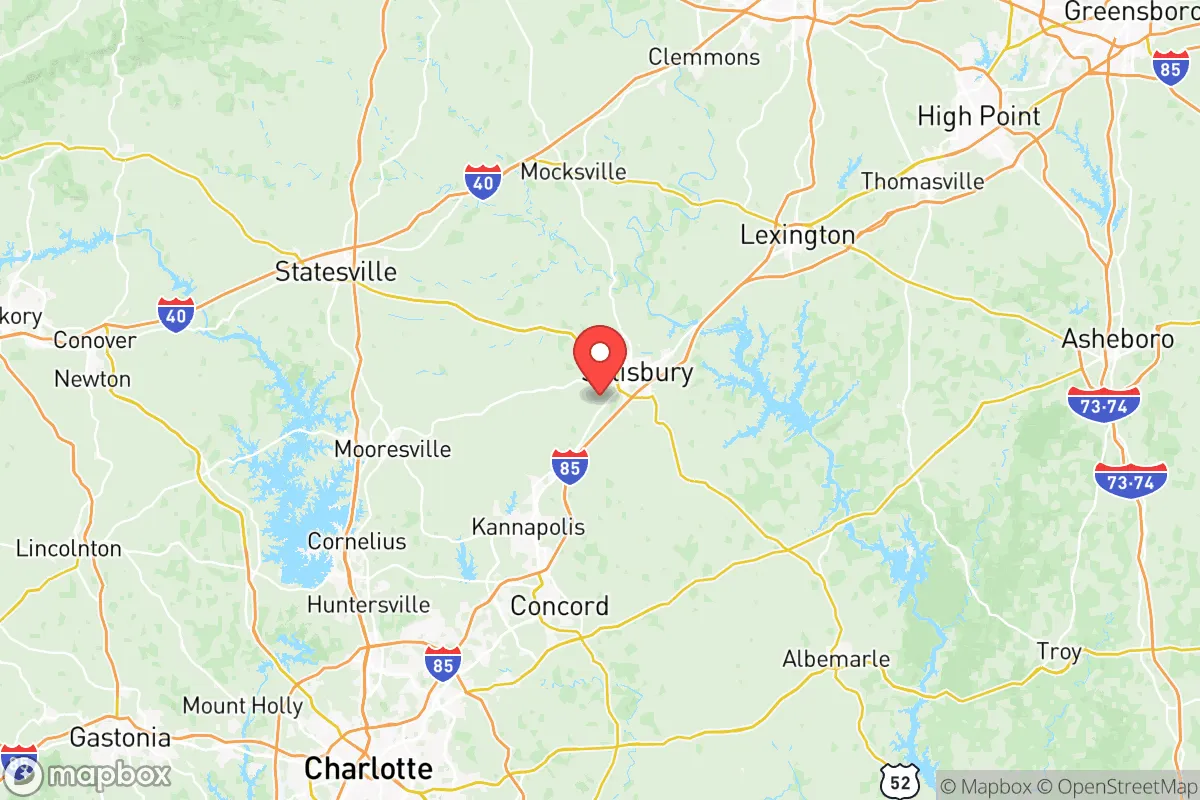
Suburbanization has reshaped the county's settlement patterns since the 1990s. The construction of Interstate 85 and the expansion of U.S. Highway 29 made Rowan County a bedroom community for commuters working in Charlotte (45 minutes south) and Greensboro (40 minutes north). New subdivisions have sprouted around Granite Quarry and Faith, attracting middle-class families who want rural character with urban job access. This in-migration has been overwhelmingly white and native-born, reinforcing the county's cultural conservatism rather than diversifying it.
The future
Rowan County's population is projected to grow modestly to roughly 160,000 by 2035, driven by continued domestic migration from the Rust Belt and from higher-cost North Carolina metros. The Hispanic population will likely continue its gradual increase, potentially reaching 15-18% by 2040, as family reunification and natural increase outpace any new international migration. The Black population share is expected to remain stable, while the white share will continue a slow decline in percentage terms even as the absolute number of white residents holds steady or grows slightly.
The county is not tribalizing into distinct ethnic enclaves in the way that larger metros have. Instead, Rowan County is experiencing a slow homogenization around a traditional, church-centered, family-oriented culture that absorbs newcomers rather than being transformed by them. The small Hispanic community is integrating into existing neighborhoods and churches, with second-generation Hispanic residents increasingly identifying as culturally American and English-dominant. The Asian and Indian populations are too small to form distinct enclaves and are assimilating into the broader community.
The most significant demographic trend is the aging of the white population, which has a median age of 44 compared to 30 for the Hispanic population and 36 for the Black population. This means that Rowan County's future growth will depend increasingly on the children of Hispanic families and on continued domestic in-migration of younger families from outside the county. The county's low college attainment rate (21.5%) and manufacturing-heavy economy may limit its ability to attract the kind of high-skilled, high-income migrants who are reshaping Charlotte and Raleigh, but it also means that Rowan County will likely retain its working-class, culturally conservative character for the foreseeable future.
For someone moving into Rowan County now, the county offers a stable, slow-growing community where traditional values, church life, and family ties remain central. The population is becoming slightly more diverse but remains overwhelmingly native-born and culturally Southern. The county is not experiencing the rapid transformation seen in Charlotte's suburbs, nor the stagnation of more remote rural counties. It is a middle path—a place where change comes gradually and is absorbed into an existing cultural framework rather than disrupting it.

* Values derived from national, state, county, city and local statistics and may differ in a specific area. Last updated: 2026-06-06T01:06:35.000Z
Narrative content on this page is AI-generated and may contain mistakes. Verify any details that matter before acting on them.
ReloMaps may earn a commission from affiliate links at no extra cost to you.

