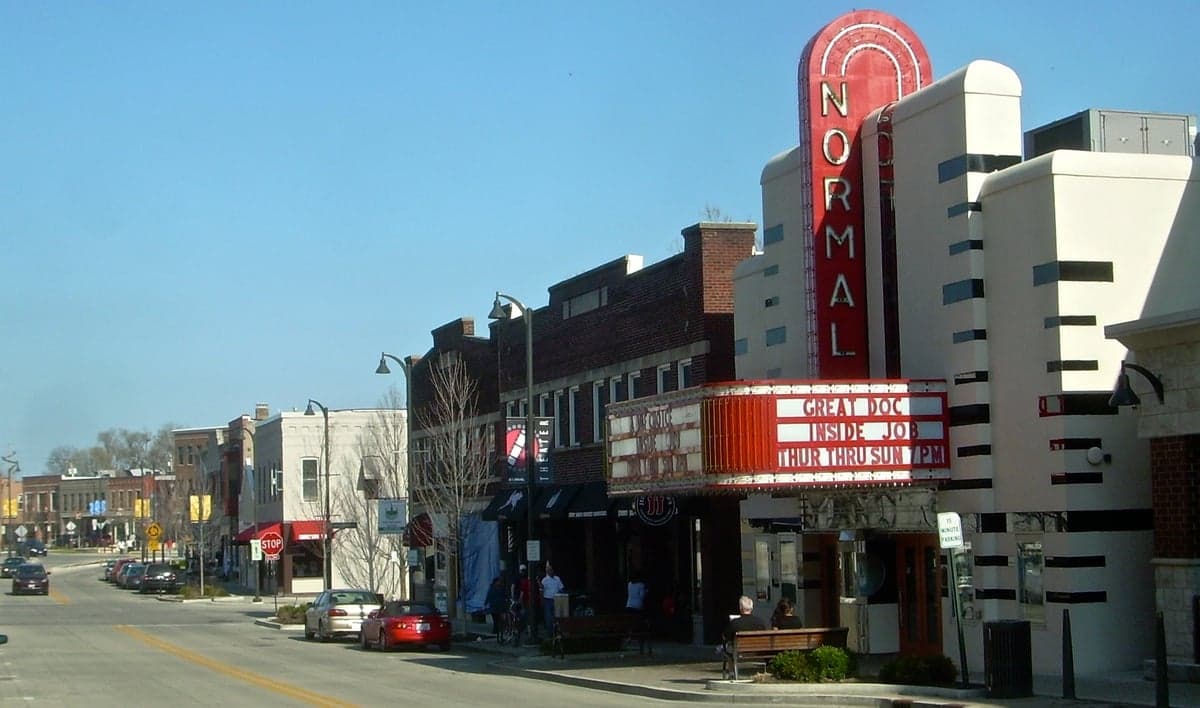
Photo: Wikipedia
Personal Sovereignty in Normal, IL
Viable for self-reliance. Generally workable, though some barriers may limit total independence.
What does Personal Sovereignty tell us?
Personal Sovereignty measures your capacity for self-reliance and independence with minimal government friction. Higher scores mean fewer barriers between you and the way you want to live... but it assumes you have the space you need and good neighbors.
What does this tell us?
Personal Sovereignty measures your capacity for self-reliance and independence with minimal government friction. Higher scores mean fewer barriers between you and the way you want to live... but it assumes you have the space you need and good neighbors.
State Policy
Energy independence: Importer (45% of energy produced in-state)
Personal Liberty
Homesteading

Personal Liberty Analysis
Normal, Illinois, presents a mixed picture for those prioritizing personal sovereignty. While the town itself offers a relatively quiet, low-key environment, it sits squarely within a state whose regulatory and fiscal posture is increasingly at odds with individual autonomy. For the survivalist or prepper, the key question isn't just about the local vibe—it's about how much the state government will reach into your life, your property, and your decisions. The answer, in short, is that Normal provides a decent baseline for day-to-day living, but you'll be navigating a state-level framework that consistently favors centralized control over personal freedom.
Tax burden and regulatory posture: how much the state takes and controls
Illinois is not a low-tax state, and that reality directly impacts your ability to keep what you earn and build self-reliance. The state's flat income tax rate of 4.95% is moderate, but the property tax burden is among the highest in the nation. In McLean County, where Normal sits, effective property tax rates often exceed 2% of a home's assessed value annually. For a $250,000 home, that's over $5,000 per year—money that could otherwise fund supplies, land improvements, or a generator. Sales tax in Normal is 8.5% (state + local), which adds up quickly on bulk purchases. The regulatory environment is also notable: Illinois has a state-level building code with energy-efficiency mandates that can increase construction costs for new outbuildings or workshops. There are no county-level zoning exemptions for "hobby farms" or small-scale agricultural structures in most residential zones within town limits. If you're looking to minimize your tax footprint and regulatory friction, Normal is workable, but you'll be paying a premium for the privilege of living in a state with strong public-sector unions and expansive government services.
Self-defense and gun law specifics: what you can and cannot do
Illinois is a "shall issue" state for concealed carry, but the process is more burdensome than in many other states. To carry a firearm in Normal, you need a Firearm Owner's Identification (FOID) card and a Concealed Carry License (CCL). The FOID requires a background check and a fee, and the CCL requires 16 hours of state-approved training, a live-fire qualification, and a separate application. This is a significant time and cost investment compared to constitutional carry states. More concerning for the prepper: Illinois has a ban on "assault weapons" and large-capacity magazines (over 10 rounds for long guns, over 15 for handguns) that was enacted in 2023 and is currently being challenged in court. While enforcement in Normal is not aggressive, the law is on the books, and possession of standard-capacity magazines or certain rifles (like AR-15s) is technically a felony. There is no state preemption for firearm laws, meaning local ordinances could theoretically add restrictions, though Normal itself has not done so. Castle doctrine applies in Illinois—you have no duty to retreat in your home—but the "safe corridor" protections for transporting firearms are limited. For the self-reliant individual, this means you can defend your home, but your ability to maintain a robust personal arsenal is legally constrained.
Self-reliance and homesteading viability: lot sizes, zoning, and off-grid feasibility
Within Normal's city limits, true homesteading is difficult. Standard residential lots are typically 0.15 to 0.25 acres, and zoning codes restrict keeping livestock (chickens are allowed in some areas with a permit, but no goats, pigs, or larger animals). The city also requires connection to municipal water and sewer—no private wells or septic systems are permitted in most subdivisions. Rainwater collection is not prohibited, but it's not explicitly encouraged, and large-scale cistern systems may require a permit. For serious off-grid living, you need to look outside town. The unincorporated areas of McLean County, particularly to the east and south, offer 1- to 5-acre parcels at reasonable prices ($10,000–$20,000 per acre as of 2025). County zoning is more permissive: you can have a private well, septic system, and even a small wind turbine or solar array without excessive red tape. However, Illinois has net metering laws that make grid-tied solar viable, but going fully off-grid (battery storage, no utility connection) may still require navigating county health department rules for water and waste. The bottom line: Normal itself is not a homesteading hub, but the surrounding county offers viable land for those willing to drive 15–20 minutes into town for supplies.
Personal liberties: parental rights, medical autonomy, speech, and property
Parental rights in Illinois have been a flashpoint. The state passed a law in 2021 that removed parental notification requirements for minors seeking abortion, and in 2023, it expanded gender-affirming care protections for minors, overriding parental consent in some cases. This is a direct concern for conservative parents who want to maintain authority over their children's medical decisions. On medical autonomy more broadly, Illinois has a strong vaccine mandate history (schools, healthcare workers) and a state-run health insurance exchange that can limit private healthcare options. COVID-era mandates were enforced more strictly here than in many neighboring states. Free speech is protected under the First Amendment, but Illinois has a "hate crime" statute that can be applied to speech deemed threatening or harassing, and social media platforms operating in the state face content moderation transparency requirements. Property rights are generally respected, but the state's eminent domain authority is broad, and the Illinois Department of Transportation has a history of using it for infrastructure projects. There is no state-level "right to farm" law that protects agricultural operations from nuisance lawsuits, which is relevant if you plan to raise animals near residential areas.
Overall, Normal offers a livable environment for those who value personal sovereignty, but it's not a sanctuary. The state's tax burden, gun restrictions, and erosion of parental rights are real constraints. Compared to states like Indiana (45 minutes east) or Missouri (2 hours west), Illinois is significantly more restrictive on firearms and taxes, but it offers better infrastructure and access to healthcare. For the strategic relocator, Normal is a compromise: you get a stable community with decent schools and a low crime rate, but you must be willing to navigate a state government that consistently prioritizes collective mandates over individual choice. If you're serious about prepping and autonomy, the surrounding county land is the better play—just be prepared to drive into town for work and supplies.

* Values derived from national, state, county, city and local statistics and may differ in a specific area. Last updated: 2026-04-19T07:08:06.000Z
Narrative content on this page is AI-generated and may contain mistakes. Verify any details that matter before acting on them.
ReloMaps may earn a commission from affiliate links at no extra cost to you.

