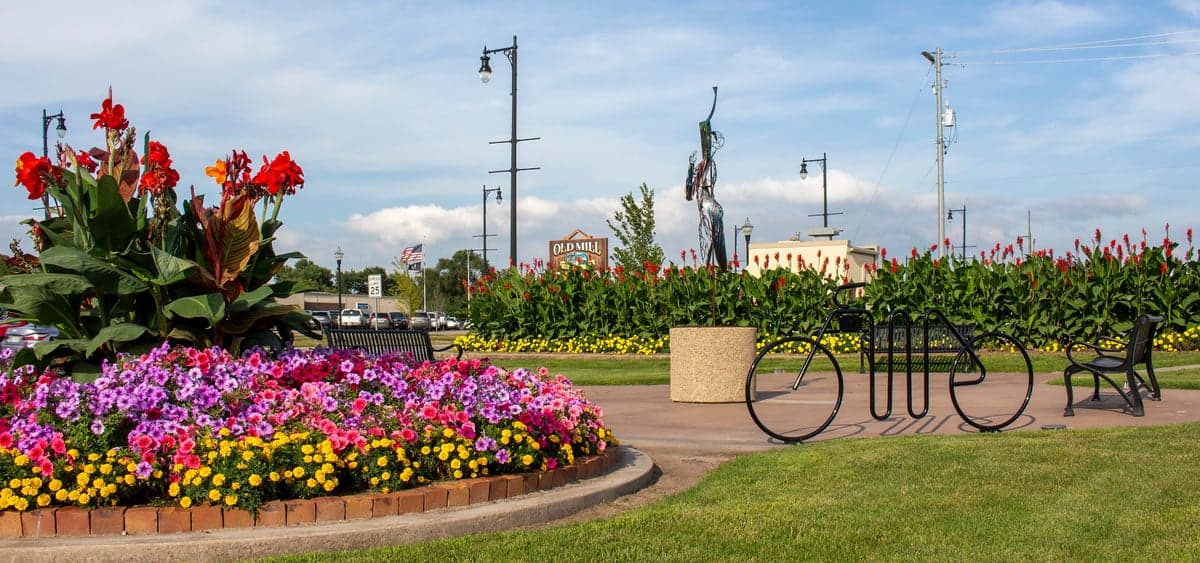
Photo: Wikipedia
Political ClimatePolitical Climate in Norfolk, NE
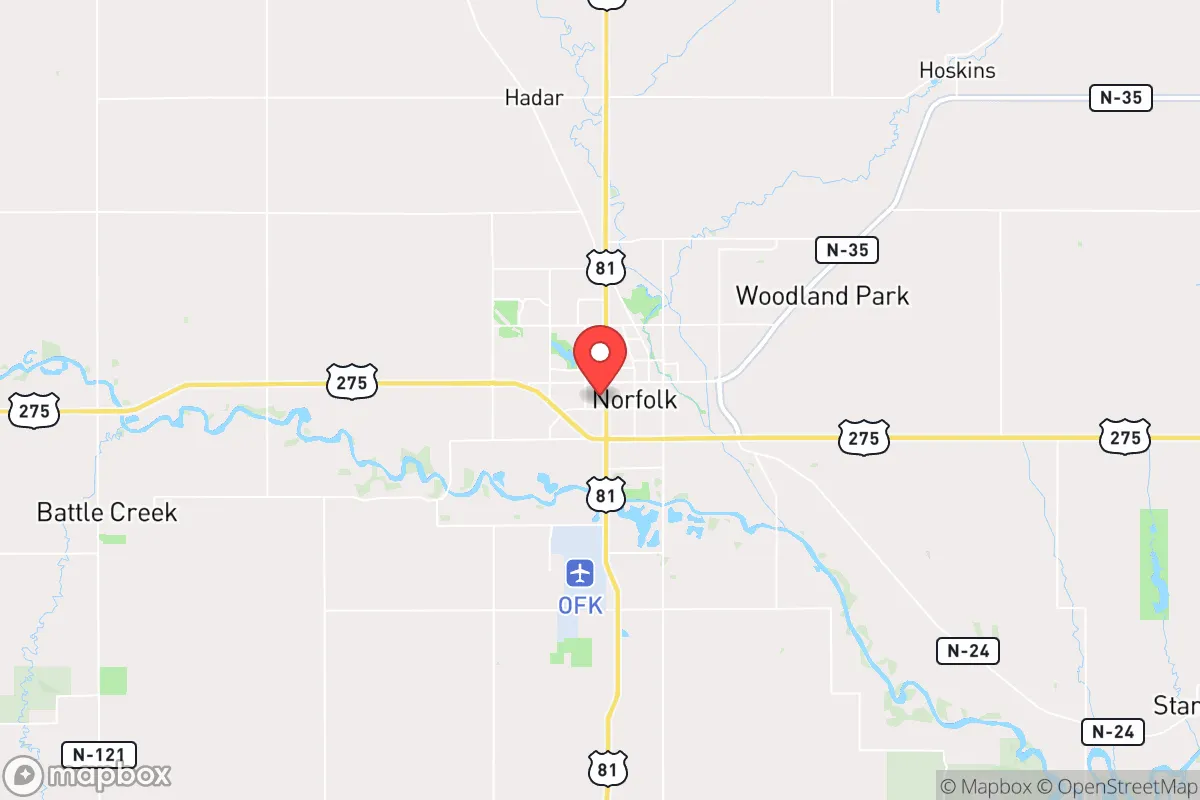
District shown is the primary district for this city’s centroid. Cities may span multiple districts.
Local Political AnalysisPolitical Analysis of Norfolk, NE
Norfolk, Nebraska, has long been a solidly conservative community, and that hasn't changed much despite some national trends. The Cook Partisan Voting Index (PVI) of R+6 tells you the baseline, but it doesn't capture the full story. This area leans Republican by a comfortable margin, and you feel it in local elections, school board races, and the general attitude around town. The real shift I've noticed over the past decade isn't a swing left, but a growing unease about how much government—state and federal—is sticking its nose into local affairs. People here value their independence, and that's getting harder to hold onto.
How it compares
Drive thirty minutes south to Columbus, and you'll find a similar conservative vibe, though maybe a bit more corporate and less "old Nebraska." Head west to O'Neill, and it's even more rural and traditional. The real contrast is if you go east to Sioux City, Iowa, or up to Yankton, South Dakota—those places have seen more progressive influence creep in, especially in their city councils and school policies. Norfolk has largely resisted that. We don't have the same kind of activist groups or loud progressive movements you see in Lincoln or Omaha. Our county commissioners and city council members are mostly folks who believe in limited government, low taxes, and letting people run their own lives. That said, I've seen a few younger transplants from the cities try to push for things like "diversity initiatives" in the schools or more bike lanes and "green" mandates. So far, those haven't gained much traction, but it's something to keep an eye on.
What this means for residents
For the average person living here, the political climate means you're generally left alone. There's no heavy-handed local government telling you what you can do with your property or how to run your small business. The tax burden is reasonable compared to other parts of the state, and you don't see the kind of overreach you hear about in blue states. But it's not perfect. The biggest concern I hear from neighbors is about state-level mandates coming down from Lincoln—things like unfunded education requirements or environmental regulations that don't fit a farming community. There's also a growing frustration with federal overreach, especially on land use and agricultural policies. People here are practical: they want good roads, safe streets, and good schools, but they don't want bureaucrats in Omaha or Washington telling them how to live. That's the core tension right now.
One thing that sets Norfolk apart is its strong sense of community self-reliance. You don't see a lot of hand-wringing about national politics here. Instead, folks focus on local issues: keeping the hospital strong, supporting the local businesses on Norfolk Avenue, and making sure the schools teach the basics without pushing an agenda. The cultural vibe is still very much "Nebraska nice" but with a backbone. If you're looking for a place where you can live your life without constant political noise or government intrusion, Norfolk is a solid bet. Just don't expect it to stay that way forever if we don't stay engaged. The progressive wave is lapping at the edges, and it's up to us to keep it from washing over the whole town.

State Political ClimatePolitical Climate in Nebraska
State Political AnalysisPolitical Environment in the State
Nebraska has long been a reliably conservative state, but its political landscape is more layered than the simple "red state" label suggests. The state has voted Republican in every presidential election since 1968, and its current partisan lean is roughly R+15, driven by a deeply conservative rural expanse and a growing, increasingly influential conservative suburban base. Over the last 10-20 years, the biggest shift hasn't been a leftward drift, but rather a consolidation of Republican power in the legislature and a hardening of the urban-rural divide, with the state's two major population centers—Omaha and Lincoln—pulling in opposite directions from the rest of the state.
Urban vs. rural divide
The political map of Nebraska is a textbook case of geographic polarization. The eastern third of the state, anchored by Omaha (Douglas County) and Lincoln (Lancaster County), is the only reliably blue territory. Douglas County has voted Democratic in every presidential race since 2008, and Lancaster County flipped blue in 2020 and held in 2024. These two counties contain about half the state's population, but their influence is blunted by the rest of the state's overwhelming Republican margins. The real story is the Second Congressional District, which encompasses Omaha and its western suburbs. This district has flipped between parties in recent cycles—voting for Biden in 2020, then flipping back to Trump in 2024—making it one of the most competitive House seats in the country. The suburbs of Papillion and La Vista in Sarpy County are a key battleground; they're growing fast with families fleeing Omaha proper, and they lean Republican but are less rock-ribbed than rural areas. Meanwhile, the rest of the state—places like Grand Island, Kearney, North Platte, and Scottsbluff—vote Republican by margins of 30-50 points. The rural counties along the Platte River valley and the Sandhills are among the most conservative in the nation, with some precincts hitting 80%+ Republican. The divide isn't just about party; it's about worldview. Omaha and Lincoln are increasingly cosmopolitan and culturally liberal, while the rest of the state remains deeply traditional, agrarian, and skeptical of government overreach.
Policy environment
Nebraska's policy environment is a mixed bag for a conservative. On the plus side, the state has a unicameral, nonpartisan legislature, which historically produced more moderate, pragmatic governance. But in recent years, that body has become more overtly partisan and conservative. The state has no income tax on Social Security benefits and a flat state income tax rate that was cut from 6.84% to 5.84% in 2023, with a path to 3.99% by 2027. Property taxes remain a major pain point, especially in rural areas, and the legislature has passed several rounds of property tax relief, including a 2024 bill that increased the homestead exemption and boosted the state's property tax credit. On education, Nebraska has a robust school choice movement: the Opportunity Scholarships Act (LB 753) was passed in 2023, creating a tax-credit scholarship program for private school tuition, though it faced a repeal referendum that was narrowly defeated in 2024. The state also has a constitutional carry law (LB 77, passed in 2023), allowing permitless concealed carry for adults 21 and older. On the concerning side, Nebraska has a state income tax that still feels too high for many, and the state's election laws are relatively moderate—no strict voter ID law was in place until 2024, when a voter ID requirement finally took effect after a 2022 ballot initiative. The state also has a red flag law? No, it does not—that's a positive. But it does have a statewide smoking ban and some local ordinances that can feel intrusive. Overall, the policy environment is conservative but not libertarian; the state still believes in using government to promote certain social and economic outcomes.
Trajectory & freedom
Nebraska is moving in a decidedly more free direction on several key fronts, but the trajectory is not uniform. The most significant recent expansion of personal liberty was the passage of constitutional carry in 2023, which eliminated the need for a permit to carry a concealed handgun. This was a major win for Second Amendment advocates. On parental rights, the state passed the Parental Bill of Rights (LB 1084) in 2024, which requires schools to notify parents about curriculum changes and gives them the right to opt their children out of certain instruction. This was a direct response to concerns about critical race theory and gender ideology in schools. On medical freedom, Nebraska has been a battleground. The state passed a 12-week abortion ban in 2023 (LB 574), which also banned gender-affirming care for minors—a move that drew national attention and legal challenges. The ban on gender-affirming care for minors is currently tied up in court, but the legislature's willingness to act on this issue signals a strong conservative tilt. On the negative side, the state's tax burden remains a concern. While income tax rates are falling, property taxes are still high, and the state's sales tax is 5.5% (plus local add-ons), which hits lower-income families harder. There's also a growing movement to eliminate the state income tax entirely, with a bill introduced in 2025, but that's a long shot. The bottom line: Nebraska is becoming more free on cultural and Second Amendment issues, but the tax and regulatory environment still has room for improvement.
Civil unrest & political movements
Nebraska is not a hotbed of civil unrest, but there have been notable flashpoints. The most visible was the 2020 George Floyd protests in Omaha and Lincoln, which saw some property damage and a heavy police response. In Omaha, the protests were concentrated in the downtown area and near the North Omaha neighborhood, which has a history of racial tension. More recently, the abortion debate has been a major source of political energy. In 2024, a ballot initiative to enshrine abortion rights in the state constitution was defeated, but the campaign was intense, with both sides spending millions. The school choice fight also saw significant grassroots activism, with teachers' unions and progressive groups trying to repeal the Opportunity Scholarships Act. On the right, the Nebraska Republican Party has been fractured between establishment conservatives and more populist, Trump-aligned factions. The 2022 gubernatorial primary was a bitter fight between Jim Pillen (the establishment pick) and Charles Herbster (a Trump-backed candidate accused of sexual misconduct), and the party is still healing. Immigration politics are less heated than in border states, but there have been local controversies, such as Grand Island and Lexington seeing tensions over meatpacking plant workers. There is no sanctuary city policy in Nebraska; in fact, the state passed a law in 2024 (LB 123) requiring local law enforcement to cooperate with federal immigration authorities. Election integrity has been a minor issue; the 2020 election was secure, but the 2024 voter ID law was pushed by conservatives who wanted to tighten the system. Overall, the political movements in Nebraska are more about policy than protest, but the temperature is rising.
Projection
Over the next 5-10 years, Nebraska is likely to become more conservative, not less, but with a twist. The key demographic trend is the growth of the Omaha suburbs—places like Gretna, Bennington, and Elkhorn—which are attracting conservative-leaning families from both coasts and from within the state. These areas are reliably Republican and will help offset any leftward drift in Omaha proper. Meanwhile, rural Nebraska is depopulating, which means the state's political center of gravity is shifting eastward, but not necessarily toward liberalism. The Second Congressional District will remain competitive, but the overall state will stay solidly red. The biggest wildcard is the unicameral legislature. If the nonpartisan tradition continues to erode, expect more aggressive conservative legislation on taxes, education, and cultural issues. The push to eliminate the income tax will gain steam, but property tax reform will be the real test. On social issues, the state will likely double down on its current trajectory: more school choice, more parental rights, and continued restrictions on abortion and gender-affirming care. The biggest risk for conservatives is complacency; if the Omaha suburbs start to drift left like their counterparts in other states, Nebraska could become a purple state within 15-20 years. But for now, the projection is for a stable, increasingly conservative Nebraska that is a safe haven for families seeking lower taxes, more freedom, and traditional values.
For a new resident, the bottom line is this: Nebraska offers a high degree of personal freedom compared to blue states, especially on gun rights, parental control over education, and cultural issues. The tax burden is moderate and improving, but property taxes are a real cost to factor in. The political climate is conservative but not extreme; you'll find a mix of pragmatic Midwestern moderation and growing populist energy. If you're moving from a high-tax, high-regulation state, you'll feel a noticeable increase in liberty. Just be aware that the urban centers of Omaha and Lincoln are more liberal than the rest of the state, so choose your county carefully. Overall, Nebraska is a solid bet for conservatives who want a stable, family-friendly environment with a government that is increasingly on their side.
* Values derived from national, state, county, city and local statistics and may differ in a specific area. Last updated: 2026-04-23T02:30:40.000Z
Narrative content on this page is AI-generated and may contain mistakes. Verify any details that matter before acting on them.
ReloMaps may earn a commission from affiliate links at no extra cost to you.

