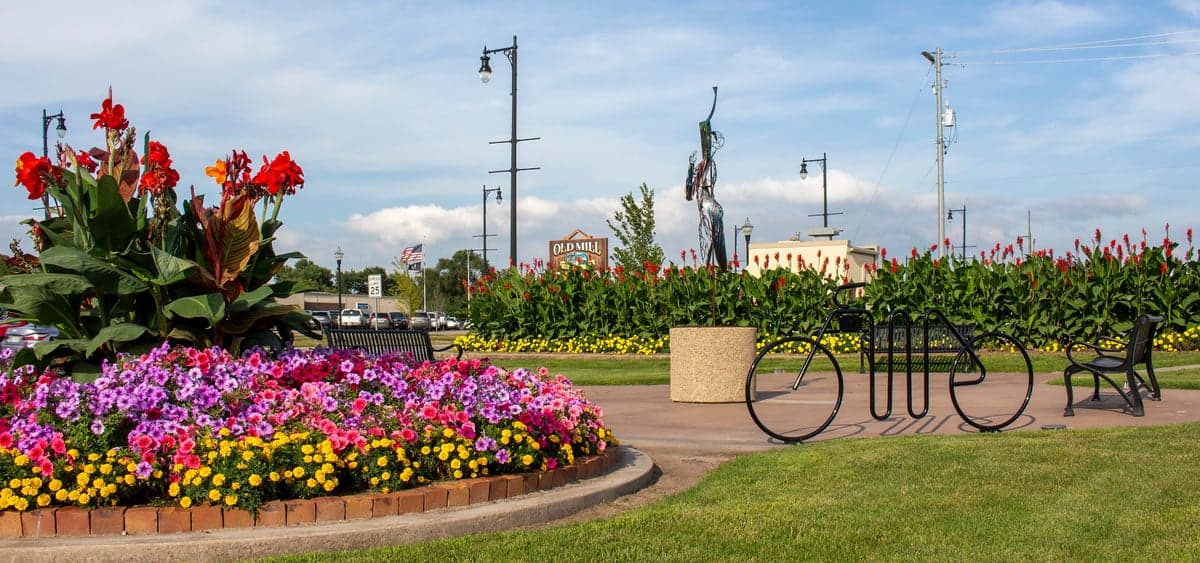
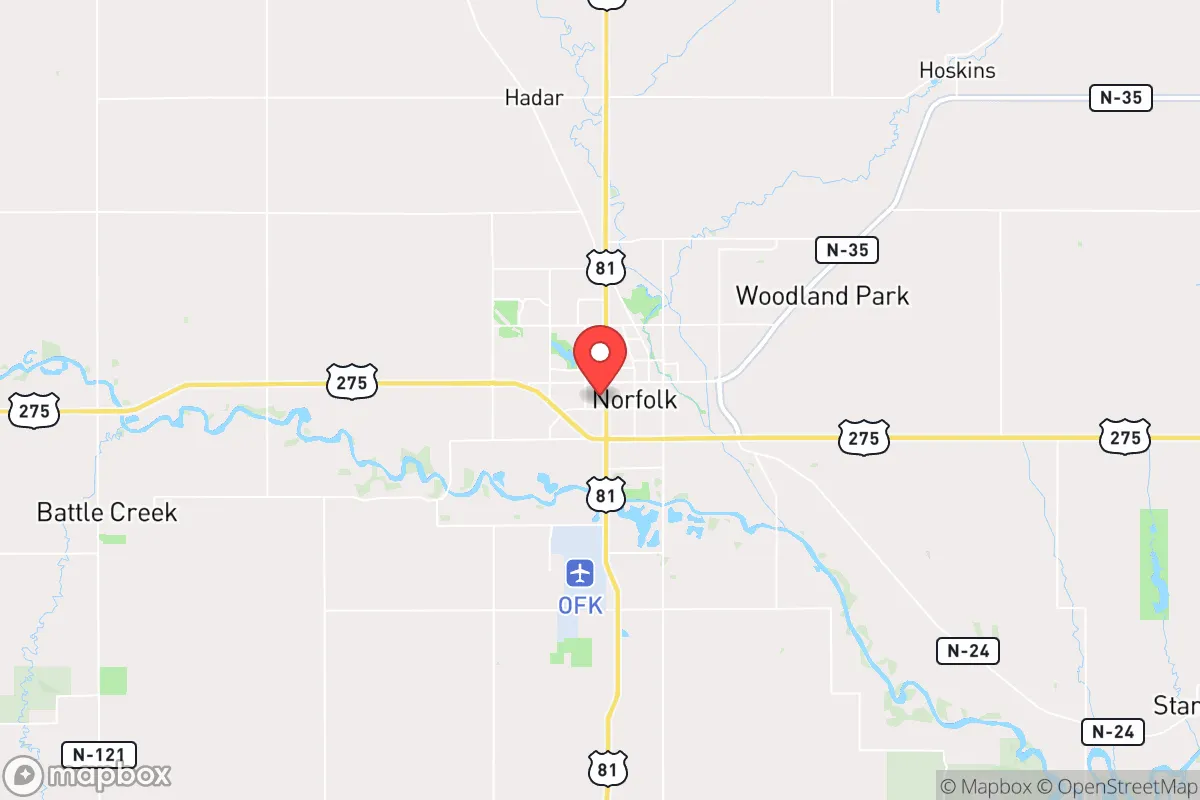
Photo: Wikipedia
Demographics of Norfolk, NE
Affluence Level in Norfolk, NE
A middle-class area roughly in line with national averages across income, home values, education, and employment.
People of Norfolk, NE
Norfolk, Nebraska, is a predominantly white, family-oriented community of 25,962 where a strong sense of local identity is rooted in its agricultural and manufacturing heritage. The city is notably more ethnically homogenous than the national average, with a Hispanic population of 14.5% representing the largest and most visible minority group, while Black (1.1%), East/Southeast Asian (0.8%), and Indian (0.1%) communities remain very small. The population is characterized by a lower-than-average college attainment rate of 24.0%, reflecting a workforce heavily concentrated in blue-collar and service-sector jobs. Residents often describe Norfolk as a safe, hardworking place where church involvement and high school sports are central to daily life.
How the city was settled and grew
Norfolk’s founding population was overwhelmingly of German and Czech descent, drawn by the Homestead Act of 1862 and the arrival of the Union Pacific Railroad in the 1870s. The city was platted in 1866, and its early growth was fueled by the surrounding agricultural economy—wheat, corn, and livestock. The original German settlers concentrated in the South Norfolk neighborhood, near the railroad tracks and the Elkhorn River, where they built St. Mary’s Catholic Church and established a tight-knit farming community. A second wave of Czech immigrants arrived in the 1880s and 1890s, settling primarily in the Northside area around what is now Norfolk Avenue, founding the Bohemian Cemetery and the Czech Hall. By 1900, the city’s population was nearly 90% of German or Czech ancestry, a demographic pattern that persisted through the mid-20th century. The post-World War II era brought a modest influx of veterans and their families, who filled new subdivisions like Skyline Park and Sunset Heights, but these were almost entirely white and native-born.
Modern era (post-1965)
The 1965 Immigration and Nationality Act had a minimal immediate effect on Norfolk. The city’s foreign-born population today stands at just 4.0%, well below the national average. The most significant demographic shift since the 1970s has been the growth of the Hispanic community, driven by labor demand in meatpacking and food processing. Tyson Foods opened a major beef processing plant in nearby Madison in the 1980s, and later a Norfolk facility, drawing Mexican and Central American workers. These families initially settled in the West Norfolk corridor along Highway 275, in older rental housing and mobile home parks, and later established a visible presence in the Downtown area, where several Mexican grocery stores and taquerias now operate. The Hispanic share of the population rose from under 2% in 1980 to 14.5% by 2020. Meanwhile, the Black population (1.1%) and East/Southeast Asian population (0.8%) remain tiny, largely composed of professionals working at Faith Regional Health Services or the regional USDA office. The Indian community (0.1%) is essentially negligible, consisting of a handful of medical and tech workers. Suburbanization has been modest, with newer subdivisions like Northridge Estates and Prairie View attracting mostly white families moving from older neighborhoods.
The future
Norfolk’s population is projected to grow slowly, likely reaching 27,000–28,000 by 2040, driven primarily by natural increase and continued Hispanic in-migration for meatpacking jobs. The Hispanic community is expected to grow to 20–22% of the population, with increasing assimilation into the broader community—second-generation Hispanic residents are already more likely to attend Norfolk Public Schools and participate in local sports. The white population is aging and declining slightly, as younger adults leave for larger cities like Omaha or Lincoln. The city is not tribalizing into distinct ethnic enclaves; rather, Hispanic families are dispersing across the city, with a growing presence in Skyline Park and Sunset Heights. The Black, East/Southeast Asian, and Indian communities are expected to remain very small, as Norfolk lacks the professional job base or cultural infrastructure to attract significant numbers. The city will likely remain a predominantly white, working-class community with a growing Hispanic minority, but without the ethnic diversity seen in larger Nebraska cities.
For someone moving to Norfolk now, the city offers a stable, safe, and culturally conservative environment where community ties are strong and change is gradual. The population is becoming slightly more diverse, but the pace is slow enough that the city’s character—rooted in its German-Czech heritage and agricultural economy—will remain intact for the foreseeable future. New residents should expect a place where church, family, and high school football define social life, and where the cost of living is low but cultural amenities are limited.

* Values derived from national, state, county, city and local statistics and may differ in a specific area. Last updated: 2026-04-23T02:30:40.000Z
Narrative content on this page is AI-generated and may contain mistakes. Verify any details that matter before acting on them.
ReloMaps may earn a commission from affiliate links at no extra cost to you.

