
Photo: Wikipedia
Strategic Assessment of Newberry, SC
Meaningful friction. Expect exposure to either population pressure, blast zones, or natural disaster risk. Consider buying a retreat property.
What does the Strategic Assessment tell us?
Our Strategic Assessment grades tactical survivability of an area. Major population centers, military targets, fallout zones, natural disasters, and border exposure all drive risk — lower exposure means a more defensible position in a crisis.
This is heavily inspired by Joel Skousen's Strategic Relocation book. Highly recommended you checkout the book ($)What does this tell us?
Our Strategic Assessment grades tactical survivability of an area. Major population centers, military targets, fallout zones, natural disasters, and border exposure all drive risk — lower exposure means a more defensible position in a crisis.
This is heavily inspired by Joel Skousen's Strategic Relocation book. Highly recommended you checkout the book ($)Strategic Pillars

Key Distances
Regional Safe Places
Below is our recommended "safe zones" in South Carolina and the surrounding area based on our strategic heuristics. For most people, it's unrealistic to live in a “safe zone” full-time due to work, family or other personal reasons. They tend to be more rural. However, many of these areas are perfect for second homes and retreat properties that double as a vacation home or even a short-term rental.
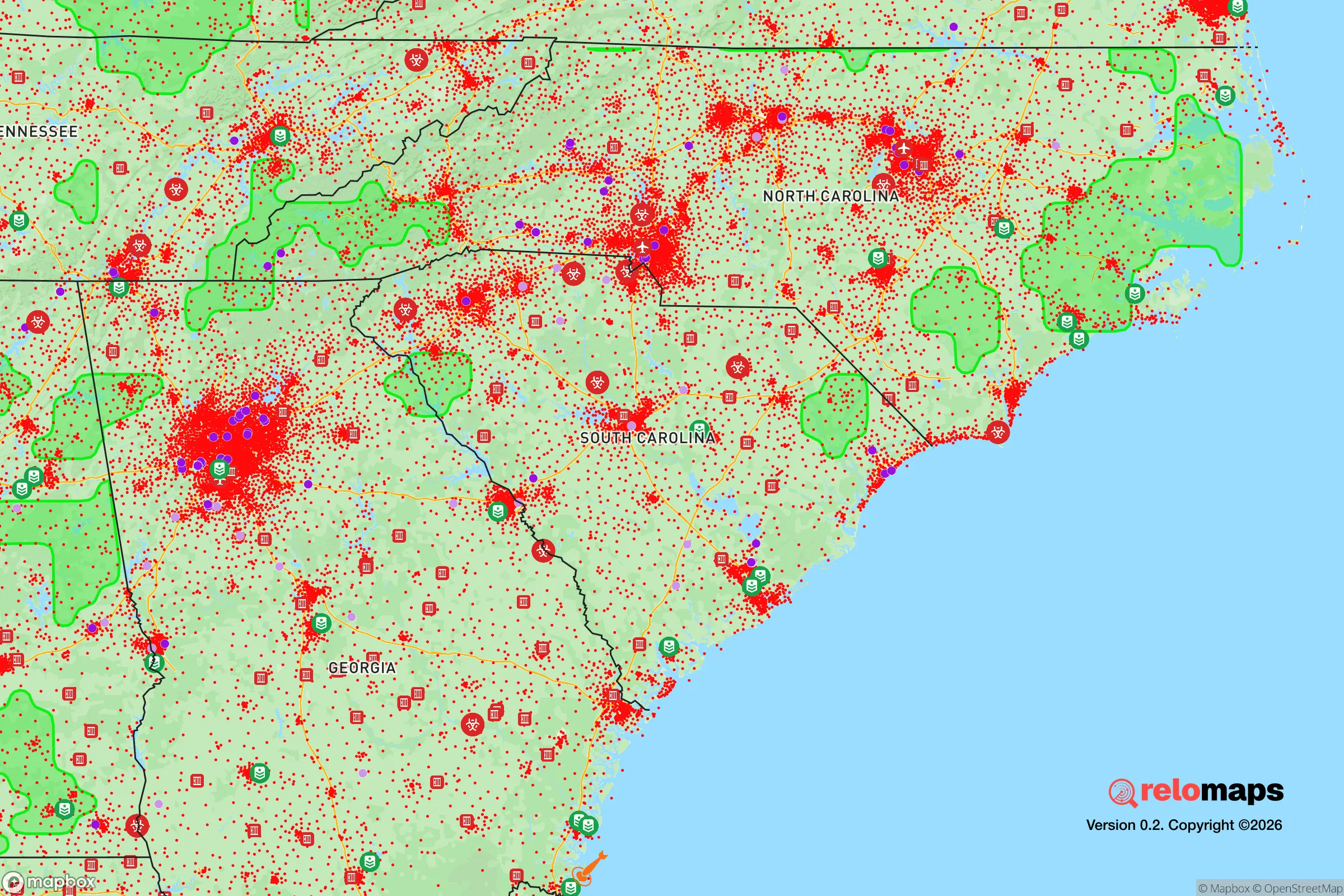
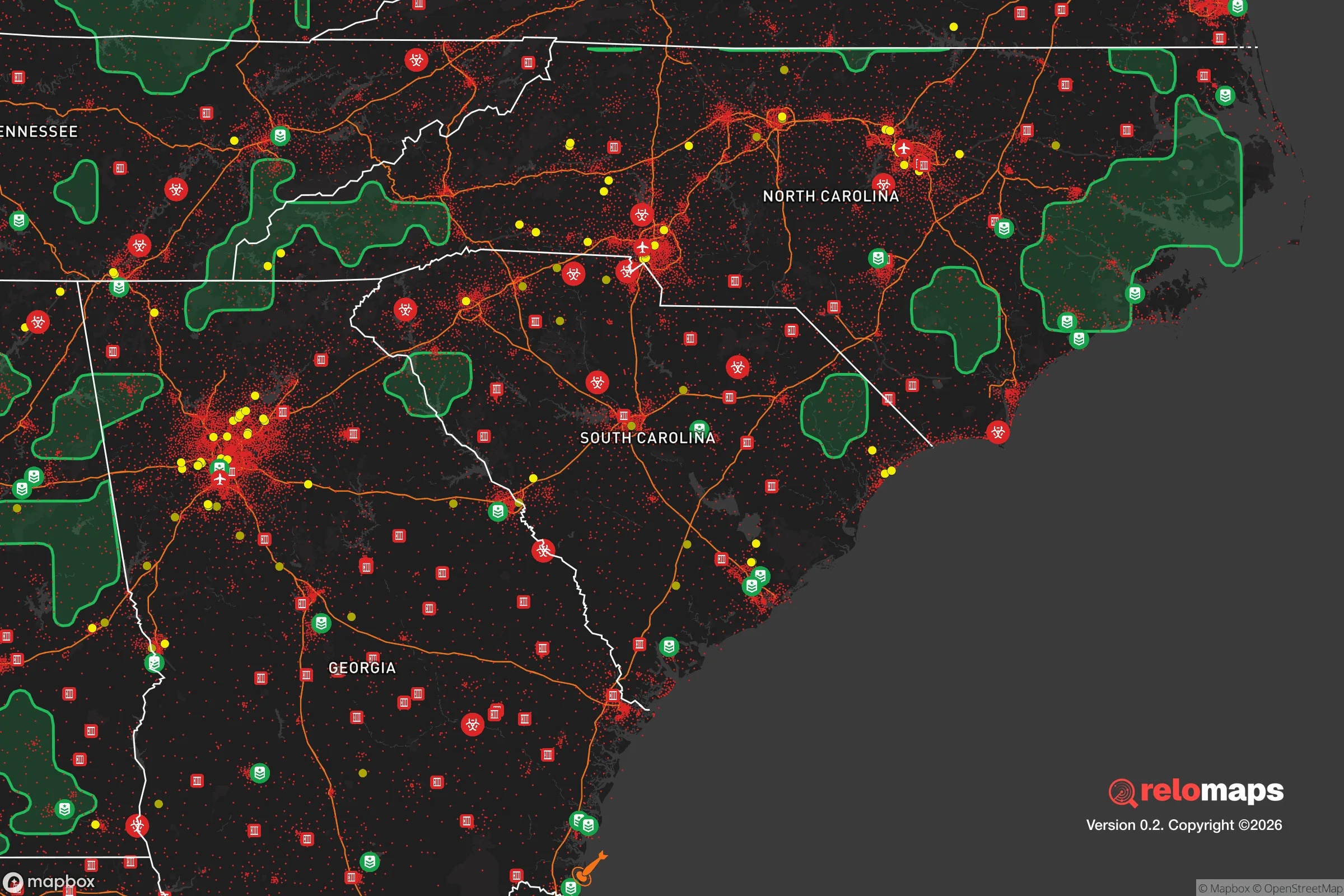


Important Note: For informational purposes only. This does not mean nothing bad ever happens in the green zones. Please use common sense. This is based on public data and modeled with AI. We tried to take a conservative approach but mistakes happen. We update this regularly as new information becomes available.
Solar Generator Recommendations
Backup power matters more here than in safer locations. We've picked three solar generators across budgets and capacity tiers — start with the budget unit if you only need a few essentials, or step up if you want to run a fridge and HVAC for days at a time.

Jackery Portable Power Station Explorer 300
Budget OptionPower on the Go: Weighing only 11 lbs, it's convenient to set up and store with book-sized foldable solar panels

BLUETTI Portable Power Station AC180
Designed for both indoor and outdoor scenarios, AC180 is highly capable as it has a robost capacity and continuous output power.

EF ECOFLOW DELTA Pro Ultra Power Station
Upgraded PickEcoFlow DELTA Pro Ultra is a whole-home energy system designed to grow with your family. Integrated with the Smart Home Panel 2, it scales to meet your evolving energy needs — keeping your home powered, intelligent, and secure through every stage of life.
We earn a commission, at no additional cost to you.
Strategic Assessment Analysis
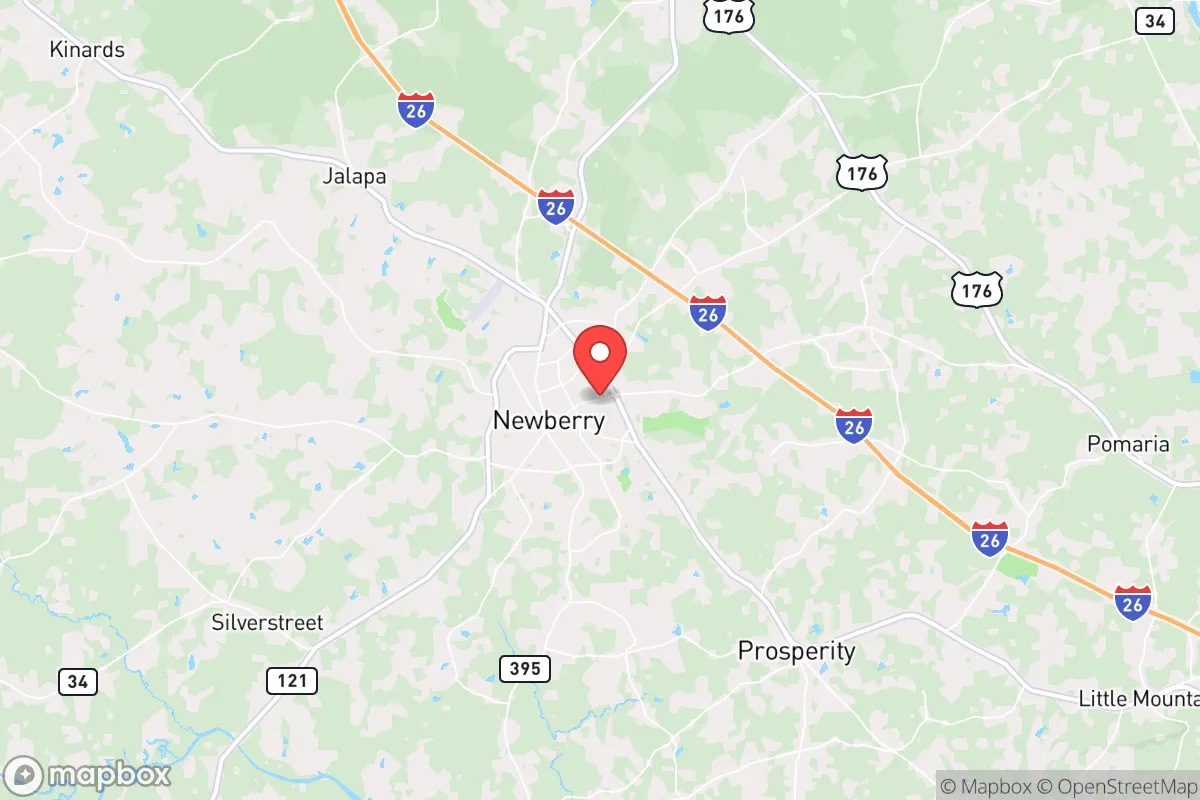
Newberry, South Carolina, sits in a sweet spot that resilience-minded relocators should take seriously: far enough from the major metro corridors to avoid the worst of cascading chaos, yet close enough to supply lines and logistical hubs to sustain a post-disruption household. The town’s position in the Piedmont region, roughly 40 miles northwest of Columbia and 70 miles southeast of Greenville, places it outside the blast-radius thinking of most strategic assessments, but inside a zone that offers genuine defensive depth. For someone weighing civic unrest, grid collapse, or mass-casualty scenarios, Newberry’s combination of low population density (around 11,000 in the city, 38,000 in the county), agricultural land, and water access makes it a candidate worth vetting—not a fortress, but a viable fallback position.
Geographic position and natural advantages for long-term stability
Newberry County sits on the fall line where the Piedmont meets the Coastal Plain, giving it a mix of rolling hills, clay soils, and hardwood forests that support both farming and defensive positioning. The area’s elevation averages around 500 feet, which is high enough to avoid the flooding risks that plague coastal South Carolina but low enough to keep winters mild—average January lows hover around 30°F, meaning no deep-freeze survival challenges. The Broad River runs along the county’s western edge, and the Saluda River forms part of the eastern boundary, providing two reliable surface water sources that don’t depend on municipal treatment plants. For a prepper household, that means you can draw, filter, and store water without relying on a grid-tied pump station. The surrounding countryside is a patchwork of family farms, timberland, and small pastures, which translates into local food production capacity that many suburban areas have lost entirely. Newberry’s position also places it outside the I-85 corridor’s high-traffic vulnerability zone—if a major event triggers mass evacuation from Charlotte or Atlanta, the main escape routes will clog on I-26 and I-85, but Newberry sits on secondary roads (US 76, SC 34) that offer alternate egress without funneling through a single chokepoint.
Risks, exposures, and proximity to fallout-relevant landmarks
No location is immune, and Newberry has specific vulnerabilities that a strategic relocator must weigh. The most obvious is the Savannah River Site (SRS), a nuclear weapons complex and waste storage facility roughly 70 miles southwest, near Aiken. While 70 miles provides significant standoff distance from a radiological release, the prevailing wind patterns in the Southeast generally blow from west to east, meaning a worst-case SRS incident could push a plume toward the Columbia basin and potentially affect Newberry’s air and water depending on the specific weather at the time. That’s a low-probability, high-consequence risk—worth monitoring but not disqualifying. More immediate is the proximity to Columbia (40 miles southeast), which is a state capital, a major university hub (USC), and a regional medical center. In a civil unrest scenario, Columbia would be a flashpoint for protests, supply chain disruptions, and potential federal law enforcement activity. Newberry’s distance means you’re outside the immediate riot radius, but you’re close enough that refugees or looters could filter outward along US 76 and I-26. The county’s own law enforcement presence is modest—the Newberry Police Department has about 30 officers, and the sheriff’s office covers the rest—so in a prolonged grid-down situation, you cannot rely on rapid response. The area also sits in a seismically quiet zone, with no active fault lines, and hurricane impacts are typically limited to tropical storm-force winds and heavy rain, not the catastrophic surge seen on the coast.
Practical resilience for a relocator: food, water, energy, and defensibility
For a household looking to establish a semi-self-sufficient base, Newberry offers tangible advantages. The county’s agricultural heritage means fertile soil and a growing season that runs from April to October—long enough for two crop cycles of staples like corn, beans, squash, and potatoes. Local farmers’ markets operate in Newberry proper and in nearby towns like Whitmire and Prosperity, giving you access to heirloom seeds and livestock genetics adapted to the region. Water is the stronger card: the Broad and Saluda Rivers are perennial, and the county’s groundwater table sits at 20–40 feet in most areas, making hand-dug wells or shallow boreholes feasible for a determined household. Rainwater catchment is also viable, with annual precipitation averaging 48 inches spread evenly across the year. On the energy side, Newberry County is served by Newberry Electric Cooperative, a member-owned utility that has a better track record of grid maintenance than investor-owned providers, but in a long-duration outage, solar panels with battery storage are the realistic play—the area gets about 210 sunny days per year, which is decent but not Arizona-level. Defensibility is mixed: the town itself is laid out on a traditional grid, which is hard to secure, but rural properties with tree lines, creek boundaries, and long driveways offer natural standoff. The county’s terrain is not mountainous, so you won’t get the high-ground advantage of the Appalachians, but the rolling hills and forested patches provide concealment and multiple lines of retreat. One underrated factor: Newberry’s low crime rate (violent crime is roughly half the national average) means you’re less likely to deal with pre-disaster theft or home invasion, which gives you time to build your stockpile and harden your property before things deteriorate.
The overall strategic picture for Newberry is that of a credible secondary position—not a bug-out destination for a national collapse, but a place where a prepared household can ride out regional disruptions with a reasonable margin of safety. Its weaknesses are the proximity to Columbia’s unrest potential and the distant but real SRS risk; its strengths are water abundance, agricultural capacity, and a low-profile community that won’t attract attention. For a conservative-leaning relocator who wants to stay within a few hours of Southeast supply chains while maintaining the ability to go dark and self-sustain, Newberry deserves a serious look. It won’t make you invulnerable, but it will give you options—and in the world we’re heading into, options are the only real currency.

* Values derived from national, state, county, city and local statistics and may differ in a specific area. Last updated: 2026-04-29T19:22:07.000Z
Narrative content on this page is AI-generated and may contain mistakes. Verify any details that matter before acting on them.
ReloMaps may earn a commission from affiliate links at no extra cost to you.

