Photo: Wikipedia
Demographics of Newberry, SC
Affluence Level in Newberry, SC
A low-income area with significant economic hardship. Household wealth and educational attainment are well below national averages.
People of Newberry, SC
Newberry, South Carolina, is a small city of 10,733 residents with a distinctive biracial character: 40.2% White and 41.4% Black, alongside a rapidly growing Hispanic population of 15.8% and a small East/Southeast Asian community at 0.7%. The city’s identity is shaped by its deep Southern roots, a historically Black middle class, and a newer wave of Hispanic immigrants drawn to manufacturing and agriculture. With 22.7% of adults holding a college degree, Newberry is more working-class than its college-town neighbors, and its population is slowly diversifying as younger families move into established neighborhoods.
How the city was settled and grew
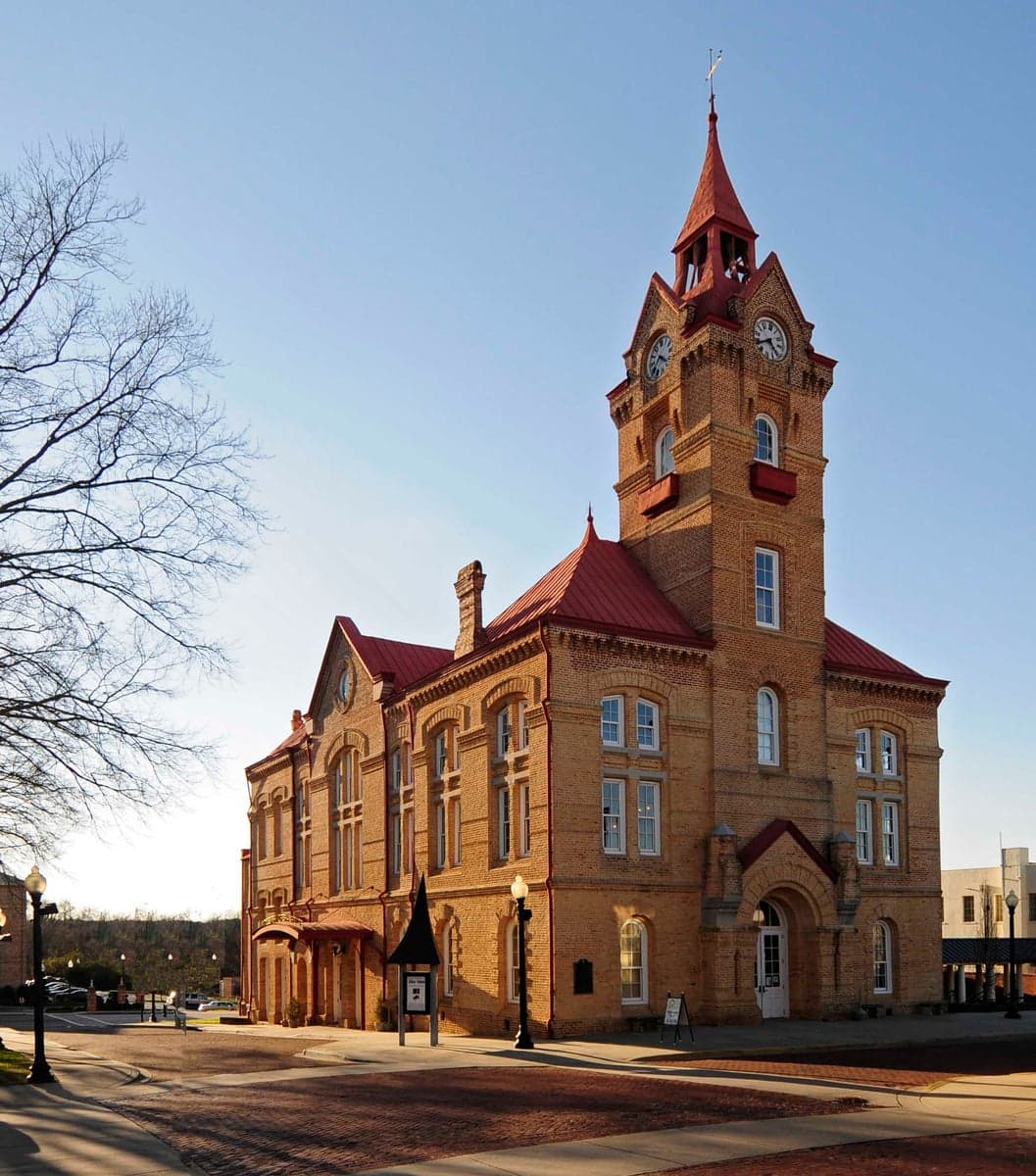
Newberry was founded in the 1780s as a frontier outpost for Scotch-Irish and German settlers moving inland from Charleston. These early families, many of them small farmers and merchants, built the original town around the courthouse square in what is now Downtown Newberry, where historic churches and antebellum homes still stand. After the Civil War, newly freed Black families established independent communities on the outskirts, most notably in Gary Street and Boundary Street neighborhoods, which became the heart of the city’s African American population. The arrival of the railroad in the 1850s and the rise of textile mills in the early 1900s drew additional White and Black workers, with mill villages like Molly’s Pond and Oakland Mill Village housing segregated but stable working-class communities through the mid-20th century.
Modern era (post-1965)
The post-1965 period brought significant demographic shifts. The Immigration and Nationality Act opened doors for new arrivals, but Newberry’s foreign-born population remained small until the 1990s, when Hispanic workers began arriving for jobs in poultry processing and construction. Today, the 8.5% foreign-born share is heavily Hispanic, concentrated in the College Street Extension area and along the Wilson Road corridor, where new apartment complexes and mobile home parks have absorbed the influx. Meanwhile, the city’s Black population, which was historically centered in Gary Street and Boundary Street, has seen some outward movement to newer subdivisions like Springfield Estates as middle-class families sought larger lots. The White population has declined slightly since 2000, with many older residents aging in place in Downtown and the historic Holland Avenue district, while younger White families often commute to jobs in Columbia or Greenville rather than settling in Newberry proper.
The future
Newberry’s population is slowly becoming more Hispanic and more diverse, but the city is not homogenizing. The Hispanic community is growing steadily—up from roughly 8% in 2010 to 15.8% today—and is concentrated in specific enclaves rather than dispersing citywide. The Black and White populations are both aging, with younger adults often leaving for larger job markets. The East/Southeast Asian community remains tiny at 0.7%, with no Indian subcontinent population recorded, and no signs of rapid growth from either group. Over the next 10–20 years, Newberry is likely to see continued Hispanic in-migration, a stable or slightly declining Black share, and a White population that holds steady due to retirees and remote workers attracted to lower housing costs. The city is not tribalizing into hostile enclaves, but distinct residential patterns by race and income are likely to persist.
For someone moving to Newberry now, the city offers a quiet, affordable Southern lifestyle with a genuinely biracial social fabric and a growing Hispanic presence. It is not a melting pot but a place where distinct communities coexist, each with its own history and neighborhood anchors. New arrivals should expect a slower pace, lower costs, and a population that is more rooted and less transient than in fast-growing suburbs.

* Values derived from national, state, county, city and local statistics and may differ in a specific area. Last updated: 2026-04-29T19:22:07.000Z
Narrative content on this page is AI-generated and may contain mistakes. Verify any details that matter before acting on them.
ReloMaps may earn a commission from affiliate links at no extra cost to you.

