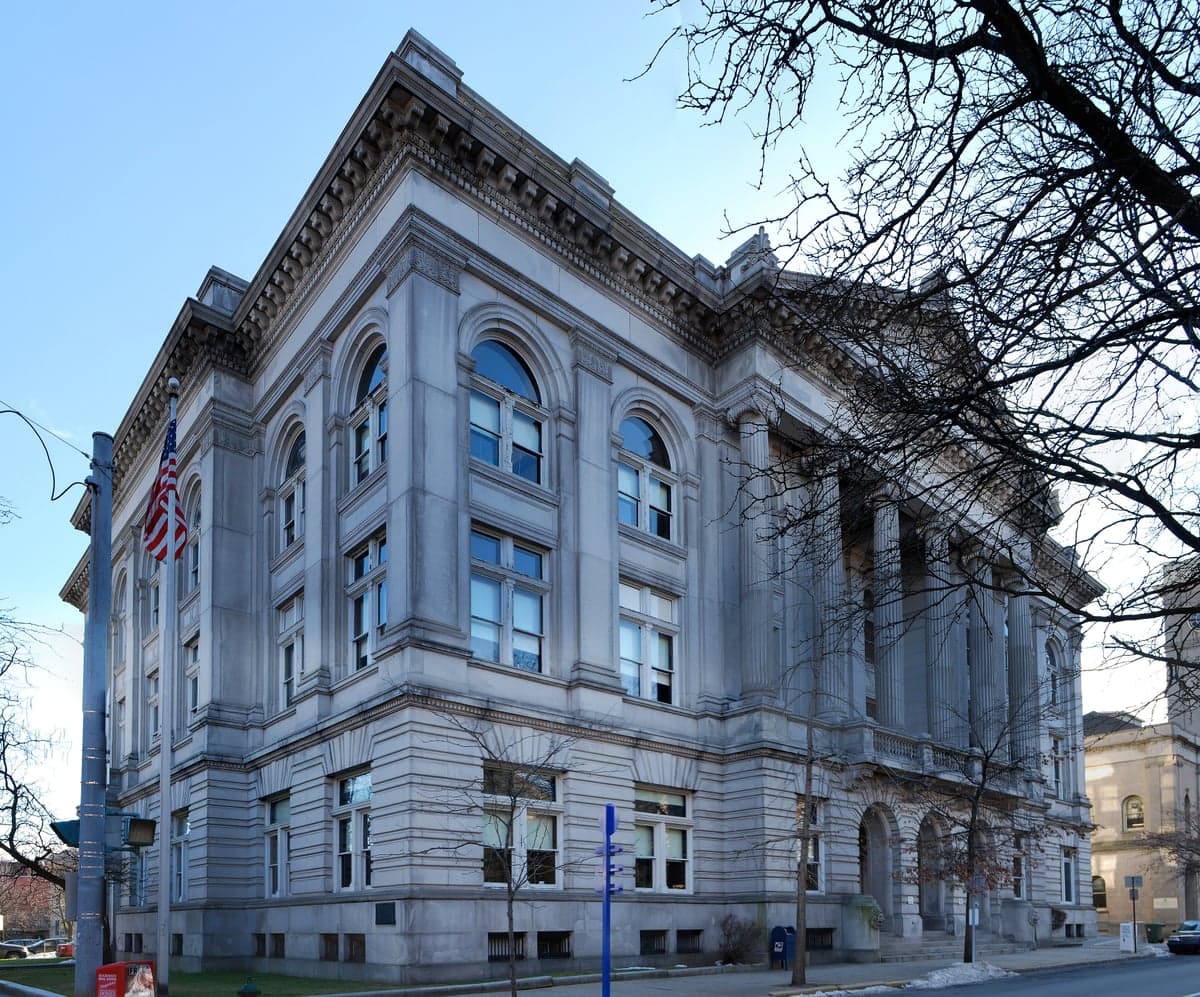
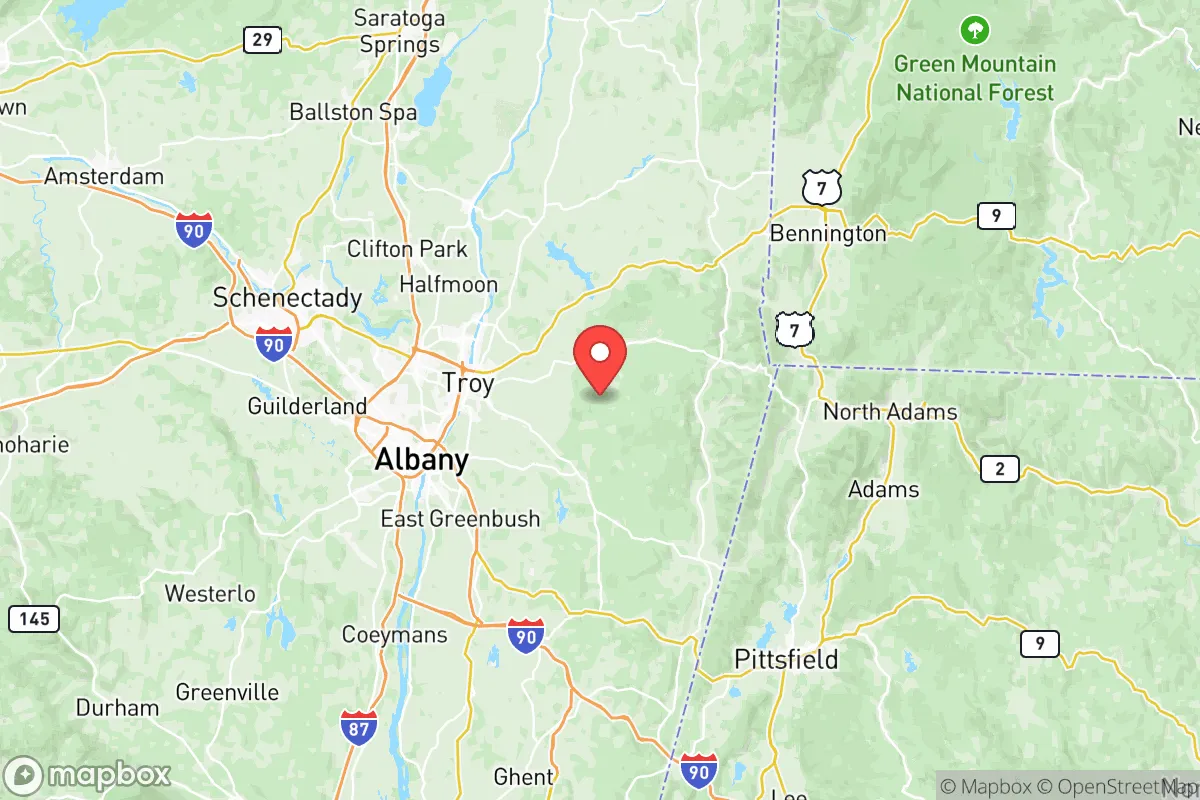
Photo: Wikipedia
Demographics of Rensselaer County
Affluence Level in Rensselaer County
A middle-class area roughly in line with national averages across income, home values, education, and employment.
People of Rensselaer County
The people of Rensselaer County, New York, today number roughly 160,000, forming a predominantly white (79.8%) and notably less diverse population than the national average, with a foreign-born share of just 2.9%. The county’s identity is shaped by its historic role as a manufacturing and industrial powerhouse anchored by the city of Troy, balanced against a rural eastern half of farms and small towns. Residents are slightly more college-educated than the national average at 37.3%, and the population carries a distinct Upstate New York character — rooted in old industrial wealth, Catholic and Protestant immigrant traditions, and a quiet, self-reliant civic culture that leans conservative relative to the state as a whole.
Settlement & growth (pre-1960)
Before European colonization, the area now known as Rensselaer County was the homeland of the Mohican (Mahican) people, an Algonquian-speaking nation whose settlements lined the Hudson River and its tributaries. The Mohicans traded with the Dutch after Henry Hudson’s 1609 voyage, but by the 1620s, the Dutch West India Company began granting vast patroonships along the river. The entire county was once part of the Van Rensselaer patroonship, a feudal-style estate that attracted Dutch farmers and tradesmen to settlements like Troy and Rensselaer (originally Greenbush) as early as the 1630s. The Dutch left a lasting imprint on the land — place names, church congregations, and a stubborn independence that would later define the region’s politics.
After the English took control in 1664, the area remained sparsely populated by Dutch-descended farmers for another century. The American Revolution brought a wave of New England Yankees — primarily of English and Scots-Irish stock — who crossed the border from Massachusetts and Connecticut into the county’s eastern towns, founding Hoosick, Petersburgh, and Berlin in the 1760s and 1770s. These Yankees were Congregationalist, commercially minded, and clashed culturally with the old Dutch patroon system. By 1800, the county’s population was a mix of Dutch, English, and Scots-Irish, with a small number of free Black families concentrated in Troy.
The 19th century transformed Rensselaer County into an industrial magnet. Troy became a national center for iron production, collar and cuff manufacturing, and later, steel. The Erie Canal’s completion in 1825 and the arrival of railroads made Troy a hub for raw materials and finished goods. This industrial boom pulled in massive waves of Irish immigrants fleeing the Great Famine in the 1840s and 1850s. The Irish settled heavily in Troy’s working-class neighborhoods — South Troy, the “Burgh” (Troy’s Fifth Ward) — and in the mill villages of Cohoes and Watervliet. They built St. Peter’s Church, founded the city’s Democratic machine, and by 1860, the Irish made up roughly a quarter of Troy’s population.
German immigrants arrived in significant numbers from the 1840s through the 1880s, drawn by the same industrial jobs and by farmland in the county’s eastern towns. Germans settled in Troy’s North Central neighborhood and in the village of Castleton-on-Hudson, where they worked in brickmaking and river transport. They established Lutheran and Catholic parishes, breweries, and social clubs that persisted well into the 20th century. A smaller wave of French-Canadians crossed from Quebec in the 1860s-1890s to work in Troy’s textile mills, settling in the “Little Canada” district near the Poesten Kill.
The turn of the century brought Eastern and Southern Europeans. Italian immigrants — primarily from Sicily and Calabria — arrived between 1890 and 1920, taking jobs in construction, masonry, and the city’s iron foundries. They concentrated in Troy’s “Little Italy” along River Street and in the Lansingburgh neighborhood. Polish immigrants followed a similar timeline, settling in North Greenbush and Troy’s Sixth Ward, where they founded St. Joseph’s Church and a strong Catholic school system. Jewish immigrants from Russia and Poland established a small but influential community in Troy, centered on the “Jewtown” district around Second Street, with synagogues and kosher markets that lasted through the mid-20th century.
African Americans had a continuous presence in Rensselaer County since the colonial period, but the population remained small — under 2% until the Great Migration. Between 1910 and 1950, Black families moved from the rural South to Troy and Albany (just across the Hudson) for industrial jobs, settling in Troy’s downtown and the “Hill” neighborhood. The county’s Black population grew slowly, reaching about 3% by 1960, constrained by housing discrimination and the region’s relatively modest industrial base compared to Buffalo or Detroit.
Modern era (post-1965)
The 1965 Hart-Cellar Act had a muted effect on Rensselaer County compared to the nation as a whole. The county’s foreign-born population today stands at just 2.9%, far below the national average of roughly 14%. The most significant post-1965 immigrant group has been East and Southeast Asian communities — primarily Chinese, Korean, and Vietnamese — who began arriving in the 1980s and 1990s, drawn by professional opportunities at Rensselaer Polytechnic Institute (RPI) in Troy and the Albany-area healthcare sector. These families settled in Troy’s downtown and in the suburban towns of Brunswick and East Greenbush, where good schools and newer housing stock attracted them. The Asian share of the county’s population is 2.1% as of the most recent data.
Indian subcontinent immigrants — from India, Pakistan, and Bangladesh — arrived in smaller numbers, primarily as professionals in engineering and medicine. They now make up 1.0% of the county’s population, with a visible concentration in East Greenbush and the RPI-adjacent neighborhoods of Troy. The Hispanic population, at 5.9%, grew steadily from the 1990s onward, driven by Puerto Rican migration and, more recently, by Mexican and Central American families working in construction, landscaping, and food service. Hispanic residents are dispersed across the county, with modest clusters in Troy’s South End and in Rensselaer city.
Domestic migration patterns since 1970 have been dominated by suburbanization and population loss in the old industrial cities. Troy’s population peaked at over 72,000 in 1950 and has since fallen to roughly 50,000, as white working-class families moved to the surrounding towns of Brunswick, North Greenbush, and Schaghticoke. These towns grew rapidly in the 1970s-1990s, developing strip malls, new school districts, and a car-dependent suburban lifestyle. The county’s overall population has been nearly flat since 2000, hovering around 160,000, as out-migration of young adults to the Sun Belt has been partially offset by in-migration of retirees and commuters to Albany.
The future
Rensselaer County is likely to remain a predominantly white, low-immigration region over the next 10-20 years, but with gradual diversification. The Hispanic share is projected to rise to 8-10% by 2040, driven by natural increase and continued labor migration. The East/Southeast Asian and Indian populations will grow modestly, tied to RPI’s ability to attract international students and retain them as professionals. The Black population share is expected to remain stable or decline slightly, as younger Black residents continue to leave for larger metro areas with more economic opportunity.
The most significant demographic trend is aging. The county’s median age is above the national average, and the 65+ population is growing as younger adults leave for jobs in the South and West. This will put pressure on housing markets — demand for smaller homes, senior apartments, and assisted living in Wynantskill, West Sand Lake, and other suburban hamlets will rise — while school enrollments in districts like Brunswick and East Greenbush may continue to shrink. The county’s cultural identity will remain rooted in its Dutch, Irish, Italian, and Yankee heritage, with a conservative-leaning political character that contrasts with the more liberal city of Albany across the river.
For someone moving in now, Rensselaer County offers a stable, low-crime, family-oriented environment with good schools in the eastern suburbs and a slower pace of life than the national average. The population is not becoming dramatically more diverse or cosmopolitan; it is becoming older, more suburban, and more settled. New residents will find a place where the old ethnic neighborhoods of Troy still hold memory, but the future is being written in the subdivisions of Brunswick and the commuter corridors of East Greenbush.

* Values derived from national, state, county, city and local statistics and may differ in a specific area. Last updated: 2026-08-24T16:31:13.000Z
Narrative content on this page is AI-generated and may contain mistakes. Verify any details that matter before acting on them.
ReloMaps may earn a commission from affiliate links at no extra cost to you.

