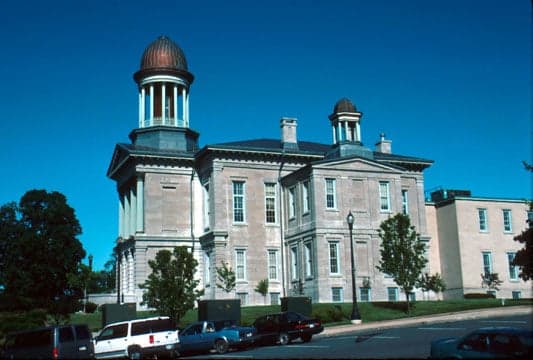
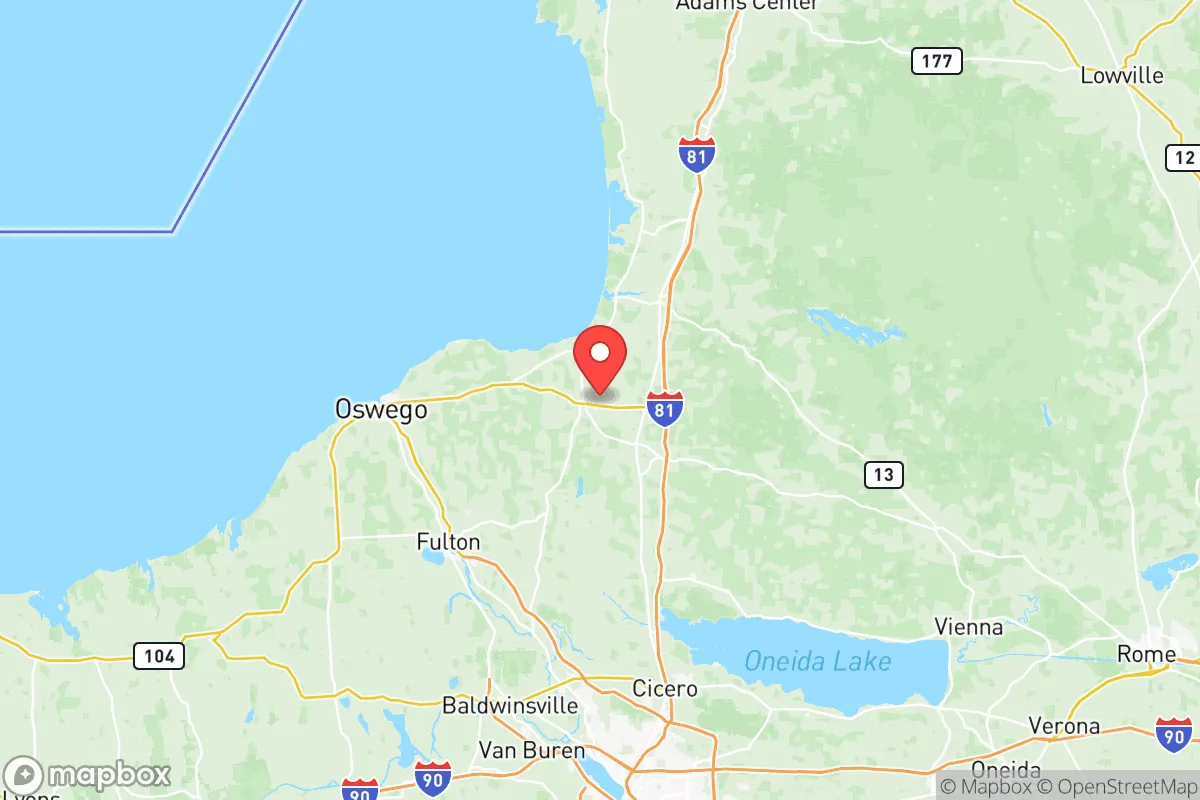
Photo: Wikipedia
Demographics of Oswego County
Affluence Level in Oswego County
A middle-class area roughly in line with national averages across income, home values, education, and employment.
People of Oswego County
The people of Oswego County, New York, today number 117,945 and form one of the most ethnically homogeneous populations in the state, with 91.6% of residents identifying as white alone. The county's character is defined by its working-class roots in manufacturing, agriculture, and the Port of Oswego, combined with a strong sense of place rooted in small cities like Fulton and Oswego and numerous rural hamlets. With a foreign-born population of just 0.7% and a college attainment rate of 21.9%, Oswego County remains a predominantly native-born, blue-collar region where family ties to the area often stretch back generations.
Settlement & growth (pre-1960)
The original inhabitants of the region were the Haudenosaunee, particularly the Onondaga and Oneida nations, who used the Oswego River corridor for trade and fishing. French explorers and Jesuit missionaries arrived in the mid-17th century, establishing Fort Oswego in 1727 as a strategic fur-trading post on Lake Ontario. British control followed after the French and Indian War, but significant American settlement did not begin until after the Revolutionary War, when New Englanders—primarily from Massachusetts and Connecticut—poured into the region under land grants from the state of New York.
The first major wave of American settlers arrived between 1790 and 1820, clearing forests and establishing farms in what would become the towns of Mexico, Williamstown, and Richland. These early settlers were overwhelmingly of English and Scots-Irish stock, and they laid the foundation for the county's Protestant, rural character. The opening of the Oswego Canal in 1828, connecting the Erie Canal to Lake Ontario, transformed the county's economy and demographics. The port city of Oswego became a major transshipment point for grain and lumber, drawing Irish immigrants who dug the canal and later worked the docks. By 1850, Irish Catholics made up a substantial portion of Oswego's population, and St. Mary's Church became a cornerstone of the city's Irish community.
The second major wave came with German immigration between 1840 and 1880. German farmers settled in the fertile lake plains around Fulton and Hannibal, while German craftsmen and merchants established themselves in Oswego city. The German Methodist and Lutheran churches that dot the county's rural landscape date from this period. Simultaneously, the paper and textile industries that grew along the Oswego River—particularly in Fulton and Phoenix—attracted French-Canadian workers from Quebec starting in the 1870s. These French-Canadian families, often seasonal laborers who later settled permanently, gave Fulton a distinctive Franco-American character that persists in family names and the annual St. Jean Baptiste celebrations.
Italian and Polish immigrants arrived in smaller numbers between 1890 and 1920, primarily to work in the growing paper mills of Fulton and the foundries of Oswego. The Italian community concentrated in Oswego's east side, while Polish families settled in the mill neighborhoods of Fulton. A small but notable community of Syrian and Lebanese Christian merchants also established themselves in Oswego city during this period, operating dry goods stores and restaurants. By 1930, the county's population had reached roughly 90,000, and its ethnic mosaic—English, Irish, German, French-Canadian, Italian, Polish, and Syrian—was largely set. The Great Depression and World War II slowed immigration dramatically, and the post-war period saw little new foreign settlement.
Modern era (post-1965)
The 1965 Hart-Cellar Act, which reshaped American immigration nationwide, had almost no effect on Oswego County. The county's foreign-born population today stands at just 0.7%, compared to the national average of roughly 14%. No significant new immigrant enclaves formed in the post-1965 period. Instead, the county's demographic story since the 1970s has been one of domestic out-migration and gradual aging. The decline of manufacturing—particularly the closure of Miller Brewing in Fulton in 1994 and the downsizing of paper mills—led to a steady loss of young adults, who moved to Albany, Syracuse, or the Sun Belt for work.
The Hispanic population, now 3.2% of the county, grew modestly from near zero in 1990, driven primarily by Puerto Rican families moving from New York City and by Mexican migrant workers employed in the county's apple orchards and vegetable farms around Oswego Town and Volney. These families are dispersed rather than concentrated in a single neighborhood. The Black population, at 1.0%, is largely composed of military families stationed at Fort Drum (just outside the county in Jefferson County) and a small number of professionals at SUNY Oswego. The East/Southeast Asian population (0.6%) is almost entirely connected to SUNY Oswego, with faculty and graduate students living near the campus. The Indian-subcontinent population (0.2%) is similarly small and university-linked.
Suburbanization within the county has been modest. The city of Oswego has lost population since its 1950 peak of 23,000, while the surrounding town of Oswego and the village of Mexico have seen slight growth as commuters seek rural homes within driving distance of Syracuse. The county's population peaked at 124,000 in 1980 and has declined slowly since, dropping to 117,945 by the 2020 census.
The future
Oswego County is projected to continue its slow population decline over the next 10-20 years, driven by an aging population and the out-migration of young adults. The county's median age is already above the state average, and the school-age population has been shrinking for two decades. Diversity will increase only marginally: the Hispanic share may rise to 5-6% by 2040 through natural increase and continued agricultural migration, but the county will remain overwhelmingly white and native-born. The East/Southeast Asian and Indian populations will likely remain tiny and tied to SUNY Oswego.
The county's cultural identity is evolving slowly. The old Franco-American and Polish ethnic identities that defined Fulton and Oswego are fading as younger generations intermarry and move away. What is emerging is a broader "North Country" identity—rural, self-reliant, and politically conservative—that is more about geography and lifestyle than ethnic heritage. The county's few new residents are overwhelmingly domestic migrants from downstate New York and New Jersey, drawn by low housing costs and lake access. These newcomers tend to settle in lakefront communities like Sandy Creek and Pulaski, where they buy seasonal or retirement homes.
For someone moving to Oswego County now, the region offers a stable, safe, and affordable environment where community ties are strong but diversity is minimal. The population is not becoming younger or more diverse in any meaningful way. What the county offers instead is continuity: a place where the same family names have been on the same land for 150 years, where the rhythms of lake and river still shape daily life, and where the biggest demographic change is the slow ticking of the clock.

* Values derived from national, state, county, city and local statistics and may differ in a specific area. Last updated: 2026-08-14T12:32:11.000Z
Narrative content on this page is AI-generated and may contain mistakes. Verify any details that matter before acting on them.
ReloMaps may earn a commission from affiliate links at no extra cost to you.

