 Popular
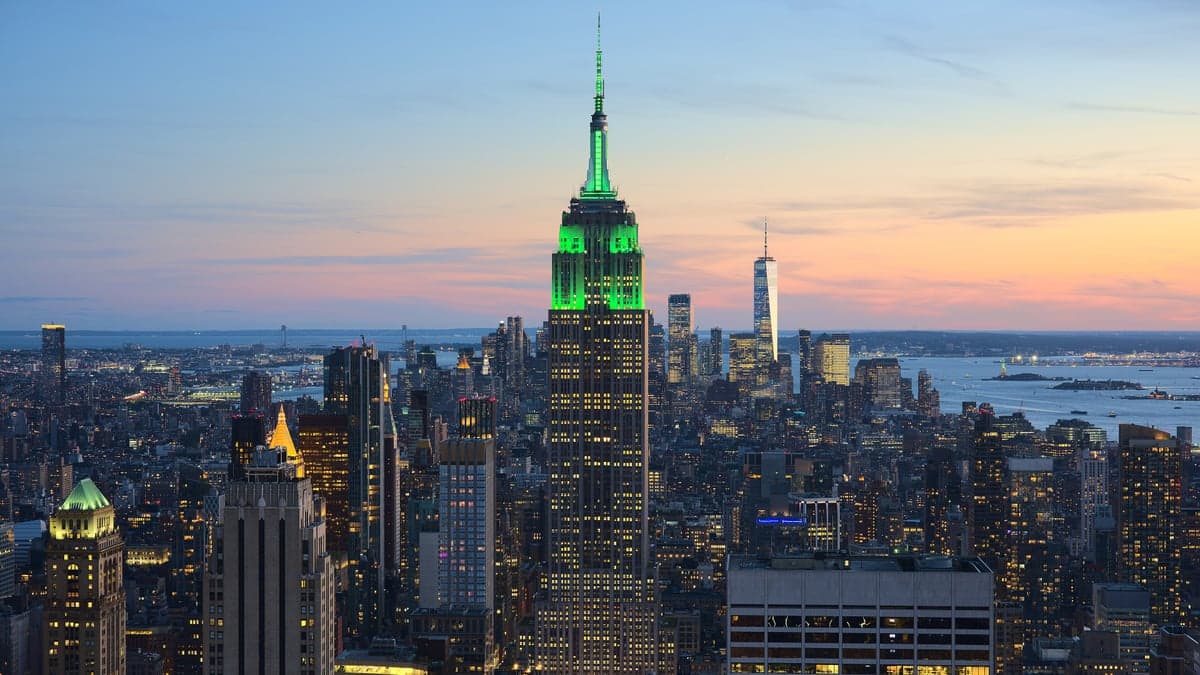
Photo: Wikipedia
Demographics of New York City, NY
Affluence Level in New York City, NY
A middle-class area roughly in line with national averages across income, home values, education, and employment.
People of New York City, NY
Today, New York City is home to 8,516,202 people, making it the most densely populated major city in the United States. Its population is a complex mosaic: 31.3% White, 28.4% Hispanic, 20.8% Black, 10.0% East and Southeast Asian, and 4.5% Indian (subcontinent), with 15.0% foreign-born. The city’s character is defined by its relentless pace, its role as a global economic hub, and a cultural identity forged by successive waves of immigration that have layered distinct communities across its five boroughs.
How the city was settled and grew
New York City’s human history begins with the Lenape people, who inhabited the region for centuries before European contact. The Dutch West India Company founded New Amsterdam in 1624 on the southern tip of Manhattan, establishing a fur-trading post that attracted a mix of Dutch, Walloon, and English settlers. The English seized the colony in 1664, renaming it New York, and the city grew as a deep-water port and commercial center. The 19th century brought the first massive wave of immigration: Irish fleeing the Great Famine (1840s–1850s) settled in the Five Points and later Lower East Side neighborhoods, while Germans arrived in large numbers, establishing communities in Kleindeutschland (today’s East Village and Lower East Side). By the late 1800s, Eastern European Jews and Italians poured in, transforming the Lower East Side into a dense tenement district. These groups provided the labor for the city’s garment industry, docks, and construction, and their descendants remain a significant part of the city’s cultural fabric.
Modern era (post-1965)
The Immigration and Nationality Act of 1965 fundamentally reshaped New York’s population. The city’s White share, which had been over 80% in 1950, declined sharply as domestic out-migration to suburbs accelerated and new immigration diversified the city. The Chinatown neighborhood in Manhattan expanded rapidly, absorbing waves of Chinese immigrants from Hong Kong and Fujian province, while Flushing, Queens became a major hub for East and Southeast Asian communities, including Chinese, Korean, and Taiwanese immigrants. The Indian subcontinent population, now 4.5% of the city, concentrated heavily in Jackson Heights, Queens and Richmond Hill, creating vibrant enclaves of Indian, Pakistani, Bangladeshi, and Nepali businesses and temples. Hispanic immigration, primarily from Puerto Rico (a U.S. territory since 1917) and later the Dominican Republic, Mexico, and Central America, transformed neighborhoods like Washington Heights (Dominican) and Bushwick, Brooklyn (Puerto Rican and later Mexican). The Black population, which peaked at roughly 25% in the 1970s, has declined to 20.8% as some families moved to Southern suburbs, while new African and Caribbean immigrants have replenished areas like Flatbush, Brooklyn (West Indian) and Harlem (increasingly gentrifying). The city’s college-educated share now stands at 41.0%, reflecting a long-term trend of attracting young professionals to neighborhoods like Williamsburg and Long Island City.
The future
New York City’s population is projected to remain stable or grow slowly, driven by international immigration rather than domestic in-migration. The White share is likely to continue its gradual decline, while the Hispanic and East/Southeast Asian shares are expected to increase modestly. The Indian subcontinent population is growing rapidly, particularly in Queens, and is dispersing beyond traditional enclaves into neighborhoods like Astoria and Sunset Park. The city is becoming more diverse internally, with mixed-race and multi-ethnic identities rising. Gentrification continues to push lower-income residents to outer boroughs and northern suburbs, while high housing costs constrain family formation. The cultural identity of New York is evolving from a city of distinct ethnic enclaves toward a more fluid, cosmopolitan mix, though neighborhood-level clustering remains strong.
For someone moving in now, New York City offers unparalleled economic opportunity and cultural density, but at a high cost of living and with increasing economic stratification. The city remains a magnet for ambitious individuals and families seeking global connectivity, but the era of cheap rents and spontaneous neighborhood change is largely over. The next decade will likely see continued diversification, with East/Southeast Asian and Indian communities growing their footprint, while the city’s overall character remains that of a fast-paced, high-stakes global capital.

* Values derived from national, state, county, city and local statistics and may differ in a specific area. Last updated: 2026-08-13T19:18:24.000Z
Narrative content on this page is AI-generated and may contain mistakes. Verify any details that matter before acting on them.
ReloMaps may earn a commission from affiliate links at no extra cost to you.

