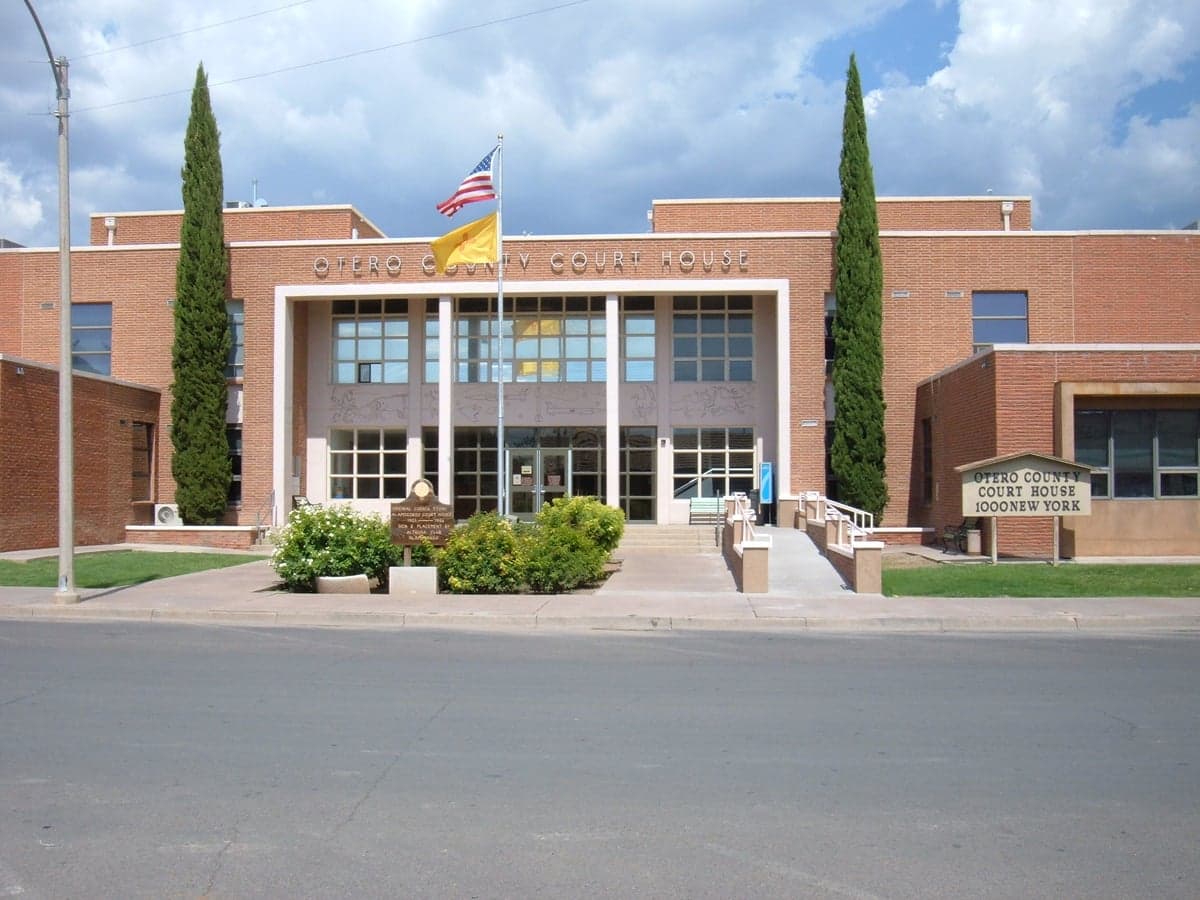
Photo: Wikipedia
Political ClimatePolitical Climate in Otero County
Showing district-level results — no local-only data available.
Local Political AnalysisPolitical Analysis of Otero County
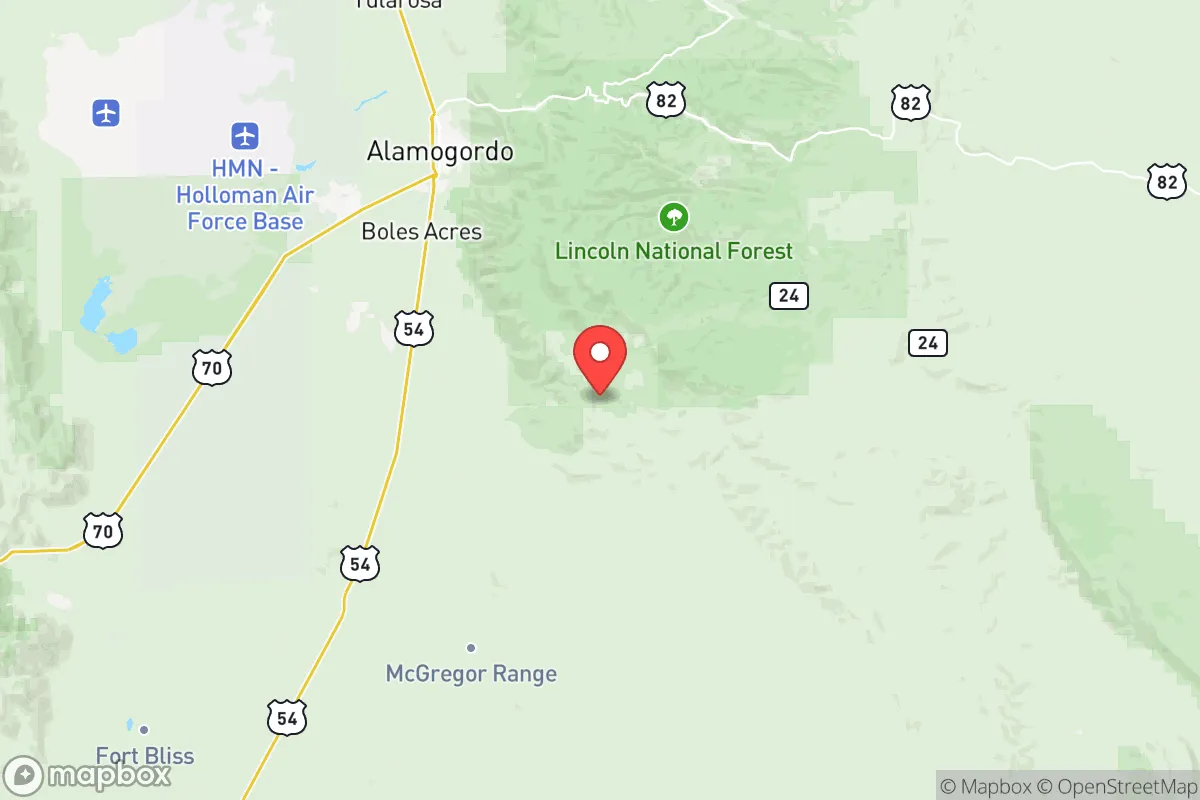
Otero County is one of New Mexico's most politically competitive areas, with a Cook Partisan Voting Index of EVEN that makes it a true bellwether in a state that leans Democratic overall (D+3). The county has been trending slightly more Republican in recent cycles, but it's far from a lock for either party — Alamogordo, the county seat and largest city, is the key battleground, with its northern precincts often leaning blue while the southern and eastern parts of the county are reliably red. The unincorporated community of Tularosa tends to vote more conservatively, while the village of Cloudcroft, with its mix of retirees and second-home owners, can swing either way depending on the election. The county's political identity is shaped by a large federal workforce (Holloman Air Force Base and White Sands Missile Range), a significant Hispanic population, and a growing number of retirees from out of state.
How it compares to New Mexico as a whole
While New Mexico as a whole has a D+3 PVI and has voted Democratic in every presidential election since 2004, Otero County is a genuine swing area that has voted for the winner in every presidential race since 2000 except 2020, when it narrowly went for Trump while the state went for Biden by 11 points. The county's EVEN rating means it's about 3 points more Republican than the state average — but that gap has been widening. In 2024, Otero County voted for Trump by about 8 points, while the state went for Harris by about 6 points, a 14-point divergence. The difference is driven by Alamogordo's working-class and military-aligned voters, who have shifted rightward faster than the state's urban centers like Albuquerque and Santa Fe. The county's rural precincts, especially around Weed and Sacramento, are deeply conservative, while the Mescalero Apache Reservation (which straddles Otero and Lincoln counties) tends to vote Democratic, though turnout there is often low.
What this means for residents
For conservative residents, Otero County offers a rare pocket of political competitiveness in a blue-leaning state. Local elections are often decided by narrow margins, and the county commission has flipped between Republican and Democratic control in recent years. For liberal residents, the county's swing nature means their votes carry more weight than in deep-blue parts of the state — a single precinct in Alamogordo can decide a school board race or a county commission seat. The practical effect is that both parties invest real resources here: you'll see campaign signs for both candidates in most neighborhoods, and local issues like water rights, land use, and base expansion tend to be debated on their merits rather than along strict party lines. The presence of Holloman Air Force Base and White Sands creates a politically moderate, federally dependent workforce that doesn't always vote the same way as the county's rural ranchers or its growing retiree population.
Culturally, Otero County is more pragmatic than ideological. The county's political fights are less about national culture wars and more about local concerns: how to manage growth in Alamogordo, whether to support new solar farms on ranchland, and how to balance tourism in Cloudcroft with the needs of year-round residents. The county's large Hispanic population — about 35% of residents — doesn't vote as a monolith; many Hispanic voters here are conservative on fiscal issues and moderate on social ones, which helps explain the county's swing status. The Mescalero Apache Tribe's casino and resort at Inn of the Mountain Gods is a major economic driver and a reminder that the county's politics can't be reduced to simple red-blue maps. For anyone moving here, the key takeaway is that Otero County rewards engagement: your vote actually matters, and local politics is where the real action is.

State Political ClimatePolitical Climate in New Mexico
State Political AnalysisPolitical Environment in the State
New Mexico carries a Cook PVI of D+3, making it a reliably Democratic state in presidential elections, but that label masks a deeply complex and often contentious political reality. The state hasn't voted for a Republican presidential candidate since George W. Bush in 2004, and the Democratic coalition has held steady for two decades, but the margins are narrower than the PVI suggests — Biden won by just 11 points in 2020, and the state's politics are a constant tug-of-war between a powerful, progressive Albuquerque-Santa Fe corridor and a vast, conservative rural expanse that feels increasingly alienated from the capital.
Urban vs. rural divide
The political map of New Mexico is essentially a story of two states. The urban core — Bernalillo County (Albuquerque), Santa Fe County, and Doña Ana County (Las Cruces) — drives the Democratic majority. These three counties alone account for over 60% of the state's population, and they vote blue by margins of 15 to 30 points. Santa Fe County is the most progressive, routinely delivering 70%+ Democratic votes. Albuquerque's East Mountains and the far South Valley have some conservative pockets, but the city's overall lean is solidly left, driven by a mix of government workers, university faculty, and a growing Hispanic electorate that trends Democratic. In contrast, the eastern plains — Lea County (Hobbs), Roosevelt County (Portales), and Curry County (Clovis) — are deep red, often voting 75-80% Republican. These are oil-and-gas country and agricultural communities with strong ties to West Texas culture. The northwest corner, San Juan County (Farmington), is also reliably Republican, anchored by the energy industry. The real battleground is the state's sprawling rural Hispanic counties — places like Valencia, McKinley, and Rio Arriba — where Democratic registration is high but turnout is inconsistent, and where cultural conservatism on issues like abortion and gun rights sometimes clashes with party loyalty.
Policy environment
New Mexico's policy landscape is a mixed bag that defies easy ideological labels. The state has a progressive income tax structure with a top marginal rate of 5.9%, but no state-level estate tax and a relatively low property tax burden — the effective rate is around 0.55%, among the lowest in the Southwest. This makes the state attractive for retirees and second-home buyers from higher-tax states like California and Colorado, though the trade-off is a chronically underfunded infrastructure and education system. The state's gross receipts tax (GRT) is a notable pain point — it's essentially a sales tax on nearly everything, including services, and combined local rates can push above 8-9% in some municipalities. On education, New Mexico has seen a leftward shift: the state adopted a universal free school meals program in 2023 and expanded early childhood education funding through a constitutional amendment in 2022 that tapped the Land Grant Permanent Fund. School choice advocates have made limited inroads — there is no broad voucher program, though charter schools exist. Healthcare policy is dominated by the state's Medicaid expansion under the ACA, which covers roughly 40% of the population, one of the highest rates in the nation. Election law is relatively accessible: same-day voter registration is available, and the state has automatic voter registration through the MVD. There are no voter ID laws requiring a photo — a non-driver ID or a utility bill suffices — which is a point of contention for conservatives who argue the system is vulnerable to fraud.
Recent policy direction
Over the past five years, the state legislature and Governor Michelle Lujan Grisham have pushed a distinctly progressive agenda, though with notable moderation on some fronts. In 2021, the state repealed its dormant abortion ban and passed the Reproductive and Gender Affirming Health Care Act, which protects providers and patients from out-of-state legal action — a direct response to the Dobbs decision. On gun policy, the state passed a red flag law in 2020 and a 7-day waiting period for firearm purchases in 2023, along with a ban on carrying firearms at polling places and government buildings. These measures are deeply unpopular in rural counties, several of which have passed symbolic Second Amendment sanctuary resolutions. On education and parental rights, the state has moved left: it passed a law in 2023 requiring school districts to adopt policies supporting transgender students, including access to bathrooms and sports consistent with gender identity. This has sparked significant backlash, particularly in conservative eastern counties. On property rights, the state has not enacted rent control, but it did pass a 2023 law requiring landlords to provide relocation assistance in certain no-fault eviction scenarios. On privacy and surveillance, New Mexico has a relatively weak data privacy framework compared to states like California, though a 2023 law created a task force to study the issue. The state also legalized recreational cannabis in 2021, with sales beginning in 2022 — a move that has generated significant tax revenue but also created friction with federal law enforcement and some local governments that opted out of retail sales.
Civil unrest & political movements
New Mexico has a history of political activism that ranges from the radical to the routine. The 2020 protests in Albuquerque over the murder of George Floyd were among the largest in the state's history, with several nights of property damage and clashes with police. The city's response — including a temporary ban on chokeholds and a push for police reform — remains a live issue. On the right, the New Mexico Civil Guard, a militia group, gained national attention in 2020 for detaining protesters in Albuquerque, and the state has seen a steady presence of armed activist groups at county commission meetings and public land disputes. Immigration politics are a constant flashpoint: New Mexico is a sanctuary state by practice, with state law prohibiting state and local agencies from asking about immigration status. The border with Mexico runs the entire southern edge of the state, and the Sunland Park area near El Paso is a frequent site of border patrol activity and migrant crossings. In 2023, Governor Lujan Grisham briefly declared a public health emergency over gun violence in Albuquerque, drawing criticism from civil liberties groups and conservatives alike. Election integrity remains a charged topic: the state's 2020 election was certified without major controversy, but Republican activists continue to push for stricter voter ID laws, and some rural counties have passed resolutions questioning the security of Dominion voting machines. There is also a small but vocal secessionist movement in eastern New Mexico, with Lea and Curry counties periodically floating the idea of joining Texas — a largely symbolic gesture that reflects deep cultural and political alienation from Santa Fe.
Projection
Over the next 5-10 years, New Mexico's political trajectory will be shaped by two competing forces: demographic growth in the progressive urban core and a slow but steady influx of conservative-leaning retirees and remote workers from California and Colorado. The Albuquerque metro is projected to continue growing, driven by the national labs (Sandia and Los Alamos) and a modest tech sector, which will reinforce the state's Democratic lean. However, the rural-urban divide is likely to widen, not narrow. The eastern plains and northwest counties will become even more Republican as the Democratic Party's national brand continues to alienate culturally conservative Hispanic voters. The wild card is the state's Hispanic electorate — roughly 50% of the population — which is not monolithic. Younger, urban Hispanic voters trend Democratic, while older, rural Hispanic voters are more culturally conservative and increasingly open to Republican appeals on energy, gun rights, and religious freedom. If the GOP can make inroads with this group, New Mexico could become a genuine swing state within a decade. For now, the state will remain D+3 to D+5, but the margin of control will be narrower than the PVI suggests, and single-party dominance in Santa Fe will continue to produce policy that pleases the base but alienates the hinterlands.
For a conservative-leaning relocator, the bottom line is this: New Mexico offers a low property tax environment, wide-open spaces, and a slower pace of life, but you will be living under a state government that is consistently progressive on social issues, gun control, and education policy. If you settle in the eastern plains or the northwest, you'll find a like-minded community and local officials who share your values, but you'll have limited influence over state-level outcomes. If you move to Albuquerque or Santa Fe, you'll be in a blue bubble where your political views may be in the minority. The state's political climate is best understood as a cold civil war between two Americas that share a border but not a worldview — and that tension is unlikely to resolve anytime soon.
* Values derived from national, state, county, city and local statistics and may differ in a specific area. Last updated: 2026-07-17T17:45:22.000Z
Narrative content on this page is AI-generated and may contain mistakes. Verify any details that matter before acting on them.
ReloMaps may earn a commission from affiliate links at no extra cost to you.

