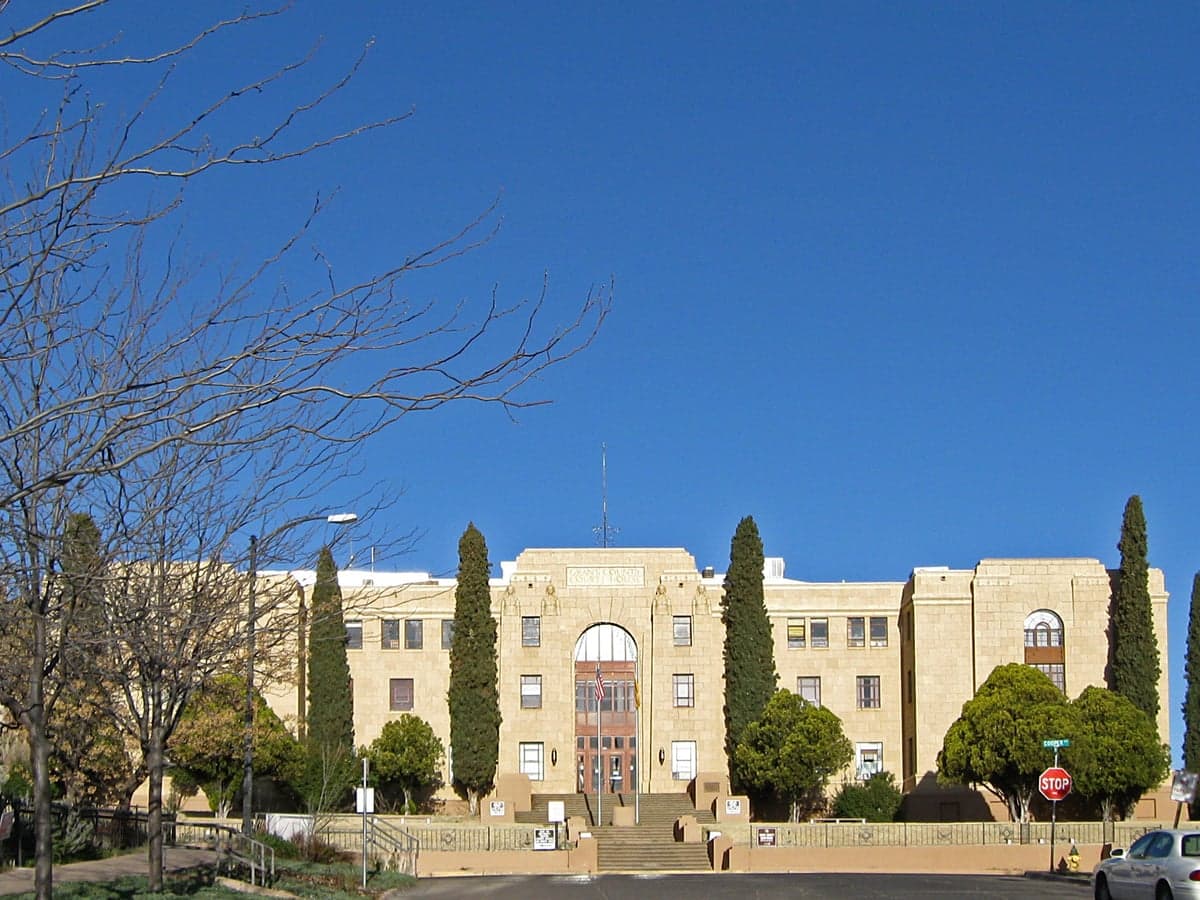
Photo: Wikipedia
Political ClimatePolitical Climate in Grant County
Showing district-level results — no local-only data available.
Local Political AnalysisPolitical Analysis of Grant County
Grant County, New Mexico, is one of the most politically competitive areas in the state, carrying a Cook Partisan Voting Index (PVI) of EVEN. That puts it in a different league entirely from the rest of New Mexico, which leans Democratic by a D+3 margin. In practice, this means Grant County is a true battleground where neither party can take a win for granted, and the county has a habit of swinging between candidates and parties from one election to the next. The county seat, Silver City, tends to pull the county blue, while the smaller towns and rural precincts — places like Bayard, Santa Clara, and Hurley — lean reliably red. The swing precincts are often found in the unincorporated areas around the Gila National Forest and along the Highway 180 corridor, where independent and split-ticket voters decide the outcome.
How it compares
Compared to the rest of New Mexico, Grant County is significantly more conservative. While the state as a whole has trended Democratic in recent cycles — driven by Albuquerque, Santa Fe, and Las Cruces — Grant County has remained stubbornly purple. In 2020, for example, the county voted for Joe Biden by a very narrow margin, while many surrounding counties like Luna and Hidalgo went for Donald Trump by double digits. The D+3 lean of New Mexico as a whole masks the fact that large swaths of the state, especially the southwest, are deeply conservative. Grant County sits right at the seam: Silver City, with its arts scene, Western New Mexico University, and a growing retiree population, provides a solid Democratic base, while the mining towns and ranching communities in the rest of the county vote Republican by margins that often exceed 20 points. This internal split is what keeps the county's PVI at EVEN, and it makes Grant County one of the few places in New Mexico where a Republican can win a countywide race if they run a strong campaign.
What this means for residents
For conservative residents, Grant County offers a political environment where their votes actually matter — unlike in deep-blue Santa Fe or Albuquerque, a Republican candidate can win here, and local offices like county commission and sheriff are genuinely competitive. For liberal residents, the county provides a blue foothold in an otherwise red region of the state, and Silver City functions as a progressive hub in the southwest. The practical consequence of this balance is that local governance tends to be moderate and pragmatic. County commission meetings in Grant County rarely devolve into the kind of partisan gridlock seen at the state level; instead, issues like water rights, wildfire management, and economic development in the mining sector tend to be handled with a focus on local needs rather than party lines. That said, the political divide is real and visible — you'll see Trump signs on the outskirts of Silver City and Biden signs in town, and conversations about national politics can get heated. But most residents will tell you that the county's competitive nature forces both sides to show up and engage, which keeps local democracy healthier than in many one-party areas.
Culturally, Grant County stands apart from the rest of New Mexico in a few notable ways. The county has a strong independent streak that predates the current partisan alignment — this is a place where the mining union tradition (centered in Bayard and Santa Clara) coexists with a libertarian ranching culture, and where environmental debates over the Gila River diversion project have created strange political alliances. Policy-wise, the county has been more resistant to statewide gun control measures than urban New Mexico, and local law enforcement tends to take a less aggressive approach to immigration enforcement than in neighboring Luna County. At the same time, Silver City has embraced progressive policies on public art, historic preservation, and renewable energy in ways that would be unthinkable in more conservative parts of the state. The bottom line is that Grant County is not a microcosm of New Mexico — it's its own political animal, and anyone moving here should expect a community where the political conversation is real, contested, and far from settled.

State Political ClimatePolitical Climate in New Mexico
State Political AnalysisPolitical Environment in the State
New Mexico is a classic swing state that has drifted left over the past two decades, but it’s far from a deep-blue monolith. With a Cook PVI of D+3, the state leans Democratic in presidential elections, but that margin is narrow enough that local races—especially for governor and the state legislature—remain genuinely competitive. Over the last 10-20 years, the state has shifted from a purple battleground (it went for Bush in 2004) to a reliably blue presidential pick, driven largely by explosive growth in the Albuquerque metro and the steady leftward march of Santa Fe and Las Cruces. But the rest of the state—the oil-rich southeast, the conservative ranching counties, and the rural Hispanic north—votes just as reliably red, creating a political map that looks like a checkerboard.
Urban vs. rural divide
The political geography of New Mexico is stark. The state’s blue vote is concentrated in three main metros: Albuquerque (Bernalillo County, which alone casts about a third of the state’s votes), Santa Fe (the liberal stronghold that routinely votes 75%+ Democratic), and Las Cruces (Doña Ana County, a growing border metro that leans blue but is more moderate). These three areas, plus the tribal lands and the small liberal enclave of Taos, supply the Democratic margin of victory. In contrast, the eastern plains and southeastern corner—Hobbs, Carlsbad, Roswell, and Clovis—are deeply conservative, often voting 70-80% Republican. These are oil-and-gas country, where the Permian Basin economy drives both prosperity and a pro-business, anti-regulation political culture. The rural Hispanic counties in the north, like Mora and Rio Arriba, are culturally conservative but vote Democratic out of tradition and union ties, though that loyalty has frayed in recent cycles. The upshot: a relocator from a red state will feel at home in Hobbs or Carlsbad, while a liberal will find their people in Santa Fe or Albuquerque’s North Valley.
Policy environment
New Mexico’s state-level policy is a mixed bag that reflects its purple-to-blue tilt. The tax structure is relatively moderate: no state income tax on Social Security, a graduated income tax with a top rate of 5.9%, and a gross receipts tax (essentially a sales tax) that varies by locality but averages around 7-8%. Property taxes are among the lowest in the nation, which is a major draw for retirees and families. The regulatory posture is business-friendly in the oil and gas sector—the state is the #2 oil producer in the U.S.—but increasingly progressive on social and environmental issues. Education policy is a perennial battleground: the state has a constitutional mandate to fund early childhood education (funded by a new land-grant trust fund), but test scores remain near the bottom nationally. Healthcare is a bright spot for liberals: the state expanded Medicaid early and has a robust public option, but rural access remains poor. Election laws are relatively accessible: same-day registration, no-excuse absentee voting, and automatic voter registration at the DMV. For a conservative relocator, the low property taxes and oil-friendly regulatory climate in the southeast are draws, but the state’s social policy direction may give pause.
Recent policy direction
The last five years have seen a clear leftward shift in Santa Fe. In 2021, the legislature passed the Energy Transition Act, mandating 100% carbon-free electricity by 2045, which has rattled the coal and gas communities around Farmington and Grants. On gun policy, the state enacted a red-flag law (the Extreme Risk Firearm Protection Order Act) in 2020 and a 7-day waiting period for most firearm purchases in 2023, both of which drew fierce opposition from rural counties. On education, the state repealed its 50-year-old ban on school choice in 2023, but the new law is limited to charter schools and doesn’t include vouchers or education savings accounts—a compromise that satisfied neither side. On medical and bodily autonomy, New Mexico has some of the nation’s most protective abortion laws (no gestational limits, no mandatory waiting periods) and became a sanctuary for out-of-state patients after Dobbs. On property rights, the state has not passed any broad rent control or land-use preemption, but local control is strong—Santa Fe and Albuquerque have their own tenant protections. On voting and ballot access, the state has moved toward universal mail-in ballots (all active voters receive a ballot by default), which conservatives in the eastern counties view with suspicion. The net effect: a relocator who values gun rights will find the state increasingly restrictive, while someone prioritizing reproductive freedom or climate action will see it as a leader.
Civil unrest & political movements
New Mexico has a history of low-boil political tension rather than explosive unrest. The most visible flashpoint in recent years has been the Oñate statue controversy in Albuquerque and Española, where protests over Spanish colonial monuments led to their removal or destruction in 2020, sparking counter-protests from Hispanic traditionalists. Immigration politics are ever-present: the state is a border state (though the busiest crossings are in Texas), and Las Cruces and Santa Fe have declared themselves sanctuary cities, while Hobbs and Carlsbad have passed resolutions opposing sanctuary policies. The New Mexico Civil Guard, a militia group, has been active in the southern border region, conducting patrols and drawing both support and condemnation. Election integrity has been a live issue: in 2022, the Otero County Commission (centered on Alamogordo) refused to certify primary election results over unfounded fraud claims, leading to a state Supreme Court intervention. The New Mexico Land Grant movement, which advocates for the return of Spanish and Mexican land grants, is a unique local political force that crosses party lines, especially in the northern counties. A new resident will notice that political signs are common and often aggressive—you’ll see “Don’t California My New Mexico” bumper stickers in the east and “Protect Abortion Access” yard signs in Santa Fe—but actual street-level conflict is rare outside of organized protests.
Projection
Over the next 5-10 years, New Mexico is likely to continue its slow leftward drift, but the pace will depend on migration patterns. The state is seeing modest in-migration from California and Texas, but the numbers are small compared to the Mountain West boom. The Albuquerque metro is growing, and its suburbs—Rio Rancho and Los Lunas—are trending purple, which could push the state’s overall lean slightly bluer. However, the oil and gas economy in the southeast is booming, and that region’s population is growing too, which could keep the state competitive at the local level. The wild card is the Hispanic vote: traditionally Democratic, but younger Hispanic voters are more progressive while older ones are drifting right on cultural issues. If the GOP can make inroads with rural Hispanic voters in the north, the state could become a true toss-up again. For a relocator, the realistic expectation is that the state will remain D+3 to D+5 for the foreseeable future—blue enough to pass progressive legislation, but purple enough that your vote in a local race actually matters.
For a conservative relocator, the bottom line is that New Mexico offers a low-tax, low-regulation environment in the oil and gas counties, but you’ll be living in a state where the governor and legislature are controlled by Democrats who are actively moving the state left on guns, energy, and social policy. For a liberal relocator, the state is a haven for reproductive rights and climate action, but you’ll have to accept that large swaths of the state are deeply conservative and that your vote in Santa Fe or Albuquerque is balanced by a vote in Hobbs or Carlsbad. The practical takeaway: New Mexico is not a culture-war battlefield like some states, but it is a place where your neighbors will have very different political signs in their yards, and you’ll need to be comfortable with that.
* Values derived from national, state, county, city and local statistics and may differ in a specific area. Last updated: 2026-06-23T18:43:46.000Z
Narrative content on this page is AI-generated and may contain mistakes. Verify any details that matter before acting on them.
ReloMaps may earn a commission from affiliate links at no extra cost to you.

