
Photo: Wikipedia
Demographics of Grant County
Affluence Level in Grant County
A below-average socioeconomic profile. Incomes, home values, and educational attainment trail the U.S., with higher poverty and unemployment.
People of Grant County
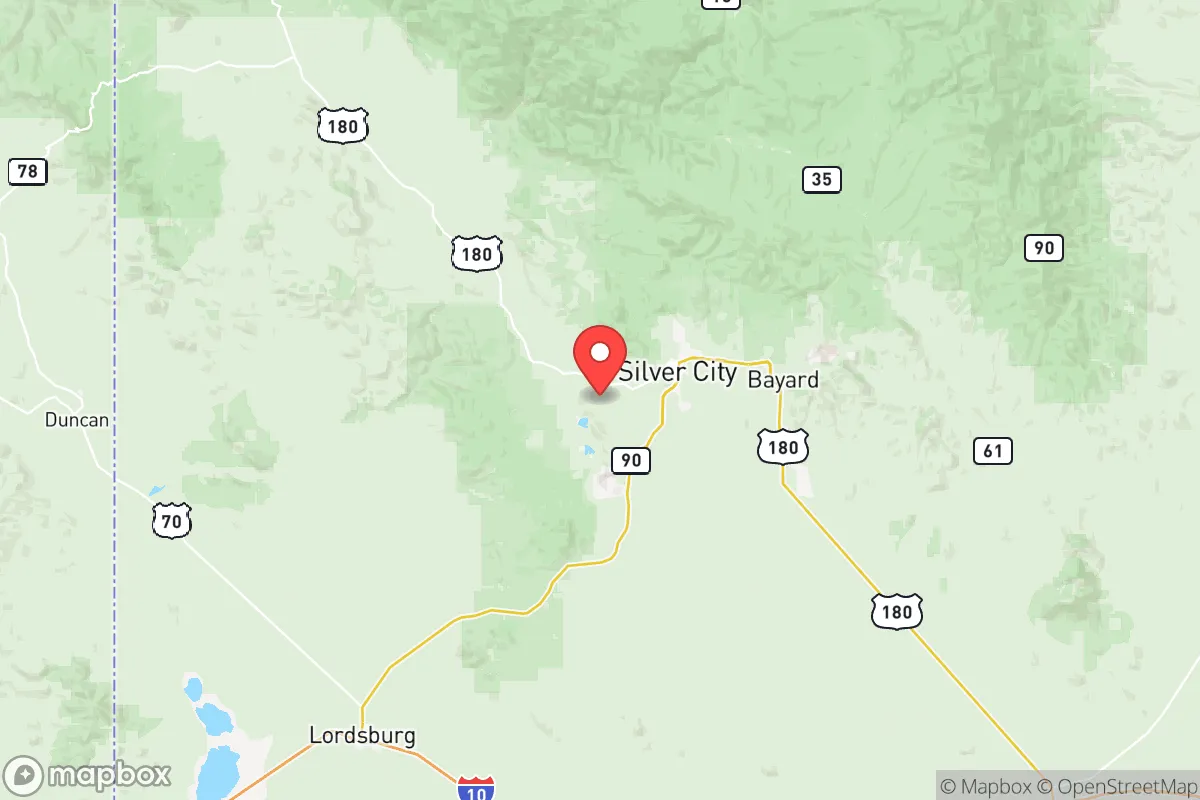
Grant County, New Mexico, is a place where a near-even split between Hispanic (48.0%) and non-Hispanic White (47.5%) residents defines its character, creating a bicultural identity rare in the American Southwest. With a population of 27,856 and a foreign-born share of just 2.0%, this is a deeply rooted, stable community where most families have been here for generations rather than a destination for new international arrivals. The county’s identity is shaped by its history as a mining and ranching hub, with a conservative, self-reliant ethos that appeals to families seeking a slower pace of life in a scenic, mountainous setting. The low population density and small-town feel, centered on the city of Silver City, make it a place where newcomers are quickly noticed and expected to integrate into existing community structures.
Settlement & growth (pre-1960)
Long before European contact, the land now known as Grant County was home to the Mimbres people, a prehistoric Native American culture that flourished between 1000 and 1130 CE, leaving behind distinctive black-on-white pottery that is still unearthed in the Mimbres Valley. By the time Spanish explorers arrived in the 16th century, the area was inhabited by the Apache, particularly the Chiricahua band, who fiercely resisted colonization and maintained control of the region well into the 19th century. Spanish colonial influence was minimal in Grant County compared to the Rio Grande Valley, but the legacy of Spanish land grants and place names persists in communities like Santa Clara and Pinos Altos.
The first major wave of American settlement came with the discovery of gold in 1860 at Pinos Altos, a rugged mining camp that drew fortune seekers from across the United States and Mexico. This boom established Silver City as the county seat in 1874, and the town quickly grew into a rough-and-tumble supply hub for miners, ranchers, and outlaws. The arrival of the railroad in the 1880s connected Grant County to national markets and spurred a second wave of settlement, this time dominated by Anglo-American ranchers and farmers who took advantage of the open rangeland. Towns like Bayard, Hurley, and Tyrone emerged as company towns for the Kennecott Copper Corporation and other mining giants, drawing a workforce that was a mix of Anglo-Americans, Hispanic New Mexicans, and a small number of European immigrants, primarily from Italy and Ireland.
The copper industry became the economic backbone of Grant County for nearly a century, with the Santa Rita mine (later the Chino Mine) operating continuously from 1910. This industrial base attracted a stable, working-class population that was overwhelmingly native-born and culturally conservative. The Dust Bowl of the 1930s brought a small influx of displaced farmers from Oklahoma and Texas, but Grant County never experienced the massive population booms seen in other parts of the Sun Belt. By 1960, the county’s population had settled into a pattern that would persist for decades: a predominantly White and Hispanic community, with African Americans and other groups making up less than 1% of residents, centered on the mining towns of Silver City, Bayard, and Hurley.
Modern era (post-1965)
The 1965 Hart-Cellar Act had minimal direct impact on Grant County, as the foreign-born population remains at just 2.0% today, far below the national average. Unlike major urban centers that saw waves of new immigration from Asia and Latin America, Grant County’s demographic story since 1965 has been one of stability and gradual internal change rather than transformation through international migration. The most significant shift has been the steady growth of the Hispanic population, which rose from roughly one-third of the county in 1970 to 48.0% today, driven by higher birth rates and the return of some Hispanic families who had left for urban areas.
The collapse of copper prices in the 1980s triggered a painful economic restructuring that led to the closure of many mines and a population decline of nearly 20% between 1980 and 2000. This period saw an out-migration of younger, working-age families, particularly non-Hispanic Whites, who left for job opportunities in Albuquerque, Las Cruces, and out of state. The county’s population has since stabilized, with a modest recovery driven by retirees and remote workers attracted to the area’s low cost of living, mild climate, and outdoor recreation opportunities. The town of Silver City has become a small hub for artists and retirees, while Mimbres and Gila have seen growth in hobby farms and rural homesteads.
Domestic migration from other parts of New Mexico and neighboring states has been the primary source of new residents, with a noticeable influx of retirees from Texas and California seeking lower taxes and a quieter lifestyle. The county’s Asian population, at 0.8%, is small and concentrated in Silver City, primarily among professionals in healthcare and education. The Indian-subcontinent population is effectively zero, and the Black population remains at 0.7%, with no significant enclave forming. The county’s racial and ethnic composition has become more balanced between White and Hispanic residents, but it remains one of the least diverse counties in New Mexico by overall measures.
The future
Grant County is projected to remain a stable, bicultural community with slow population growth over the next 10-20 years, likely reaching 30,000 residents by 2040. The Hispanic share of the population will continue to rise gradually, potentially surpassing 55% by 2040, as younger Hispanic families have higher birth rates and older non-Hispanic White residents age out. The county is not becoming more diverse in the traditional sense, as the Asian, Black, and foreign-born populations are expected to remain very small, with no major new immigrant communities forming.
The most significant demographic trend is the aging of the non-Hispanic White population, which is concentrated in the 55-and-older age bracket, particularly in Silver City and the retirement communities around Santa Clara. Younger families, both Hispanic and White, are more likely to settle in the more affordable rural areas like Cliff and Buckhorn, where land prices are lower and a homesteading lifestyle is still possible. The cultural identity of Grant County is evolving from a mining-based, Anglo-dominated society to a more balanced bicultural community where Hispanic traditions, language, and family structures are increasingly central to daily life.
For someone moving in now, Grant County offers a community that is stable, affordable, and deeply connected to its history, but it is not a place of rapid change or new diversity. Newcomers should expect to integrate into a community where most people have deep roots, where the economy is driven by healthcare, education, and government jobs rather than industry, and where the cultural divide between Hispanic and Anglo residents is more a matter of shared history than conflict. The county is becoming more Hispanic, more rural, and more oriented toward retirees and remote workers, making it a good fit for those seeking a quiet, low-cost lifestyle in a beautiful natural setting.

* Values derived from national, state, county, city and local statistics and may differ in a specific area. Last updated: 2026-06-23T18:43:46.000Z
Narrative content on this page is AI-generated and may contain mistakes. Verify any details that matter before acting on them.
ReloMaps may earn a commission from affiliate links at no extra cost to you.

