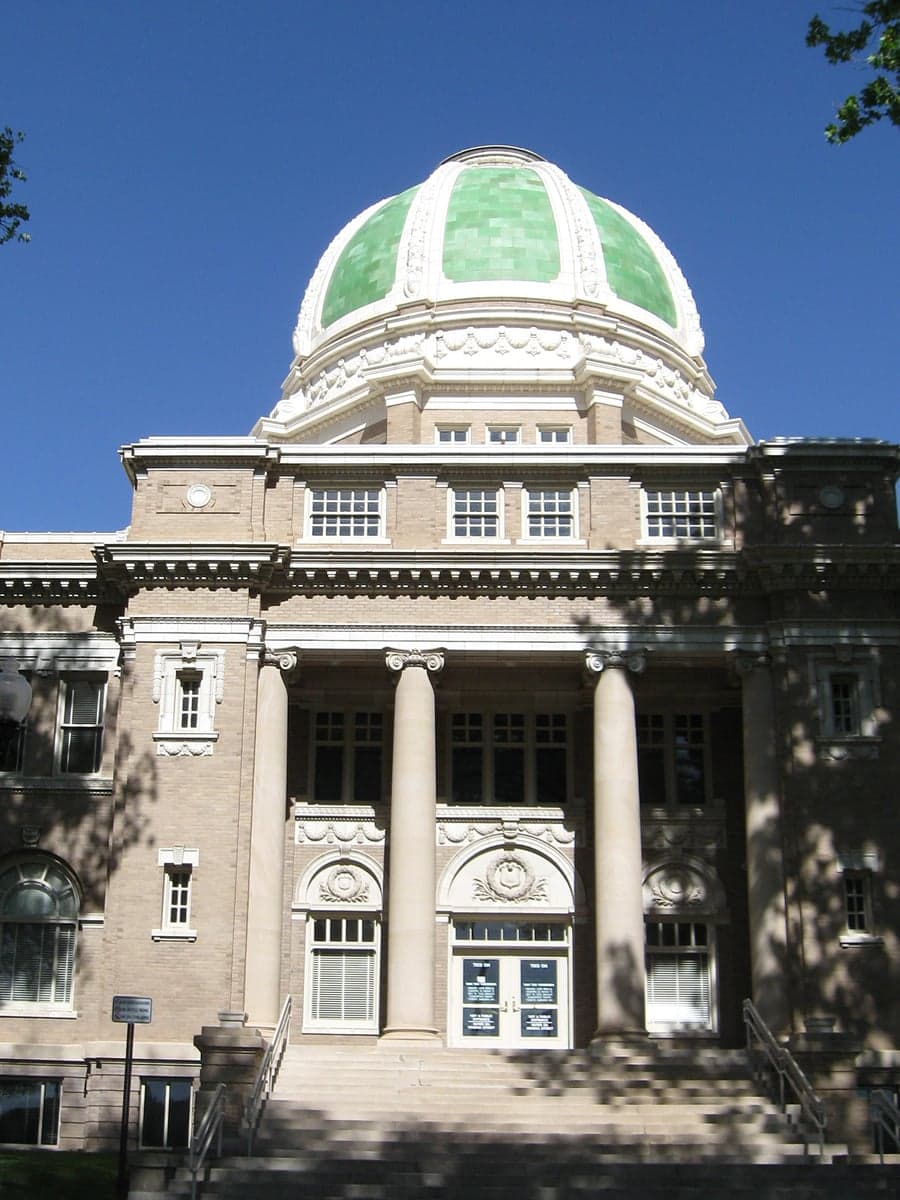
Photo: Wikipedia
Demographics of Chaves County
Affluence Level in Chaves County
A below-average socioeconomic profile. Incomes, home values, and educational attainment trail the U.S., with higher poverty and unemployment.
People of Chaves County
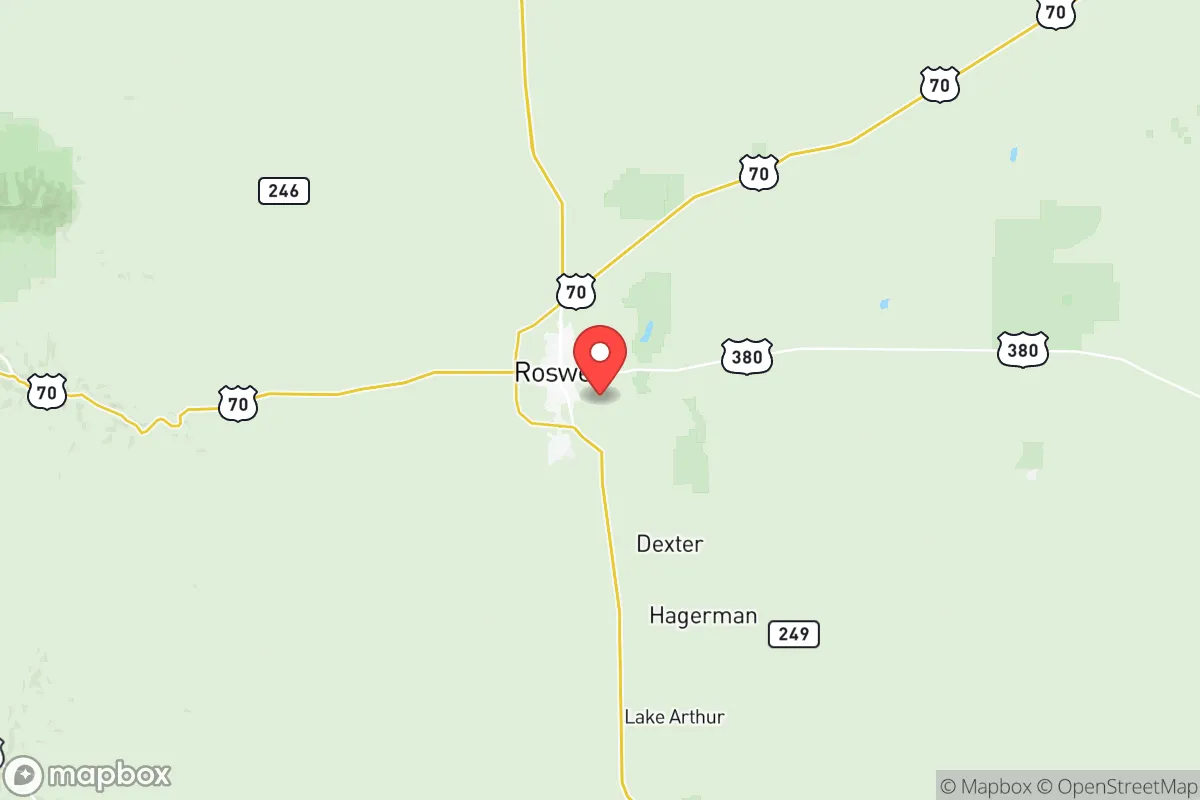
The people of Chaves County, New Mexico, today number 64,446, forming a predominantly Hispanic (57.9%) and White (37.1%) population with a distinctive rural, conservative character rooted in ranching, oil, and agriculture. The county seat of Roswell concentrates the majority of residents, while smaller communities like Dexter, Hagerman, and Lake Arthur anchor the agricultural valleys. With only 18.2% of adults holding a college degree and a foreign-born population of 5.8%, Chaves County remains a place where generational ties to the land and local industry run deep, and where demographic change has been gradual rather than transformative.
Settlement & growth (pre-1960)
Long before European contact, the area that is now Chaves County was inhabited by nomadic Apache and Comanche peoples, who followed bison herds across the High Plains and used the Pecos River as a seasonal corridor. Spanish exploration reached the region in the 16th century, but permanent colonization was sparse; the Spanish Crown granted large land tracts known as mercedes, but few settlements took root in this arid, remote stretch of what was then the province of Santa Fe de Nuevo México.
After the United States acquired the territory in 1848 following the Mexican-American War, the area remained largely unsettled by Anglo-Americans for decades. The first significant wave of non-Native settlement came in the 1870s and 1880s, driven by the arrival of the Pecos Valley Railroad and the promise of irrigated farming along the Pecos River. Homesteaders—primarily Anglo-Americans from Texas, the Midwest, and the South—established the towns of Roswell (founded 1869), Dexter, and Hagerman as agricultural hubs. These early settlers raised cattle and grew alfalfa, cotton, and grain, laying the foundation for a ranching economy that persists today.
A second major wave arrived in the 1890s and early 1900s, when the Pecos Valley Irrigation and Investment Company dug canals and promoted the region as an agricultural paradise. This period brought a smaller but notable influx of German and Czech families, who settled in the Roswell area and in the farming communities of Lake Arthur and Elida. These groups established churches, schools, and mutual-aid societies that remained distinct into the mid-20th century.
The discovery of oil in the Permian Basin during the 1920s and 1930s transformed Chaves County's economy and population. Roswell became a regional oilfield service center, attracting workers from Texas, Oklahoma, and the broader Southwest. The Dust Bowl of the 1930s pushed additional Anglo families—many of them "Okies" and "Texans"—off depleted farms and into the county, where they found work in the oil patch or on ranches. By 1940, the county's population had grown to roughly 23,000, with Roswell as the dominant urban center.
World War II and the early Cold War brought a new and unexpected population driver: the Roswell Army Air Field (later Walker Air Force Base). Established in 1941, the base housed bomber crews and, after the war, became a Strategic Air Command installation. It drew military personnel and civilian contractors from across the country, many of whom stayed after their service ended. The base's closure in 1967 was a severe economic blow, but the military families who remained had already diversified the county's Anglo population with roots in the Northeast, Midwest, and West Coast.
Modern era (post-1965)
The 1965 Hart-Cellar Act had a limited direct impact on Chaves County compared to major urban centers. The foreign-born population today stands at just 5.8%, and the majority of those immigrants are Hispanic, primarily from Mexico, who arrived from the 1970s onward to work in agriculture, construction, and oilfield services. These newer Mexican-origin residents have tended to settle in Roswell's south side and in the smaller farming towns of Dexter and Hagerman, where they have joined a Hispanic community that has been present in the region since before Anglo settlement.
The most significant demographic shift of the post-1965 era has been the steady growth of the Hispanic share of the population, driven by higher birth rates and continued immigration. In 1970, the county was roughly 65% Anglo and 35% Hispanic; by 2020, those proportions had inverted, with Hispanics making up 57.9% and non-Hispanic Whites 37.1%. This change has been gradual and largely organic, rather than the result of a sudden influx, and has occurred without the kind of ethnic enclave formation seen in larger cities. Hispanic residents are dispersed throughout the county, though Roswell's older neighborhoods near the downtown and the river show higher concentrations.
Domestic migration patterns since 1965 have been modest. The closure of Walker Air Force Base in 1967 triggered a population decline from a peak of roughly 57,000 in 1960 to 51,000 in 1970, and the county did not regain its 1960 population level until the 1990s. Since then, growth has been slow but steady, driven by the oil and gas industry's boom-and-bust cycles and by retirees and remote workers attracted to the area's low cost of living. The Black population remains small at 1.4%, concentrated in Roswell, while East/Southeast Asian residents (0.8%) and Indian-subcontinent residents (0.3%) are present in very small numbers, mostly as professionals in healthcare and education.
The future
Chaves County is projected to continue its slow growth, with the population likely reaching 68,000–70,000 by 2040. The Hispanic share will continue to rise, potentially approaching 65% by mid-century, as the Anglo population ages and younger Hispanic families have more children. The county is not becoming more diverse in the broad sense—the Asian, Black, and foreign-born shares are expected to remain small—but it is becoming more uniformly Hispanic, a trend common across much of rural New Mexico and South Texas.
New residential development is concentrating in Roswell's northern and eastern edges, where newer subdivisions are attracting a mix of Anglo retirees and Hispanic families moving up from older neighborhoods. The smaller towns of Dexter, Hagerman, and Lake Arthur are likely to see continued population stagnation or slight decline as young people leave for educational and job opportunities elsewhere. The oil and gas industry will remain the primary economic driver, and its cyclical nature will continue to shape migration: booms bring in temporary workers from Texas and Oklahoma, while busts push some residents out.
Culturally, Chaves County is evolving into a place where Hispanic and Anglo traditions are increasingly blended, particularly in Roswell, where bilingualism is common and local festivals like the Eastern New Mexico State Fair and the UFO Festival draw from both heritages. The county's conservative political character—it has voted Republican in every presidential election since 1980—is likely to persist, even as the electorate becomes more Hispanic, reflecting the socially conservative values of many rural Hispanic voters in the region.
For someone moving to Chaves County now, the area offers a stable, slow-growing community where the economy hinges on oil, agriculture, and the modest service sector of Roswell. The population is becoming more Hispanic and slightly older, but the county's essential character—rural, conservative, family-oriented, and deeply tied to the land—shows little sign of fundamental change. New arrivals will find a place where neighborly connections matter, where the pace of life is unhurried, and where the demographic shifts of the past half-century have unfolded without the friction seen in faster-changing parts of the country.

* Values derived from national, state, county, city and local statistics and may differ in a specific area. Last updated: 2026-07-19T20:59:13.000Z
Narrative content on this page is AI-generated and may contain mistakes. Verify any details that matter before acting on them.
ReloMaps may earn a commission from affiliate links at no extra cost to you.

