
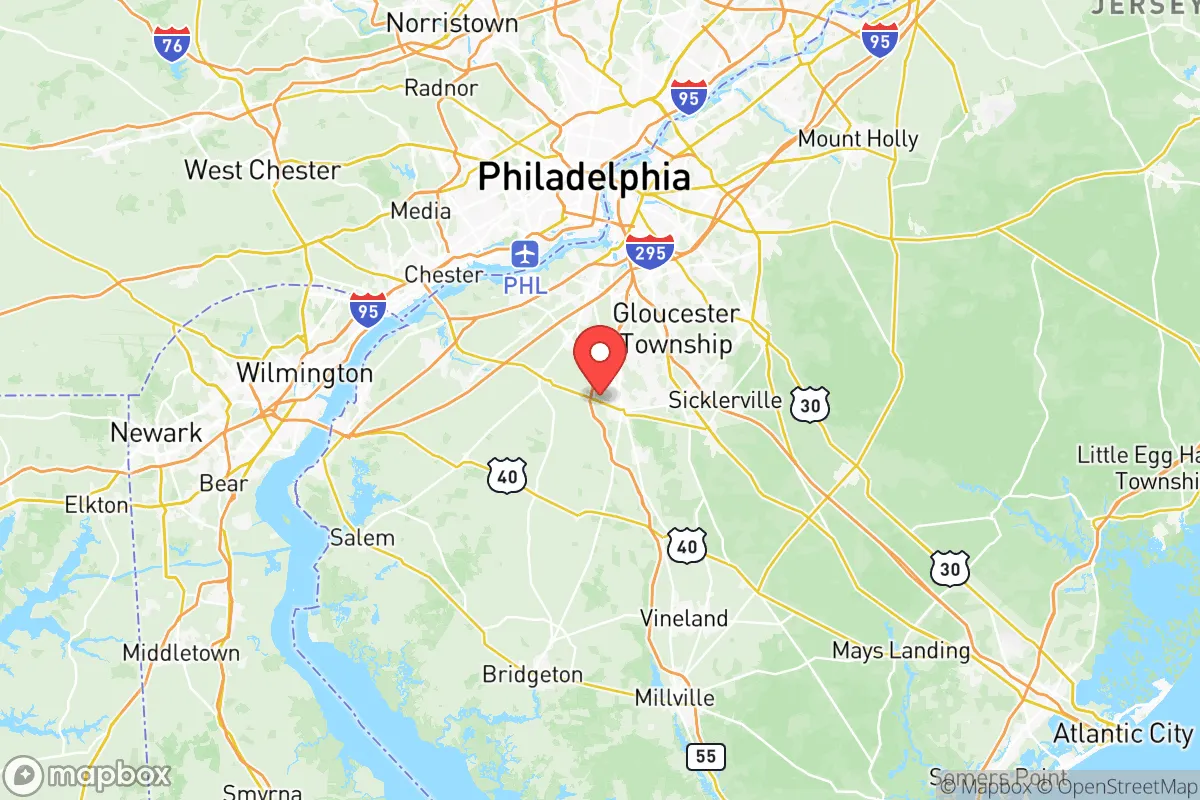
Photo: Wikipedia
Political ClimatePolitical Climate in Gloucester County
Showing district-level results — no local-only data available.
Local Political AnalysisPolitical Analysis of Gloucester County
Gloucester County has been a reliable Democratic stronghold for decades, but it's not the kind of deep-blue lock you see in Hudson or Essex. The county's Cook Partisan Voting Index (PVI) of D+10 means it votes about 10 points more Democratic than the national average, which is a solid notch bluer than New Jersey's overall D+5 rating. That said, the real story here is the slow, steady rightward drift—especially in the county's outer suburbs and rural stretches—that's making local elections more competitive than they were 20 years ago.
How it compares
Gloucester County's D+10 PVI puts it about 5 points more Democratic than New Jersey as a whole, but that gap is narrowing. In the 2020 presidential election, Joe Biden carried the county by about 14 points, while he won the state by 16—meaning Gloucester actually ran slightly behind the state average. That's a shift from 2008, when Barack Obama won the county by 22 points. The county's Democratic edge is largely driven by its older, union-heavy industrial towns like Paulsboro, Woodbury, and Glassboro, where Democratic registration often tops 60%. But head east or south, and the picture flips. Harrison Township, Woolwich Township, and South Harrison Township are reliably Republican, often voting 55-60% for GOP candidates. The real battlegrounds are the sprawling suburban developments in Mantua, Washington Township, and Deptford, where ticket-splitting is common—these are the swing precincts that decide countywide races. In 2021, Republican Jack Ciattarelli actually carried Gloucester County in the governor's race, a sign that the county's blue veneer can crack in off-year elections.
What this means for residents
For liberal residents, the D+10 lean means you're in the majority, but not overwhelmingly so. Local Democratic primaries are often the real contest, especially in county commissioner races, and progressive candidates can win without needing to moderate much. Conservative residents, meanwhile, aren't politically isolated—they have strong representation in the county's southern and eastern townships, and the GOP is competitive enough to win countywide seats in good years. The practical effect is that Gloucester County government tends to be pragmatic rather than ideological. The county's Democratic machine, long led by the late Sheriff's Officer and party chair, has historically focused on patronage and infrastructure rather than culture-war issues. That's changing slowly, as national polarization seeps into local school board and library board elections, but the county's political DNA is still more "union hall" than "activist base."
One cultural distinction that sets Gloucester apart from the rest of South Jersey is its stronger sense of local identity. People here don't think of themselves as "South Jersey" in the same way Atlantic or Cape May counties do—they're "Gloucester County" first. This shows up in the fierce loyalty to local high school sports, the dominance of county-level news coverage, and the way political candidates almost always lead with their local roots. The county's Democratic tilt is also older and more working-class than the college-educated, suburban liberalism of places like Montclair or Princeton. You'll find more "Reagan Democrats" here than anywhere else in the state—voters who back Democrats locally but have voted for Republicans like Donald Trump in presidential races. That cross-pressure is what makes Gloucester County one of the most politically interesting places in New Jersey to watch in 2026 and beyond.

State Political ClimatePolitical Climate in New Jersey
State Political AnalysisPolitical Environment in the State
New Jersey has a solid Democratic lean, with a Cook PVI of D+5, but that number masks a deeply layered political reality. The state hasn't voted for a Republican for president since 1988, and Democrats hold both legislative chambers and the governorship. Yet over the past 10-20 years, the partisan balance has shifted subtly: the once-reliable GOP suburbs of Bergen and Morris counties have moved left, while the southern and western exurbs have hardened into Republican strongholds. The result is a state where the Democratic majority is real but not monolithic, and where a conservative relocator can find pockets of like-minded community — especially if they know where to look.
Urban vs. rural divide
The political map of New Jersey is a classic story of density driving ideology. The urban core — Newark, Jersey City, and Paterson — votes overwhelmingly Democratic, often delivering 75-85% of the vote for the party. These cities are powered by union households, public-sector workers, and a diverse population that includes large Black and Hispanic communities. The suburbs immediately surrounding them, like Montclair and Maplewood, are among the most liberal in the nation, with high rates of college education and professional-class voters who prioritize climate policy and social justice. In contrast, the rural and exurban areas — Sussex County, Hunterdon County, and much of Ocean County — vote reliably Republican. Toms River and Flemington are typical of these areas: lower density, more retirees and veterans, and a cultural orientation toward self-reliance and lower taxes. The divide is stark: in the 2024 presidential election, Sussex County voted +18 R, while Essex County (Newark) voted +45 D. A conservative moving to New Jersey would find the most comfortable fit in the northwestern and central-southern counties, but they should expect to drive 30-45 minutes to reach a reliably red polling place.
Policy environment
New Jersey's policy environment is defined by high taxes and heavy regulation. The state has the highest property taxes in the nation, averaging over $9,500 annually, and a progressive income tax that tops out at 10.75% for income over $1 million. The sales tax is 6.625%, with no local add-ons. For a conservative relocator, the tax burden is the single biggest practical concern. On the regulatory side, New Jersey is a home-rule state with strong municipal zoning, which means permitting for new construction or business expansion can be slow and expensive. Education policy is centralized: the state funds schools heavily, but mandates are extensive, and the New Jersey Student Learning Standards are aligned with Common Core. Healthcare is dominated by large hospital systems like Hackensack Meridian and RWJBarnabas, and the state expanded Medicaid under the ACA. Election laws are relatively liberal: no-excuse mail-in voting is permanent, same-day registration is available, and early in-person voting runs for nine days. For a conservative, the policy environment feels like a trade-off: you get strong public services and infrastructure, but you pay for them, and the regulatory climate can feel stifling.
Recent policy direction
Over the past five years, New Jersey has moved decisively left on several fronts. In 2022, the legislature passed the New Jersey Gun Safety Act, which requires a permit to purchase a handgun, mandates a 10-day waiting period, and bans the sale of .50 caliber rifles. In 2023, the state enacted a red flag law allowing courts to temporarily seize firearms from individuals deemed a threat. On education, the state passed a law in 2022 requiring all public schools to teach LGBTQ+ inclusive curriculum from kindergarten through 12th grade, and in 2024, it expanded parental notification requirements for school health services — a compromise that satisfied neither side fully. On medical and bodily autonomy, New Jersey codified abortion rights into state law in 2022, and in 2024, it passed a shield law protecting providers who prescribe abortion pills via telehealth to patients in states with bans. Property rights are constrained by the state's Mount Laurel doctrine, which requires municipalities to provide a "fair share" of affordable housing, often leading to litigation. On voting, the state expanded mail-in voting permanently in 2021 and added automatic voter registration at the DMV. For a conservative relocator, the direction is clear: the state is becoming more restrictive on guns, more expansive on social policy, and more aggressive on housing mandates. The trade-off is that the state's tax burden has not increased in recent years — the top income tax rate has held steady since 2018 — and the state's credit rating was upgraded by Moody's in 2024, a sign of fiscal stabilization.
Civil unrest & political movements
New Jersey has a history of organized political activism on both sides. The 2020 Black Lives Matter protests in Newark and Jersey City were large but largely peaceful, with some property damage in downtown Newark. The state's sanctuary policy is informal but real: in 2018, the attorney general issued a directive limiting local law enforcement cooperation with ICE, and several cities, including Newark and Jersey City, have declared themselves sanctuary cities. On the right, the New Jersey Second Amendment Society is a well-organized group that has successfully challenged several gun laws in court, including a 2023 ruling that struck down the state's ban on carrying firearms in "sensitive places" like parks and libraries. The 2020 election integrity controversy was less intense in New Jersey than in swing states, but conservative groups have raised concerns about mail-in ballot security, particularly in Paterson, where a 2020 city council race was overturned due to fraud. Immigration politics are a flashpoint: the state's immigrant population is about 22%, one of the highest in the nation, and the debate over driver's licenses for undocumented residents (passed in 2019) remains contentious. A new resident would notice that political conversations are more muted than in, say, Pennsylvania or Ohio — New Jerseyans tend to keep their politics to themselves, but the underlying tensions are real.
Projection
Over the next 5-10 years, New Jersey's political trajectory is likely to continue its slow leftward drift, but with important caveats. The state's population is aging and growing slowly (0.2% annually), and the in-migration from New York City is bringing more liberal voters to the northern suburbs. However, the exodus of high-income earners to Florida and Texas — driven by taxes — is disproportionately conservative, which could actually deepen the Democratic lean. The wild card is the suburban shift: if the GOP can moderate its message on social issues, it could win back some of the Bergen County and Morris County voters who have drifted left. But the structural advantages for Democrats — union density, urban population, and the state's reliance on public-sector employment — are likely to hold. A conservative moving in now should expect that in a decade, the state will be slightly more Democratic, slightly more regulated, and slightly more expensive. The best bet for a like-minded community is the northwest corner (Sussex, Warren counties) or the central-south shore (Ocean County), where the GOP remains competitive.
For a new resident, the bottom line is this: New Jersey is a blue state with a high cost of living and a regulatory environment that favors government solutions. But it's also a state with excellent schools, strong public safety, and a quality of life that many find worth the price. A conservative can live here comfortably by choosing the right county — Sussex or Ocean — and by accepting that state-level politics will not reflect their views. The practical takeaway: if you value low taxes and limited government, New Jersey is a tough fit. If you value community, schools, and proximity to major cities, it's a place where you can find your people — even if they're a minority at the ballot box.
* Values derived from national, state, county, city and local statistics and may differ in a specific area. Last updated: 2026-07-13T08:06:18.000Z
Narrative content on this page is AI-generated and may contain mistakes. Verify any details that matter before acting on them.
ReloMaps may earn a commission from affiliate links at no extra cost to you.

