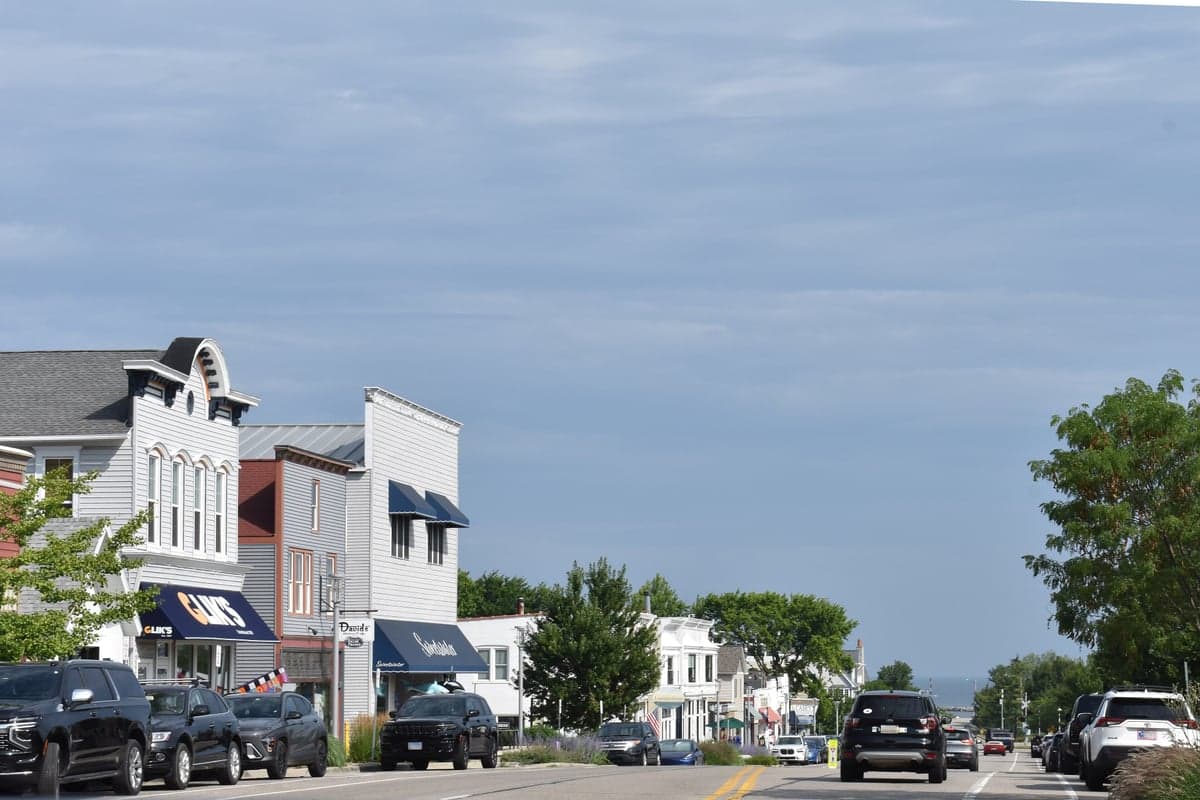
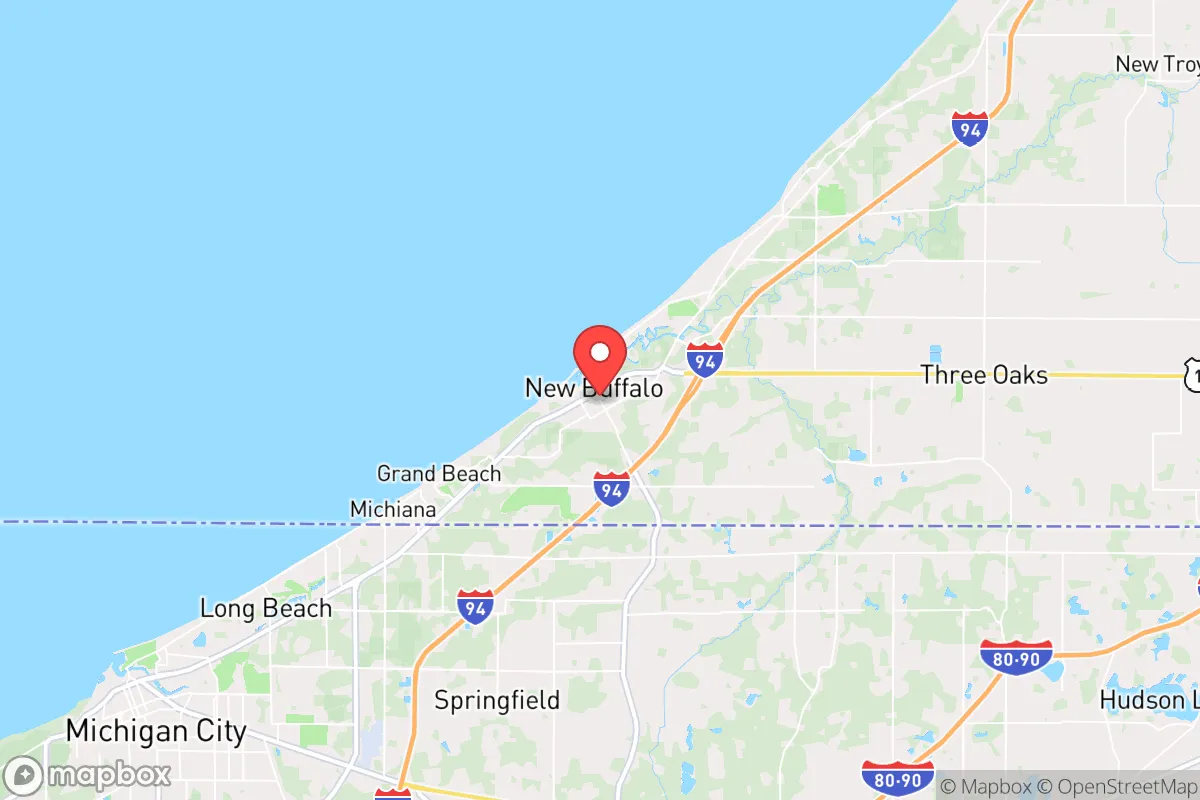
Photo: Wikipedia
Political ClimatePolitical Climate in New Buffalo, MI
District shown is the primary district for this city’s centroid. Cities may span multiple districts.
Local Political AnalysisPolitical Analysis of New Buffalo, MI
How it compares
Michigan as a whole is rated EVEN on the Cook PVI, meaning the state is a true battleground—think 2020’s 154,000-vote margin for Biden or 2016’s 10,700-vote win for Trump. New Buffalo’s R+13 is a stark contrast to that knife’s-edge reality. Drive 20 minutes north to St. Joseph or Benton Harbor, and you’ll hit a different political climate: St. Joseph leans more moderate-to-Democratic, while Benton Harbor is heavily Democratic, driven by a majority-Black population and urban poverty issues. Head east to Niles or south into Indiana’s LaPorte County, and you’re back in deep-red territory. So New Buffalo isn’t an outlier in its immediate region—it’s actually the pivot point. The town itself often splits tickets, especially in local races, but the state House and Senate seats covering this area have been reliably Republican for over a decade. That R+13 isn’t a fluke; it’s the product of a district that stretches inland past farmland and small towns like Three Oaks and Union Pier, where gun rights, taxes, and agricultural policy dominate the conversation.What this means for residents
For conservatives, living in an R+13 district means your vote carries real weight in primaries—the GOP nomination is usually the de facto general election here. You’ll see Republican candidates campaign hard in New Buffalo proper, not just the rural stretches, because the town’s 1,800 or so year-round residents can swing a close primary. For liberals, it’s a different reality: you’re likely in the minority at the county GOP meetings, but you’re not isolated. The Chicago exurban influence—many residents commute or telework for Illinois employers—keeps a visible Democratic presence, especially in the waterfront neighborhoods and among newer transplants. Practical effects: expect conservative leadership on local zoning, a lighter touch on environmental regulation along the Galien River, and a school board that’s cautious on curriculum changes. But don’t expect a culture war hotbed—the tourist economy forces a certain pragmatism, and most folks just want the beach access and the breweries to keep thriving.What’s distinct about this area
The real political quirk here is the seasonal split. Summer weekends swell the population with Illinois voters who bring Chicago’s politics with them—they’re more likely to vote Democratic, and they do, in the precincts around the marina and the downtown core. But they don’t register locally, so the permanent electorate stays red. That creates a weird dynamic where local officials talk out of both sides of their mouth: pro-business and low-tax in the winter, but quietly accommodating of the summer crowd’s expectations on things like beach access and short-term rental rules. Looking ahead, the trajectory is slow but real—new development along the lakefront is attracting younger, more diverse residents, and if that pace holds, the R+13 could shrink to R+8 or R+9 within a decade. But don’t hold your breath for a flip; the rural anchor is too strong. For now, it’s a place where your neighbor might have a Trump flag in the garage and a Biden sticker on the kayak, and everyone just gets along.
State Political ClimatePolitical Climate in Michigan
State Political AnalysisPolitical Environment in the State
Michigan sits as one of the most hotly contested battleground states in the country, with a Cook PVI of EVEN, meaning it votes almost identically to the national average. The state’s political identity is a tug-of-war between the heavily unionized, urbanized southeast (Detroit, Ann Arbor, Flint) and the vast, more culturally conservative rural and exurban north and west. Over the last 20 years, the state has swung violently between the parties—flipping from a Republican trifecta in the 2010s to a complete Democratic sweep in 2022—making it a true bellwether for national politics.
Urban vs. rural divide
The geographic split in Michigan is stark and defines every statewide election. The Democratic coalition is anchored in Wayne County (Detroit), Oakland County, and Washtenaw County (Ann Arbor), which together account for roughly 40% of the state’s vote. Detroit alone delivers massive margins for Democrats, while Ann Arbor’s university population and tech sector make it one of the most liberal enclaves in the Midwest. Grand Rapids, the state’s second-largest city, has been trending leftward in recent cycles, though its surrounding Kent County suburbs remain competitive.
Conversely, the Republican base is built on the rural Upper Peninsula, the northern Lower Peninsula, and the exurbs of Detroit like Macomb County and Livingston County. Macomb County is the quintessential bellwether—a working-class, union-heavy suburban county that flipped hard to Trump in 2016 and has been fiercely contested since. The city of Midland, home to Dow Chemical, and the conservative stronghold of Holland on the west coast anchor the GOP’s appeal to manufacturing and faith-based voters. The 2022 midterms saw Democrats win the governorship, both chambers of the legislature, and the Secretary of State and Attorney General offices—the first full trifecta for the party in nearly 40 years—but the margins in the legislature were razor-thin, reflecting a state that remains deeply divided.
Policy environment
Michigan’s policy environment is a mixed bag that has shifted dramatically depending on which party holds the pen. The state has a flat income tax rate of 4.25%, which is moderate by national standards, and no state-level sales tax on groceries or prescription drugs. Property taxes are relatively high, but the Proposal A system from 1994 caps annual increases on primary residences, which is a significant benefit for long-term homeowners. The regulatory posture leans heavily on the state’s union heritage—Michigan is a "right-to-work" state only on paper, as the Democratic legislature repealed the 2012 right-to-work law in 2023, a major symbolic victory for organized labor.
Education policy is a flashpoint. Detroit’s public schools have been under state oversight for years, and the charter school sector is robust, giving parents options but also creating a fragmented system. The 2023 Democratic legislature expanded the state’s per-pupil funding formula and boosted early childhood education, but school choice remains a live issue. Healthcare is a bright spot for liberals: Michigan expanded Medicaid under the Affordable Care Act in 2014, and the state has some of the strongest patient protections in the Midwest, including a ban on surprise billing and robust telehealth coverage.
Recent policy direction
The 2023-2024 legislative session was a whirlwind, as Democrats used their trifecta to pass a sweeping agenda that will define the state for years. On gun policy, Michigan enacted universal background checks, safe storage laws, and a "red flag" extreme risk protection order law—a sharp reversal from its prior status as a permissive gun state. For conservatives, this is a major concern, though the state still allows open carry and has a shall-issue concealed carry permit system. On parental rights, the legislature passed a comprehensive LGBTQ+ non-discrimination package that includes protections in schools, which has energized conservative opposition and led to a wave of local school board activism.
On taxes, the 2023 budget included a significant expansion of the Earned Income Tax Credit and a rollback of the retirement tax, which benefits seniors. Voting access was expanded with the passage of Proposal 2 in 2022, which enshrined nine days of early voting, drop boxes, and automatic voter registration into the state constitution. For those concerned about election integrity, this is a point of contention, though the state’s 2024 election audits found no widespread fraud. On energy, Michigan has committed to a 100% clean energy standard by 2040, which will accelerate the transition away from coal and natural gas—a policy that has rural communities worried about land use and grid reliability.
Civil unrest & political movements
Michigan has been a flashpoint for political activism on both sides. The 2020 lockdown protests at the state capitol in Lansing, where armed demonstrators opposed Governor Gretchen Whitmer’s COVID-19 restrictions, drew national attention and led to the foiled "Whitmer kidnapping plot" by a militia group. That event radicalized both camps: it energized the right’s distrust of government overreach and galvanized the left’s push for stricter gun laws. The state also saw significant Black Lives Matter protests in Detroit and Grand Rapids in 2020, which were largely peaceful but led to calls for police reform.
Immigration politics are less volatile than in border states, but Michigan has seen a surge in migrant workers in agriculture and manufacturing, particularly in the southwest corner near Benton Harbor and in the Upper Peninsula’s seasonal industries. The state is not a sanctuary state, but several cities, including Detroit and Ann Arbor, have adopted "welcoming city" ordinances that limit local cooperation with federal immigration enforcement. Election integrity remains a live issue: the 2020 results in Antrim County were briefly challenged due to a software error, which became a national conspiracy theory, though the error was quickly corrected and certified. New residents will notice the political energy—yard signs, bumper stickers, and local activism are far more visible here than in solidly blue or red states.
Projection
Over the next 5-10 years, Michigan is likely to remain a toss-up, but the demographic currents are shifting subtly. The state’s population is aging, and the exodus of young people to Sun Belt states is a long-term concern for both parties. However, in-migration from Chicago and other Midwest metros into Ann Arbor, Grand Rapids, and the lakeshore communities is bringing a more educated, moderate-liberal electorate. The Republican Party is consolidating its base in rural areas and the exurbs, but it faces a structural challenge in the suburbs, where college-educated women have moved decisively toward Democrats since 2016.
The 2024 election saw Michigan remain in the Democratic column for the presidency, but the margins were tight, and the state’s Arab-American community in Dearborn—historically a Democratic stronghold—showed significant dissatisfaction with the party’s foreign policy, a wildcard for future cycles. The 2026 midterms will be a test of whether the Democratic trifecta can hold, and the state’s independent redistricting commission, created by voter referendum in 2018, has produced competitive maps that will keep the legislature in play. For a new resident, expect a decade of close elections, shifting policy, and a political culture that rewards engagement—your vote genuinely matters here in a way it doesn’t in safe states.
For a relocator, Michigan offers a genuinely competitive political environment where your vote carries weight. If you’re conservative, you’ll find strong communities in the rural north and west, but you’ll need to accept that the state government is currently controlled by Democrats and is likely to remain competitive. If you’re liberal, you’ll find a welcoming policy environment in the cities and suburbs, but you’ll be living in a state where your priorities are constantly contested. The bottom line: Michigan is not a place for those who want political certainty—it’s a place for those who want to be part of the fight.
* Values derived from national, state, county, city and local statistics and may differ in a specific area. Last updated: 2026-11-01T01:16:16.000Z
Narrative content on this page is AI-generated and may contain mistakes. Verify any details that matter before acting on them.
ReloMaps may earn a commission from affiliate links at no extra cost to you.

