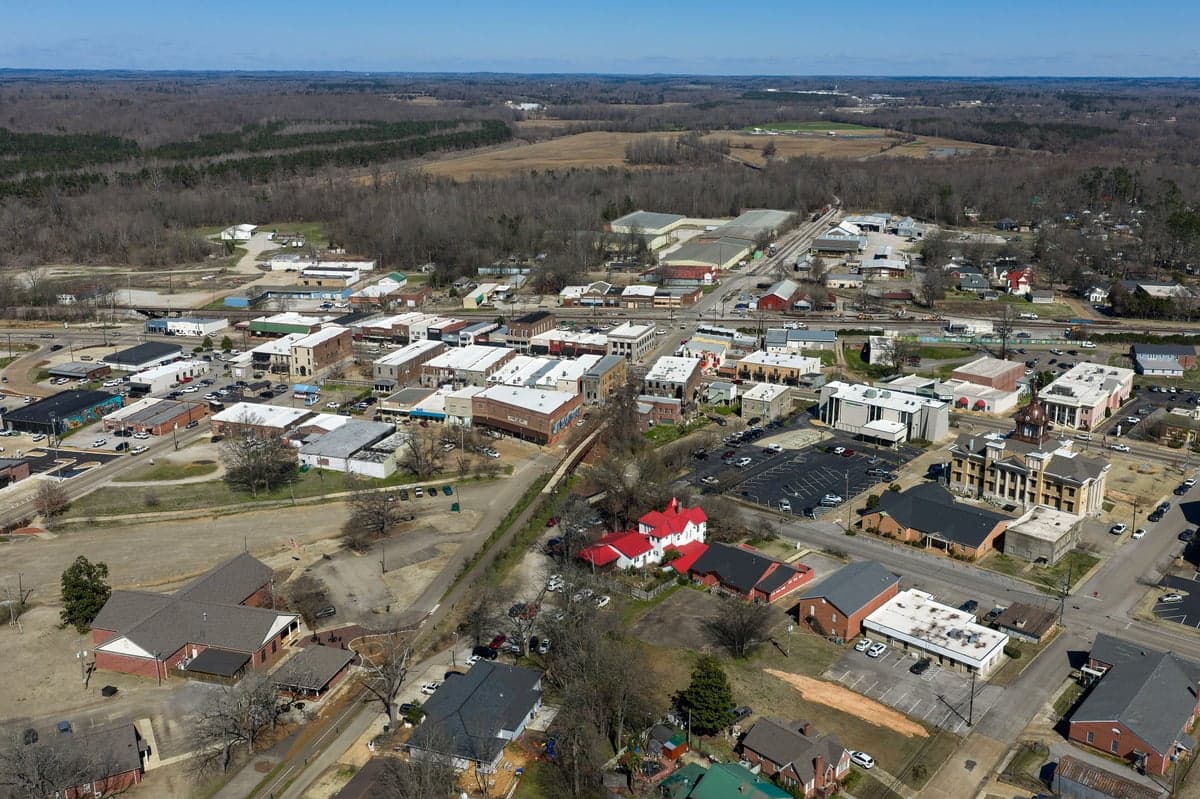
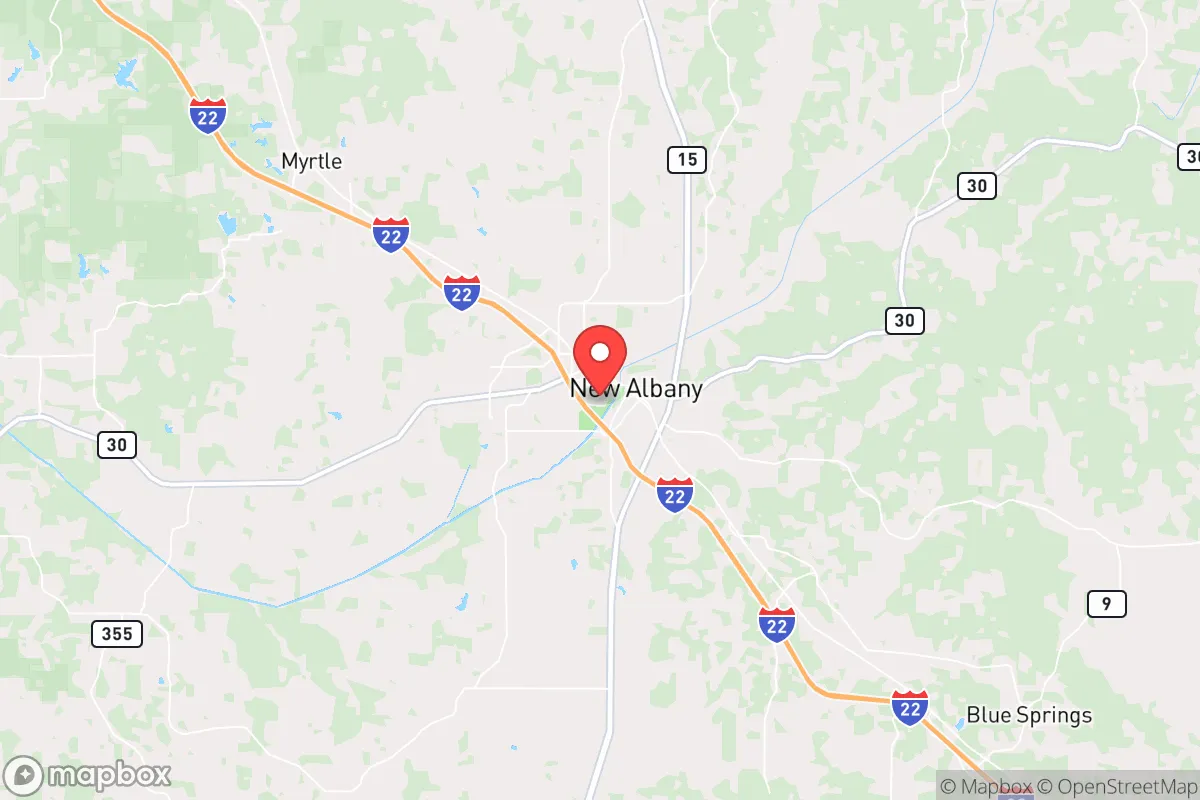

Photo: Wikipedia
Political ClimatePolitical Climate in New Albany, MS
District shown is the primary district for this city’s centroid. Cities may span multiple districts.
Inherited from parent county — no local data available.
* Lean and PVI are calculated from the surrounding county’s 2020 and 2024 presidential results, Cook-style — a finer measure here than its congressional district (MS-1).
Political rankings in Mississippi
- Most Conservative Cities in Mississippi
- Most Liberal Cities in Mississippi
- Best Liberal-Leaning Towns in the South
- Best Liberal-Leaning Towns in the Deep South
- Safest Liberal-Leaning Towns in the South
- Safest Conservative-Leaning Towns in the South
- Affordable Small Towns for Conservatives
- Safest Conservative-Leaning Cities in the U.S.
- Most Conservative Counties in Mississippi
- Most Liberal Counties in Mississippi
Local Political AnalysisPolitical Analysis of New Albany, MS
New Albany, Mississippi, sits deep in the heart of one of the most conservative corners of the state, with a Cook Partisan Voting Index (PVI) of R+35. That’s not just red; it’s a shade of crimson that makes the surrounding state’s R+11 rating look almost purple by comparison. The town’s political lean is baked into its culture, shaped by generations of family ties, local manufacturing, and a strong evangelical presence. If you’ve been around here long, you’ve seen the shift: the county has gotten redder over the last two decades, even as a few younger families and remote workers have trickled in from places like Tupelo or Oxford. The trajectory is steady—don’t expect any dramatic flips. New Albany is solid, and it’s staying that way.
How it compares
When you stack New Albany against the rest of Mississippi, the difference is stark. The state as a whole leans Republican by R+11, which already puts it in the top tier of red states nationally. But Union County, where New Albany sits, is a full 24 points more conservative than the state average. That’s not an accident. Drive 30 minutes south to Tupelo, and you’ll find a more moderate mix—still Republican, but with a noticeable Democratic minority, especially in the city limits. Head west to Oxford, home of Ole Miss, and you’ll see a younger, more liberal pocket that votes bluer than almost anywhere else in North Mississippi. New Albany, by contrast, feels like a throwback: fewer transplants, less college influence, and a local economy anchored by manufacturing plants like the Ashley Furniture and Cooper Tire facilities. The political reality here is that Republican candidates routinely win by 70-80% margins in local races, and Democratic campaigns rarely even bother to knock on doors.
What this means for residents
For conservative residents, New Albany is about as comfortable as it gets. Local government, school board meetings, and even the chamber of commerce all operate with a shared conservative ethos. You won’t find much debate over tax policy or Second Amendment issues—the consensus is baked in. For liberal residents, life is more of a balancing act. They’re not ostracized, but they’re definitely in the minority. Most keep their political views private, especially in workplace or church settings. That said, the town’s small size means personal relationships often trump political labels. Your neighbor might vote straight-ticket Republican, but they’ll still help you fix a fence or bring over a casserole when you’re sick. The practical effect is that policy debates are rare, and change comes slowly—if at all. Don’t expect a local push for public transit or progressive zoning laws anytime soon.
Cultural and policy distinctions
One thing that sets New Albany apart from even nearby conservative towns is its deep-rooted sense of self-reliance. There’s a palpable distrust of outside influence, whether from Jackson or Washington. Local ordinances tend to be minimal, and the county government keeps taxes low—property rates are among the most favorable in the state. Culturally, the town is proud of its history as the birthplace of author William Faulkner, but that literary heritage doesn’t translate into political liberalism. Instead, it’s woven into a broader narrative of Southern tradition. If you’re moving here, understand that the political climate isn’t just about voting—it’s about how people live their daily lives. Church attendance is high, hunting and fishing are common pastimes, and community events like the annual Union County Fair are the social glue. For both conservatives and liberals, the unwritten rule is simple: keep your politics to yourself at the dinner table, and you’ll fit in just fine.

State Political ClimatePolitical Climate in Mississippi
State Political AnalysisPolitical Environment in the State
Mississippi is one of the most reliably Republican states in the country, with a Cook Partisan Voting Index of R+11, meaning it votes about 11 points more Republican than the national average. The state hasn’t voted for a Democratic presidential candidate since Jimmy Carter in 1976, and every statewide elected office is held by a Republican. Over the last 10-20 years, the shift has been dramatic: as recently as the 1990s, Democrats still controlled the state legislature and held most statewide offices, but a combination of national party realignment and local cultural shifts has turned Mississippi into a deep-red stronghold. The dominant coalition is a mix of rural white conservatives, evangelical Christians, and a growing number of suburban voters who have moved rightward, while the Democratic base is overwhelmingly concentrated among Black voters in the Delta and urban centers.
Urban vs. rural divide
The political map of Mississippi is starkly divided between a handful of Democratic-leaning urban islands and a vast Republican sea. The state’s largest metro, Jackson (Hinds County), is a Democratic stronghold — Hinds County voted 80% for Joe Biden in 2020 — but it’s surrounded by heavily Republican suburbs like Madison and Ridgeland, which are among the wealthiest and fastest-growing parts of the state. The Gulf Coast cities of Biloxi and Gulfport lean Republican but are more competitive, often splitting tickets in local races. The northeastern corner, anchored by Tupelo (Lee County), is reliably Republican, while the Mississippi Delta — places like Greenville (Washington County) and Clarksdale (Coahoma County) — is overwhelmingly Democratic due to its large Black population. The rural “Pine Belt” region around Hattiesburg and the southwestern counties near Natchez are more mixed, with local races often decided by turnout in Black precincts. The key takeaway: if you live in a city of over 50,000, you’re likely in a blue bubble; anywhere else, you’re in deep-red territory.
Policy environment
Mississippi’s policy environment is among the most conservative in the nation. The state has no state income tax on wages (phased out in 2022), a flat 4% corporate income tax, and one of the lowest property tax burdens in the country. Sales tax is high — 7% state rate, plus local add-ons — so the tax structure is regressive, hitting lower-income residents harder. Education policy is a flashpoint: the state has a school choice program (the Mississippi Education Scholarship Account) for students with disabilities, but no broad voucher system. Public schools are chronically underfunded, with teacher pay among the lowest in the nation, though recent raises have been passed. Healthcare is a major concern — Mississippi did not expand Medicaid under the Affordable Care Act, leaving about 200,000 residents in the “coverage gap.” The state has some of the strictest abortion laws in the country, with a near-total ban in effect since the Dobbs decision. Election laws are restrictive: voter ID is required, no-excuse absentee voting is not allowed, and early voting was only introduced in 2024 (limited to in-person absentee with an excuse).
Recent policy direction
Mississippi’s recent legislative sessions have pushed the state further right on nearly every front. In 2024, the legislature passed a law allowing permitless carry of firearms (constitutional carry), joining the majority of Southern states. Parental rights were strengthened with a “Parents’ Bill of Rights” that requires school districts to notify parents of any changes to a student’s health or well-being, including gender identity issues — a direct response to the national debate over transgender policies. On education, the state banned critical race theory in public schools and prohibited instruction on sexual orientation and gender identity in K-3 classrooms (similar to Florida’s “Don’t Say Gay” law). Medical marijuana was legalized in 2022 after a ballot initiative, but the program is tightly regulated with a limited number of dispensaries. Property rights were bolstered by a 2023 law restricting local governments from regulating short-term rentals (like Airbnb) in most areas. On voting, the state resisted federal pressure to expand mail-in voting and instead tightened ballot security measures, including a ban on ballot harvesting. The overall direction is clear: Mississippi is doubling down on gun rights, parental control in schools, and limited government, while maintaining a cautious approach to medical cannabis and resisting Medicaid expansion.
Civil unrest & political movements
Mississippi has a long history of civil rights activism, and that legacy continues today, though the flashpoints have shifted. The most visible recent protests have been around racial justice — after George Floyd’s murder in 2020, demonstrations occurred in Jackson, Oxford (home of Ole Miss), and Hattiesburg, with a focus on removing Confederate monuments and renaming buildings. The state flag was changed in 2020, removing the Confederate battle emblem after decades of debate. On the right, the most organized movements are around gun rights (the Mississippi Gun Owners Caucus is influential) and anti-abortion activism, with groups like Mississippi Right to Life holding significant sway in the legislature. Immigration politics are less heated than in border states, but there’s a vocal minority pushing for stricter enforcement, and the state has a law requiring police to check immigration status during lawful stops. Election integrity remains a hot-button issue: after the 2020 election, Republican legislators passed a law requiring all absentee ballots to be returned by mail (no drop boxes) and limiting who can assist voters. You won’t see daily protests in most of Mississippi, but the cultural divide is real — especially in college towns like Oxford and Starkville, where younger, more liberal populations coexist with deeply conservative rural areas.
Projection
Over the next 5-10 years, Mississippi is likely to remain solidly Republican, but the margins may narrow slightly due to demographic shifts. The state’s Black population (about 38% of residents) is growing in political influence, particularly in the Delta and Jackson metro, and younger Black voters are more engaged than previous generations. However, white in-migration to suburbs like Madison and Ocean Springs (on the Gulf Coast) is reinforcing Republican dominance in those areas. The biggest wildcard is economic growth: if the state continues to attract manufacturing and logistics jobs (like the recent Amazon and Nissan expansions), it could draw more moderate voters who prioritize economic opportunity over culture war issues. But the legislature shows no sign of moderating — expect further restrictions on abortion, continued resistance to Medicaid expansion, and more school choice legislation. The practical effect for a new resident: if you’re conservative, you’ll find a state that aligns with your values on guns, taxes, and education; if you’re liberal, you’ll need to live in Jackson, Oxford, or the Gulf Coast to find like-minded community, and you’ll face a state government that is actively hostile to your policy preferences.
Bottom line for a new resident: Mississippi is a state where your political experience depends heavily on where you live. If you’re a conservative family looking for low taxes, strong gun rights, and a culture that values traditional religion and family structures, you’ll feel at home almost anywhere outside of Jackson. If you’re a liberal or moderate, you can still find community in the urban centers and college towns, but you’ll be swimming against the current of state policy. The state’s trajectory is firmly rightward, and that’s unlikely to change in the next decade — so come with your eyes open about what that means for your daily life, your kids’ schools, and your access to healthcare.
* Values derived from national, state, county, city and local statistics and may differ in a specific area. Last updated: 2026-11-23T16:26:28.000Z
Narrative content on this page is AI-generated and may contain mistakes. Verify any details that matter before acting on them.
ReloMaps may earn a commission from affiliate links at no extra cost to you.

