
Photo: Wikipedia
Demographics of New Albany, MS
Affluence Level in New Albany, MS
A below-average socioeconomic profile. Incomes, home values, and educational attainment trail the U.S., with higher poverty and unemployment.
People of New Albany, MS
New Albany, Mississippi, is a small city of 7,661 residents where a White majority (55.6%) coexists with a substantial Black population (31.0%) and a growing Hispanic community (9.7%), creating a demographic profile distinct from many Deep South towns of similar size. The city’s identity is shaped by its roots in furniture manufacturing and railroad commerce, a history that drew waves of workers from different backgrounds and continues to influence its neighborhoods today. With a foreign-born share of 5.6% and a college-educated rate of 22.5%, New Albany is a working-class community where family ties and local industry remain central to daily life.
How the city was settled and grew
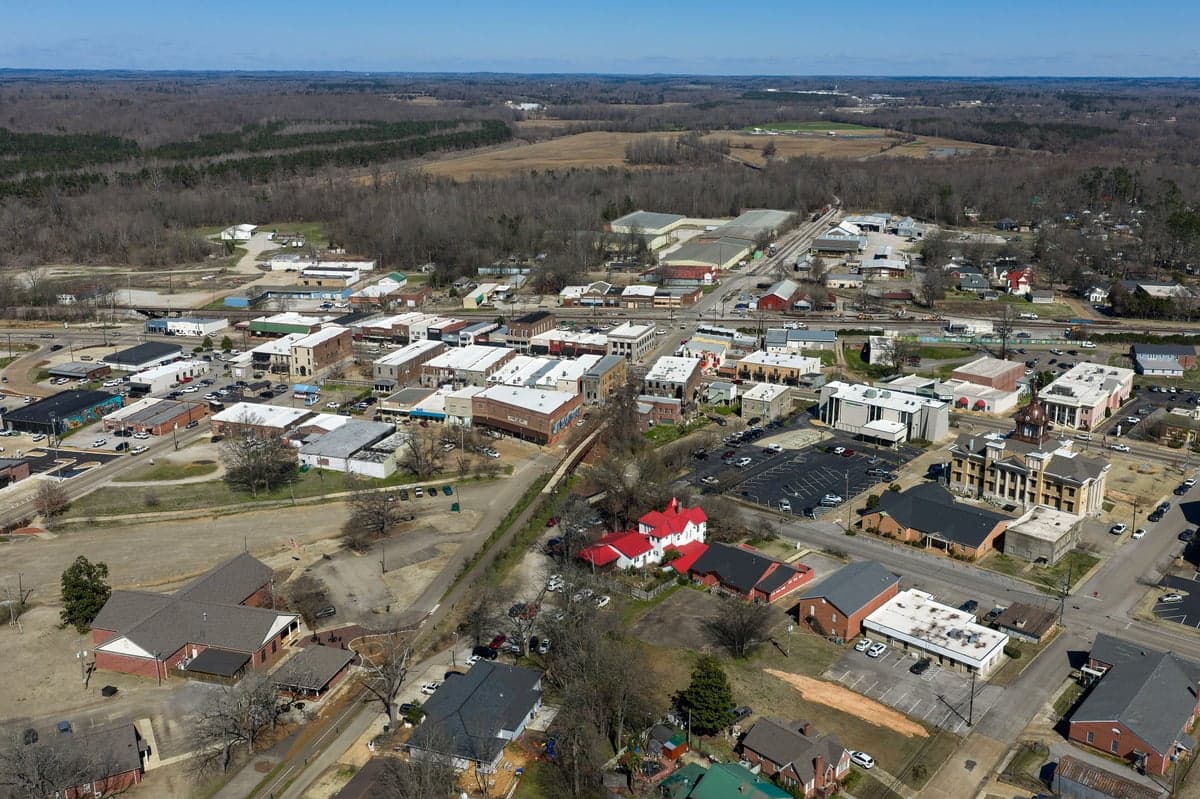
New Albany was founded in 1840 as a trading post along the Tallahatchie River, but its population boom came after the Civil War with the arrival of the railroad in the 1880s. The first major wave of settlers were White yeoman farmers and merchants from the surrounding hill country, who built the Historic Downtown District around the courthouse square, establishing a commercial hub that still anchors the city. By the early 1900s, the rise of the furniture industry—fueled by abundant local timber—drew a second wave: Black laborers from rural Union and Pontotoc counties who settled in the West End neighborhood, near the factories along the railroad tracks. This area became the heart of the city’s African American community, with churches, schools, and small businesses serving families who worked in the mills. A third, smaller wave of White immigrants from the Appalachian foothills arrived during the Great Depression, filling mill jobs and establishing the East Side neighborhood, a modest area of bungalows and shotgun houses that remains predominantly White today.
Modern era (post-1965)
The post-1965 era brought significant demographic change, driven by the decline of the furniture industry and the expansion of manufacturing in the broader region. The Immigration and Nationality Act of 1965 opened doors for new arrivals, but New Albany’s foreign-born population remained low (5.6% today) compared to national averages. The most notable shift has been the growth of the Hispanic community, which rose from near zero in 1990 to 9.7% of the population by 2020. These families—primarily from Mexico and Central America—moved into the Bissell Creek area on the city’s southern edge, drawn by jobs in poultry processing and light manufacturing. Meanwhile, the Black population, which had been concentrated in the West End, began dispersing into the Northgate subdivision and other newer developments as housing discrimination eased and incomes rose. The White population, while still a majority, has declined slightly as younger families have moved to larger cities like Tupelo or Oxford for professional opportunities. The Asian and Indian subcontinent populations remain at 0.0%, reflecting the city’s limited draw for high-skilled immigration.
The future
New Albany’s population is projected to remain stable or grow modestly over the next decade, driven by its affordability and proximity to the Tupelo metro area. The Hispanic share is expected to continue rising, likely reaching 12-15% by 2035, as families in the Bissell Creek area expand and new arrivals are attracted to the region’s manufacturing and logistics jobs. The Black population is likely to hold steady or grow slightly, with younger families moving into the Oak Park neighborhood, a newer subdivision on the city’s western edge that offers larger lots and newer homes. The White population will probably continue a slow decline, as outmigration of young adults to college towns and urban centers is only partially offset by retirees seeking low costs. The city’s cultural identity is evolving from a historically biracial (White-Black) community to a tri-ethnic one, with Hispanic festivals and businesses becoming more visible in the downtown area. The college-educated share (22.5%) is below the national average, limiting the growth of a professional class, but the city’s low cost of living and strong sense of community may attract remote workers and small business owners in the coming years.
For someone moving in now, New Albany offers a stable, family-oriented environment where the cost of living is low and community ties are strong. The city is becoming more diverse, but at a gradual pace that preserves its small-town character. New residents will find a place where the furniture industry’s legacy still shapes the economy and the neighborhoods, and where the biggest changes are the quiet arrival of Hispanic families and the slow dispersal of long-established Black and White communities into newer subdivisions.

* Values derived from national, state, county, city and local statistics and may differ in a specific area. Last updated: 2026-11-23T16:26:28.000Z
Narrative content on this page is AI-generated and may contain mistakes. Verify any details that matter before acting on them.
ReloMaps may earn a commission from affiliate links at no extra cost to you.

