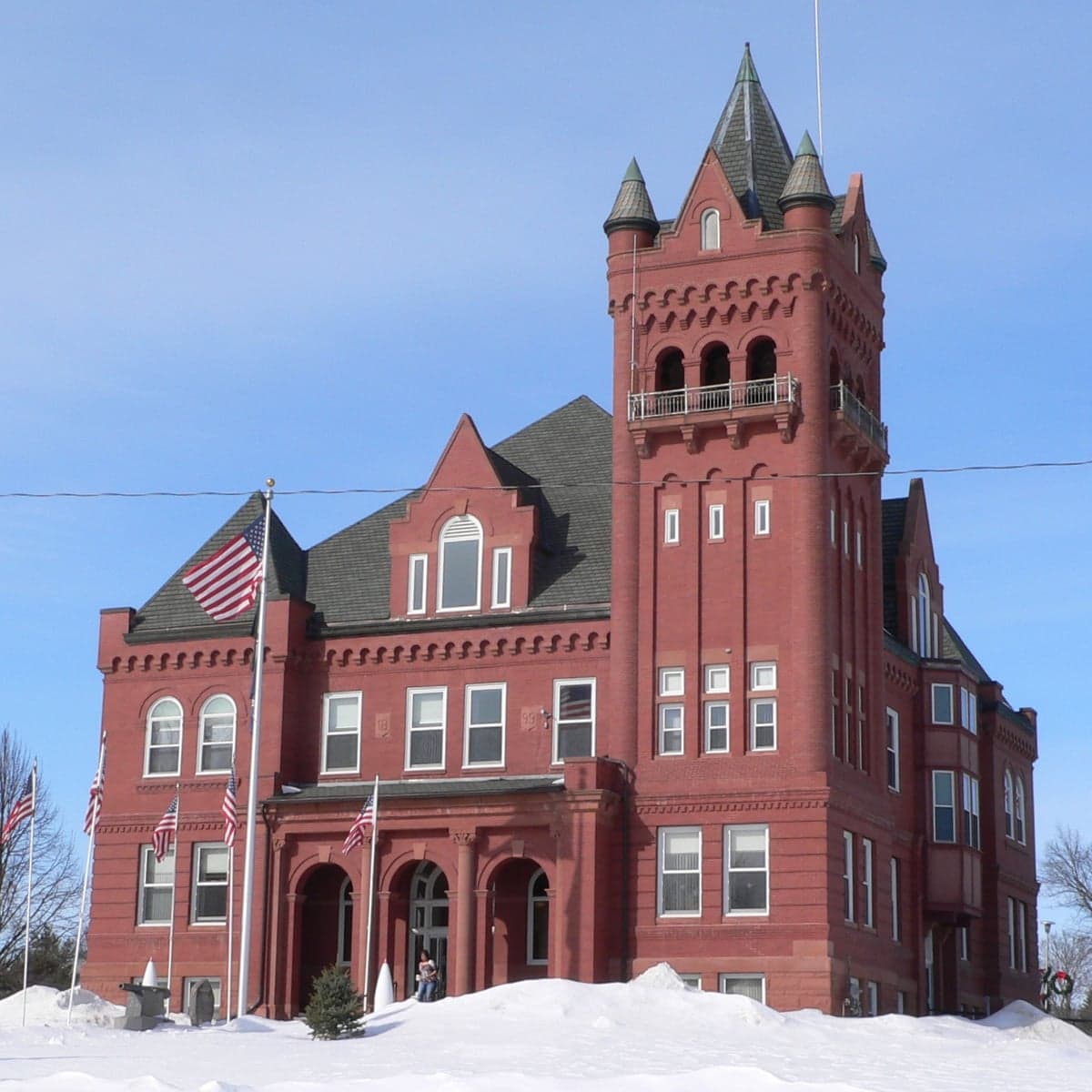
Photo: Wikipedia
Political ClimatePolitical Climate in Wayne County
Showing district-level results — no local-only data available.
Local Political AnalysisPolitical Analysis of Wayne County
Wayne County, Nebraska, is one of the most reliably Republican counties in the state, carrying a Cook Partisan Voting Index (PVI) of R+27. That’s a full 17 points more conservative than the state of Nebraska as a whole, which sits at R+10. In practice, this means Republicans routinely win countywide races by margins of 70% or more, and Democratic candidates rarely crack 30% of the vote. The county has been trending redder over the past decade, mirroring the broader rural shift in Nebraska, though the pace has been slightly slower here than in some neighboring counties due to the stabilizing influence of Wayne State College.
How it compares
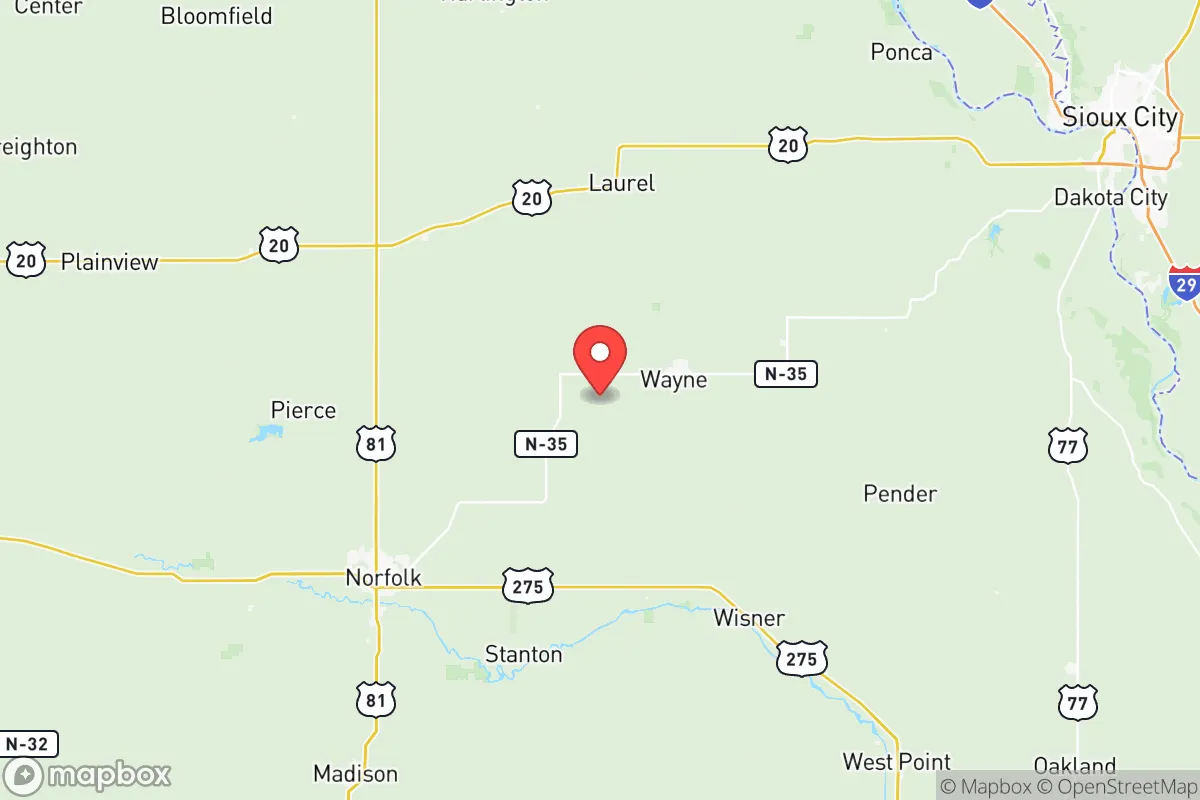
To understand Wayne County’s politics, you have to look at the towns. The city of Wayne itself, home to Wayne State College, is the county’s only real blue dot. Precincts around campus and the downtown core can swing 5-10 points more Democratic than the county average, with some precincts occasionally hitting 40-45% Democratic in presidential years. In contrast, the small towns of Winside, Carroll, and Hoskins are deeply red, often voting 80%+ Republican. The unincorporated areas and farm precincts between these towns are the most conservative, with turnout heavily favoring GOP candidates. Compared to Nebraska as a whole, Wayne County lacks the moderate suburban pockets you’d find around Omaha or Lincoln. The state’s R+10 rating is pulled left by Douglas and Lancaster counties; Wayne County has no such counterbalance. The county’s trajectory is stable but hardening — the college provides a small liberalizing effect, but it’s not enough to shift the overall lean.
What this means for residents
For conservative residents, Wayne County is a comfortable place to live politically. Local offices — county commission, school board, sheriff — are reliably held by Republicans, and policy debates tend to focus on agricultural issues, property taxes, and infrastructure rather than social wedge topics. Conservative voters can expect their values to be reflected in local governance without much friction. For liberal residents, the reality is more isolating. While the college town of Wayne offers a small progressive bubble — with faculty and students organizing around issues like climate and LGBTQ+ rights — those voices are a distinct minority. Liberal residents often find themselves navigating a community where their political views are assumed to be the exception, not the norm. That said, the college’s presence means there’s more tolerance for political diversity than in surrounding counties like Dixon or Cedar. Most residents, regardless of affiliation, agree that local politics are less contentious than national politics; people know each other, and partisan disagreements rarely spill into personal relationships.
Culturally, Wayne County stands apart from Nebraska’s urban centers in its emphasis on self-reliance and community volunteerism. The county has a strong tradition of supporting local schools and the college, which creates a shared civic identity that transcends party lines. Policy-wise, the county leans toward low taxes and limited government, but there’s also a pragmatic streak — voters here have supported bond measures for school improvements and community facilities when the need is clear. The college brings a steady stream of young people and new ideas, which keeps the county from becoming as insular as some of its neighbors. For anyone moving here, the political climate is straightforward: it’s deeply conservative, but with a small, active liberal minority centered in Wayne itself. The trajectory suggests this divide will persist, with the county remaining a Republican stronghold even as Nebraska’s urban areas continue to pull the state in a more competitive direction.

State Political ClimatePolitical Climate in Nebraska
State Political AnalysisPolitical Environment in the State
Nebraska is a solidly Republican state with a Cook PVI of R+10, but that number hides a more complicated reality than a simple red-state label suggests. The state has been reliably conservative for decades, though the margin has tightened slightly in presidential races — Donald Trump won it by 19 points in 2020, down from 25 points in 2016, while the 2022 gubernatorial race saw Republican Jim Pillen win by 20 points. What makes Nebraska genuinely unique is its split electoral vote system: the statewide winner gets two electoral votes, but the winner of each congressional district gets one, meaning Omaha's 2nd District has gone blue in three of the last four presidential elections, including Joe Biden in 2020.
Urban vs. rural divide
The political map of Nebraska breaks cleanly along the urban-rural axis. Omaha's Douglas County and Lincoln's Lancaster County are the Democratic strongholds, with Douglas County going for Biden by 10 points in 2020 and Lancaster County by 8 points. The rest of the state is overwhelmingly Republican. Sarpy County, the suburban ring south of Omaha, is a key battleground — it voted for Trump by 12 points in 2020, down from 20 points in 2016, making it one of the fastest-purpling suburban counties in the Great Plains. Grand Island and Kearney in central Nebraska are reliably red but have growing Latino populations that could shift the calculus over time. The Panhandle, including Scottsbluff and Chadron, votes heavily Republican, often by 40-point margins. The 2nd District's competitiveness means Omaha gets outsized attention from national campaigns, and its electoral vote has been targeted by both parties since 2008.
Policy environment
Nebraska's policy landscape is broadly conservative but with notable pragmatic streaks. The state has a unicameral, nonpartisan legislature — the only one in the country — which historically encouraged cross-party cooperation, though that dynamic has frayed in recent years. There is no state income tax on Social Security benefits, and the top individual income tax rate was cut from 6.84% to 5.84% in 2023, with a path to 3.99% by 2027. Property taxes are high relative to the region, a persistent source of frustration. The state is a right-to-work state with no union security agreements. Education policy is locally controlled, with school choice expansion a major recent fight — the legislature passed a tax-credit scholarship program in 2023, then repealed it after a referendum challenge, then reinstated a modified version in 2024. Nebraska has no sales tax on groceries. Election laws include voter ID requirements passed in 2021 and implemented in 2024, with a photo ID mandate at the polls. Early voting and mail-in voting remain available without an excuse.
Recent policy direction
Nebraska's recent legislative sessions have moved the state decisively to the right on several fronts. Gun and self-defense law: In 2023, Nebraska passed permitless concealed carry, allowing any legal gun owner to carry a concealed handgun without a permit. The state already had preemption of local gun ordinances and a Castle Doctrine law. Parental and education rights: The 2023 "Let Them Grow Act" banned gender-affirming care for minors, and the 2024 "Sports and Spaces Act" restricted transgender athletes to teams matching their sex assigned at birth. A 2023 law requires schools to post curriculum materials online for parental review. Medical and bodily autonomy: Nebraska banned abortion at 12 weeks in 2023, with exceptions for rape, incest, and medical emergencies. A 2024 ballot initiative to enshrine abortion rights in the state constitution failed to gather enough signatures. Property rights: The state has strong eminent domain protections, and a 2022 law restricted local governments from regulating short-term rentals. Voting and ballot access: The 2021 voter ID law was among the stricter versions nationally, requiring a physical photo ID to vote in person and a copy of ID for mail ballots. Taxation: The 2023 tax cut package was the largest in state history, with income tax rates scheduled to drop further and a phase-out of the inheritance tax beginning in 2025.
Civil unrest & political movements
Nebraska has not seen the kind of large-scale civil unrest common in coastal states, but there have been notable flashpoints. Omaha saw protests in 2020 following George Floyd's death, with some property damage and a heavy police response, but the city avoided the sustained violence seen elsewhere. The 2023 abortion ban sparked protests at the state capitol in Lincoln, with both pro-choice and pro-life groups holding regular demonstrations. Immigration politics have been relatively quiet compared to border states, but Schuyler and Lexington — small towns with large meatpacking plants and majority-Latino populations — have seen tensions over housing and school resources. There is no sanctuary city policy anywhere in the state; local law enforcement generally cooperates with federal immigration authorities. The election integrity debate has been less heated than in some states, though the 2021 voter ID law was pushed by Republicans citing concerns about public confidence. The unicameral legislature's nonpartisan structure has occasionally produced surprising coalitions, such as the 2023 failure of a major school choice bill that was defeated by a coalition of rural Republicans and urban Democrats.
Projection
Over the next 5-10 years, Nebraska is likely to remain solidly Republican but with a slowly tightening margin driven by suburban shifts and demographic change. Omaha's 2nd District will probably stay competitive, with the potential to flip back and forth depending on the national environment. The Latino population in central and western Nebraska is growing — now about 12% of the state total — and while this group has not voted monolithically, it could push some rural districts toward the center over time. The Sarpy County trend toward competitiveness is real and likely to continue as Omaha's suburbs grow and diversify. The state's tax-cutting trajectory is likely to continue, with further income tax reductions and potential property tax relief on the agenda. The abortion debate will remain active, with likely ballot measure attempts in 2026 or 2028. The unicameral legislature may face pressure to become partisan, but that change would require a constitutional amendment and is not imminent. In-migration is modest but growing, with people moving from Colorado and California for lower housing costs and a more conservative policy environment.
For a new resident, Nebraska offers a reliably conservative policy environment with pragmatic governance and low drama compared to many states. The tax burden is moderate and falling, gun laws are permissive, and the regulatory climate is business-friendly. Liberal residents will find a welcoming community in Omaha and Lincoln but will face a state government that is increasingly conservative on social issues, particularly around abortion and transgender rights. The practical takeaway is that Nebraska is a place where conservative values shape state policy, but where the nonpartisan legislative structure and the competitive 2nd District mean that political outcomes are not a foregone conclusion. If you're looking for a state where your vote matters more than in a deep-red or deep-blue state, and where the politics are serious but not apocalyptic, Nebraska is a solid bet.
* Values derived from national, state, county, city and local statistics and may differ in a specific area. Last updated: 2026-07-24T18:17:52.000Z
Narrative content on this page is AI-generated and may contain mistakes. Verify any details that matter before acting on them.
ReloMaps may earn a commission from affiliate links at no extra cost to you.

