Photo: Wikipedia
Political ClimatePolitical Climate in Madison County
Showing district-level results — no local-only data available.
Local Political AnalysisPolitical Analysis of Madison County
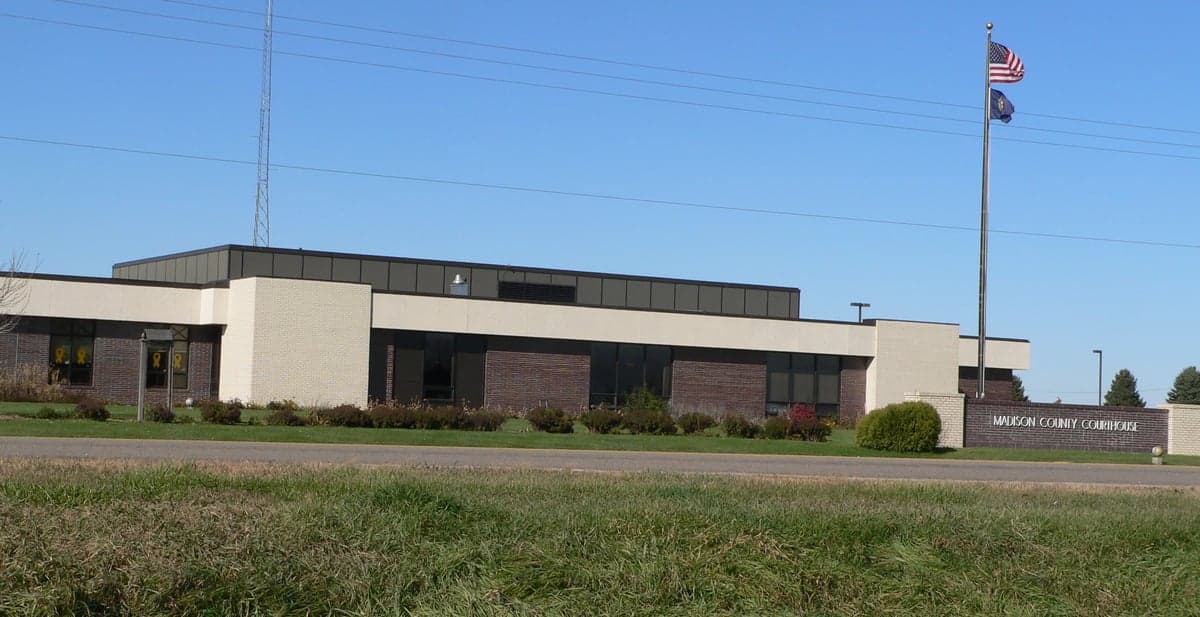
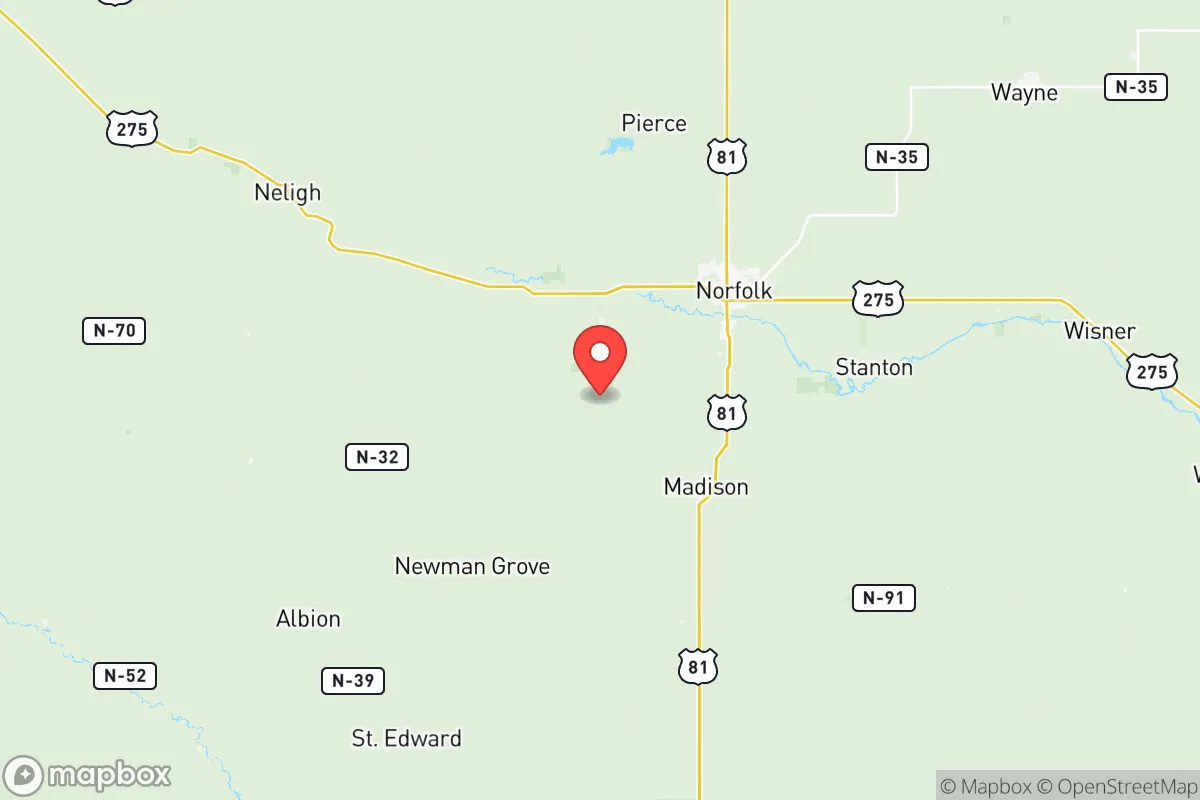
Madison County, Nebraska, leans reliably Republican, but it’s not quite as deep red as the rest of the state. With a Cook PVI of R+6, the county is noticeably less conservative than Nebraska’s statewide R+10 rating. That difference matters on the ground. The county seat, Norfolk, is the political bellwether—it’s where you’ll find the most competitive precincts, especially around the city’s core and near Northeast Community College. Meanwhile, the smaller towns like Battle Creek, Madison, and Tilden vote more solidly Republican, often by margins that push the county’s overall lean rightward. Over the last decade, the GOP advantage has held steady, but Norfolk’s growing diversity and younger population have kept the county from drifting as far right as its rural neighbors.
How it compares
Compared to Nebraska as a whole, Madison County is a moderate outlier. The state’s R+10 PVI reflects the deep-red dominance of western and central Nebraska, where counties like Holt or Cherry routinely vote 80%+ Republican. Madison County, by contrast, sits closer to the state’s political center of gravity. In the 2024 presidential race, the county voted about 62% Republican, while the state overall hit roughly 67%. That 5-point gap is consistent across recent cycles. Norfolk’s 2nd precinct, which includes downtown and the college area, has trended bluer in recent years—sometimes splitting 50-50 or even tipping Democratic in local races. The rural precincts outside Norfolk, however, are reliably 75-80% Republican. So the county’s R+6 rating is really a composite of two distinct political worlds: a purple city surrounded by a red countryside.
What this means for residents
For conservative residents, Madison County is a comfortable place to live. Republican candidates win most races, and the county GOP is active and well-organized. Norfolk hosts regular party events, and conservative values are reflected in local policy—from school board decisions to zoning debates. For liberal residents, the picture is more nuanced. They’re a clear minority countywide, but in Norfolk’s core precincts, they have real representation. The city council and school board often include moderate Democrats or independents, and progressive voices are heard on issues like affordable housing and public transit. The key takeaway: Madison County isn’t a place where either side feels silenced, but conservatives clearly set the tone. The political climate is civil compared to more polarized metros—people tend to disagree without being disagreeable, especially in person.
Culturally, Madison County stands apart from much of Nebraska in a few ways. Norfolk’s growing Latino population—now roughly 15% of the city—has introduced more bilingual services and cultural events, like the annual Cinco de Mayo celebration. That demographic shift hasn’t dramatically changed voting patterns, but it has made local politics more attentive to immigrant and working-class issues. Policy-wise, the county leans fiscally conservative but is pragmatic about economic development—Norfolk has invested heavily in its industrial park and workforce training programs, often with bipartisan support. Gun laws follow state preemption, so there’s no local variation. Social issues like abortion or LGBTQ+ rights are debated mostly along party lines, but Norfolk’s college presence keeps those conversations active. In short, Madison County offers a slightly more moderate, community-focused version of Nebraska’s broader conservatism—a place where the politics are red, but the people are neighborly.

State Political ClimatePolitical Climate in Nebraska
State Political AnalysisPolitical Environment in the State
Nebraska is a solidly Republican state with a Cook PVI of R+10, but that blanket statement hides a more interesting reality: the state’s politics are a tug-of-war between its two dominant population centers, Omaha and Lincoln, and the vast, deeply conservative rural expanse that surrounds them. Over the last 10-20 years, the rural areas have only grown redder while the urban cores have shifted left, creating a political landscape that feels increasingly polarized even as the statewide result stays reliably Republican. For a relocator, this means your day-to-day experience of politics will depend heavily on which corner of the state you land in.
Urban vs. rural divide
The political map of Nebraska is straightforward: the state’s two major metros, Omaha (Douglas County) and Lincoln (Lancaster County), are the blue islands in a sea of red. Omaha has been trending Democratic for years, and in 2020, Joe Biden won Douglas County by about 6 points, a shift from 2016 when Hillary Clinton won it by a narrower margin. Lincoln is more moderate but still leans left, with Biden carrying Lancaster County by roughly 8 points. The rest of the state is overwhelmingly Republican. The third-largest city, Grand Island (Hall County), is a bellwether—it voted for Trump in both 2016 and 2020, but by narrower margins than the surrounding farm counties. Out west, Scottsbluff and North Platte are deep red, routinely voting 70%+ Republican. The real outlier is Nebraska’s 2nd Congressional District, which includes Omaha and its suburbs; it’s competitive enough that it split its electoral vote in 2020, giving one of Nebraska’s five electoral votes to Biden. That district is the only real battleground in the state, and its suburban swing areas—places like Papillion and La Vista in Sarpy County—are where the political future of Nebraska will be decided.
Policy environment
Nebraska’s policy environment is broadly conservative, but with some notable wrinkles. The state has no personal or corporate income tax on the horizon—though it does have a progressive income tax with a top rate of 6.84%—and property taxes are a perennial frustration for homeowners and farmers alike. The state legislature is officially nonpartisan (the only one in the country), but in practice it’s dominated by Republicans who caucus along party lines. Education policy is a flashpoint: Nebraska has a robust system of public schools, but school choice and voucher debates have heated up, with a 2023 law creating a tax-credit scholarship program for private school tuition. Election laws are moderately restrictive: voters must show ID at the polls (a law passed in 2023), and early voting is available without an excuse. The state also has a unique “winner-take-all” system for its electoral votes, though there have been repeated attempts to switch to a congressional district method, which would make the 2nd District even more of a prize. Healthcare policy is mixed: Nebraska expanded Medicaid under the Affordable Care Act via a 2018 ballot initiative, but the state has not embraced the full ACA exchange and has a relatively high uninsured rate compared to neighboring states.
Recent policy direction
Over the last few years, Nebraska has moved decisively to the right on several fronts. In 2023, the legislature passed a major permitless carry law, allowing Nebraskans to carry concealed firearms without a permit—a significant shift from the state’s previous shall-issue regime. On education, the 2023 tax-credit scholarship program was paired with a ban on “divisive concepts” in public schools, mirroring laws in other red states. Abortion policy has been a central battleground: after the Dobbs decision, Nebraska passed a 12-week abortion ban in 2023, with exceptions for rape, incest, and medical emergencies. A subsequent attempt to pass a near-total ban failed, but the issue remains live, and a 2024 ballot initiative to enshrine abortion rights in the state constitution is expected to drive turnout. On voting, the 2023 voter ID law was paired with a reduction in early voting days, though mail-in voting remains available. Property rights are generally strong, with no statewide zoning mandates, though local governments in Omaha and Lincoln have their own land-use regulations. Surveillance and privacy are less contentious, but the state has not passed any major data privacy laws. Overall, the direction is toward more gun rights, more school choice, and tighter abortion restrictions, but the pace is moderated by the need to keep the Omaha and Lincoln suburbs from rebelling.
Civil unrest & political movements
Nebraska is not a hotbed of civil unrest, but there have been notable flashpoints. The 2020 George Floyd protests in Omaha were large and occasionally violent, leading to property damage and a heavy police response. Since then, Omaha has seen organized activism around police reform and racial justice, but it hasn’t reached the intensity of larger cities. On the right, the state has a strong grassroots conservative movement, particularly around gun rights and anti-abortion activism. The Nebraska Republican Party has been factionalized between establishment conservatives and more populist, Trump-aligned elements, but that hasn’t spilled into the streets. Immigration politics are relatively quiet, though there was a 2023 controversy over a proposal to ban sanctuary cities—a largely symbolic move since none exist in Nebraska. Election integrity has been a recurring theme: after 2020, some rural counties passed resolutions questioning the election results, but no major changes to election administration followed. The most visible political movement in the state right now is the abortion rights campaign, which has mobilized both sides and is likely to dominate the 2024 election cycle. A new resident in Omaha or Lincoln will see yard signs and canvassers; in rural areas, the issue is less visible but deeply felt.
Projection
Over the next 5-10 years, Nebraska is likely to remain a solidly Republican state, but the margins could narrow. The key demographic trend is the growth of the Omaha metro, particularly Sarpy County, which is becoming more suburban and slightly more competitive. If the 2nd Congressional District continues to trend left, it could eventually flip the state’s electoral vote allocation or force Republicans to moderate on some issues to hold the suburbs. Meanwhile, rural areas are aging and losing population, which will slowly erode the Republican base. The abortion ballot initiative in 2024 could reshape the political landscape if it passes, potentially making the state more moderate on social issues while keeping it conservative on economics and guns. In-migration is modest—Nebraska isn’t a boom state like Texas or Florida—but the people who do move in tend to be retirees or remote workers drawn to low cost of living, which could reinforce the conservative tilt. A relocator moving in now should expect the state to remain Republican-controlled, but with a more visible urban-rural split and a growing suburban swing vote that will make statewide elections closer than the PVI suggests.
For a new resident, the bottom line is that Nebraska offers a conservative policy environment with a pragmatic, non-ideological edge. If you’re a conservative, you’ll find a state that generally aligns with your values on guns, taxes, and school choice, but you’ll need to accept that Omaha and Lincoln are blue cities with their own political culture. If you’re a liberal, you’ll find safe havens in those cities, but you’ll be living under a state government that is actively moving right on abortion, education, and voting. The practical takeaway is that Nebraska is a place where your local experience—your school district, your city council, your county government—matters as much as the state-level politics. Choose your town carefully, and you’ll find a community that fits.
* Values derived from national, state, county, city and local statistics and may differ in a specific area. Last updated: 2026-08-08T11:49:34.000Z
Narrative content on this page is AI-generated and may contain mistakes. Verify any details that matter before acting on them.
ReloMaps may earn a commission from affiliate links at no extra cost to you.

