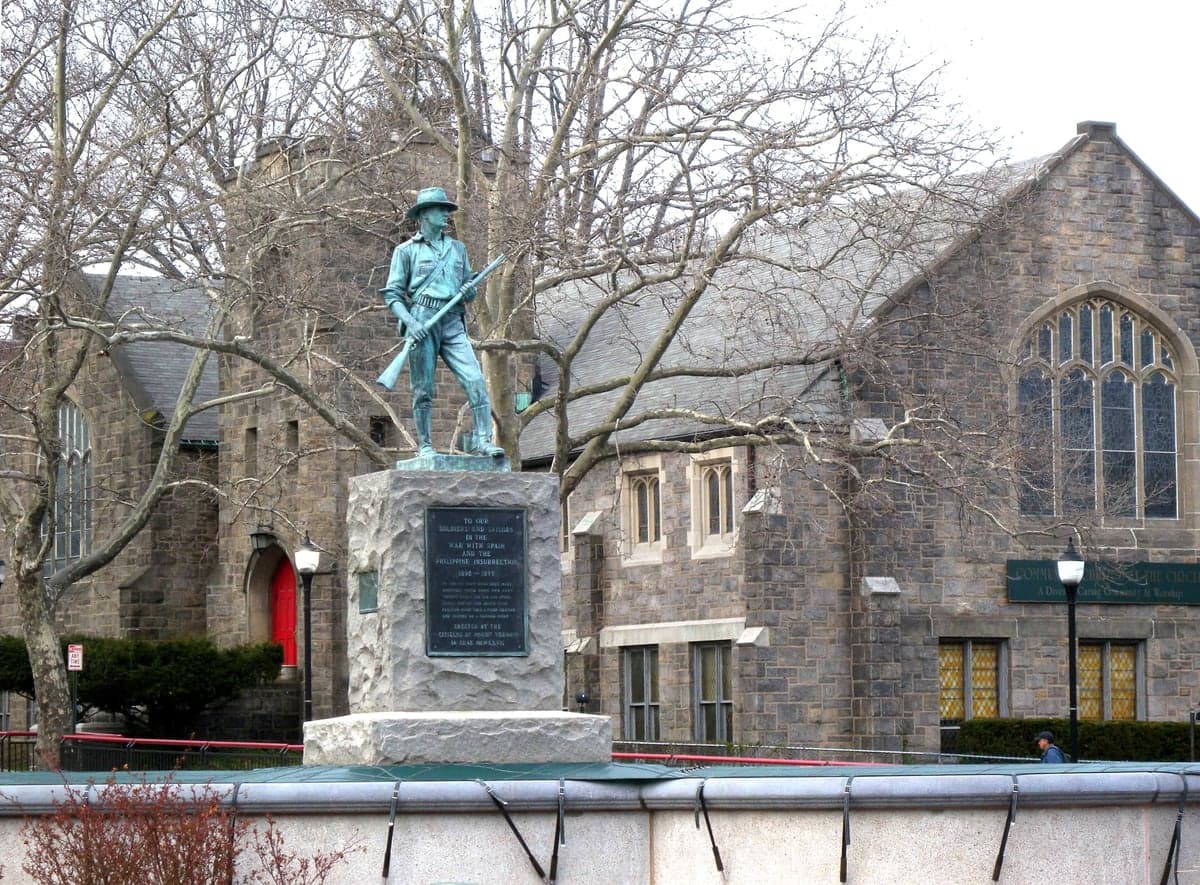
Photo: Wikipedia
Political ClimatePolitical Climate in Mount Vernon, NY
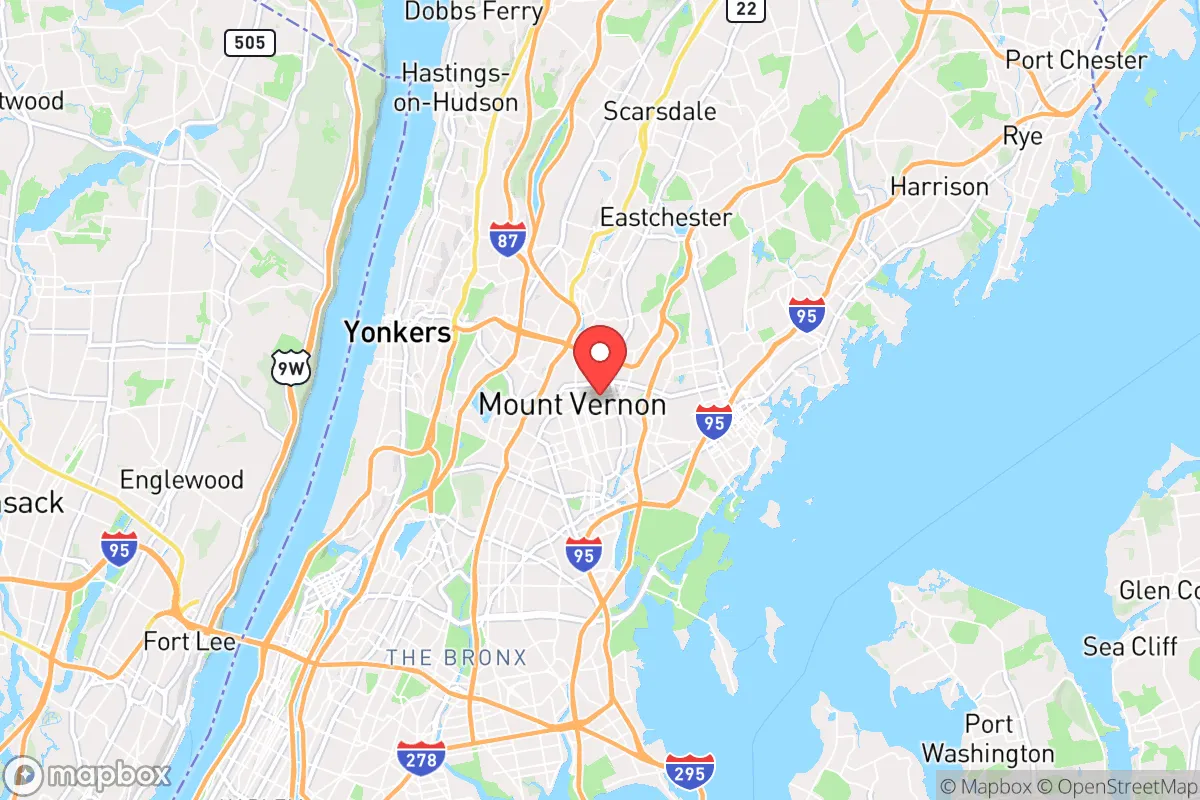
District shown is the primary district for this city’s centroid. Cities may span multiple districts.
Local Political AnalysisPolitical Analysis of Mount Vernon, NY
Mount Vernon has been a Democratic stronghold for decades, and it’s only gotten bluer. The Cook PVI of D+18 tells you the basics—this city votes about 18 points more Democratic than the national average—but the real story is how that lockstep loyalty has tightened over the years. Back in the 1990s, you’d still see a decent number of Republican yard signs around Fleetwood or near the Bronx River border. Now? You’re lucky to spot one. The last time Mount Vernon voted for a Republican presidential candidate was George H.W. Bush in 1988, and since then the margins have only grown wider. In 2024, Kamala Harris carried the city by roughly 70 points. That’s not just a trend; it’s a one-party system.
How it compares
Drive ten minutes north to New Rochelle, and you’ll find a slightly more moderate electorate—still blue, but with a Cook PVI around D+12 and a few more split-ticket voters in local races. Head east into Scarsdale or Larchmont, and you hit wealthy suburbs where fiscal conservatism still has a pulse, even if social issues lean left. But Mount Vernon is different. It’s the most reliably Democratic city in Westchester County, and that uniformity has consequences. In local elections, the Democratic primary is the only race that matters; the general election is a formality. That means the real political fights happen behind closed doors, not at the ballot box. For a conservative or even a moderate, it can feel like your vote doesn’t count for much beyond sending a message.
What this means for residents
If you value personal freedoms—especially around property rights, school choice, and how you spend your own money—Mount Vernon’s political climate can feel suffocating. The city council and mayor’s office have pushed through a series of progressive ordinances over the past decade: stricter rent control measures that make it harder for small landlords to operate, a local minimum wage hike above the state level, and zoning changes that limit what you can do with your own home. The school board, too, has leaned heavily into DEI initiatives and social-emotional learning curricula, sometimes at the expense of core academics. For a conservative parent, that’s a red flag. The tax burden is also among the highest in Westchester, and with no real opposition party to push back on spending, you can expect those rates to keep climbing. The long-term trajectory is concerning: more government programs, less local autonomy, and a culture that increasingly views dissent as intolerance.
One cultural distinction worth noting: Mount Vernon has a strong, historically Black middle class that once balanced progressive social views with a practical, family-first conservatism on fiscal matters. That old-school pragmatism is fading. Younger voters and transplants from New York City are driving the city further left, and the old guard—the folks who remembered when the city was a thriving, safe place to raise kids—are being pushed aside. If you’re considering a move here, understand that your voice on issues like school choice, property rights, or tax caps will be a minority one. It’s not a bad place to live—the commute to Manhattan is fast, and the housing stock is solid—but politically, you’ll be swimming against a very strong current.

State Political ClimatePolitical Climate in New York
State Political AnalysisPolitical Environment in the State
New York State has shifted from a classic purple battleground to a deeply blue stronghold over the past two decades, with Democrats now holding a supermajority in the state legislature and every statewide office. The state hasn't voted Republican in a presidential election since 1984, and in 2024, Kamala Harris carried it by roughly 12 points. But that top-line number hides a brutal internal war: the five boroughs of New York City and a handful of wealthy suburbs now dictate policy for a vast, increasingly resentful upstate region that feels like a different country. For a conservative considering relocation, the state is effectively two governments — one in Albany that keeps tightening the screws, and another in your local county that might still be fighting back.
Urban vs. rural divide
The political map of New York is a story of two worlds separated by the Hudson Valley. New York City alone delivers roughly 70% of the state's Democratic vote, with Manhattan and Brooklyn producing margins of 80-85% for Democrats. The immediate suburbs — Nassau County on Long Island and Westchester County north of the city — have trended blue over the last decade, though they still elect a few moderate Republicans at the local level. Drive an hour north of the city, and the landscape flips hard. Orange County and Sullivan County in the Hudson Valley are now reliably red, with Trump winning them by double digits in 2024. The real conservative strongholds are the "Southern Tier" counties along the Pennsylvania border — Steuben, Chemung, and Allegany — which vote 65-70% Republican. Erie County (Buffalo) and Monroe County (Rochester) are blue islands surrounded by red rural seas, while Onondaga County (Syracuse) has become a genuine swing county that both parties target. The divide isn't just political — it's cultural and economic. Upstate residents feel ignored by Albany, and that resentment fuels a quiet but persistent secession movement in counties like Steuben and Tioga, where "New York City runs the state" is a daily grievance.
Policy environment
New York's policy climate is among the most progressive in the nation, and it's been accelerating. The state has the highest combined state and local tax burden in the country, with income tax rates topping out at 10.9% and property taxes that can exceed 2.5% of home value in places like Westchester and Nassau. The 2019 "Green New Deal" for New York (the Climate Leadership and Community Protection Act) mandates a 70% renewable energy grid by 2030 and net-zero emissions by 2050 — a regulatory hammer that's already driving up energy costs and pushing manufacturers out. On education, the state has eliminated most charter school caps and expanded universal pre-K, but it also passed a law in 2023 banning "outdated" disciplinary practices, which critics say has made classrooms harder to manage. Healthcare is dominated by the state's Medicaid program, which covers roughly one in three New Yorkers and costs taxpayers over $80 billion annually. Election laws are among the most permissive in the country: no-excuse absentee voting, same-day registration, and automatic voter registration are all in place. The state also passed a law in 2021 allowing non-citizens to vote in local elections in New York City — a policy that has sparked fierce debate and legal challenges.
Trajectory & freedom
New York is moving decisively toward less personal freedom across multiple fronts, and the trend has accelerated since 2020. On gun rights, the state passed the Concealed Carry Improvement Act (CCIA) in 2022 after the Bruen Supreme Court decision, which created a list of "sensitive places" where guns are banned — including Times Square, subways, and private businesses unless the owner explicitly allows them. The law also requires a 16-hour training course and a social media review for applicants. It's been challenged in court, but remains in effect. On parental rights, the state passed a law in 2023 that prohibits school districts from notifying parents if a child changes their gender identity or pronouns — a direct conflict with the parental rights movement that has led to lawsuits in Nassau County and Suffolk County. Medical autonomy took a hit with the state's strict COVID-19 vaccine mandates for healthcare workers, which were only lifted in 2024 after a court ruling. Property rights are under pressure from the state's rent control laws, which cover over a million apartments in New York City and have been extended to some upstate cities like Albany and Buffalo. The state also passed a law in 2023 banning "source of income" discrimination, which effectively forces landlords to accept Section 8 vouchers — a policy that small landlords say is an unfunded mandate. On the tax front, the state's mansion tax on properties over $1 million and the pied-à-terre tax on second homes have driven some high-net-worth individuals to Florida and Texas, but the legislature keeps raising rates.
Civil unrest & political movements
New York has been a flashpoint for political activism on both sides. The 2020 George Floyd protests in New York City were among the largest in the country, with looting and property damage in Manhattan and Brooklyn that led to a 2021 law banning chokeholds and creating a new disciplinary system for police. The state's sanctuary city policies have been a constant source of tension: New York City's "right to shelter" law, combined with the state's 2019 "Green Light Law" that allows undocumented immigrants to get driver's licenses, has drawn millions of migrants to the city since 2022, overwhelming shelters and sparking protests in neighborhoods like Staten Island and Queens. On the right, the "New York State of Mind" movement — a coalition of upstate conservatives — has organized rallies in Albany against the CCIA and the parental notification ban. The Steuben County legislature passed a resolution in 2023 declaring the county a "Second Amendment Sanctuary," and similar resolutions have passed in over 30 counties. Election integrity remains a hot-button issue: the state's 2020 mail-in voting expansion led to a 2021 law requiring all counties to offer early voting, but Republicans in Monroe County and Erie County have raised concerns about ballot harvesting and the lack of voter ID. The most visible flashpoint for a new resident would be the migrant crisis — busloads of asylum seekers arriving in New York City and being sent to upstate hotels in places like Orange County and Sullivan County, where local officials have sued the state to stop the practice.
Projection
Over the next 5-10 years, New York is likely to become even more progressive at the state level, driven by demographic trends in New York City and its inner suburbs. The city's population has stabilized after a post-COVID dip, and the influx of young, left-leaning professionals into Brooklyn and Queens will keep the legislature blue. Upstate, the trend is the opposite: population decline in rural counties like Steuben and Allegany will reduce their political clout, while the growth of Orange County and Sullivan County as exurbs of New York City will bring more moderate voters. The state's tax burden is unlikely to decrease — the legislature is considering a wealth tax on assets over $1 billion, which would drive more high-income earners out. The parental rights battle will intensify, with the state likely to pass a "trans refuge" law shielding minors who travel to New York for gender-affirming care from out-of-state parents. On housing, the state is pushing a "good cause eviction" law that would effectively end no-fault evictions statewide, which could make it even harder to find rental housing. The migrant crisis will remain a political third rail, with the state likely to expand sanctuary policies while upstate counties continue to resist. A new resident moving in now should expect a state where the government is increasingly involved in personal decisions — from what you can teach your kids to where you can carry a gun — and where the cost of living will keep rising faster than wages.
For a conservative considering New York, the bottom line is this: you can find a good life here if you pick your county carefully, but you'll be fighting the state government every step of the way. The rural and exurban areas — Steuben, Orange, Sullivan, Tioga — still offer strong communities, lower taxes, and local governments that push back against Albany. But the state's trajectory is clear: more regulation, higher taxes, and less personal freedom. If you're willing to be a political minority and pay a premium for it, New York has world-class natural beauty, strong schools in the right districts, and a resilient economy. Just don't expect the state to get out of your way anytime soon.
* Values derived from national, state, county, city and local statistics and may differ in a specific area. Last updated: 2026-05-01T10:49:39.000Z
Narrative content on this page is AI-generated and may contain mistakes. Verify any details that matter before acting on them.
ReloMaps may earn a commission from affiliate links at no extra cost to you.

