Photo: Wikipedia
Political ClimatePolitical Climate in Mount Vernon, IA
District shown is the primary district for this city’s centroid. Cities may span multiple districts.
Local Political AnalysisPolitical Analysis of Mount Vernon, IA
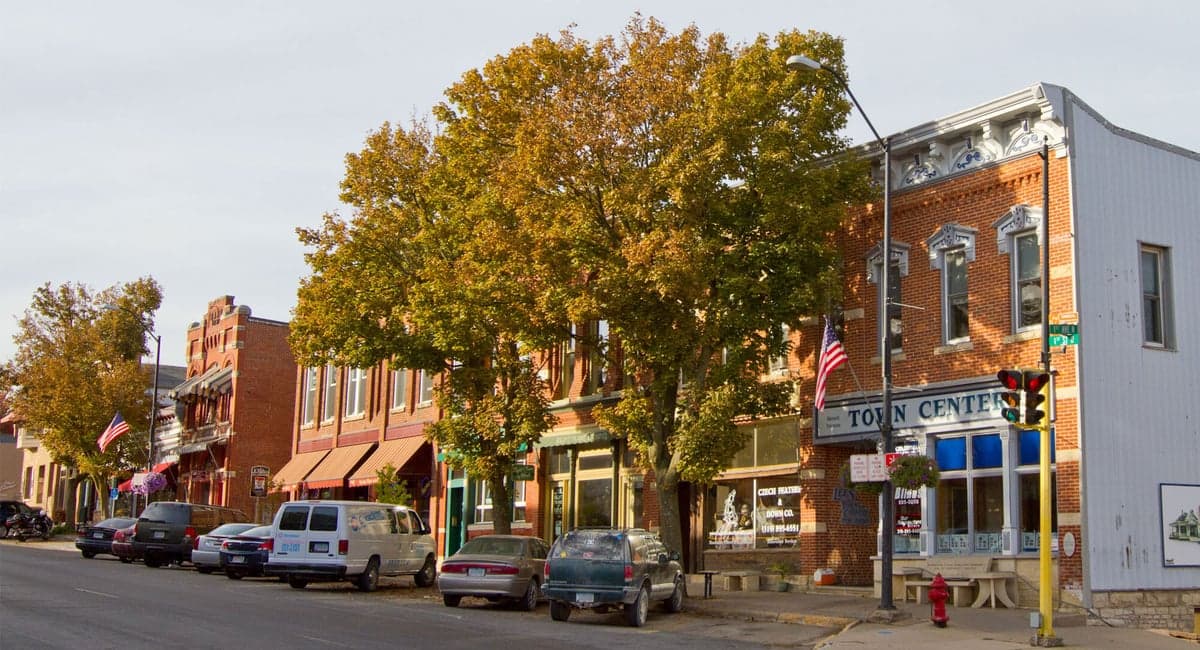
Mount Vernon sits in a political sweet spot that's a bit more nuanced than the surrounding area. The town itself leans Republican, but with a Cook PVI of R+4, it's noticeably less conservative than Iowa as a whole, which sits at R+6. That two-point gap might not sound like much, but in practice it means Mount Vernon is one of those rare places in eastern Iowa where you'll find a genuine mix of perspectives, not just a straight red wall. The trajectory here has been slowly shifting toward the center over the past decade, driven largely by the influx of faculty and staff connected to Cornell College and by younger families moving out from Cedar Rapids and Iowa City who want small-town life without the ideological uniformity.
How it compares
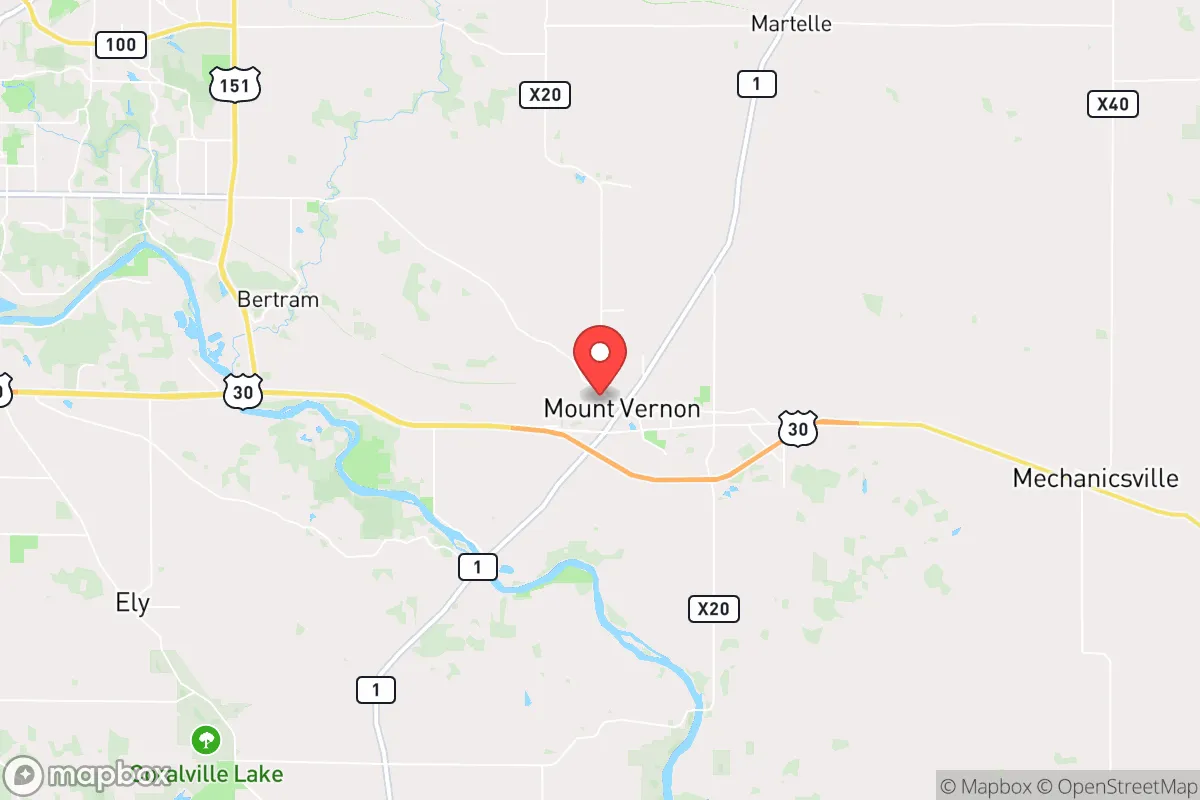
Drive ten miles west to Cedar Rapids and you're in a county that's been trending purple, with Linn County voting blue in recent presidential cycles. Head south toward Iowa City and you're in one of the most liberal pockets in the state. But go north or east into rural Linn and Jones counties, and the landscape turns deep red fast. Mount Vernon acts almost like a political buffer zone. The R+4 rating reflects a community where local elections are often competitive and where you'll see yard signs for both parties during a tight race. That's not something you can say for nearby towns like Lisbon or Springville, which lean harder conservative. The contrast is most visible in school board and city council races, where Mount Vernon voters tend to prioritize moderate candidates who can bridge the gap between the college crowd and the farming families who've been here for generations.
What this means for residents
For conservative residents, Mount Vernon offers a comfortable environment where traditional values are still the baseline, but you won't feel like you're in a bubble. You can attend church, send your kids to a strong public school, and talk politics at the coffee shop without tension. For liberal residents, the town provides enough like-minded neighbors—especially around the Cornell campus and the newer developments—that you don't feel isolated, even if you're outnumbered in the countywide vote. The practical effect is that most people here learn to get along. You'll see a mix of bumper stickers in the Hy-Vee parking lot, and the local diner doesn't have a "side" you need to pick. That said, the county-level R+6 lean does shape things like property tax debates and zoning decisions, where conservative fiscal priorities tend to carry the day.
The real cultural distinction in Mount Vernon is that politics rarely dominates daily life the way it does in more polarized towns. People here are more likely to bond over the high school football team or the summer concert series on the square than over cable news talking points. The college brings in a steady stream of younger, more progressive voices, but the agricultural roots and the strong sense of local tradition keep things grounded. If you're looking for a place where you can be politically active without being politically consumed, Mount Vernon delivers that balance. It's not a battleground—it's a community that happens to vote slightly right of center, with enough room for everyone to feel heard.

State Political ClimatePolitical Climate in Iowa
State Political AnalysisPolitical Environment in the State
Iowa has shifted from a classic purple swing state to a solidly Republican one, carrying a Cook PVI of R+6 that reflects a rightward march over the past two decades. The state voted for George W. Bush in 2004, then flipped to Barack Obama in 2008 and 2012, but since 2016 it has backed Donald Trump by increasing margins—from +9 in 2016 to +8 in 2020, and a decisive +13 in 2024. This trajectory is driven by a coalition of rural and small-town voters, evangelical Christians, and working-class whites who have abandoned the Democratic Party over cultural and economic issues, while the state's few urban centers—Des Moines, Iowa City, and Cedar Rapids—remain Democratic strongholds but lack the population to offset the rest of the map.
Urban vs. rural divide
The political geography of Iowa is stark. The Des Moines metro area, including Polk and Dallas counties, is the state's Democratic anchor—Polk County went for Biden by 18 points in 2020 and Harris by 16 in 2024, while fast-growing Dallas County flipped from red to blue in 2020 and stayed there. Iowa City (Johnson County) is the most liberal enclave, voting Democratic by over 40 points, driven by the University of Iowa's academic and student population. Cedar Rapids (Linn County) also leans blue, though less intensely. Outside these islands, the rest of the state is deeply Republican. Counties like Sioux, Plymouth, and Lyon in the northwest routinely vote 70-80% Republican, while the rural south and east—places like Ottumwa, Burlington, and Fort Madison—have shifted hard right as manufacturing and agriculture declined. The divide is not just urban vs. rural but also generational: younger voters in college towns push left, while older, non-college voters in small towns and farms drive the GOP's dominance.
Policy environment
Iowa's policy environment is conservative but pragmatic, shaped by a Republican trifecta that has controlled the governorship and legislature since 2017. The state has a flat income tax rate of 3.8% (phased down from 8.53% in 2018), with a goal of reaching 3.5% by 2027, and no estate tax. Property taxes are relatively low, averaging about 1.5% of home value, but vary by county. The regulatory posture is business-friendly: Iowa is a right-to-work state, has no state-level minimum wage above the federal $7.25, and offers generous tax credits for renewable energy and manufacturing. Education policy is a flashpoint: the state passed a universal school voucher program in 2023 (HF 68), allowing any family to use public funds for private or homeschool expenses, which has expanded school choice but drawn criticism from rural districts worried about funding. Healthcare is mixed—Iowa expanded Medicaid under the Affordable Care Act in 2014, but the state has also imposed work requirements for able-bodied adults on the program, and abortion is banned after six weeks (a "fetal heartbeat" law signed in 2023, currently in effect after a 2024 court ruling). Election laws have tightened: voter ID is required, absentee ballot drop boxes were restricted in 2021, and early voting windows were shortened from 29 to 20 days.
Recent policy direction
The last five years have seen Iowa move decisively to the right on a broad set of liberties. On gun rights, the state enacted permitless carry (constitutional carry) in 2021, allowing any legal adult to carry a concealed firearm without a permit, and a "stand your ground" law in 2022. Parental rights and education saw the "Parents Bill of Rights" (HF 241) in 2021, requiring schools to notify parents of curriculum changes and allowing them to opt children out of sex education, followed by a 2023 law banning instruction on sexual orientation and gender identity in K-6 classrooms (SF 496). Speech and privacy: the state passed a law in 2022 prohibiting public universities from requiring diversity statements in hiring, and a 2023 law restricts transgender minors' access to gender-affirming care (SF 538). Medical and bodily autonomy: the six-week abortion ban is among the strictest in the Midwest, with no exceptions for rape or incest, only for medical emergencies. Property rights: Iowa has strong eminent domain protections for landowners, but also allows carbon pipeline companies to use eminent domain for private projects, sparking fierce opposition from farmers. Taxation: the flat tax phase-down is ongoing, with the goal of eliminating income tax entirely by 2030, though that remains aspirational. Voting access: voter ID is enforced, and a 2021 law (SF 413) reduced early voting days and banned most absentee ballot drop boxes, which critics say suppresses turnout in Democratic-leaning areas.
Civil unrest & political movements
Iowa has seen relatively low levels of civil unrest compared to coastal states, but political movements are active. The most visible flashpoint in recent years has been the fight over carbon capture pipelines—Summit Carbon Solutions and Navigator CO2 Ventures proposed pipelines to transport ethanol plant emissions, using eminent domain to cross private land. This sparked a grassroots movement of farmers and landowners, often conservative, who opposed the projects as a violation of property rights. The Iowa Legislature passed a law in 2022 allowing pipeline companies to use eminent domain, but Navigator canceled its project in 2023 after regulatory hurdles, while Summit continues. Immigration politics are less heated than in border states, but Governor Kim Reynolds sent Iowa National Guard troops to Texas in 2021 and 2024 as part of Operation Lone Star, and the state passed a law in 2024 making it a crime to enter Iowa after being deported (SF 2340). Election integrity controversies flared after 2020, with Trump's narrow loss in the state leading to audits and a 2021 law tightening voting rules, but no widespread fraud was found. Protests have been small and focused: Black Lives Matter demonstrations in Des Moines and Iowa City in 2020, and annual March for Life rallies in Des Moines. The state's political culture remains civil compared to national norms, but the pipeline fights and school board meetings over LGBTQ+ policies have become heated.
Projection
Over the next 5-10 years, Iowa is likely to remain solidly Republican, but demographic shifts could moderate the trend. The state's population is aging and growing slowly—it gained only 4% between 2010 and 2020, with most growth in the Des Moines metro and Iowa City. In-migration from blue states like Illinois and California is modest but increasing, particularly to suburbs like Ankeny and Waukee, which could slowly shift some suburban districts toward purple. However, rural depopulation continues, and the Republican base in small towns and farms is aging but loyal. The flat tax and business-friendly climate may attract more remote workers and manufacturers, but the state's restrictive abortion law and education policies could deter some younger families. The GOP's dominance is unlikely to be seriously challenged unless Democrats can rebuild in rural areas or the Des Moines metro grows enough to flip a few state legislative seats. Expect continued conservative policy on guns, abortion, and education, with potential further tax cuts and school choice expansion. A new resident moving in now should expect a state that is reliably red, with a pragmatic but increasingly ideological Republican leadership, and a political culture that values stability and low taxes over rapid change.
For a new resident, the bottom line is that Iowa offers a low-tax, business-friendly environment with strong gun rights and school choice, but also strict abortion laws and a polarized education landscape. Conservatives will find a welcoming political climate and a government that aligns with their values on most issues. Liberals will find safe havens in Des Moines, Iowa City, and Cedar Rapids, but will face a state government that is actively rolling back policies they support. The practical takeaway is that Iowa is a place where your vote matters less in statewide races—the Republican lean is baked in—but local elections, especially school boards and county commissions, are where the real battles over policy play out. If you value low taxes, gun rights, and parental control in education, you'll feel at home. If you prioritize abortion access or progressive social policies, you'll need to live in one of the blue islands and accept that state law will often run counter to your preferences.
* Values derived from national, state, county, city and local statistics and may differ in a specific area. Last updated: 2026-10-20T17:16:53.000Z
Narrative content on this page is AI-generated and may contain mistakes. Verify any details that matter before acting on them.
ReloMaps may earn a commission from affiliate links at no extra cost to you.

