

Photo: Wikipedia
Political ClimatePolitical Climate in Mount Sterling, KY
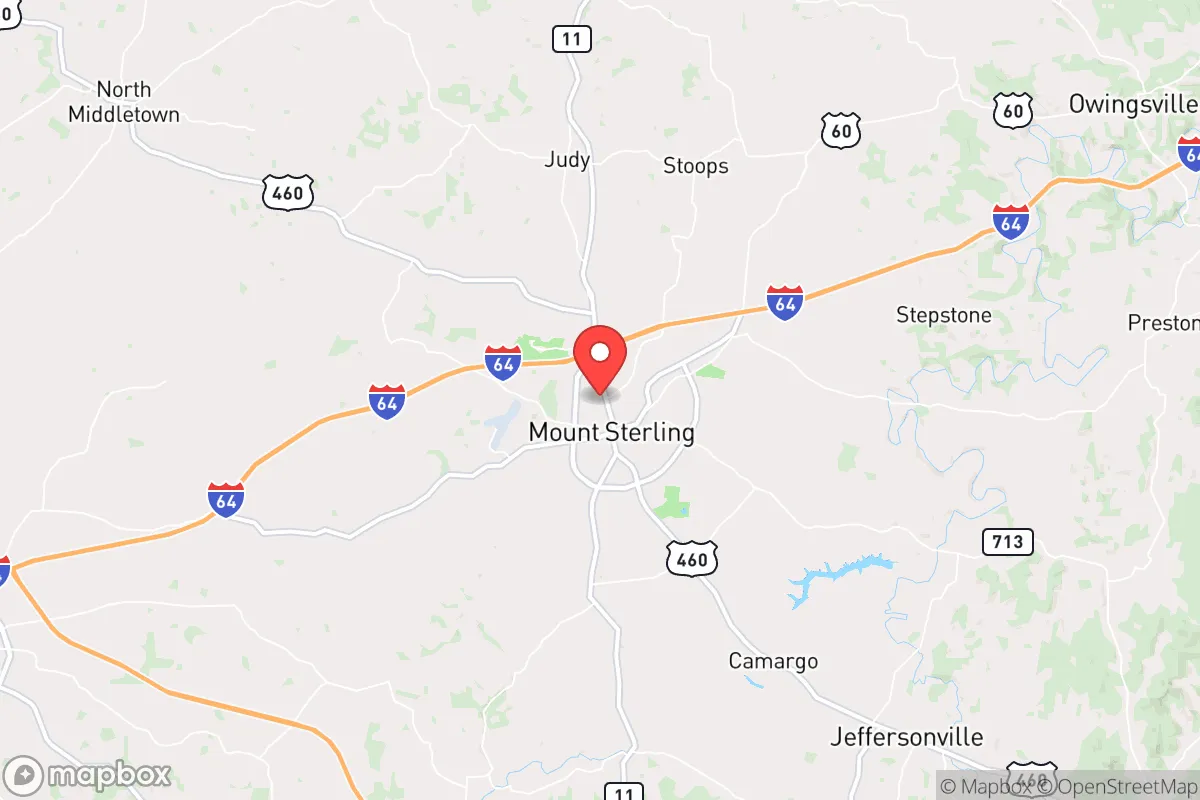
District shown is the primary district for this city’s centroid. Cities may span multiple districts.
Local Political AnalysisPolitical Analysis of Mount Sterling, KY
Mount Sterling has a solidly conservative political character, but it’s not as deep red as much of the rest of Kentucky. The area’s Cook Partisan Voting Index (PVI) of R+7 is noticeably less Republican than the statewide R+15, meaning Democrats here can still win local races and hold a seat at the table. Over the past decade, the shift has been subtle but real: the county seat of Montgomery County has seen a slow trickle of folks moving in from Lexington (about 40 miles west), bringing more moderate suburban sensibilities, while the surrounding rural precincts have stayed deeply conservative. The net effect is a community that votes Republican in most national elections but is far more willing to split tickets in state and local contests than, say, Morehead to the east or Winchester to the south.
How it compares
Compared to Kentucky as a whole, Mount Sterling is a political outlier in its relative moderation. The statewide R+15 PVI reflects a deep-red environment where Republicans hold every statewide office and supermajorities in the legislature. In Mount Sterling, by contrast, you’ll find a more competitive local dynamic: Democrats have held county judge-executive seats and school board positions within the last decade, and the city council often includes a mix of party affiliations. The contrast is especially sharp when you look at neighboring counties. Bath County to the northeast is R+20, and Powell County to the southeast is R+22. Even Clark County (Winchester), just 15 miles south, leans R+12. Mount Sterling’s R+7 puts it closer to the political center of gravity you’d find in suburban Louisville or northern Kentucky, not the rural eastern part of the state.
What this means for residents
For conservative residents, Mount Sterling is a comfortable place where Republican candidates usually win, but you won’t find the kind of monolithic party control that can feel stifling in deeper red areas. You can expect conservative policies on taxes and gun rights to be the norm, but there’s enough Democratic presence to keep local debates substantive rather than one-sided. For liberal residents, the reality is that you’re in a minority, but not an invisible one. There are active Democratic precinct committees, and local elections are often decided by margins of a few hundred votes, so your vote genuinely counts. The practical effect is that public discourse tends to be more civil and less polarized than in the state’s deep-red rural pockets. You won’t see the kind of performative culture-war politics that dominates in Frankfort; instead, local issues like road funding, school budgets, and economic development take center stage.
One cultural distinction worth noting: Mount Sterling has a strong independent streak that predates modern party labels. The town’s historic reliance on tobacco and manufacturing created a pragmatic, union-friendly conservative tradition that’s different from the evangelical-driven conservatism of central Kentucky. You’ll still find a few union households here that vote Democratic, a rarity in most of the state. Looking ahead, the trajectory seems to be a slow drift toward the center as Lexington’s suburban sprawl continues to push outward. If that trend holds, Mount Sterling could become a genuine swing area within a decade, making it one of the more politically interesting small towns in Kentucky.

State Political ClimatePolitical Climate in Kentucky
State Political AnalysisPolitical Environment in the State
Kentucky is a deeply red state with a Cook PVI of R+15, meaning it votes about 15 points more Republican than the nation as a whole. Over the past two decades, the state has shifted hard to the right, driven by the collapse of the old Democratic machine in rural areas and the cultural realignment of working-class voters. While Louisville and Lexington remain blue strongholds, the rest of the state has become reliably Republican, with the GOP now holding supermajorities in both chambers of the General Assembly and all but one statewide office.
Urban vs. rural divide
The political map of Kentucky is a study in contrasts. Louisville (Jefferson County) and Lexington (Fayette County) are the two major Democratic anchors, delivering margins of 20-30 points for Democrats in statewide races. These cities are home to the state's major universities, healthcare systems, and a growing professional class. In contrast, the rest of the state is overwhelmingly Republican. The Ohio River counties like Boone, Kenton, and Campbell (the Cincinnati suburbs) have flipped from swing to solid red over the last decade. The Appalachian coal counties in the east—Harlan, Pike, Perry—were once Democratic strongholds but now vote 70-80% Republican. The Bluegrass region around Lexington is a mix, with affluent horse-country suburbs like Versailles and Midway trending red, while the city core stays blue. The Jackson Purchase region in the far west, including Paducah and Murray, is reliably Republican outside of Murray State University's influence.
Policy environment
Kentucky's policy environment is shaped by a conservative supermajority in Frankfort. The state has a flat income tax that is being phased down from 4.5% to 4.0% in 2026, with a long-term goal of elimination. There is no state property tax, but local property taxes vary. The state is a right-to-work state and has a constitutional amendment banning same-sex marriage (though unenforceable after Obergefell). Education policy has been a flashpoint: the state passed a school choice bill in 2022 creating education opportunity accounts, though it was struck down by the state Supreme Court in 2023. The legislature is currently pursuing a new constitutional amendment to allow public funds for private and religious schools. Healthcare is a mixed bag: Kentucky expanded Medicaid under the ACA, but the state has imposed work requirements and premiums for able-bodied adults. Election laws are moderately restrictive: voter ID is required, early voting is limited to three days before an election, and no-excuse absentee voting was rolled back after 2020.
Recent policy direction
The last five years have seen a clear conservative acceleration. On gun rights, Kentucky is a constitutional carry state (permitless carry for adults 21+), and in 2023 the legislature passed a law allowing armed school marshals. Parental rights have been a major focus: the 2022 "Parents' Bill of Rights" (HB 563) requires schools to notify parents of any changes to a child's mental or physical health services, effectively restricting LGBTQ+ discussion in classrooms. Abortion is banned at all stages with no exceptions for rape or incest, following a trigger law that took effect after Dobbs. The state has also passed a near-total ban on transgender care for minors (SB 150, 2023), overriding the governor's veto. On property rights, Kentucky is a strong eminent domain state, but has no statewide rent control. Taxation is trending downward: the income tax rate is scheduled to drop to 3.5% by 2028 if revenue targets are met. Voting access has tightened: the 2021 law (SB 1) reduced early voting days and imposed stricter ID requirements. On privacy and surveillance, Kentucky has no comprehensive data privacy law, but the legislature has debated bills to limit government use of facial recognition.
Civil unrest & political movements
Kentucky has seen its share of political flashpoints. The 2020 Breonna Taylor protests in Louisville were among the largest in the nation, leading to months of demonstrations, property damage, and a state police takeover of the city's police department. That event galvanized both the local Black Lives Matter movement and a strong counter-mobilization of pro-police and Second Amendment activists. In rural areas, the coal industry's decline has fueled populist anger, with local movements pushing for economic diversification and opposing federal environmental regulations. Immigration politics are less visible than in border states, but the state has seen a small but growing Latino population in Louisville and Shelby County, and the legislature has passed bills requiring local law enforcement to cooperate with ICE. There is no sanctuary city movement of any significance. Election integrity remains a live issue: the 2020 election saw Trump win Kentucky by 26 points, but some rural counties passed resolutions questioning the results. The Kentucky State Fair and Fancy Farm Picnic remain annual political rituals where candidates trade barbs.
Projection
Over the next 5-10 years, Kentucky is likely to become more Republican, not less. The in-migration from other states is modest compared to the Sun Belt, but the people moving in tend to be retirees and remote workers from the Midwest and Northeast, many of whom are culturally conservative. The Louisville and Lexington suburbs are slowly diversifying and may become more competitive, but the rural population is aging and shrinking, which actually concentrates GOP power. The Democratic Party in Kentucky is increasingly confined to the two major cities and a handful of college towns (Bowling Green, Richmond, Murray). The Republican supermajority is likely to persist, meaning continued tax cuts, school choice expansion, and social conservatism. The wildcard is the 2027 gubernatorial election: if a Democrat wins again (as Andy Beshear did in 2023), it could slow the pace of legislation, but the legislature will remain veto-proof. A new resident moving in now should expect a state that is solidly red, with low taxes, limited government services, and a culture that values individual liberty and traditional social norms.
For a new resident, the bottom line is this: Kentucky offers a low-cost, low-regulation environment with a strong sense of community and a conservative political culture. If you align with that, you'll find a welcoming state with a growing economy and a government that mostly stays out of your way. If you lean left, you'll find your political voice in Louisville or Lexington, but you'll be in the minority in the state legislature and in most of the state's 120 counties. The trajectory is clear: Kentucky is getting redder, and that's unlikely to change anytime soon.
* Values derived from national, state, county, city and local statistics and may differ in a specific area. Last updated: 2026-09-05T23:48:44.000Z
Narrative content on this page is AI-generated and may contain mistakes. Verify any details that matter before acting on them.
ReloMaps may earn a commission from affiliate links at no extra cost to you.

