Photo: Wikipedia
Demographics of Mount Sterling, KY
Affluence Level in Mount Sterling, KY
A below-average socioeconomic profile. Incomes, home values, and educational attainment trail the U.S., with higher poverty and unemployment.
People of Mount Sterling, KY
Mount Sterling, Kentucky, is a small city of 7,549 residents that remains overwhelmingly white and native-born, with a foreign-born population of just 0.2% and a 92.7% white demographic share. The city’s identity is rooted in its role as a rural county seat and agricultural trading hub, where family ties often stretch back multiple generations and newcomers are still a relative rarity. With only 22.7% of adults holding a college degree, the population skews toward blue-collar and service-sector employment, and the community retains a distinctly traditional, conservative character shaped by its Appalachian-borderland location in Montgomery County.
How the city was settled and grew
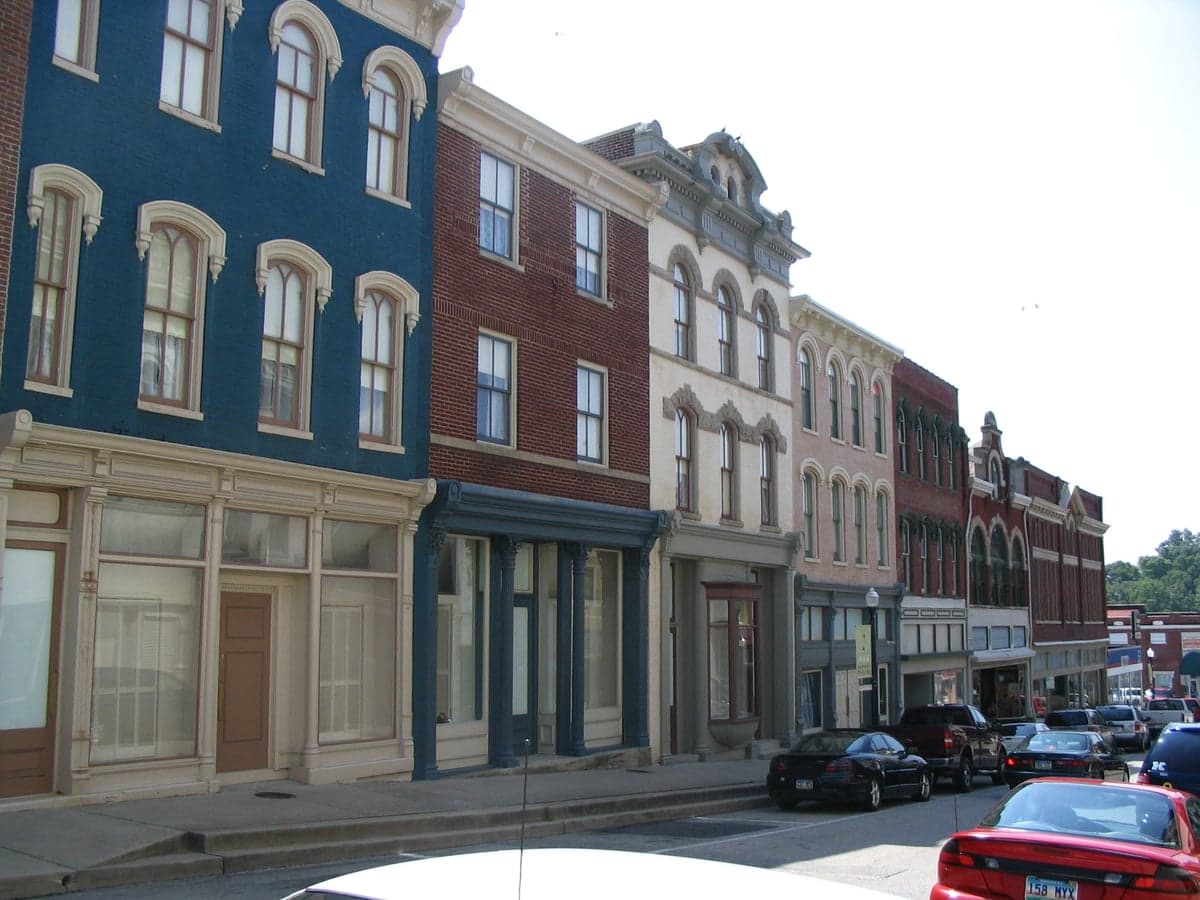
Mount Sterling was founded in 1792 as the seat of Montgomery County, carved from Bourbon County during Kentucky’s early statehood. The original settlers were primarily of English, Scots-Irish, and German descent, moving west from Virginia and Pennsylvania along the Great Wagon Road. These families were drawn by land grants offered to Revolutionary War veterans and by the fertile limestone soils of the Licking River valley, which supported tobacco and livestock farming. The earliest residential core developed around the central courthouse square, with modest frame houses spreading along Main Street and Broadway. By the mid-19th century, the arrival of the railroad in the 1850s transformed Mount Sterling into a regional market center for tobacco, burley leaf, and livestock, attracting a small number of German and Irish merchants who settled in what is now the Historic District around North and South Maysville Street. The city’s Black population, which reached roughly 15% by 1900, was concentrated in the West End neighborhood along West Main Street and in the Bunker Hill area near the old railroad depot, where many worked as domestic laborers, farmhands, and railroad workers. The early 20th century saw little new immigration; the city’s growth came almost entirely from natural increase and rural-to-urban movement within Montgomery County.
Modern era (post-1965)
After the 1965 Hart-Cellar Act, Mount Sterling experienced virtually no international immigration — the foreign-born share remains below 1% — and the city’s demographic story since the 1970s has been one of domestic out-migration and gradual racial homogenization. The Black population, which stood at 12% in 1960, declined to 4.8% by the 2020 census, reflecting broader patterns of African American movement to larger Midwestern cities for industrial employment. Meanwhile, the white population consolidated its majority, reaching 92.7% as younger, college-bound residents left for Lexington (35 miles west) or Louisville. The Stoner Creek Estates subdivision, developed in the 1980s and 1990s off U.S. 460 east of town, became the primary destination for middle-class white families seeking newer housing within the city limits. The Indian Mound area, a mix of older ranch homes and newer construction near the Montgomery County High School campus, absorbed much of the modest suburban-style growth of the 2000s. The Hispanic population, though small at 1.5%, has grown from near zero in 1990, with a handful of families settling in rental properties along the Camargo Road corridor, often working in tobacco farming, landscaping, or the local food-processing plant. No significant East/Southeast Asian or Indian-subcontinent communities have formed; the Asian share remains 0.0%.
The future
Mount Sterling’s population is projected to remain stable or decline slightly over the next decade, as the city’s aging white population (median age 42) is not being replaced by younger in-migrants. The Hispanic share may inch upward from 1.5% as agricultural labor demand persists, but the foreign-born population is unlikely to exceed 2% given the area’s limited economic draw. The Black population share appears to have stabilized near 5%, with no major return migration expected. New residential development is concentrated in the Gateway Drive area near the Interstate 64 interchange, where a handful of subdivision lots have been platted for commuters who work in Lexington but prefer Mount Sterling’s lower cost of living and slower pace. The city’s cultural identity is likely to remain deeply conservative, church-centered, and family-oriented, with little pressure toward the diversification seen in larger Kentucky cities like Lexington or Louisville. For a newcomer, Mount Sterling offers a stable, predictable community where most residents share a common background and values, but where diversity of any kind — racial, ethnic, religious, or educational — remains minimal.
Mount Sterling is becoming a quieter, older, and slightly more Hispanic version of its 20th-century self, with demographic change arriving at a glacial pace. For someone moving in now, the city offers a tight-knit, culturally homogeneous environment where the biggest adjustment is likely not to diversity but to the slow rhythm of a small county seat that has changed less in 50 years than most American suburbs change in 10.

* Values derived from national, state, county, city and local statistics and may differ in a specific area. Last updated: 2026-09-05T23:48:44.000Z
Narrative content on this page is AI-generated and may contain mistakes. Verify any details that matter before acting on them.
ReloMaps may earn a commission from affiliate links at no extra cost to you.

