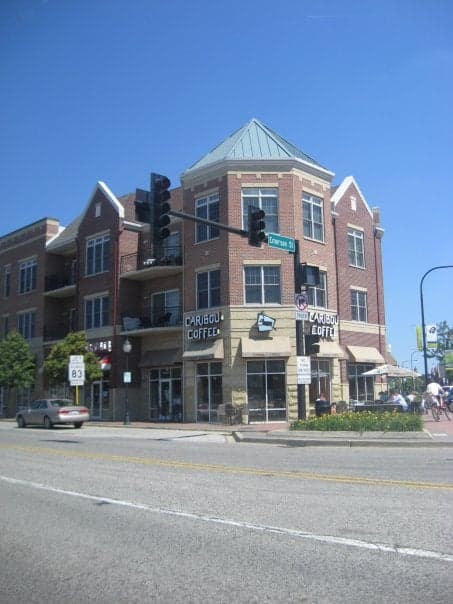
Photo: Wikipedia
Demographics of Mount Prospect, IL
Affluence Level in Mount Prospect, IL
A middle-class area roughly in line with national averages across income, home values, education, and employment.
People of Mount Prospect, IL
Mount Prospect, Illinois, is a mature inner-ring suburb of 55,648 residents that blends a historically German and Polish working-class foundation with a rapidly diversifying, college-educated population. Today, 48.6% of adults hold a bachelor’s degree or higher, and the city’s foreign-born share stands at 13.2%, driven primarily by East/Southeast Asian and Indian-subcontinent families. The city’s identity is one of stable, single-family neighborhoods with a growing professional class, where older ethnic enclaves are giving way to a more multiethnic, family-oriented character.
How the city was settled and grew
Mount Prospect was platted in the 1850s along the Chicago and North Western Railway, but its real growth began after the Great Chicago Fire of 1871, when German and Luxembourgish farmers moved northwest to work the fertile prairie soil. The original settlement clustered around the downtown depot, an area now known as Historic Downtown Mount Prospect, where the first Lutheran and Catholic churches anchored a tight-knit German community. By the 1920s, Polish immigrants joined the wave, settling in the Northwest Highway corridor near the railroad, building St. Raymond’s Parish and establishing small grocery and trades businesses. The city remained a quiet farming village of fewer than 1,000 residents until the post-World War II boom, when the GI Bill and the expansion of O’Hare Airport (opened 1955) triggered explosive suburbanization. Developers built thousands of Cape Cod and ranch homes in the Sunset Park and Country Club neighborhoods, drawing young white families—mostly of German, Polish, and Irish descent—from Chicago’s Northwest Side. By 1970, the population had surged past 30,000, and Mount Prospect became a classic “collar county” bedroom community, overwhelmingly white and middle-class.
Modern era (post-1965)
The 1965 Immigration and Nationality Act reshaped Mount Prospect’s demographics, though the shift was gradual. East/Southeast Asian families—initially Chinese and Filipino engineers and medical professionals—began moving into the Rand Road corridor and the Southwest neighborhood near Busse Woods in the 1980s, drawn by the proximity to O’Hare and the highly rated Mount Prospect School District 57. By 2000, the Asian share (East/Southeast) had reached roughly 6%, concentrated in newer subdivisions like Briarwood and the townhomes along Central Road. Indian-subcontinent families—primarily Gujarati and Punjabi professionals in IT and healthcare—arrived in larger numbers after 2000, settling in the Northwest neighborhood near Randhurst Village and the Elk Grove border area. Today, East/Southeast Asians make up 8.9% of the population, and Indian-subcontinent residents account for 5.6%, making Mount Prospect one of the most diverse suburbs in Cook County outside Chicago. The Hispanic share (16.2%) grew steadily from the 1990s onward, with Mexican and Central American families moving into older, more affordable housing stock in the Central Road corridor and near the Mount Prospect Golf Club area. The white share has declined from 90% in 1980 to 63.3% today, but the city has avoided the sharp racial polarization seen in some neighboring suburbs; neighborhoods remain relatively integrated, with no single ethnic group dominating any one census tract.
The future
Mount Prospect’s population is trending toward further diversification, but at a slower pace than in the 2000s. The East/Southeast Asian and Indian-subcontinent communities are both growing, but they are increasingly assimilating into the broader professional class rather than forming isolated enclaves. The Hispanic share is stable, with second-generation families moving outward to more affordable suburbs like Carpentersville or Elgin. The white population is aging in place, with many empty-nesters staying in their original homes in Sunset Park and Country Club, while younger white families are less likely to move in due to high property taxes and the premium on older homes. The city’s school district has seen a rise in English-language learners, but overall test scores remain above state averages, suggesting that the new immigrant families are integrating successfully. Over the next decade, Mount Prospect will likely become a “majority-minority” suburb, but one where no single group dominates—a mosaic of established white retirees, second-generation Hispanic families, and professional East/Southeast Asian and Indian households. The city’s housing stock (mostly 3-bedroom ranches and split-levels) and its location near O’Hare and the Metra line will continue to attract upwardly mobile immigrant families seeking good schools and safe streets.
For a conservative-leaning mover, Mount Prospect offers a stable, family-oriented environment where property values have held steady and crime remains low. The demographic change has been orderly and market-driven, not disruptive, and the city’s politics remain moderate—a mix of fiscal conservatism and pragmatic local governance. The bottom line: Mount Prospect is becoming a multiethnic, middle-class suburb where the old German-Polish character is fading but the core values of homeownership, education, and community safety remain intact. It is a good fit for a family that values diversity as a fact of life, not a political project, and wants a safe, well-run suburb with a strong tax base and solid schools.

* Values derived from national, state, county, city and local statistics and may differ in a specific area. Last updated: 2026-04-23T10:21:19.000Z
Narrative content on this page is AI-generated and may contain mistakes. Verify any details that matter before acting on them.
ReloMaps may earn a commission from affiliate links at no extra cost to you.

