Photo: Wikipedia
Political ClimatePolitical Climate in Morton Grove, IL
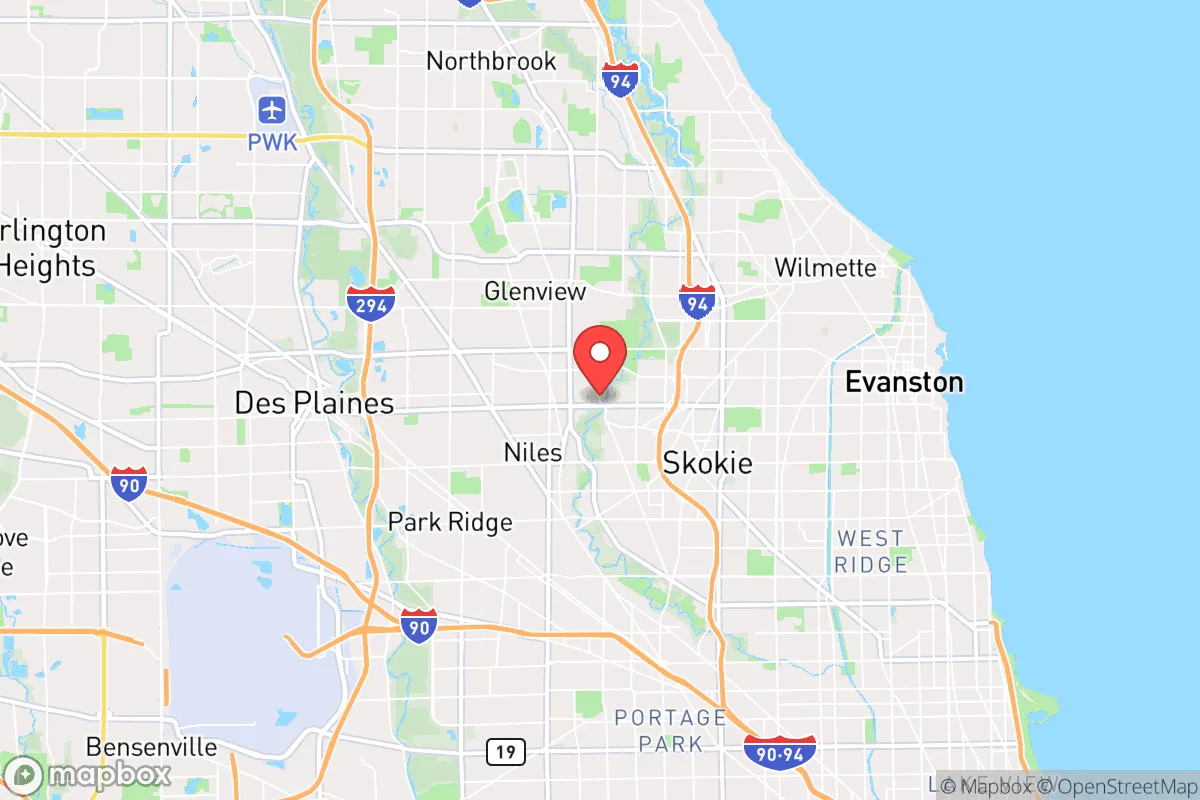
District shown is the primary district for this city’s centroid. Cities may span multiple districts.
Local Political AnalysisPolitical Analysis of Morton Grove, IL
How it compares
To understand Morton Grove’s politics, you have to look at the contrast with its immediate surroundings. Just a few miles west, you hit Des Plaines and Park Ridge, which are far more competitive—Park Ridge in particular has a history of splitting tickets and occasionally electing Republicans at the local level. Head further northwest to Arlington Heights or Palatine, and you’re in territory that, while trending left, still has a meaningful GOP presence in township races and state legislative contests. Morton Grove doesn’t have that dynamic. The D+19 PVI is closer to what you’d see in urban Chicago wards than in most suburban Cook County towns. For context, the state’s D+7 overall is dragged down by downstate Illinois, where counties like Effingham and Williamson vote 70%+ Republican; Morton Grove is essentially the polar opposite of that reality.What this means for residents
For liberal residents, the practical effect is that you rarely feel like you’re in a political fight. Local elections are effectively decided in the Democratic primary, and the village board, park district, and library board have been uniformly Democratic for decades. If you’re a conservative living in Morton Grove, you’re in the minority—usually around 25–30% of the vote in any given race—and you’ll find that your neighbors are generally polite but not particularly interested in hearing a defense of GOP positions on taxes or public safety. That said, the village is not a hotbed of activism; it’s a quiet, family-oriented community where politics mostly comes up around property taxes and school funding, not national culture wars. The trajectory is clear: with an aging but steadily diversifying population—more South Asian and East Asian families have moved in over the past 15 years—the Democratic margin is likely to hold or even grow in the near term.What this means for residents
One thing that stands out about Morton Grove is how its political culture translates into policy. The village has been a leader in the region on environmental initiatives, including a robust tree preservation ordinance and participation in ComEd’s community solar programs, which aligns with the progressive lean of its voters. It’s also one of the few suburbs in the area that has maintained a dedicated senior center and a strong network of commuter bus routes to the CTA’s Yellow Line, reflecting a local preference for public investment over tax cuts. The contrast with, say, nearby Niles—which is also Democratic but more fiscally cautious—shows up in how willingly Morton Grove approves bond referendums for infrastructure. In the long run, expect the village to stay firmly in the D+20 range, with the only real political drama being whether the progressive wing or the moderate wing of the local Democratic Party controls the village board. For anyone moving here, the takeaway is simple: if you’re comfortable in a deeply blue, policy-focused suburb, you’ll fit right in; if you’re not, you’ll be in a small but tolerated minority.
State Political ClimatePolitical Climate in Illinois
State Political AnalysisPolitical Environment in the State
Illinois is a solidly Democratic state, with a Cook PVI of D+7, meaning it votes about seven points more Democratic than the nation as a whole. The Democratic coalition is anchored by Chicago and its inner suburbs, while the rest of the state — from Rockford to the Quad Cities to the far southern tip — has drifted hard into the Republican column over the last two decades. The practical result is a state that has become a one-party government in Springfield, with Republicans holding almost no statewide office and Democrats holding veto-proof supermajorities in both legislative chambers since 2021.
Urban vs. rural divide
The political map of Illinois is a tale of two states. Cook County, which contains Chicago, casts roughly 40% of the state's votes and delivers margins of 60-70% for Democrats. The collar counties — DuPage, Lake, Kane, McHenry, and Will — were once reliably Republican but have shifted dramatically; DuPage County, which voted for George W. Bush by 18 points in 2004, went for Joe Biden by 10 points in 2020. That suburban shift is the single biggest reason Illinois has become safely Democratic.
Outside the Chicago metro, the picture flips completely. Downstate counties like Effingham, Williamson, and Jefferson routinely vote 70-80% Republican. Even mid-sized cities that once had competitive politics have moved right: Rockford's surrounding Winnebago County is now solidly red, and the Quad Cities area along the Iowa border has become a battleground that leans Republican in statewide races. The divide is stark enough that some downstate residents joke about "Chicagoland" as if it were a separate state — and a small but persistent movement for the counties south of Interstate 80 to form their own state, "New Illinois," surfaces every few years, though it has never gained serious legislative traction.
Policy environment
Illinois' policy environment is defined by a few hard realities. The state has the second-highest property tax burden in the nation, with an average effective rate around 2.0% — roughly double the national average. The state income tax is a flat 4.95%, and the sales tax can exceed 10% in Chicago and Cook County when local add-ons are included. The state also has a massive unfunded pension liability, estimated at over $140 billion, which is the single biggest driver of the state's structural budget deficits.
On the regulatory side, Illinois is a union-friendly state with no right-to-work laws, and it has one of the most restrictive gun permit regimes in the country. The state requires a Firearm Owners Identification (FOID) card for any gun possession, and in 2023, Governor J.B. Pritzker signed a ban on the sale of many semi-automatic rifles and high-capacity magazines. Education policy is centralized in Springfield, with school funding heavily reliant on local property taxes — which is why wealthy suburbs have excellent schools while many downstate districts struggle. Healthcare is broadly liberalized, with strong Medicaid expansion and abortion protections codified into state law in 2019.
Recent policy direction
The last five years have seen Illinois move decisively left on nearly every front. The 2023 gun ban (HB 5471) is the most visible example — it prohibits the sale of dozens of specific firearm models, and while it is currently tied up in federal court challenges, it remains in effect. On parental rights, Illinois has gone the opposite direction of states like Florida: the state mandates that schools adopt inclusive curriculum standards, and there is no parental notification requirement for a minor's reproductive health services. The state also passed the Healthcare Protection Act in 2024, which, among other things, banned "step therapy" insurance practices and expanded coverage mandates.
On election law, Illinois has moved toward expanded access: automatic voter registration, same-day registration, and no-excuse mail-in voting are all in place. The state also passed a law in 2021 requiring that all public high schools offer a semester-long civics course. Property rights are comparatively weak — the state has a robust eminent domain framework, and Cook County's assessment practices are frequently challenged. On privacy, Illinois stands out with the Biometric Information Privacy Act (BIPA), which has produced massive class-action settlements against companies that mishandle fingerprint or facial-recognition data.
Civil unrest & political movements
Illinois has a visible history of organized political activism on both sides. Chicago saw sustained protests during the George Floyd summer of 2020, and the city's status as a sanctuary jurisdiction — it has been one since 2017 — makes it a frequent flashpoint in immigration politics. Governor Pritzker has repeatedly positioned Illinois as a "refuge" for out-of-state patients seeking abortions and for transgender individuals, which has drawn both national attention and organized opposition from pro-life and parental-rights groups.
On the right, the most organized movements are around gun rights and property tax reform. The Illinois State Rifle Association has a strong downstate presence, and the 2023 gun ban has energized a wave of county-level "sanctuary" resolutions — over 80 counties have passed symbolic resolutions declaring they will not enforce the ban. Election integrity concerns have also surfaced, particularly in Cook County, where the 2020 election saw a high number of mail-in ballots and a delayed count that drew criticism from Republican observers. The state's automatic voter registration system has been a target of conservative scrutiny, though no major fraud cases have been proven.
Projection
Over the next decade, Illinois is likely to become more Democratic, not less. The collar counties are still trending left, and Chicago's population loss — down about 80,000 residents since 2020 — is being offset by in-migration of younger, college-educated workers into the city's core. Downstate will continue to bleed population, which reduces Republican vote share in statewide races. The state's fiscal trajectory is the wild card: if pension costs continue to crowd out spending, expect continued property tax pressure and a possible push for a graduated income tax, which voters rejected in 2020 but which Democrats may try again. A new resident moving in now should expect a state where Democratic control is entrenched, but where the downstate vs. Chicago cultural divide will remain the defining political tension.
For a new resident, the bottom line is that Illinois offers a clear trade-off. If you value strong public services, robust civil rights protections, and a union-friendly environment, the state delivers — particularly in the Chicago metro. If you are a conservative weighing gun rights, property taxes, or parental control over education, you will find yourself in a permanent minority with limited statewide recourse. The practical advice is to choose your county carefully: DuPage and Lake counties offer a more moderate suburban environment, while downstate areas like the St. Louis suburbs or the Quad Cities provide a more conservative cultural fit, even if they cannot change the state's overall direction.
* Values derived from national, state, county, city and local statistics and may differ in a specific area. Last updated: 2026-10-21T01:16:13.000Z
Narrative content on this page is AI-generated and may contain mistakes. Verify any details that matter before acting on them.
ReloMaps may earn a commission from affiliate links at no extra cost to you.

