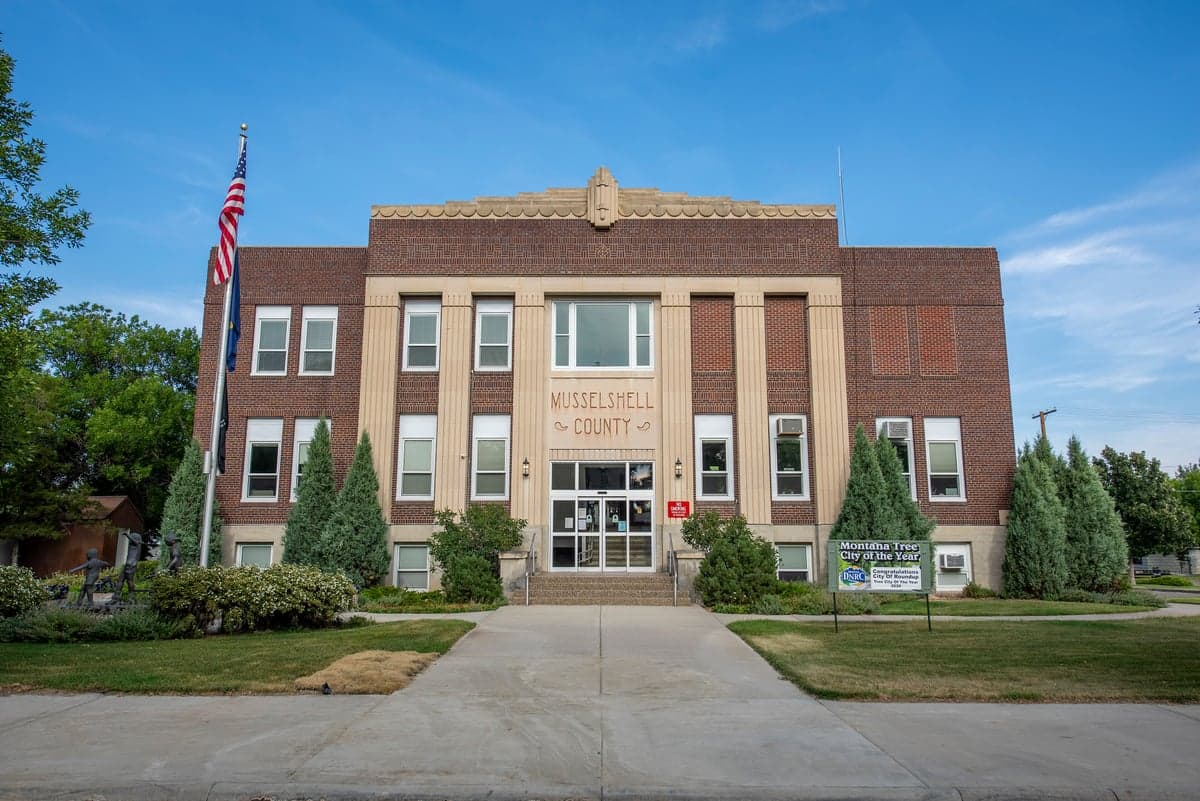
Photo: Wikipedia
Demographics of Musselshell County
Affluence Level in Musselshell County
A middle-class area roughly in line with national averages across income, home values, education, and employment.
People of Musselshell County
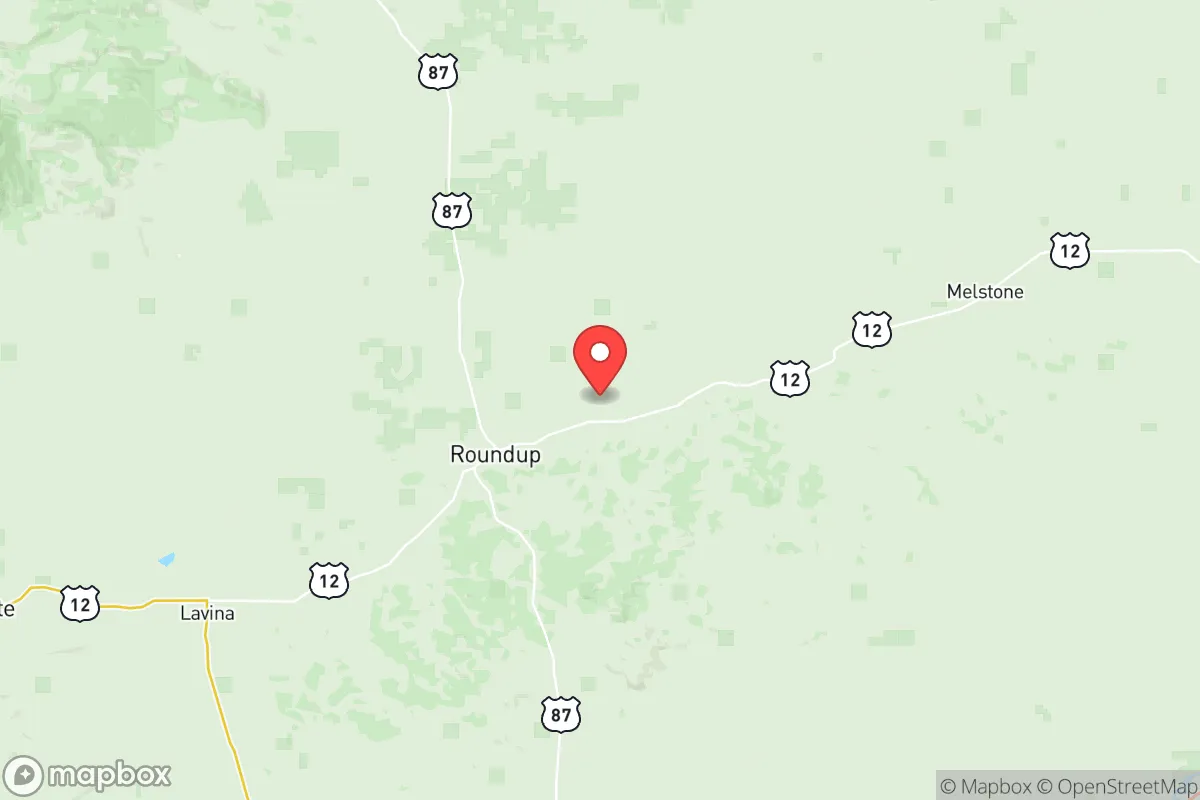
Today, Musselshell County, Montana, is home to roughly 5,068 residents, making it one of the state’s least densely populated counties. The population is overwhelmingly white (87.7%) and native-born, with only 1.2% foreign-born, and the county retains a distinctly rural, working-class character rooted in its ranching and energy history. Its people are concentrated in the small towns of Roundup, the county seat, and Musselshell, with smaller clusters in Melstone and Delphia, and the area’s identity is shaped by a legacy of homesteading, resource extraction, and a slow, steady outmigration of younger generations.
Settlement & growth (pre-1960)
Long before European settlement, the area now known as Musselshell County was part of the traditional territory of several Plains Indian nations, most notably the Crow (Apsáalooke) and the Sioux (Lakota). The Musselshell River valley provided game, water, and shelter, and these tribes used the region for seasonal hunting and travel. The first non-Native presence came with fur trappers and traders in the early 1800s, but sustained American settlement did not begin until the 1880s, when the Northern Pacific Railroad pushed westward and the U.S. government opened the land to homesteaders under the Dawes Act and subsequent land policies.
The first major wave of settlers arrived in the 1880s and 1890s, drawn by the promise of cheap land and the railroad’s expansion. These were primarily Anglo-American homesteaders from the Midwest and Great Lakes states—farmers and ranchers of English, German, and Scandinavian descent who filed claims along the Musselshell River and its tributaries. The town of Roundup was founded in 1889 as a railroad stop and quickly became the commercial hub, named for the annual cattle roundups that defined the local economy. Nearby Musselshell, established in the 1890s, grew as a supply point for ranchers, while Melstone (founded 1908) and Delphia (a now nearly abandoned hamlet) sprang up along the railroad line to serve homesteaders and coal miners.
A second, smaller wave came during the early 1900s, driven by the Enlarged Homestead Act of 1909, which offered 320-acre claims in semi-arid regions. This attracted a mix of northern European immigrants—Norwegians, Swedes, and Germans—who settled on dryland farms around Elso and Stacey, two tiny communities that later faded as the Dust Bowl and agricultural consolidation took hold. The region’s economy diversified with the discovery of coal deposits near Roundup in the 1910s, drawing a modest influx of miners, many of them second-generation immigrants from other parts of Montana and the Upper Midwest. By 1930, the county’s population peaked at around 7,000, but the Great Depression and the Dust Bowl of the 1930s drove many homesteaders off the land, and the population began a long decline that continued for decades.
World War II and the postwar period saw little new settlement. The county’s population dropped to around 5,500 by 1950, as mechanized agriculture and the decline of small-scale coal mining reduced the need for labor. The people who remained were overwhelmingly native-born whites, with a small number of Hispanic ranch hands and a tiny Native American population, mostly Crow and Northern Cheyenne descendants who lived in scattered rural households rather than in any concentrated community.
Modern era (post-1965)
The 1965 Hart-Cellar Act, which dramatically reshaped U.S. immigration patterns, had almost no direct impact on Musselshell County. The foreign-born population today stands at just 1.2%, and the county has not seen the large-scale immigration from Latin America, Asia, or Africa that transformed many other parts of Montana, such as the Billings or Bozeman areas. Instead, the post-1965 demographic story of Musselshell County is one of domestic outmigration and gradual aging.
Since the 1970s, the county has lost population steadily, falling from about 5,200 in 1970 to 4,500 in 1990, before a slight recovery to 5,068 today. The primary driver has been the departure of young adults seeking education and employment in larger cities like Billings (about 50 miles east) or further afield in the Mountain West. The remaining population is older than the state average, with a median age around 50, and the county’s Hispanic share (3.7%) is the only non-white group of any size, consisting mostly of families who work in ranching, oil-field services, and the coal mines near Roundup. There are no significant East/Southeast Asian, Indian-subcontinent, or Black communities—each group registers at 0.0% in census data.
The energy boom of the 2000s and 2010s, driven by coal-bed methane extraction and renewed coal mining, brought a temporary influx of workers—many from Texas, Oklahoma, and Wyoming—but most were transient, living in man camps or commuting from Billings, and few put down roots. The county’s college-educated share is low at 21.9%, reflecting the dominance of blue-collar industries: ranching, mining, and oil and gas. Suburbanization has not occurred in any meaningful way; the county has no suburbs, and the towns of Roundup (population ~1,800) and Musselshell (population ~60) remain small, with most residents living on ranches or in unincorporated areas.
The future
The demographic trajectory of Musselshell County points toward continued slow decline and aging, with little prospect of significant diversification. The county’s population is projected to remain flat or shrink slightly over the next 10–20 years, as the energy sector faces headwinds from coal’s declining competitiveness and as younger residents continue to leave for urban centers. The Hispanic share may grow modestly, driven by labor demand in ranching and oil-field maintenance, but it is unlikely to exceed 5–7% given the county’s remote location and limited economic opportunities.
There is no sign of the kind of in-migration seen in Montana’s western counties—no influx of remote workers, retirees, or out-of-state transplants—because Musselshell County lacks the scenic amenities (mountains, ski resorts, national parks) that attract newcomers. The cultural identity will remain heavily rural, conservative, and white, with a strong attachment to ranching and energy heritage. For someone moving in now, the county offers a quiet, low-cost, and deeply traditional way of life, but it is not a place of demographic dynamism or growth.
In short, Musselshell County is becoming an older, smaller, and more homogeneous place, shaped by the departure of its youth and the slow contraction of its resource-based economy. For a relocation-minded individual or family, it represents a stable but shrinking community where the past weighs more heavily than the future, and where the people who remain are deeply rooted in the land and its history.

* Values derived from national, state, county, city and local statistics and may differ in a specific area. Last updated: 2026-06-17T06:00:25.000Z
Narrative content on this page is AI-generated and may contain mistakes. Verify any details that matter before acting on them.
ReloMaps may earn a commission from affiliate links at no extra cost to you.

