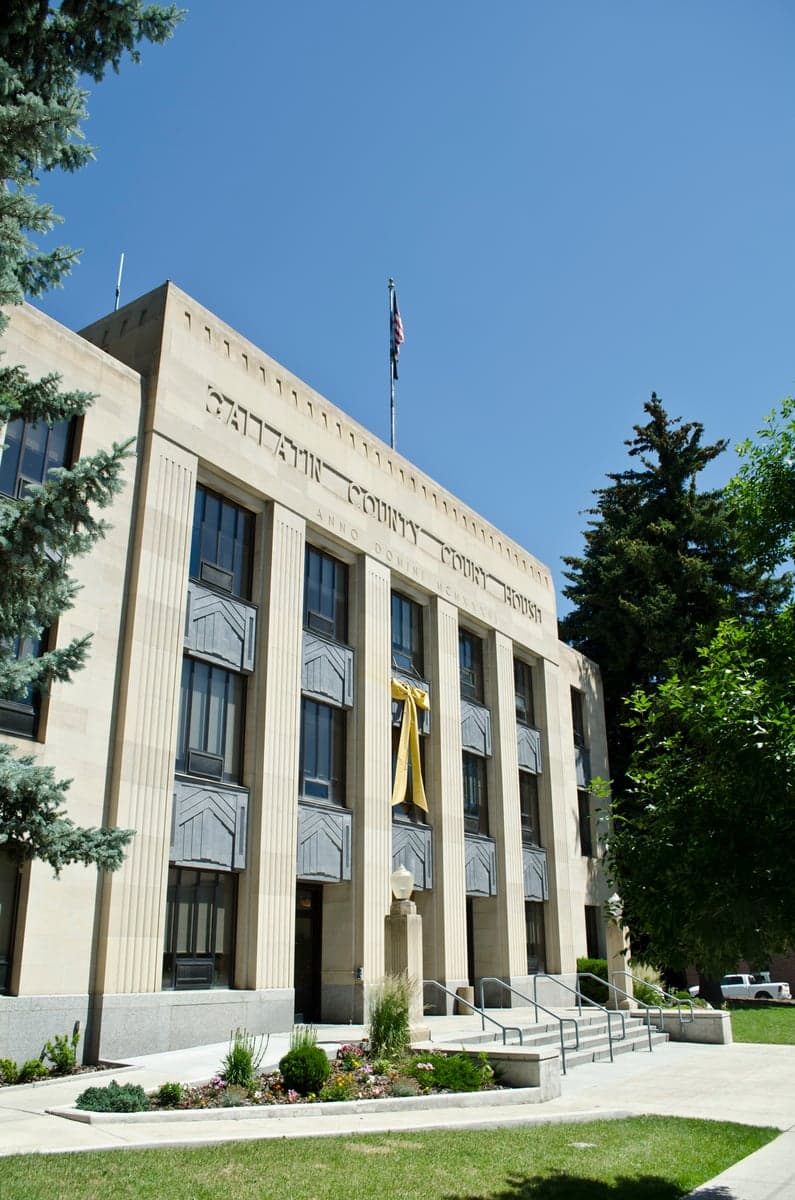
Photo: Wikipedia
Political ClimatePolitical Climate in Gallatin County
Showing district-level results — no local-only data available.
Local Political AnalysisPolitical Analysis of Gallatin County
Gallatin County, Montana, is a political battleground that has shifted from reliably red to a competitive R+5 district, while the rest of Montana remains a solid R+10. The county’s rapid growth—driven by Bozeman’s tech boom and Montana State University—has injected a steady stream of out-of-state transplants, many from blue states, creating a stark urban-rural divide. Bozeman itself now leans blue in local elections, while the surrounding ranch towns and mountain communities remain deeply conservative.
How it compares
Gallatin County is the only county in Montana that consistently votes more Democratic than the state average. In the 2024 presidential race, the county went for Trump by just 5 points, while the state as a whole gave him a 10-point margin. This gap is driven almost entirely by Bozeman’s precincts—especially around Main Street and the university—which regularly vote 60-70% Democratic. In contrast, towns like Manhattan, Three Forks, and West Yellowstone vote 70-80% Republican. The swing precincts are in the fast-growing suburbs north of Bozeman, like Belgrade and Four Corners, where new arrivals from California and Colorado have made races for county commission and state legislature increasingly competitive. In 2022, a Democrat won a state House seat in Belgrade for the first time in a decade.
What this means for residents
For conservative residents, the county’s purple status means they can no longer take local elections for granted. School board races, zoning decisions, and county commission seats are now genuine contests, with the Bozeman area’s liberal bloc often clashing with rural conservatives over growth management, property taxes, and land use. For liberal residents, it means their votes actually matter—Bozeman’s city council has a progressive majority, and the county has passed measures like a non-discrimination ordinance and a climate action plan. But it also means gridlock: the county commission is split 2-1 Republican, so major policy shifts require coalition-building. The practical effect is that Gallatin County feels more like a Colorado Front Range county than the rest of Montana—politics here is less about culture war and more about housing affordability, traffic, and water rights.
Culturally, the divide is visible in daily life. In Bozeman, you’ll see Biden-Harris yard signs next to Patagonia-clad mountain bikers; in Manhattan, it’s Trump flags and diesel trucks. The county’s growth has also created a policy split: Bozeman has strict short-term rental regulations and a higher minimum wage, while the rural towns resist any new rules. The result is a county that feels like two different Montanas—one that’s cosmopolitan and growing, the other that’s traditional and wary of change. For newcomers, the political climate is a constant reminder that Gallatin County is a place where the future of the state is being fought out, precinct by precinct.

State Political ClimatePolitical Climate in Montana
State Political AnalysisPolitical Environment in the State
Montana has shifted from a purple-leaning swing state to a solidly Republican stronghold over the past two decades, with a Cook PVI of R+10 reflecting a durable conservative majority. The state’s political center of gravity moved rightward after 2008, driven by rural realignment and an influx of conservative-leaning transplants, though a persistent Democratic foothold remains in the western mountain valleys and on tribal lands. The 2024 presidential race saw Donald Trump carry the state by roughly 20 points, a margin that has widened from the single-digit splits of the 1990s and early 2000s, cementing Montana’s place as one of the most reliably red states in the Rocky Mountain West.
Urban vs. rural divide
The political map breaks into three distinct zones. The Flathead Valley and western mountain counties — Missoula, Gallatin (Bozeman), and Lewis and Clark (Helena) — are the state’s blue islands. Missoula County voted for Joe Biden by 22 points in 2020 and has only grown more Democratic as the University of Montana and outdoor-recreation economy attract younger, left-leaning residents. Bozeman’s Gallatin County, once a swing area, flipped to Biden by 6 points in 2020 and has become a Democratic stronghold as tech workers and climate-conscious newcomers flood in. In contrast, the eastern plains and rural counties — places like Richland County (Sidney), Dawson County (Glendive), and Blaine County (Chinook) — routinely deliver 75-85% of their votes to Republicans. The Hi-Line and tribal reservations (Fort Belknap, Rocky Boy’s, Crow, Northern Cheyenne) are reliably Democratic, though turnout is low. The key swing counties that decide statewide races are now shrinking: Cascade County (Great Falls) and Yellowstone County (Billings) have moved from competitive to lean-Republican, with Yellowstone giving Trump a 12-point win in 2024. The suburbs of Billings — Lockwood and the Heights — are increasingly conservative, while downtown Billings and the West End remain more moderate.
Policy environment
Montana’s policy landscape is defined by a low-tax, low-regulation posture with a populist streak. There is no state sales tax; the top income tax rate was cut from 6.9% to 5.9% in 2021 and is scheduled to drop further to 5.4% by 2027 under House Bill 303. Property taxes are moderate but rising fast in growing counties like Gallatin and Missoula, where assessed values have doubled since 2020. The state has a constitutional right to bear arms (Article II, Section 12), and permitless carry became law in 2021. Montana is a “stand your ground” state with no duty to retreat. Education policy is decentralized: school funding is tied to local property taxes, and the state has a robust charter school law (passed in 2023) that allows for public charter schools without local district approval. Healthcare is a mixed bag: Montana expanded Medicaid under the Affordable Care Act in 2015, and the program covers roughly 100,000 residents, but the state legislature has repeatedly tried to impose work requirements. Election laws have tightened: voter ID requirements were strengthened in 2021, same-day voter registration was eliminated in 2023, and mail-in ballots now require a notarized signature or witness for first-time voters. The state has no sanctuary city policies; in fact, a 2023 law (SB 171) prohibits local governments from adopting “sanctuary” ordinances that limit cooperation with federal immigration enforcement.
Recent policy direction
The last three legislative sessions (2021, 2023, 2025) have pushed Montana sharply rightward on nearly every axis a relocator might care about. Gun and self-defense law: Permitless carry (HB 102, 2021) and a “Second Amendment Preservation Act” (HB 258, 2023) that prohibits state enforcement of any future federal gun bans. Parental and education rights: The “Parents’ Bill of Rights” (HB 233, 2021) requires schools to notify parents of any curriculum involving sexuality or gender identity, and a 2023 law (SB 99) bans transgender girls from participating in K-12 girls’ sports. Speech and privacy: Montana passed one of the nation’s strictest data privacy laws (the Montana Consumer Data Privacy Act, 2023), giving residents the right to opt out of data collection and sue companies for violations. Medical and bodily autonomy: Abortion remains legal up to fetal viability under a 1999 state Supreme Court ruling (Armstrong v. State), but the legislature passed a 20-week ban in 2021 and a law requiring parental consent for minors (2023). A 2024 ballot initiative to enshrine abortion rights in the state constitution failed by 4 points. Property rights: The “Montana Land Use Planning Act” (2023) limited local governments’ ability to impose inclusionary zoning or rent control, and a 2025 law (HB 400) expanded mineral rights protections for surface owners against forced pooling. Taxation: The income tax cuts mentioned above are paired with a flat 4% corporate income tax rate, down from 6.75% in 2021. Voting and ballot access: The elimination of same-day registration and stricter ID requirements have reduced turnout in Democratic-leaning precincts, particularly on reservations and in Missoula.
Civil unrest & political movements
Montana has seen relatively low levels of street-level civil unrest compared to coastal states, but organized political movements are active. The Montana Freedom Caucus, a hardline conservative faction in the state legislature, has pushed for further tax cuts, school vouchers, and restrictions on local government authority. On the left, the Montana Conservation Voters and Indigenous-led groups like Western Native Voice have mobilized around public lands protection and voting rights, particularly after the 2023 voter ID law. Immigration politics are less visible than in border states, but a 2024 controversy erupted in Havre when a local meatpacking plant was raided by ICE, leading to protests from immigrant-rights groups and counter-protests from the Hi-Line Patriots, a local militia-aligned group. Election integrity remains a flashpoint: the 2022 gubernatorial race saw the Republican nominee, Greg Gianforte, win by 13 points, but a recount in the state auditor’s race (won by Republican Troy Downing by 1,200 votes) was challenged by Democrats, leading to a months-long legal battle that ended in the state Supreme Court. Secession rhetoric is rare, but “county supremacy” movements — where rural counties assert local control over federal land management — have gained traction in Beaverhead County and Granite County, with resolutions passed in 2023 declaring those counties “Second Amendment sanctuaries” and “constitutional counties.”
Projection
Over the next 5-10 years, Montana’s political trajectory points toward continued Republican dominance at the state level, with growing internal friction between the libertarian-leaning “Big Sky” conservatives and the more populist, culturally conservative faction. The demographic wildcard is in-migration: the state added roughly 100,000 new residents between 2020 and 2025, with most settling in Gallatin, Missoula, and Flathead counties. These newcomers are disproportionately white-collar, remote workers who lean moderate-to-liberal on social issues but are often fiscally conservative. If this trend continues, the western valleys could flip several state legislative districts blue by 2030, but the rural eastern two-thirds of the state will remain deeply red. The state’s property tax crisis — with assessments rising 30-50% in hot markets — is likely to become the dominant political issue, potentially fracturing the Republican coalition between homeowners and developers. Expect ballot initiatives on property tax caps and school funding to become perennial fights. The state’s abortion-rights movement, though defeated in 2024, will likely return with a stronger campaign in 2026 or 2028. For a new resident, the practical reality is that Montana will remain a conservative state in its policy outputs — low taxes, gun-friendly, limited regulation — but the cultural tone in the growing cities will become more diverse and contested.
Bottom line for a new resident: If you’re a conservative moving to Montana, you’ll find a state government that largely shares your values on taxes, guns, and education, but you’ll need to accept that the western mountain towns are becoming increasingly liberal and culturally distinct. If you’re a liberal, you’ll find a small but active political community in Missoula, Bozeman, and Helena, but you’ll be living under a state government that is actively hostile to many of your policy preferences — and that’s unlikely to change in the next decade. The state’s political future will be shaped by the tension between the libertarian, live-and-let-live ethos of the old West and the newer, more polarized national politics that in-migrants bring with them. Either way, expect property taxes to be your biggest local political headache, and plan to get involved in county-level politics if you want a say in how your community grows.
* Values derived from national, state, county, city and local statistics and may differ in a specific area. Last updated: 2026-08-23T09:03:22.000Z
Narrative content on this page is AI-generated and may contain mistakes. Verify any details that matter before acting on them.
ReloMaps may earn a commission from affiliate links at no extra cost to you.

