Political ClimatePolitical Climate in Monroe Township, NJ
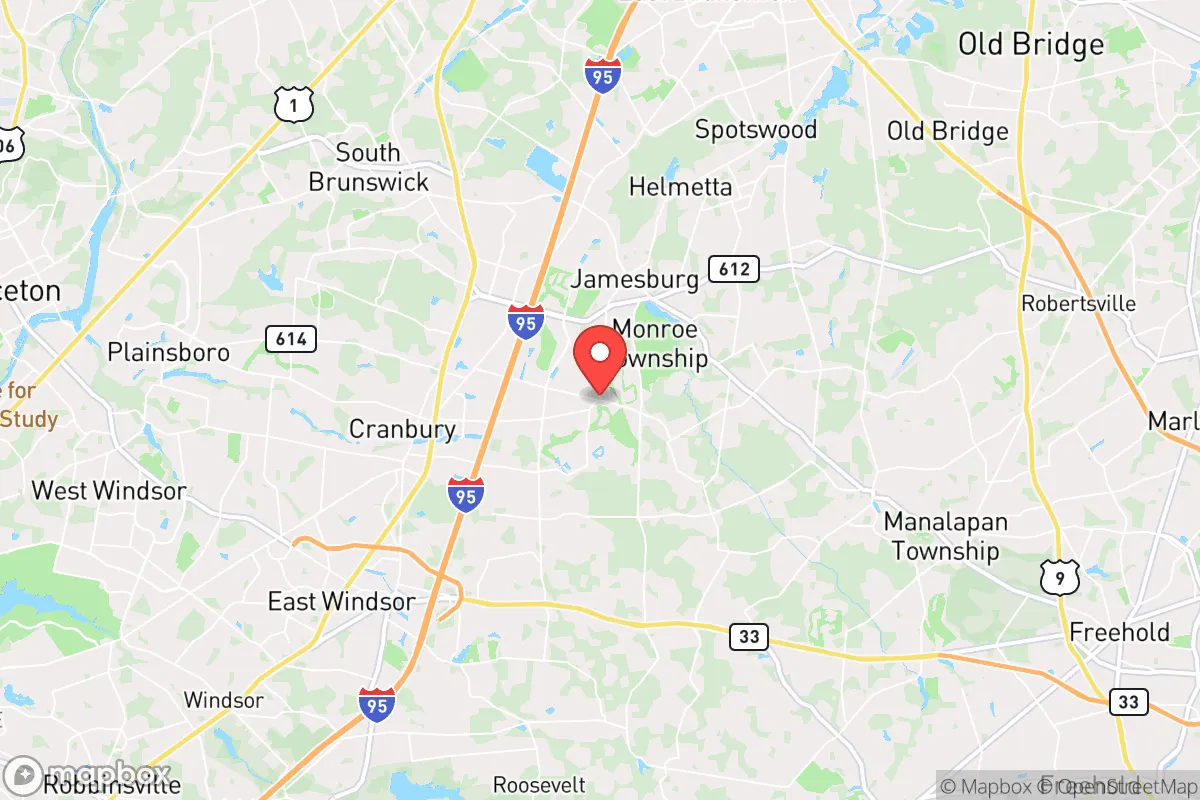
District shown is the primary district for this city’s centroid. Cities may span multiple districts.
Political rankings in New Jersey
- Most Conservative Cities in New Jersey
- Most Liberal Cities in New Jersey
- Best Conservative-Leaning Towns in the Northeast
- Best Conservative-Leaning Towns in the Mid-Atlantic
- Safest Liberal-Leaning Towns on the East Coast
- Safest Conservative-Leaning Towns on the East Coast
- Most Affordable Liberal-Leaning Small Towns in the U.S.
- Safest Liberal-Leaning Cities in the U.S.
- Most Conservative Counties in New Jersey
- Most Liberal Counties in New Jersey
Local Political AnalysisPolitical Analysis of Monroe Township, NJ
Monroe Township, in Middlesex County, is a solidly Democratic stronghold with a Cook PVI of D+13, meaning it votes about 13 points more Democratic than the national average. That’s a significantly deeper blue tilt than New Jersey as a whole, which sits at D+5, and it reflects a community that has shifted leftward over the past two decades as its population has grown and diversified. The township has reliably backed Democratic presidential candidates by wide margins—think 60-65% of the vote in recent cycles—and local offices are overwhelmingly held by Democrats, though not without occasional primary challenges that keep things interesting.
How it compares
To understand Monroe’s politics, it helps to look at its neighbors. Head west a few miles into neighboring East Windsor Township (Mercer County) and you’ll find a similar D+10 lean, but drive north to South Brunswick (D+8) or east to Old Bridge (D+6) and the Democratic margins shrink noticeably. The real contrast comes in the more rural and exurban townships of western Middlesex County—places like Spotswood or Helmetta, which lean more moderate or even Republican in local races. Monroe’s D+13 is also well above the statewide D+5 average, putting it in the same league as reliably blue suburbs like Montclair (D+14) or Maplewood (D+15), though Monroe is less affluent and more ethnically diverse than those North Jersey counterparts. The township’s large Asian American and Indian American communities, many of whom moved here from Edison and other nearby hubs, have been a key driver of its Democratic shift—these groups tend to vote Democratic at high rates, and their growing presence has reshaped local politics over the last 15 years.
What this means for residents
For liberal residents, Monroe’s lean means local government is generally aligned with their priorities—school funding, environmental initiatives, and social services tend to get consistent support. The township council and school board are Democratic-controlled, so progressive policies like renewable energy commitments or diversity programs face little organized opposition. For conservative residents, the reality is more nuanced. You won’t find many Republican elected officials, but the GOP does field candidates in most races, and the local party is active enough to keep Democrats honest. Property taxes are a perennial issue that crosses party lines—Monroe’s rates are among the highest in Middlesex County, and both parties’ candidates routinely campaign on restraint. Socially, conservative viewpoints on issues like gun rights or school curriculum are a minority position, but they’re not silenced; the township’s civic life includes active Republican clubs and conservative-leaning houses of worship. The practical effect is that while Democrats set the agenda, they can’t ignore fiscal concerns or the vocal minority—especially in local elections where turnout is low and a few hundred votes can swing a council primary.
Culturally, Monroe stands out for its strong sense of community identity that transcends partisan labels. The township’s annual Heritage Day festival, its well-regarded public schools, and its extensive park system are sources of pride that residents of all political stripes share. One notable policy distinction: Monroe has been more aggressive than some neighboring towns in pursuing affordable housing obligations under New Jersey’s Mount Laurel doctrine, a move that has drawn both praise from housing advocates and criticism from residents worried about tax impacts. The township also maintains a volunteer fire department and a municipal police force that are generally well-regarded, keeping public safety debates less heated than in larger cities. Looking ahead, the trajectory seems clear: as Monroe continues to grow—its population has nearly doubled since 2000—its Democratic lean is likely to deepen, especially if new residents come from similarly blue areas. But the township’s moderate, family-oriented character means it’s unlikely to become a hotbed of progressive activism anytime soon. For most people, the political climate here is less about ideological battles and more about practical concerns: good schools, reasonable taxes, and a safe place to raise kids.

State Political ClimatePolitical Climate in New Jersey
State Political AnalysisPolitical Environment in the State
New Jersey has a solid Democratic lean, with a Cook PVI of D+5, but that number masks a state that is far more politically complex than its reputation suggests. The dominant coalition is built on the dense, diverse suburbs of the New York City and Philadelphia metros, but the state has a stubborn, vote-splitting Republican minority that holds down-ballot power in the legislature and county governments. Over the past 20 years, the state has shifted leftward on social and cultural issues, but the tax burden and regulatory climate have kept fiscal conservatism alive as a real, if often losing, argument in statewide races.
Urban vs. rural divide
The political map of New Jersey is a textbook study in the urban-rural split. The Democratic stronghold is the northeastern corridor, anchored by Newark, Jersey City, and the dense suburbs of Bergen County and Essex County. These areas deliver massive vote margins driven by a mix of union households, public-sector workers, and a diverse, college-educated professional class. The Philadelphia suburbs in Camden County and Burlington County have also trended blue in recent cycles, with Burlington County flipping from red to blue at the presidential level after 2016. On the other side, the rural and exurban counties of Sussex County, Hunterdon County, and Ocean County are reliably Republican, often voting 60-40 or wider for GOP candidates. Ocean County, in particular, is a Republican bastion driven by a large retiree population and a strong law-and-order voting bloc. The divide is not just geographic but cultural: the urban core votes on social and economic liberalism, while the rural west and shore vote on taxes, property rights, and a skepticism of state government overreach.
Policy environment
New Jersey's policy environment is defined by its highest-in-the-nation property taxes, a progressive income tax structure with a top marginal rate of 10.75%, and a regulatory apparatus that touches nearly every aspect of business and housing. The state has some of the strictest gun laws in the country, including a carry permit system that was only loosened after the Supreme Court's Bruen decision in 2022. Education policy is dominated by the School Funding Reform Act, which directs disproportionate state aid to urban districts, a perennial source of suburban resentment. Healthcare is heavily regulated, with a state-based insurance exchange and Medicaid expansion under the Affordable Care Act. Election laws are among the most accessible in the nation: no-excuse mail-in voting, automatic voter registration at the DMV, and same-day registration during early voting. For a conservative relocator, the policy environment is a mixed bag: the tax burden is punishing, but the schools are generally excellent, and the state's infrastructure and services are well-funded.
Recent policy direction
The last five years have seen New Jersey accelerate in a progressive direction on several fronts. In 2022, the state passed a public option health insurance plan (the "New Jersey Health Plan") aimed at covering the uninsured, and in 2023, it enacted a clean energy mandate requiring 100% carbon-free electricity by 2035. On gun policy, the state responded to Bruen by passing a law that bans carrying in "sensitive places" like parks, libraries, and private businesses unless the owner explicitly permits it, a law that is currently being litigated. On parental and education rights, the state has moved in the opposite direction from many red states: it requires schools to adopt LGBTQ-inclusive curriculum standards and has a strong anti-discrimination framework that protects transgender students. Property rights are constrained by the state's powerful Mount Laurel doctrine, which forces municipalities to zone for affordable housing, a policy that has generated decades of litigation and suburban pushback. Voting access has been expanded, with the 2020 election seeing a massive shift to mail-in voting that was later codified into permanent law. For a relocator weighing personal liberties, the tradeoff is clear: New Jersey offers broad protections for bodily autonomy and speech, but imposes tight restrictions on gun ownership and property use.
Civil unrest & political movements
New Jersey has a history of organized political activism on both sides, but it rarely reaches the flashpoint levels seen in other states. The 2020 Black Lives Matter protests were large and sustained in Newark, Jersey City, and Trenton, but they were largely peaceful. On the right, the New Jersey Second Amendment Society has been a persistent legal and political force, filing lawsuits against the state's gun laws and organizing at the county level. Immigration politics are a live issue: the state has a sanctuary state policy under Executive Order 2018-01, which limits cooperation between state and local law enforcement and federal immigration authorities. This has been a rallying point for conservative activists, particularly in Ocean and Sussex counties, where local governments have passed resolutions opposing the policy. Election integrity controversies flared after 2020, with Republican activists challenging the state's mail-in voting system, but no major fraud was ever proven, and the system remains in place. A new resident would notice that political activism is more legal and procedural than street-level: it's about lawsuits, zoning board meetings, and county committee elections rather than mass demonstrations.
Projection
Over the next 5-10 years, New Jersey's Democratic lean is likely to hold or deepen, driven by continued in-migration of diverse, college-educated professionals to the urban and inner-suburban core. The state's population is aging, but the younger cohorts are more liberal, and the rural Republican base is shrinking as a share of the electorate. However, the tax burden is a real vulnerability: if remote work continues to erode the premium on living near New York City, the state could see an outflow of high-income earners that would strain the budget and force a reckoning with spending. The most likely scenario is a slow, grinding continuation of the status quo: Democratic control of the governorship and legislature, with Republicans holding a minority veto in the State Senate through the 21-19 seat split that has persisted for years. A relocator moving in now should expect a state that will remain blue, but with a robust, if outnumbered, conservative counterweight that keeps the policy debate from becoming a monolith.
For a new resident, the bottom line is that New Jersey offers a high-quality, high-cost environment where your political views will be in the minority if you lean conservative, but you will not be isolated. The state's political culture is transactional and pragmatic, not ideological: your neighbors may vote differently, but they will still shovel your sidewalk. The tradeoffs are real: you get excellent schools, strong public services, and broad personal freedoms on social issues, but you pay for them with the highest taxes in the country and a regulatory system that can feel suffocating. If you can afford the price of admission, New Jersey is a place where you can live your politics quietly, without the culture-war intensity of a swing state.
* Values derived from national, state, county, city and local statistics and may differ in a specific area. Last updated: 2026-11-13T05:53:07.000Z
Narrative content on this page is AI-generated and may contain mistakes. Verify any details that matter before acting on them.
ReloMaps may earn a commission from affiliate links at no extra cost to you.

