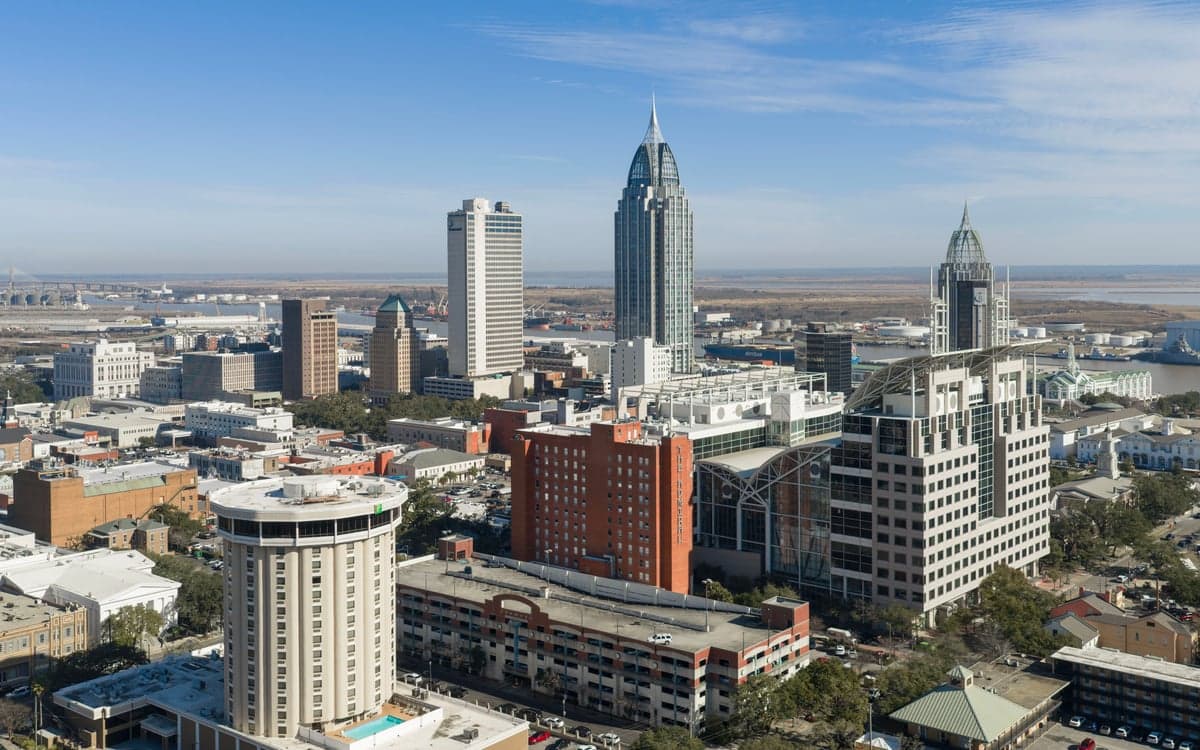
Photo: Wikipedia
Political ClimatePolitical Climate in Mobile, AL
District shown is the primary district for this city’s centroid. Cities may span multiple districts.
Local Political AnalysisPolitical Analysis of Mobile, AL
Look, I’ve lived in Mobile my whole life, and I’ll tell you straight: this city has always been a conservative stronghold in a state that’s deep red, but the numbers tell a more complicated story now. Mobile County itself is reliably Republican in statewide races, but the city of Mobile proper has a Cook PVI of D+5, meaning it leans five points more Democratic than the national average. That shift didn’t happen overnight—it’s been a slow creep over the last decade, driven by younger transplants and a growing professional class that’s brought some progressive ideas with them. If you’re looking for a place where traditional values still hold strong, Mobile is still solid, but you can feel the ground shifting under your feet.
How it compares
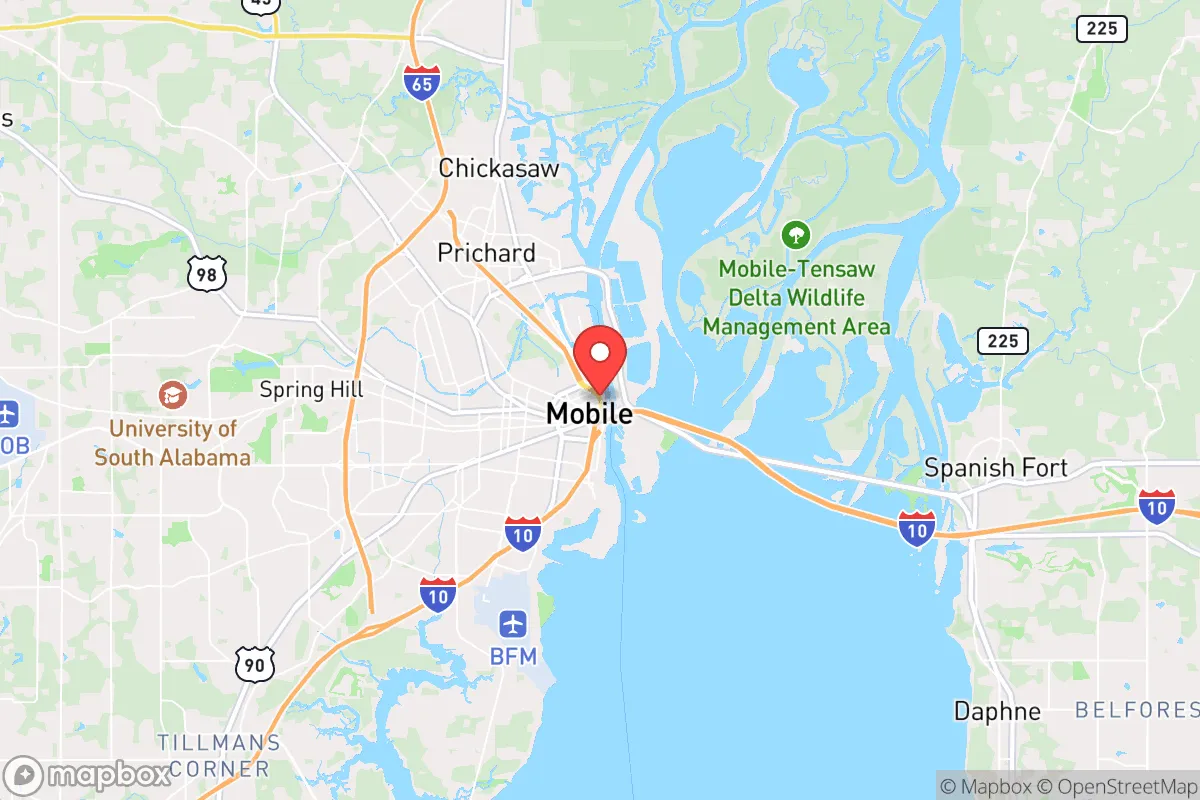
Drive twenty minutes west to Daphne or Fairhope across the bay, and you’re in Baldwin County—one of the fastest-growing and most reliably Republican areas in the Southeast. Those towns vote +30 or more for GOP candidates, and they’re a stark contrast to Mobile’s more mixed political landscape. Head north to Saraland or Satsuma, and you’re back in deep-red territory, where folks still fly the Gadsden flag and talk about limited government like it’s gospel. Mobile sits right in the middle: you’ve got the old guard, the shipyard workers, and the military families who vote conservative, but you also have a growing number of young professionals, university faculty from South Alabama, and service industry workers who lean left. That D+5 rating means Mobile is the most liberal city in the region, and it shows in local elections—city council races are getting tighter, and you see more candidates pushing for things like zoning changes and “equity” initiatives that would have been laughed out of the room twenty years ago.
What this means for residents
For someone like me who values personal freedom and limited government, the trend is concerning. The biggest red flag is how the city government has started to nibble at property rights and local business autonomy. There’s been talk of mandatory inclusionary zoning and stricter rental inspection regimes that sound like they’re designed to “help” but really just give bureaucrats more control over what you can do with your own land. The school board has also gotten more activist, pushing curriculum changes that prioritize social justice over fundamentals. On the flip side, the tax burden here is still relatively low compared to other D+5 cities—no city income tax, and property taxes are about half of what you’d pay in Birmingham or Montgomery. But if the progressive faction keeps gaining ground, I wouldn’t be surprised to see new fees or regulations that make it harder to run a small business or own a gun without jumping through hoops.
Culturally, Mobile still feels like the Old South in the best ways—people are polite, church attendance is high, and the Mardi Gras traditions are family-friendly and community-driven. But you can see the cracks. The local paper and the university crowd are pushing hard for a more “inclusive” narrative that downplays the city’s conservative roots. Long-term, I think Mobile will stay purple for a while, but if the D+5 trend continues, we could end up looking more like a smaller New Orleans—fun, but with a government that thinks it knows better than you do. Keep your eye on the next city council election; that’s where the real fight is.

State Political ClimatePolitical Climate in Alabama
State Political AnalysisPolitical Environment in the State
Alabama is a deeply conservative state, with Republicans holding every statewide elected office and supermajorities in both legislative chambers, a position solidified over the past 20 years. The state voted for Donald Trump by a margin of over 25 points in 2024, and the GOP’s dominance extends from the governor’s mansion to the county courthouses. However, this isn’t a static picture—the political climate is shaped by a growing urban-rural divide, a policy environment that aggressively protects traditional values, and a trajectory that, while still strongly conservative, is seeing subtle shifts in its fastest-growing areas.
Urban vs. rural divide
The political map of Alabama is a study in contrasts. The state’s two major metro areas—Birmingham and Montgomery—are Democratic strongholds, with Jefferson County (Birmingham) and Montgomery County consistently voting blue by double digits. These cities are home to the state’s largest universities, healthcare systems, and a growing professional class that leans left on social issues. In contrast, the rest of the state is overwhelmingly Republican. The rural Black Belt, stretching from the Mississippi border to the Georgia line, is a unique exception: counties like Greene, Sumter, and Lowndes are heavily Democratic due to a majority-Black population, but they are also among the poorest and least populated. The real engine of conservative power is the suburban and exurban ring around Birmingham—places like Shelby County (voted +40 R in 2024) and Autauga County (north of Montgomery)—along with the fast-growing Gulf Coast region. Baldwin County, home to Fairhope and Gulf Shores, is one of the fastest-growing counties in the state and voted +45 R in 2024, driven by retirees and families fleeing higher-tax states. The Huntsville metro area, anchored by the Redstone Arsenal and a booming aerospace sector, is a fascinating microcosm: it’s economically vibrant and increasingly diverse, but still votes reliably Republican, though with a more libertarian, pro-business flavor than the rural counties.
Policy environment
Alabama’s policy environment is a textbook example of conservative governance. There is no state income tax on retirement income, and the state’s property taxes are among the lowest in the nation—averaging around 0.4% of assessed value. The state has a right-to-work law, and the regulatory climate is business-friendly, with no state-level minimum wage above the federal $7.25. On education, Alabama has a robust school choice movement: the Alabama Accountability Act provides tax credits for private school tuition, and the state’s new CHOOSE Act (2024) created Education Savings Accounts for families earning up to 300% of the federal poverty level. However, the state’s public schools rank near the bottom nationally, and the debate over school funding is a persistent flashpoint. Healthcare policy is deeply conservative: Alabama did not expand Medicaid under the Affordable Care Act, leaving roughly 300,000 residents in the coverage gap. The state also passed a near-total abortion ban in 2019 (the Human Life Protection Act), which took effect after the Dobbs decision. Election laws are strict: voter ID is required, and the state has purged inactive voters from rolls. There is no early voting in the traditional sense, though absentee voting is available with an excuse. The state’s constitution, still the longest in the nation, was amended in 2022 to remove racist language and segregate school funding provisions, but the underlying tax structure remains regressive.
Trajectory & freedom
On the freedom front, Alabama has been moving decisively in the direction of expanded personal liberty on most fronts, but with some notable exceptions. The state has a constitutional carry law (permitless carry) that took effect in 2022, allowing any law-abiding adult to carry a concealed firearm without a permit. The same year, the legislature passed a law prohibiting vaccine mandates by private employers, a direct response to federal COVID-19 policies. Parental rights have been strengthened: the Alabama Parental Rights Protection Act (2022) requires schools to notify parents of any medical or mental health services offered to their children and prohibits instruction on sexual orientation or gender identity in K-5 classrooms. On medical freedom, the state has a broad religious exemption for vaccinations and has resisted federal public health mandates. However, the state’s medical marijuana program, passed in 2021, has been mired in legal challenges and has yet to issue a single license, frustrating advocates of medical autonomy. Property rights are generally strong, with no state-level rent control and a homestead exemption that protects up to $5,000 of assessed value from creditors. The biggest concern for freedom-minded residents is the state’s civil asset forfeiture laws, which allow law enforcement to seize property without a criminal conviction, though a 2023 reform bill raised the burden of proof slightly.
Civil unrest & political movements
Alabama has not seen the kind of large-scale civil unrest that has rocked other states, but there are persistent political movements that shape the climate. The Yellowhammer Fund, a reproductive justice organization based in Alabama, was a major force in the pre-Dobbs era but has since scaled back operations. The state has seen periodic protests over Confederate monuments, most notably in Birmingham, where the city removed a 52-foot obelisk in 2020 and paid a $25,000 fine imposed by the state legislature for violating the Alabama Memorial Preservation Act. Immigration politics are relatively quiet, as Alabama’s foreign-born population is only about 3.5%, but the state passed a strict anti-sanctuary city law in 2019, and local law enforcement cooperates with ICE. Election integrity has been a hot topic: the 2022 midterms saw a high-profile controversy in Montgomery County over absentee ballot irregularities, leading to a state investigation and new legislation requiring stricter chain-of-custody procedures for absentee ballots. The Alabama Republican Party has been internally divided between establishment and more populist factions, but this rarely spills into public view. The most visible political movement in recent years has been the school choice advocacy, with groups like the Alabama School Choice Coalition holding annual rallies at the state capitol.
Projection
Over the next 5-10 years, Alabama’s political climate is likely to remain deeply conservative, but with a few important shifts. The fastest-growing parts of the state—Baldwin County on the coast and the Huntsville metro—are attracting newcomers from blue states, many of whom are conservative but bring a more libertarian, less culturally Southern perspective. This could moderate the state’s politics on issues like marijuana legalization and criminal justice reform, while hardening it on taxes and regulation. The rural Black Belt will continue to depopulate, reducing the Democratic base outside of Birmingham and Montgomery. The biggest wild card is the state’s congressional redistricting battle: a federal court ordered Alabama to create a second majority-Black district for the 2024 election, which could flip one of the state’s seven House seats to Democratic control. This will likely intensify partisan gerrymandering fights and could shift the state’s congressional delegation from 6-1 Republican to 5-2. On the policy front, expect further expansion of school choice, a possible move to eliminate the state income tax entirely (a proposal that has been floated by Governor Kay Ivey), and continued resistance to Medicaid expansion. The state’s abortion ban will remain in place, but there will be ongoing legal challenges over its exceptions for rape and incest.
For a new resident, the bottom line is this: Alabama offers a stable, low-tax, culturally conservative environment where your rights to keep and bear arms, direct your children’s education, and run a business are strongly protected. The trade-offs are a weak social safety net, underfunded public schools in many areas, and a political system that is resistant to change. If you’re moving here, you’ll find a state that largely leaves you alone—but you’ll also need to be self-reliant, especially when it comes to healthcare and education. The politics are predictable, the trajectory is steady, and the freedom to live as you see fit is real, as long as you’re not looking for the government to solve your problems.
* Values derived from national, state, county, city and local statistics and may differ in a specific area. Last updated: 2026-04-19T18:58:18.000Z
Narrative content on this page is AI-generated and may contain mistakes. Verify any details that matter before acting on them.
ReloMaps may earn a commission from affiliate links at no extra cost to you.

