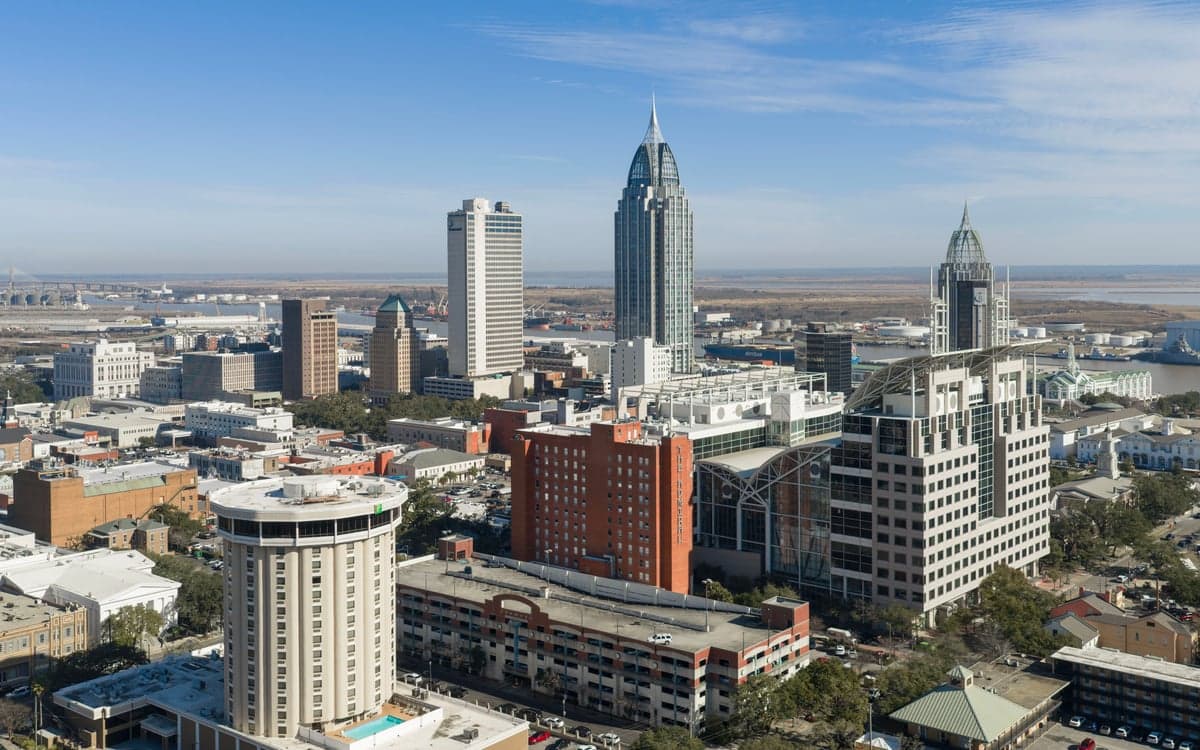
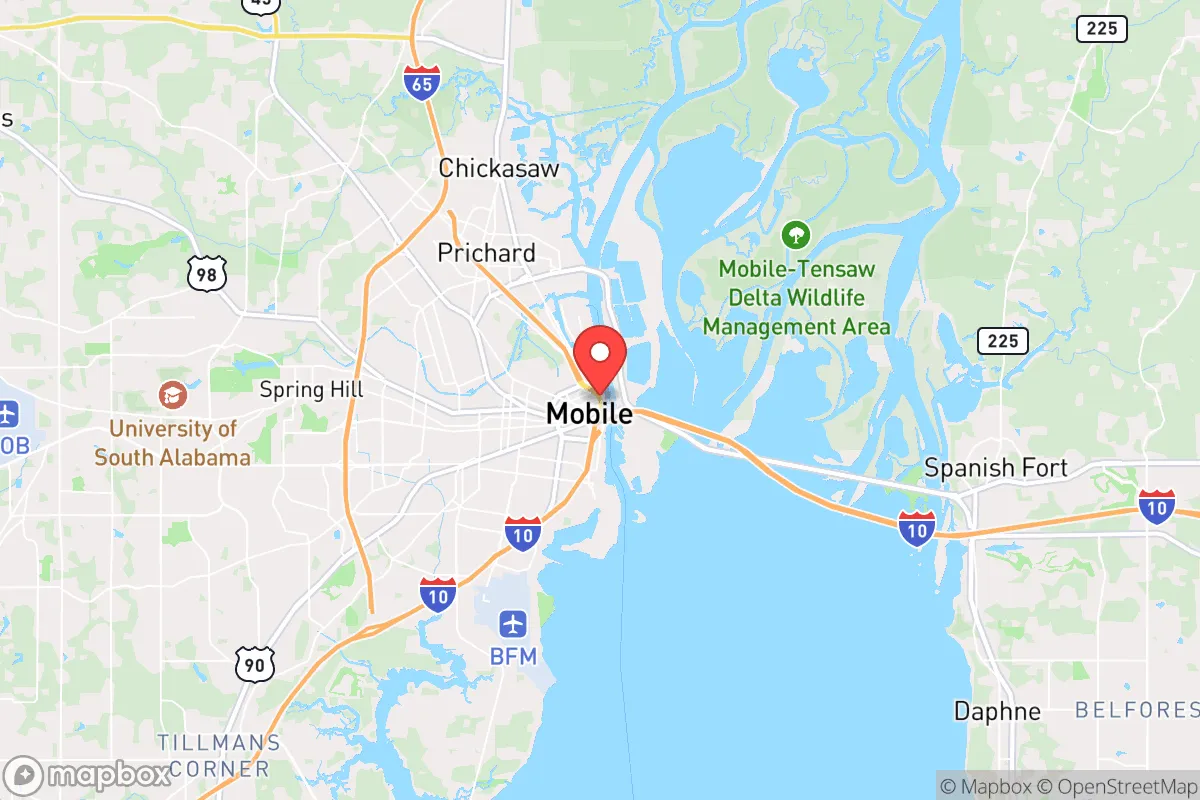
Photo: Wikipedia
Demographics of Mobile, AL
Affluence Level in Mobile, AL
A below-average socioeconomic profile. Incomes, home values, and educational attainment trail the U.S., with higher poverty and unemployment.
People of Mobile, AL
The people of Mobile, Alabama, today form a majority-Black city (52.7%) with a substantial White minority (39.2%) and very small Hispanic (3.1%), East/Southeast Asian (1.7%), and Indian-subcontinent (0.5%) populations. With only 1.6% foreign-born, Mobile is one of the least internationally diverse cities in the Gulf South, and its character is shaped by deep-rooted family lineages, a strong Catholic and Protestant church presence, and a working-class identity tied to the port and shipbuilding. The city’s population density is moderate for its size, and its distinctive identity markers include a Creole-influenced food culture, Mardi Gras traditions that predate New Orleans’, and a palpable sense of place that newcomers often describe as both welcoming and insular.
How the city was settled and grew
Mobile was founded in 1702 by French colonists under Pierre Le Moyne d’Iberville, making it the first permanent European settlement in Alabama. The original population was a mix of French soldiers, traders, and Catholic missionaries, who established the De Tonti Square and Church Street East neighborhoods as the colonial core. After the Louisiana Purchase, the city passed to the United States in 1813, and the cotton boom of the 1820s–1850s drew Anglo-American planters and merchants, who built grand homes in Oakleigh Garden District and Dauphin Street. Enslaved Africans, who made up roughly half the city’s population by 1860, worked the port and surrounding plantations; after emancipation, many settled in Africatown (north of downtown), a community founded by the last known enslaved Africans brought to the U.S. aboard the Clotilda in 1860. The late 19th and early 20th centuries saw an influx of German and Irish immigrants, who clustered in Midtown and worked in the growing shipbuilding and lumber industries. By 1950, Mobile’s population had swelled to 129,000, with a rigidly segregated Black and White social structure.
Modern era (post-1965)
The post-1965 era brought significant demographic change through domestic migration rather than foreign immigration. The 1965 Immigration Act had little effect on Mobile—the city’s foreign-born share remains under 2%—but the Great Migration’s reverse flow saw Black families returning from Northern industrial cities to the Gulf Coast, reinforcing the Black majority that emerged by the 1980 census. White flight to suburban municipalities like West Mobile and Daphne (across the bay) accelerated after school desegregation orders in the 1970s, leaving the city limits increasingly Black and lower-income. The Hispanic population grew modestly from the 1990s onward, driven by construction and service jobs tied to the port and the 2005 Katrina rebuilding, but remains concentrated in Hillsdale and Maysville neighborhoods. East/Southeast Asian communities, primarily Vietnamese and Filipino, arrived in small numbers after the Vietnam War and settled near the Austal shipyard and University of South Alabama, but never formed a large enclave. The Indian-subcontinent population is tiny and scattered, with no distinct neighborhood concentration.
The future
Mobile’s population is projected to remain stable or decline slightly through 2035, as the city has not attracted the rapid growth seen in Huntsville or Baldwin County. The Black share is likely to hold near 52–55%, while the White share may continue a slow decline due to suburban out-migration and lower birth rates. Hispanic and East/Southeast Asian communities are growing from a very small base but are unlikely to reach 5% each within a decade, as the city lacks the job magnets—tech, finance, large universities—that drive international migration. The city is not tribalizing into distinct new enclaves; rather, it is slowly homogenizing into a majority-Black, low-immigration city with a stable White minority. The most notable trend is the aging of the population: Mobile’s median age (37.8) is slightly above the national average, and younger adults often leave for job markets in Atlanta, Houston, or Nashville.
For someone moving in now, Mobile is becoming a more affordable, slower-paced Gulf Coast city with a strong sense of history and community, but limited demographic dynamism. The population is overwhelmingly native-born, family-rooted, and socially conservative, with a Black political majority and a White economic minority. Newcomers will find a place where who your family is still matters, and where the port, healthcare, and education sectors offer stable but not high-growth employment.

* Values derived from national, state, county, city and local statistics and may differ in a specific area. Last updated: 2026-04-19T18:58:18.000Z
Narrative content on this page is AI-generated and may contain mistakes. Verify any details that matter before acting on them.
ReloMaps may earn a commission from affiliate links at no extra cost to you.

