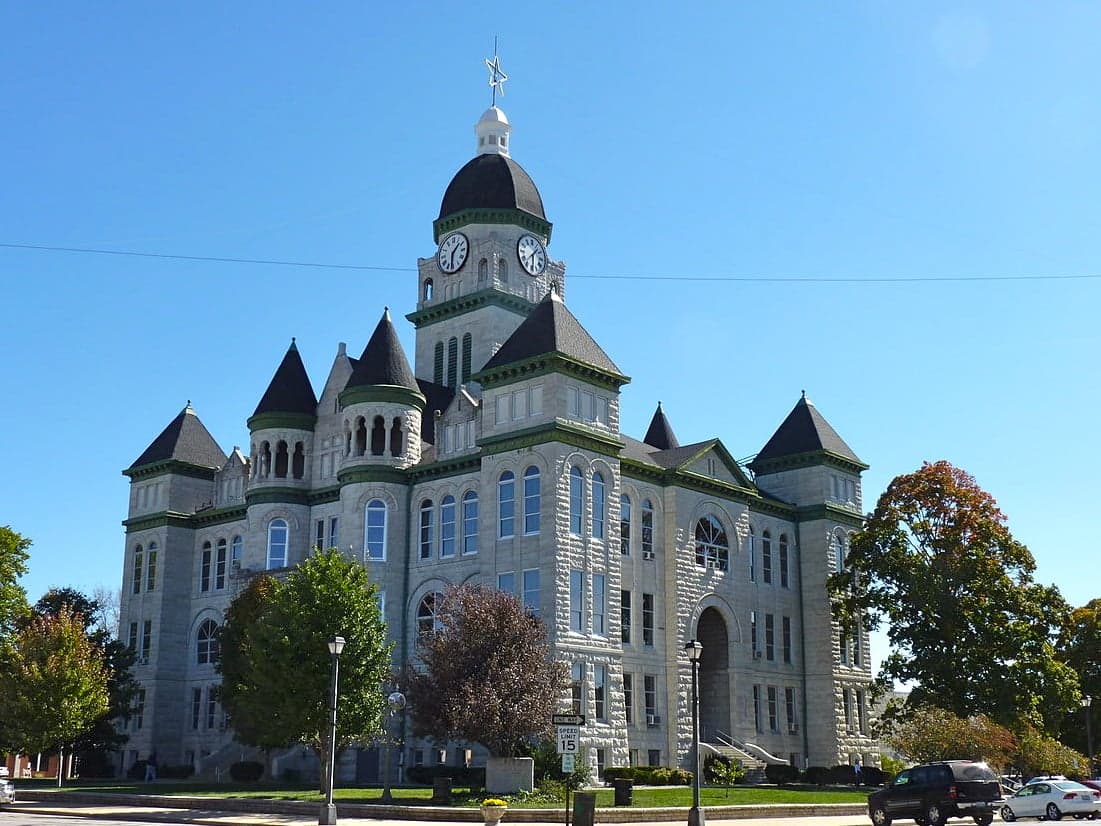
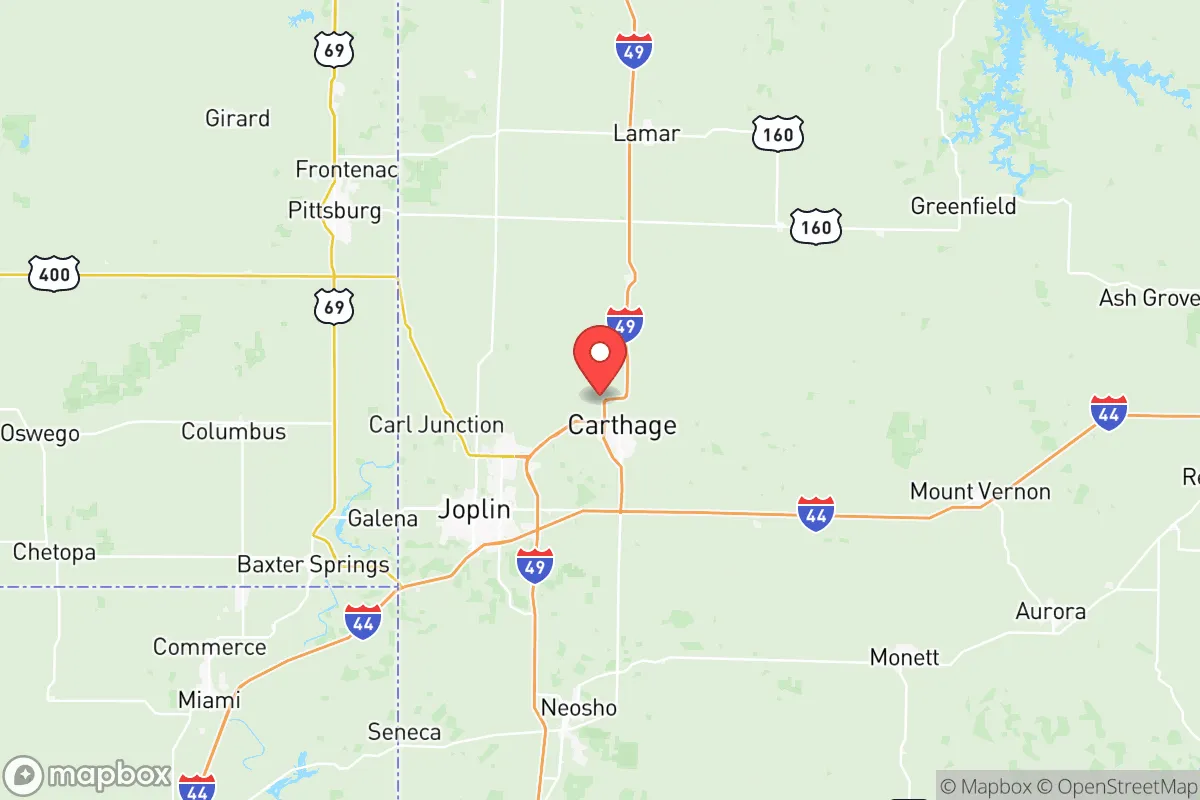
Photo: Wikipedia
Political ClimatePolitical Climate in Jasper County
Showing district-level results — no local-only data available.
Local Political AnalysisPolitical Analysis of Jasper County
Jasper County, Missouri, is a reliably conservative area with a Cook Partisan Voting Index (PVI) of R+21, making it significantly more Republican than the state of Missouri as a whole, which sits at R+8. This isn't a recent shift; the county has been a GOP stronghold for decades, driven by a mix of rural values, a strong manufacturing and mining heritage, and a population that leans older and more culturally traditional. The county's political center of gravity is firmly in the southern and western parts, while the city of Joplin, the county seat and largest population center, introduces a more moderate, and occasionally blue-leaning, counterweight.
How it compares
The difference between Jasper County's R+21 and Missouri's R+8 is stark and tells you a lot about the state's internal political geography. Missouri is a red state, but its Republicanism is heavily concentrated in the rural and exurban areas, while the major metro areas—St. Louis and Kansas City—pull the state's overall PVI toward the center. Jasper County, sitting in the southwest corner of the state, is part of that deep-red rural bloc. In practice, this means that while Missouri statewide races are often competitive (like the 2024 Senate race), Jasper County routinely delivers 65-70% of its vote to Republican candidates. For example, in the 2024 presidential election, the county went for Donald Trump by a margin of roughly 68% to 30%, a much wider gap than the statewide result. The internal variation is real, though. Joplin, with its larger university (Missouri Southern State University) and more diverse economy, has precincts that are more competitive, sometimes even leaning Democratic in local races. The towns of Webb City and Carthage are solidly red, while smaller communities like Carl Junction and Sarcoxie are among the most conservative in the county.
What this means for residents
For conservative residents, Jasper County is a comfortable place to live politically. Local government, school boards, and county commissions are overwhelmingly Republican, and conservative viewpoints dominate public discourse. Issues like gun rights, lower taxes, and limited government are broadly popular. For liberal or moderate residents, the reality is more nuanced. They are a clear minority, but not an invisible one. Joplin provides a more tolerant environment, with a visible LGBTQ+ community and a Democratic party presence that is active, if not electorally dominant. The key is that political disagreement here is generally civil, though the national culture wars do seep into local debates, particularly around school curriculum and library content. A liberal resident will find it harder to be elected to office, but they won't face social ostracism for their views, especially in Joplin.
The cultural and policy distinctions in Jasper County are rooted in its history as a lead and zinc mining region and its strong ties to agriculture and manufacturing. This creates a practical, no-nonsense political culture that values hard work and self-reliance. You see this in the county's consistently low tax rates and its resistance to new regulations. The area is also heavily influenced by its proximity to the Bible Belt, with a large number of evangelical churches shaping the social and political landscape. This means that social issues like abortion and religious freedom are front-burner topics, and candidates who align with those values have a clear advantage. Looking ahead, the county's political trajectory is likely to remain deeply red, though the growing Hispanic population in the Joplin area could introduce new political dynamics over the next decade. For now, Jasper County is a place where the political reality is clear: it's a conservative stronghold, but with a pragmatic, live-and-let-live attitude that makes it workable for most people, regardless of their party affiliation.

State Political ClimatePolitical Climate in Missouri
State Political AnalysisPolitical Environment in the State
Missouri is a solidly Republican state with a Cook PVI of R+8, meaning it typically votes about eight points more Republican than the national average in presidential elections. Over the past 20 years, the state has shifted from a competitive purple state—where it voted for Democrat Bill Clinton in 1996 and was a key battleground in 2000 and 2004—to a reliably red one, driven by the exodus of rural and suburban voters from the Democratic coalition and the consolidation of conservative voters in the St. Louis and Kansas City exurbs. The dominant coalition is a mix of rural conservatives, suburban Republicans in places like St. Charles County and Greene County, and a shrinking but still influential Democratic base anchored in the urban cores of St. Louis City, Kansas City, and Columbia.
Urban vs. rural divide
The political map of Missouri is a textbook example of the urban-rural split. The two major metros—St. Louis and Kansas City—are deep blue islands in a sea of red. St. Louis City and St. Louis County (especially the inner-ring suburbs like University City and Clayton) consistently vote Democratic by 30-40 points, while the surrounding exurbs like St. Charles County, Jefferson County, and Franklin County are heavily Republican. Kansas City’s Jackson County is reliably blue, but the suburbs to the north (Platte County) and south (Cass County) are trending red. The third major metro, Springfield (Greene County), is a Republican stronghold, voting +20 to +30 points Republican in recent cycles. The rural areas—the Bootheel, the Ozarks, and the northern plains—are among the most conservative in the nation, with counties like Texas County and Howell County routinely voting 80%+ Republican. The only notable blue outlier in rural Missouri is Boone County, home to the University of Missouri in Columbia, which has flipped from purple to solidly blue over the past decade as the college town’s population has grown and become more progressive.
Policy environment
Missouri’s policy environment is distinctly conservative, with a low-tax, low-regulation posture. The state has a flat income tax rate of 4.95% (phased down from 5.3% in 2022), a sales tax of 4.225% (with local add-ons pushing it to 8-10% in some cities), and no estate tax. Property taxes are among the lowest in the nation, averaging about 0.8% of home value. The state is a right-to-work state (though a 2018 ballot measure repealed the law, the legislature later passed a new version in 2021), and it has a strong “at-will” employment doctrine. Education policy is a flashpoint: Missouri has a robust school choice movement, with charter schools allowed in St. Louis and Kansas City, and a growing number of private school voucher programs (the MOScholars program, expanded in 2023). The state has also passed laws restricting transgender athletes from competing in women’s sports (2021) and banning gender-affirming care for minors (2023). Election laws are moderately restrictive: voter ID is required, absentee voting requires an excuse (though no-excuse absentee voting was temporarily allowed during COVID and remains a political battleground), and the state has a 27-day early voting period (enacted in 2022). Healthcare policy is mixed: Missouri expanded Medicaid in 2021 via ballot initiative, but the legislature has resisted further expansion and has passed laws restricting abortion (a near-total ban with no exceptions for rape or incest, effective 2022) and limiting telehealth access for abortion pills.
Recent policy direction
Over the past five years, Missouri’s legislature has moved aggressively to the right on a wide range of issues. On gun rights, the state passed a “Second Amendment Preservation Act” (SAPA) in 2021, which declares federal gun laws unenforceable in Missouri and has led to a legal showdown with the DOJ. On parental rights and education, the state passed a “Parents’ Bill of Rights” in 2022, requiring schools to notify parents of any curriculum involving sexual orientation or gender identity, and a law banning critical race theory in K-12 classrooms. On speech and privacy, the state has not passed a broad social media censorship law like Florida or Texas, but it has considered bills targeting “deplatforming” and data privacy. On medical and bodily autonomy, the near-total abortion ban (HB 126, 2019, triggered by the Dobbs decision) is the most significant change, with no exceptions for rape or incest. On property rights, the state has strong eminent domain protections (post-Kelo reforms) and has resisted local rent control ordinances. On taxation, the legislature has passed multiple income tax cuts, with a goal of reaching a 4% flat rate by 2027. On voting and ballot access, the state has tightened voter ID requirements and made it harder to conduct ballot initiatives (requiring a supermajority vote in 2022, though that was later struck down by the courts). The overall direction is toward a more aggressively conservative policy posture, with the legislature often overriding vetoes from Governor Mike Parson (a Republican) on the most controversial bills.
Civil unrest & political movements
Missouri has a history of high-profile civil unrest, most notably the 2014 Ferguson protests following the shooting of Michael Brown, which sparked the Black Lives Matter movement nationally. Since then, protests have been less frequent but still occur, particularly in St. Louis and Kansas City around police brutality and racial justice issues. On the right, the state has seen a rise in organized conservative activism, including the Missouri chapter of Moms for Liberty (which has been active in school board elections) and the Missouri Freedom Caucus, a group of hardline state legislators who have pushed for more aggressive conservative policies. Immigration politics are relatively low-key compared to border states, but there have been flashpoints: in 2023, the state sent National Guard troops to the Texas border, and there have been local ordinances in places like St. Charles County that restrict “sanctuary city” policies. Election integrity controversies have been a recurring theme: the 2020 election saw Trump’s narrow loss in Missouri (he won by 15 points, but some rural counties saw protests over alleged fraud), and the 2022 election saw a high-profile dispute over the St. Louis County Board of Elections. Secession or nullification rhetoric is present but not mainstream: the SAPA law is a form of nullification, and there have been occasional calls for a “Second Missouri Compromise” or even secession from the more liberal St. Louis area, but these are fringe movements. A new resident would notice the political polarization most visibly in the stark contrast between the urban and rural areas—driving from St. Louis to the Ozarks, you’ll see a dramatic shift in yard signs, bumper stickers, and even the tenor of local news.
Projection
Over the next 5-10 years, Missouri is likely to become even more Republican, driven by two demographic trends. First, the continued out-migration of younger, more liberal residents from St. Louis and Kansas City to other states (especially Illinois, Colorado, and Texas) is shrinking the Democratic base. Second, the in-migration of conservative retirees and remote workers from blue states (particularly California and Illinois) is boosting the Republican vote in the exurbs and rural areas. The St. Louis and Kansas City metros will remain blue, but their influence will wane as the state’s population growth is concentrated in the redder suburbs and rural areas. The legislature will likely continue to push rightward on social issues—expect more restrictions on abortion (possibly a ban on out-of-state travel for the procedure), further tax cuts, and more school choice expansion. The wild card is the growing influence of the Missouri Freedom Caucus, which could push the state into more confrontational stances with the federal government, particularly on gun rights and immigration. For a new resident, the state will feel increasingly like a solidly red state in the mold of Arkansas or Oklahoma, with the urban areas becoming more isolated blue enclaves. The political climate will be stable but polarized, with little chance of a statewide Democratic victory in the near future.
For a new resident, the bottom line is that Missouri offers a low-tax, conservative-friendly environment with a strong gun culture and a growing school choice ecosystem. If you’re a conservative, you’ll find a state that largely aligns with your values, especially outside the urban cores. If you’re a liberal, you’ll find a few blue enclaves (St. Louis City, Kansas City, Columbia) where you can live comfortably, but you’ll be in a state where your vote has little impact on statewide elections and where the legislature is actively hostile to many of your priorities. The practical takeaway is to choose your location carefully: the political reality of living in St. Charles County is very different from living in St. Louis City, and the gap is only widening. If you’re moving for work or family, be prepared for a state that is increasingly red, increasingly polarized, and increasingly defined by the urban-rural divide.
* Values derived from national, state, county, city and local statistics and may differ in a specific area. Last updated: 2026-06-12T19:39:17.000Z
Narrative content on this page is AI-generated and may contain mistakes. Verify any details that matter before acting on them.
ReloMaps may earn a commission from affiliate links at no extra cost to you.

