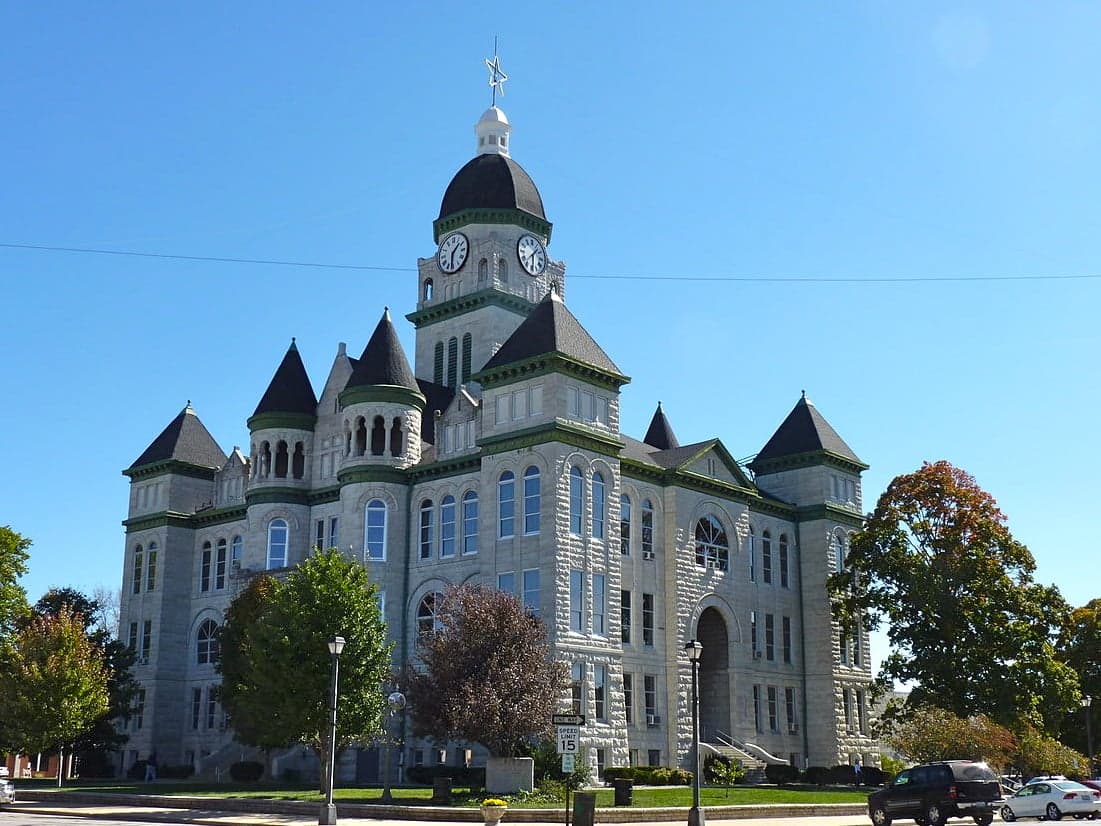
Photo: Wikipedia
Demographics of Jasper County
Affluence Level in Jasper County
A middle-class area roughly in line with national averages across income, home values, education, and employment.
People of Jasper County
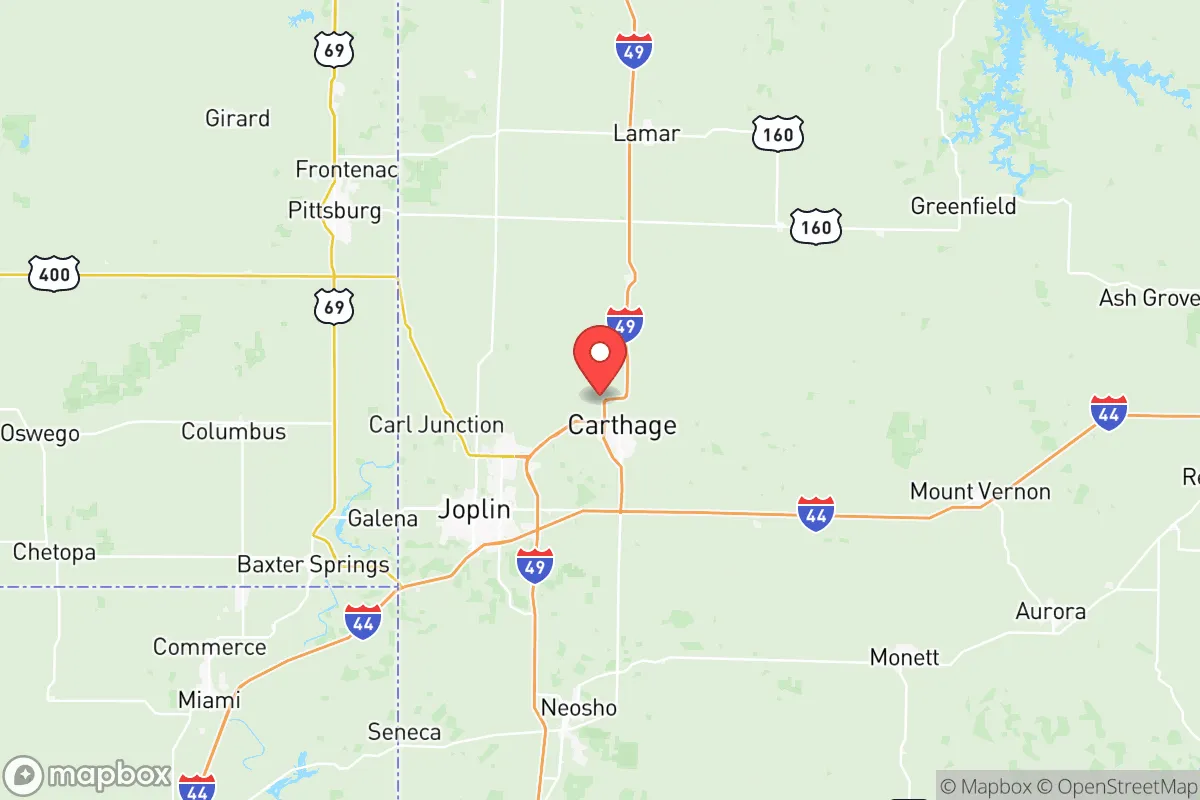
The people of Jasper County, Missouri, today form a predominantly white, working-to-middle-class population of 123,532, concentrated in the Joplin metropolitan area and the historic mining towns of Carthage, Webb City, and Carl Junction. The county’s character is shaped by a legacy of lead and zinc mining, a strong manufacturing and logistics base, and a noticeably low foreign-born share of just 2.7%, which is well below the national average. Residents identify strongly with the Ozarks region and Southwest Missouri’s conservative cultural values, with a population that is 81.2% white, 9.5% Hispanic, 1.7% Black, 0.9% East/Southeast Asian, and 0.5% Indian (subcontinent). The county is less diverse than the state of Missouri as a whole, but its Hispanic and Asian communities are slowly growing, particularly in Joplin and Carthage.
Settlement & growth (pre-1960)
Before American settlement, the area now known as Jasper County was part of the traditional territory of the Osage Nation, who used the region for hunting and seasonal camps. The Osage were forcibly removed through treaties in the early 1800s, opening the land to Euro-American settlers. The county was formally organized in 1841, named after Revolutionary War soldier William Jasper, and its earliest white settlers were primarily of Scots-Irish and English stock, migrating from Kentucky, Tennessee, and the Upper South along the Ozark frontier. These families established small farms and the first towns, including Carthage (the county seat, founded 1842) and Joplin (founded 1873), which grew as agricultural and trade centers.
The defining demographic event of Jasper County’s early history was the lead and zinc mining boom that began in the 1850s and exploded after the Civil War. The Tri-State Mining District, centered on Joplin, Webb City, and Carterville, drew tens of thousands of workers from across the United States and Europe. The first major wave of immigrant miners were Cornish (from England), who arrived in the 1870s and 1880s, bringing hard-rock mining expertise. They settled heavily in Webb City and Joplin, where Cornish Methodist churches and social halls once dotted the landscape. A second wave brought German and Irish immigrants in the 1880s and 1890s, who worked the mines and established Catholic parishes in Carthage and Joplin. Smaller numbers of Italian and Slavic miners arrived around 1900, but the mining workforce remained overwhelmingly native-born white and Cornish compared to more ethnically diverse mining regions like Pennsylvania.
By the 1910s, the mines were in decline, and the county’s population began to shift toward agriculture and manufacturing. The Dust Bowl and Great Depression of the 1930s brought a modest influx of Okies and Arkies (white migrants from Oklahoma and Arkansas) who sought work in the remaining mines and on farms. These migrants settled in rural areas and small towns like Sarcoxie and Avilla, reinforcing the county’s already strong Southern and Ozark cultural identity. The African American population, never large, was concentrated in Joplin’s East Town neighborhood and in Carthage, where a small community of freed slaves and their descendants worked as domestic laborers and railroad workers after the Civil War. By 1960, Jasper County was 96% white, with a tiny Black population (under 2%) and virtually no Hispanic or Asian residents.
Modern era (post-1965)
The 1965 Hart-Cellar Act had a muted effect on Jasper County compared to coastal and urban areas. The county’s foreign-born population remains low at 2.7%, but the composition has shifted. The most significant post-1965 change has been the growth of the Hispanic population, which rose from under 1% in 1980 to 9.5% today. This growth is driven primarily by Mexican immigrants and their U.S.-born children, who arrived for work in the county’s poultry processing plants, meatpacking facilities, and construction industry. The largest concentration is in Carthage, where a Tyson Foods plant and other food-processing employers have drawn a sizable Hispanic workforce since the 1990s. A smaller but growing Hispanic community is also present in Joplin, particularly in the city’s southern and eastern neighborhoods.
The East/Southeast Asian population (0.9%) and Indian subcontinent population (0.5%) are small but visible in Joplin, where a handful of Vietnamese and Indian families have settled, many working as healthcare professionals at Mercy Hospital Joplin or as small business owners. The county has not seen the large-scale Asian immigration common in coastal metros or even in larger Missouri cities like St. Louis or Kansas City. Domestic migration has been more consequential: since the 1970s, Jasper County has attracted white retirees and families from the Rust Belt (Illinois, Indiana, Ohio) and from California, drawn by lower housing costs, a lower cost of living, and the region’s conservative political climate. This domestic in-migration has reinforced the county’s white majority and slowed diversification.
Suburbanization has reshaped the county’s population distribution since the 1980s. Joplin remains the largest city (about 52,000), but growth has shifted to its suburbs: Webb City (pop. 12,000) and Carl Junction (pop. 8,500) have seen steady residential development, attracting families seeking newer housing and better schools. Carthage (pop. 15,000) has grown more slowly, with its historic downtown and industrial base. The county’s rural areas, particularly around Sarcoxie and Avilla, have lost population as young people leave for urban jobs, though they remain popular with retirees and hobby farmers.
The future
Jasper County is likely to become slightly more diverse over the next 10-20 years, but the pace will be slow. The Hispanic population is projected to grow from 9.5% to perhaps 12-14% by 2040, driven by natural increase and continued labor demand in food processing and construction. The East/Southeast Asian and Indian populations will likely remain small, below 2% combined, unless a major employer (such as a new manufacturing plant or a medical center) recruits specialized workers from abroad. The white population, while still the overwhelming majority, will continue to age, and the county’s overall growth rate will be modest—likely 0.5-1% annually—as domestic in-migration from the Rust Belt and California offsets a low birth rate.
The cultural identity of Jasper County is likely to remain conservative and Ozarks-rooted, but with a growing Hispanic influence in Carthage and Joplin. Spanish-language services, bilingual signage, and Hispanic-owned businesses are already visible in Carthage, and this trend will spread. The county will not become a multicultural melting pot, but it will become a place where a white majority coexists with a significant Hispanic minority, much like many other rural and small-city counties in the Midwest and Plains states.
For someone moving in now, Jasper County offers a stable, affordable, and culturally traditional environment with a slowly diversifying population. The county’s future is one of gradual change rather than rapid transformation—a place where the mining-era legacy of hard work and self-reliance still defines the local character, even as new faces and languages become part of the landscape.

* Values derived from national, state, county, city and local statistics and may differ in a specific area. Last updated: 2026-06-12T19:39:17.000Z
Narrative content on this page is AI-generated and may contain mistakes. Verify any details that matter before acting on them.
ReloMaps may earn a commission from affiliate links at no extra cost to you.

