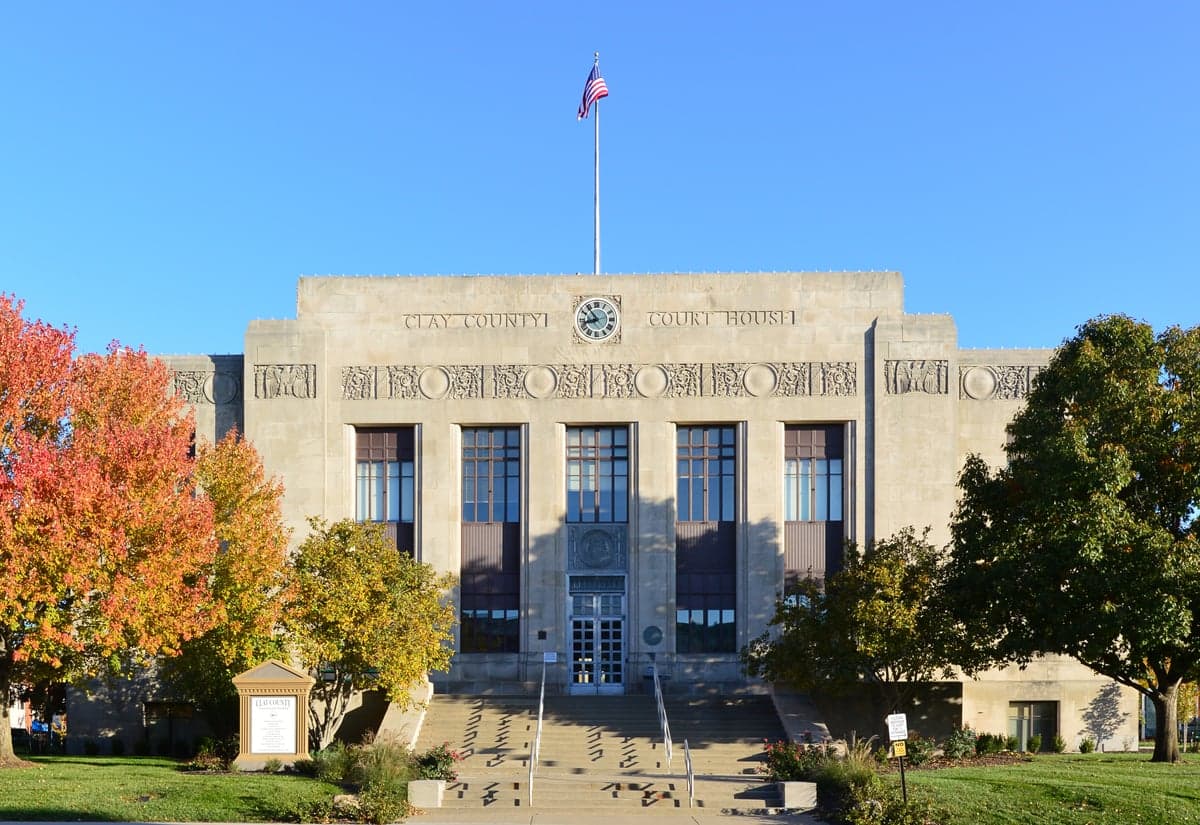
Photo: Wikipedia
Political ClimatePolitical Climate in Clay County
Showing district-level results — no local-only data available.
Local Political AnalysisPolitical Analysis of Clay County
Clay County, Missouri, is a reliably Republican stronghold with a Cook Partisan Voting Index (PVI) of R+19, meaning it votes about 19 points more Republican than the national average. This is a significantly deeper shade of red than the state of Missouri as a whole, which sits at R+8. The county has been trending further right over the past decade, driven largely by population growth in its more conservative northern and eastern exurbs, while the older, denser suburbs near the Missouri River have held a more moderate, sometimes even competitive, character.
How it compares
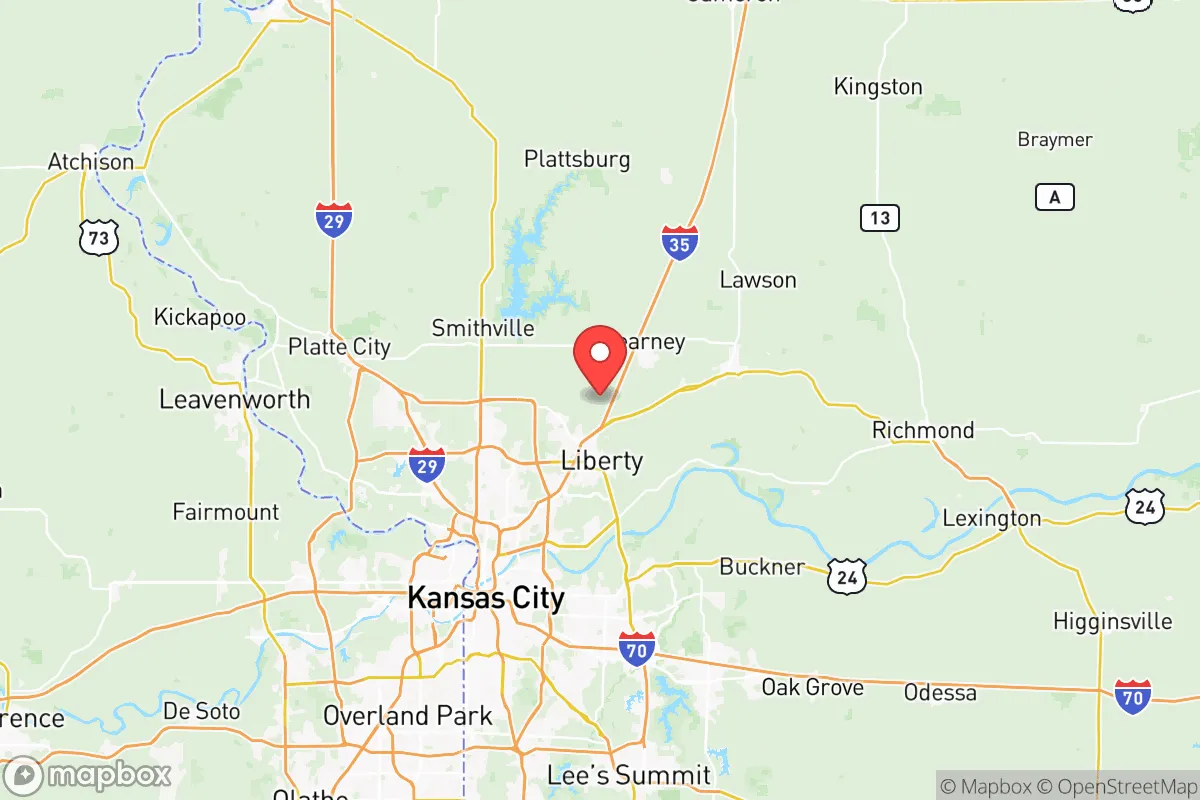
The gap between Clay County's R+19 and Missouri's R+8 is not just a number—it reflects a real political divide within the state. While Missouri is already a solidly red state, Clay County is one of its most Republican corners, especially when compared to the more competitive suburban counties around St. Louis or the reliably blue urban core of Kansas City. Within Clay County itself, the political landscape is not uniform. The city of Liberty, the county seat, leans conservative but has a noticeable moderate streak, particularly around the William Jewell College area. Kearney and Smithville are reliably red, with Trump winning precincts there by wide margins in 2024. In contrast, North Kansas City and parts of Gladstone near the river are the county's blue dots, often voting Democratic by 10-15 points. The swing precincts are in the older, more established subdivisions of Claycomo and southern Liberty, where ticket-splitting is still common—voters might back a Republican for sheriff but a Democrat for county commission.
What this means for residents
For conservative residents, Clay County is a comfortable place to live. Local elections are dominated by Republican primaries, and the county commission, sheriff's office, and school boards are reliably GOP-controlled. Policy debates tend to center on growth management, property taxes, and school funding rather than culture-war flashpoints. For liberal residents, the reality is more nuanced. They are a clear minority, but not an invisible one. In North Kansas City and Gladstone, Democratic candidates can win local races, and there is a small but active progressive community. The practical effect is that while the county's overall direction is conservative, it is not a place of intense political friction. Most residents, regardless of party, share a pragmatic focus on infrastructure, public safety, and keeping property taxes low. The biggest political fights in recent years have been over zoning and development in the fast-growing northern corridor, not over national issues.
Cultural and policy distinctions
One notable distinction is the county's relationship with Kansas City. Clay County is part of the Kansas City metro, but its politics are far more conservative than the city's. This creates a cultural tension: residents enjoy the economic and entertainment benefits of the city but often vote against the policies that come out of it. The county has also been a battleground over local control vs. state preemption, particularly on issues like mask mandates and gun laws. In practice, this means that while the county leans red, it is not a monolith. The northern exurbs are growing fast and pulling the county further right, while the older river towns are holding steady. If you're moving here, expect a place where conservative values dominate the conversation, but where the local politics are still shaped by the practical concerns of a growing suburban community rather than national partisan scripts.

State Political ClimatePolitical Climate in Missouri
State Political AnalysisPolitical Environment in the State
Missouri is a reliably red state with a Cook PVI of R+8, but it’s a deeper shade of crimson in practice than that number suggests, especially after the last decade. The Republican grip on the state legislature and every statewide office is supermajority-level, and the state has shifted steadily right since the early 2000s, driven by rural exurban growth and the realignment of the St. Louis and Kansas City suburbs. A new resident moving here in 2026 will find a state that is solidly conservative in law and governance, but with two deep-blue metro islands that create a sharp political contrast.
Urban vs. rural divide
The political map of Missouri is a textbook study in the urban-rural split. The two major metros—St. Louis and Kansas City—anchor the Democratic vote, with their inner suburbs and core counties like St. Louis City, Jackson County, and St. Louis County reliably delivering 60-70% of the vote to Democratic candidates. However, the rest of the state, from the Bootheel up through the Ozarks, votes overwhelmingly Republican. The most dramatic shift has been in the suburban ring counties. St. Charles County, directly west of St. Louis, was a swing county in the 1990s and early 2000s; it now votes consistently +25 to +30 points Republican. Greene County (home to Springfield) has followed the same trajectory, solidifying into a GOP stronghold. The only real outlier is Boone County, home to Columbia and the University of Missouri, which is a reliably blue island in the otherwise red mid-Missouri region. The rural counties in the Ozarks, like Texas County and Howell County, routinely vote +70 points Republican.
Policy environment
Missouri’s policy environment is among the most conservative in the Midwest. The state has a low income tax rate, currently a flat 4.95% (subject to triggers that could lower it further), and a relatively low property tax burden compared to neighboring states like Kansas and Illinois. There is no state-level estate tax. The state is a “right-to-work” state (though the law was repealed by referendum in 2018, the legislature has since passed other anti-union measures), and it has some of the weakest labor union protections in the region. On education, Missouri has a robust charter school presence in St. Louis and Kansas City, and a growing school choice movement, including a tax-credit scholarship program for private school tuition. The state has a strong Second Amendment culture, with permitless carry enacted in 2016 and no state-level red flag law. Abortion is illegal in Missouri with very narrow exceptions, following the trigger law that took effect after the fall of Roe v. Wade. Election laws have been tightened, with a voter ID requirement in place since 2017 and limits on absentee ballot drop boxes.
Recent policy direction
The last five years have seen Missouri’s legislature push hard on a conservative cultural and legal agenda. In 2021, the state passed the Second Amendment Preservation Act, a controversial law that purports to nullify federal gun laws, though parts of it have been struck down by federal courts. In 2023, the legislature passed a ban on gender-affirming care for minors, and a law restricting transgender student athletes. In 2024, the legislature passed a major school choice expansion, creating a universal education savings account program. On the tax front, the state cut income taxes from 5.3% to 4.95% in 2024, with triggers for further cuts. The state has also moved to restrict ballot access, including a 2024 law that requires a photo ID for all in-person voting and limits the use of absentee ballots. On the other hand, voters in 2024 approved a ballot measure that would have restored abortion access, but the legislature and courts have so far blocked its implementation. For a relocator weighing liberties, the full picture is: strong gun rights, weak abortion access, expanding school choice, low taxes, but increasingly tight voting and medical autonomy laws.
Civil unrest & political movements
Missouri has been a flashpoint for national political movements. The 2014 protests in Ferguson, a suburb of St. Louis, after the shooting of Michael Brown, sparked a national debate on policing and racial justice, and the area saw sustained protest activity for months. In 2020, protests in St. Louis and Kansas City were sometimes violent, with property damage and clashes with police. On the right, the state has a strong 2nd Amendment and anti-government activist tradition, with groups like the Missouri State Militia and various patriot organizations having a presence in rural areas. The state has seen multiple “nullification” attempts at the county level, where local sheriffs have declared they will not enforce certain state or federal gun laws. There is a persistent, though small, secessionist movement in the southern Ozarks, with some counties discussing “secession” from the state over perceived cultural differences. Immigration politics are less visible than in border states, but there are flashpoints around sanctuary policies: St. Louis and Kansas City have both been labeled “sanctuary cities” by conservative activists, though neither has a formal policy. Election integrity has been a major theme since 2020, with the Republican-led legislature passing multiple bills to tighten election security, and some rural counties have discussed decertifying their voting machines.
Projection
Looking ahead 5-10 years, Missouri is likely to become even more conservative, not less. The demographics are working against Democrats: the rural population is aging and shrinking, but the exurban and suburban population is growing and shifting right. The St. Louis and Kansas City metros are losing Democratic-leaning voters to the suburbs, which are themselves becoming more Republican. The biggest wildcard is the fast-growing suburbs of St. Charles County and Clay County, which are now solidly red and will likely become even more so. The one Democratic bright spot is Boone County (Columbia), which is becoming more reliably blue as the university grows. The state’s in-migration is mostly from other red states, not blue ones, and the national trend of coastal Democrats moving to the Midwest is bypassing Missouri in favor of states like Colorado, Tennessee, and North Carolina. A new resident moving in now should expect a state that is reliably Republican for the foreseeable future, with a policy environment that continues to push right on taxes, guns, education, and social issues.
For a new resident, the bottom line is straightforward: if you are conservative on taxes, gun rights, and education, Missouri is a very comfortable fit. If you are a moderate or liberal, you will find your political voice in the cities and in Columbia, but you will be swimming against a strong legislative tide. The state offers a low cost of living, a low tax burden, and a strong sense of local autonomy, but it demands a tolerance for a political landscape that is increasingly one-party dominant. Anyone moving here should understand that the political reality is not just red—it’s a deep, durable red that is unlikely to shift in the next decade.
* Values derived from national, state, county, city and local statistics and may differ in a specific area. Last updated: 2026-07-14T11:12:26.000Z
Narrative content on this page is AI-generated and may contain mistakes. Verify any details that matter before acting on them.
ReloMaps may earn a commission from affiliate links at no extra cost to you.

